Industry News
No End in Sight for Alternative Lending
September 17, 2013 Which one of these three isn’t like the other two?
- Quicken Loans
- RapidAdvance
- Cleveland Cavaliers
It’s a trick question because as of September 16, 2013, All three are owned by Rockbridge Growth Equity, a Detroit-based private equity firm. RapidAdvance announced the acquisition over the news wire, shocking many people around the industry. The move opens RapidAdvance to the connections and prowess of Dan Gilbert, the 126th richest man in the United States. Gilbert is worth approximately $3.9 Billion, is the founder of Quicken Loans, and he owns 4 sports teams, including the NBA’s Cleveland Cavaliers.
Compare that to On Deck Capital board member Peter Thiel, who is worth $1.9 Billion and is the 309th richest person in the U.S. You may remember Thiel, the co-founder of PayPal and first investor in Facebook as participating in a series D round for On Deck Capital along with Google Ventures back in May.
These are truly some historic times. Two of the richest people on all of planet Earth have stock in the merchant cash advance industry. Does that tell you anything about the direction things are moving in? Think about that one again… Two of the richest men in the world have invested in the merchant cash advance industry.
Four years ago, an influential friend advised me that this industry would be eradicated by 2010. As told through The Bubble That Wasn’t, some people left the business prematurely fearing the best days of alternative lending were over. At present, it looks as if those best days are still yet to come.
The Rockbridge Growth Equity move comes less than a year after Steven Mandis bought into RapidAdvance. He will reportedly stay on as a shareholder.
On Deck Capital
In other news, On Deck Capital announced that they’ve raised another $130 million in debt financing, leveraging themselves out even further. ISOs in the industry report that they’re ON FIRE with approvals. Rumors about a possible IPO on the horizon are starting to pick up again but my sources tell me that isn’t likely to happen with On Deck for another 2-3 years.
Split Funding is Here to Stay
August 21, 2013 I’ll say it for the hundredth¹ time, the advantage of split-funding is the ability to collect payments back from a small business that has traditionally had average, weak, or poor cash flow. Let’s put that into perspective. There is a distinct difference between a working business with poor cash flow and a failing business. A failing business is typically not a candidate for merchant cash advance or similar loan alternatives.
Poor cash flow could be the result of paying cash up front for inventory that will take a while to turn over. A hardware store with a healthy 50% profit margin may be able to turn $10,000 worth of inventory into $15,000 in revenue over the course of the next 90 days. The only problem is that the full $10,000 must be paid in full to the supplier on delivery.
Enter the merchant cash advance provider of old that discovers the hardware store has had a fair share of bounced checks in the past, mainly because of the timing of payments going in and out. Cash on hand is tight, the credit score is average, but the profit margin is there. Most lenders would take a pass on financing a transaction that carries legitimate risk such as this one does, that is until the ability to split-fund a payment stream became possible.
Advocates of the ACH method tout that it’s just so much easier to set up a daily debit and scratch their heads and wonder, “man, why didn’t we think of just doing ACH in the first place?”
The thing is, people did think of it and they concluded that for a large share of the merchants out there that needed capital, it didn’t make financial sense to try and debit out payments every day with the hope that there would always be cash available to cover them. Banks have had a hard enough time collecting just one payment a month, so what makes 22 payments in a month so much more likely to work?
I’m not inferring that there is something wrong with the daily ACH system that has taken the alternative business lending industry by storm. There’s plenty of situations for which that may be the best solution, especially for businesses that take little or no credit card payments. My point is that the split-funding method isn’t going to shrivel up and die. It’s here to stay. So long as businesses have electronic payment streams, they will be able to leverage them to obtain working capital.
When it comes to splitting card payments however, it’s important for a business to have faith in the payment processor. Reputation, compatibility with payment technology, and the assurance that the business will be able to conduct sales just as it always has are important. If you’re a funder, ISO, or account rep, it’s your responsibility to make sure that those three factors are addressed. A lot of processors are willing to split payments but they haven’t all made a name for themselves in the industry. Integrity Payment Systems (IPS) comes to mind as one that almost everyone works with and I’ve been in touch with Matt Pohl, the Director of Merchant Acquisition of IPS for some time. He’s been nice enough to share a little bit about what makes a split partner special, and what has made them particularly stand out in the merchant cash advance industry.
Clearly, the role of the credit card processor has diminished over the last couple years when it comes to merchant funding. ACH/Lockbox models have become more prevalent which created a sales mindset that switching a merchant account was more of a hindrance than a necessity. Some argue the decline in profit margin on residuals, due to price compression, made it no longer worth the time and effort to make an aggressive pitch to switch the merchants processing. ISOs also argue that too often merchants have reservations to switch processors because of previous bad experiences, cancellation fees, or because they simply know its not necessary in order to be funded. This is where it’s important to have the RIGHT split partner, not just any split partner
What makes Integrity Payment Systems a “special” split partner is the fact we control the settlement of the merchants funds, in house. IPS is partnered with First Savings Bank (FSB), which allows us a unique way of moving money. Because of our state-of-the-art settlement system and direct access to FSB’s Federal Reserve window, we eliminate the necessity of having layers of financial institutions behind the scenes that merchants funds typically filter through. This is a HUGE benefit to cash advance companies for several reasons. First, we implement the fixed split % when we receive the request, in real time. This allows the deal to be funded quicker. Secondly, since we handle the settlement process we have access to the raw authorization data which allows us to provide comprehensive reporting on a daily basis from the previous days activity. But also we can do true next day deposits, including Friday, Saturday, and Sunday funds available for the merchant on Monday morning. This is especially valuable when selling to restaurants/bars, or any other industry with a lot of weekend volume. Lastly, IPS makes outbound calls to merchants, on behalf of the sales agent and cash company, to download and train the merchant on their terminal. A confirmation email is sent to the agent which includes any batch activity so the deal can fund.
As an added example of this, on the last week of every month, the merchant boarding and sales support team fully understands that our MCA partners have monthly funding goals they need to reach. The IPS team goes above and beyond to ensure merchants get setup properly in time so those accounts can be funded before the month is over. We have a motto at IPS that the sales force are our #1 customers, and nowhere is that more apparent than by the way we take over all the heavy lifting once the agent gets the signatures on our contract. We firmly believe that by helping the agent by taking over the boarding process, that this will allow them to do what they do best, sell more deals!! A lot of competitors expect the agent to be involved in the boarding process, and that’s valuable time that takes them away from selling.
IPS has opened their doors to every MCA company that wishes to have an exceptional split funding partner/processor. We have all the necessary tools to provide this service the right way, and we want the opportunity to earn the business of every working capital provider out there. You don’t have to listen to a sales pitch from me, because I strongly believe that our reputation in the cash advance space speaks for itself. We would love the opportunity to talk to any MCA provider about a few additional services we offer utilizing our settlement system that will allow ISOs to fund more deals.
– Matt Pohl
(847) 720-1129
Integrity Payment Systems
One thing I can personally attest to about Integrity is their human factor. You can actually meet some of their team and see inside their office in the fun youtube video below:
Getting deals done
Ultimately, the financing business is about getting deals done and there are countless small businesses that just won’t ever be a candidate for ACH repayment. Heck, for many years the merchant cash advance industry wasn’t even a financing industry of its own, but rather it was one of many acquisition tools for merchant account reps. (See: Before it Was Mainstream). Technically it still is. You don’t want to sign up a merchant for processing and then have to move the account because the processor doesn’t split or because there is no dedicated customer service. I’ve been in that situation before personally and it’s a nightmare.
There’s a reason this website which is dedicated mainly to merchant cash advance is called the Merchant Processing Resource. You can’t know everything about cash advance without knowing about merchant processing. Get acquainted!
If you’d like to read the lighter side of Merchant Cash Advance History, you just might want to check out MCA History in Honor of Thanksgiving. 😉
¹ I said it for the 99th time on the Electronic Transactions Association’s Blog in Preserving the Marriage Between Merchant Cash Advance and Payment Processing
Your Merchant Cash Advance Press Release May be Hurting You
August 8, 2013Part of keeping up with the merchant cash advance industry means reading up on the press releases published online, but it’s not such an easy job. Legions of funders, ISOs, and lead generators are competing for valuable real-estate in search results and they’ll use every trick in the book to get it. It almost always comes with a price and these tricks don’t always work. By tricks here, I’m referring to using optimized anchor text in press releases as a way to build backlinks.
 Have you ever seen a press release with thin information but lots of embedded links that say something like “best small business loan companies”? There’s a reason for that. These companies are trying to manipulate PageRank, a Google search ranking factor that calculates the value of the page the link is on, calculates the value of the website it’s on, uses the anchor text as a signal of what the page is about, and then passes that value onto the destination page. PRWeb has a solid PageRank of 7 out of 10 and last I checked, they don’t nofollow the links. That means a webpage can gain some serious ranking points by using optimized anchor text in a press release. But that’s just on PRWeb’s domain. Consider the fact that press releases are usually syndicated to tens, hundreds, or even thousands of other websites, most of which will keep the links intact, and multiplying the value being passed to the destination site.
One press release could result in hundreds of powerful ranking signals for the keyword, “best small business loan companies.” Now if there were on-page signals for that keyword and additional external factors at work, then there’d be no reason for that page not to rank high in search results for best small business loan companies. And so anyone not totally asleep at the wheel has been using that method for months, if not for years.
There’s only one problem. Google’s Director of web spam (yes, this is a real title) had said back in December of 2012 that links in press releases shouldn’t count.
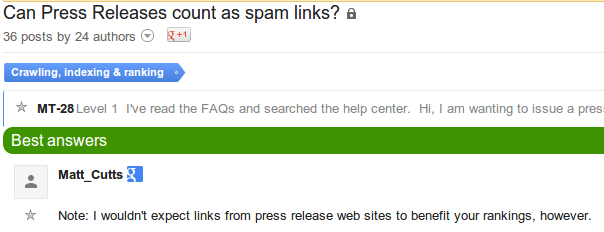
The Internet went wild over this statement especially since his choice of words implied that there is a chance they did count, he just wouldn’t expect them too. Search Engine Optimization (SEO) diehards decided this was a battle worth fighting and optimized anchor text in press releases became more used than ever before, that is until Google decided to take action.
Wouldn’t expect was apparently proven to mean definitely does. The fact is that links in press releases were passing PageRank and the sites on the other end of them were getting valuable ranking signals. That’s why to this day we see merchant cash advance releases read like an itemized list of keywords on PRWeb…
The best merchant cash advance company has announced a new program to help provide bad credit business financing to restaurants in need of a fast cash loan.
If you’ve stopped reading the article at this point, you’re in trouble. The gravy train is no longer running express. Less than two weeks ago, Google conceded that optimized anchor text in press releases works and are a form of cheating the system. That means that overuse or quite possibly any usage of a keyword rich anchor in a release means your website is at risk of a rankings penalty. Google advises that in order to be safe, webmasters should nofollow the links. There’s just one problem with that; Credible wire and release services do not under any circumstances allow companies to code in HTML attributes in their releases, rendering this feat impossible.
That means the burden of nofollowing the links is on the release services and syndicating websites, something that isn’t likely to happen anytime soon. Release services have not been shy about the potential SEO benefits they can provide, with some going so far as to offer paid consulting services to clients on how to optimize their anchor text for search engines. To them, a crackdown on links in releases means a crackdown on a very profitable portion of their business model.
Watch Matt Cutt’s explanation of links in advertorials:
Google offers the following guidance on link schemes:
The following are examples of link schemes which can negatively impact a site’s ranking in search results:
- Buying or selling links that pass PageRank. This includes exchanging money for links, or posts that contain links; exchanging goods or services for links; or sending someone a “free” product in exchange for them writing about it and including a link
- Excessive link exchanges (“Link to me and I’ll link to you”) or partner pages exclusively for the sake of cross-linking
- Large-scale article marketing or guest posting campaigns with keyword-rich anchor text links
- Using automated programs or services to create links to your site
Additionally, creating links that weren’t editorially placed or vouched for by the site’s owner on a page, otherwise known as unnatural links, can be considered a violation of our guidelines. Here are a few common examples of unnatural links that violate our guidelines:
- Text advertisements that pass PageRank
- Advertorials or native advertising where payment is received for articles that include links that pass PageRank
- Links with optimized anchor text in articles or press releases distributed on other sites. For example:
There are many wedding rings on the market. If you want to have a wedding, you will have to pick the best ring. You will also need to buy flowers and a wedding dress.- Low-quality directory or bookmark site links
- Links embedded in widgets that are distributed across various sites, for example:
Visitors to this page: 1,472
car insurance- Widely distributed links in the footers of various sites
- Forum comments with optimized links in the post or signature, for example:
Thanks, that’s great info!
– Paul
paul’s pizza san diego pizza best pizza san diegoNote that PPC (pay-per-click) advertising links that don’t pass PageRank to the buyer of the ad do not violate our guidelines. You can prevent PageRank from passing in several ways, such as:
- Adding a rel=”nofollow” attribute to the < a > tag
- Redirecting the links to an intermediate page that is blocked from search engines with a robots.txt file
You can watch John Mueller, one of Google’s lead Webmaster Trends Analyst answer questions to Google’s new link policies in the hangout below:
There are other purposes for publishing thin releases as both Google and Bing can decide to display a snippet of the release on the first page of the results for the keywords used in the announcement. So no, it’s not just about links, at least that isnt’t all of the SEO benefit to be gained.
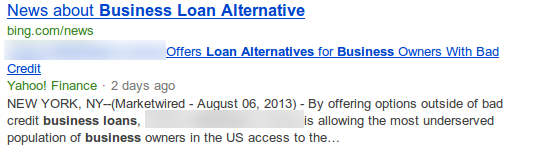
These news snippets can last up to a week, helping companies that might not be ranking well jump to the front of the line for exposure.
Link Removal
We’re not going to call anyone out by name but ever since Google Penguin 1.0 was released, many merchant cash advance companies and payment companies have hired link removal experts to identify bad links for them and are paying them to have them taken down. The only way to take down a link is to ask the webmaster hosting the site to take it down. Unfortunately, this has led to some companies finding the cheapest link removal service they can find, resulting in a poorly qualified consultant setting off to remove 100% of a site’s links instead of just the bad ones. We know this firsthand because we have had no shortage of e-mails from people claiming to be the hired link removal representative of a merchant cash advance related company.
The e-mails usually look like this:
Hello sir,
I am contacting you on behalf of Cash Advance Funder ABC and recently we have been instructed by Google to remove all of our links to have a penalty removed. Therefore we are asking that you remove our spam link from your website. We appreciate your immediate assistance in this matter.Sincerely
sfahfdspfu547@spamlinkremovalservicecompanyseobest.com
A great way to make sure your website never ranks ever again is to remove all your good links too. We can assure you that links on this website are not bad.
So…
In conclusion, if your hired SEO consultant is still banging away on optimized anchor text in press releases, there’s a good chance now that they’ll be causing damage over the long term. Press releases are for the purpose of making important company announcements and Google is on to anyone using them for any other reasons.
Your press releases might be hurting you with Google. Bing on the other hand…
Other SEO related articles on Merchant Processing Resource:
- Is Google Your Only Web Strategy?
- Google Penguin Kills Survivors
- The SEO War for Merchant Cash Advance Continues
- The SEO War for Merchant Cash Advance
https://debanked.com
What Debit Card Interchange Reform?!
August 1, 2013 After years of debating over the law to cap debit card interchange fees and its eventual enactment, a federal court has struck it down. The 21 cent cap is gone but not because it was deemed unfair to banks but because the court thinks the cap should be even lower.
I wrote about the law several times over the last couple years. In the beginning, it was unclear as to what a debit card fee cap really meant, as I myself even explained it incorrectly the first time or two. The majority of folks believed the cap applied to the end user, the merchant, which helped to encourage small businesses,journalists, and even consumers to rally around it.
But when the law actually went into place, not much really changed because it didn’t have much to do with small businesses at all. The debit card reform law capped the amount of interchange fees that an acquiring bank pays a card issuing bank. The merchant wasn’t even involved although the acquirer can pass their new savings on to the merchant, but they don’t have to.
Many acquirers did pass some of the savings on but merchants went and did the opposite of what they promised. Their call to have their swipe fees lowered initially was so that they could lower their retail prices and and pass the savings on to consumers. Consumers believed this logic and supported small businesses to get this law implemented. A study by the Electronic Payments Coalition however, found that 67% of small businesses kept their prices the same or raised them.
There was clearly a lot of misinformation around this law and now it’s been struck down.
Two big misconceptions:
merchants will pay a maximum 21 cent debit swipe fee: Wrong
small businesses will turn their debit card fee savings into lower prices for consumers: wrong

My previous articles about debit card reform:
- The Debit Interchange Fee Battle Continues 2/7/12
- Law to Reduce Debit Card Fees to Retailers has Opposite Effect 12/12/11
- Where’s the Debit Discount? 12/11/11
- Don’t Make Us Pay is Back at it Again 10/21/11
- Revenge for the Durbin Amendment 10/3/11
- Don’t Make Us Pay Goes Quiet 7/11/11
- 15,000 Exempt From the Debit Card Interchange Fee Standards 7/14/11
- And the Misinformation Continues 7/12/11
- Blackjack! 21 Cent Debit Card Interchange Fee Plus 5 Basis Points 6/30/11
- Debit Card Feed Reform to be Finalized June 29 6/28/11
- Save My Debit Card Video Finalists 5/9/11
- Debit Card Reform is Gaining Steam in Canada 4/18/11
- Interchange Regulation and Reduction 4/16/11
- Wells Fargo, Chase, SunTrust Cancel Debit Rewards Program 3/28/11
- https://debanked.com/2011/08/6497526-the-merchant-processing-resource-is-not-hiring/ 3/23/11
- A Few Good Senators Try to Stop the Madness 3/17/11
- Say Goodbye to Debit Cards 3/11/11
- Congressman Steve Israel Replies to Us 2/22/11
- Debit Card Costs May Be Put on the Consumer 2/18/11
- Electronic Payments Industry Changing Forever 12/17/10
The Alternative Business Lending Worker Shortage
July 1, 2013“You open 40 accounts, you start working for yourself. Sky’s the limit.“
Is the dream getting harder to sell? The alternative business lending industry is booming and so much so that many job openings are going unfilled. I am asked on almost a daily basis if I know any experienced sales people that are looking for work. There really aren’t that many people out there with a strong merchant cash advance background and I think it’s impacting how fast this industry can grow. On the one hand, the industry is a lot less sophisticated than it used to be. Hold on for a second and allow me to explain myself. There was a good chunk of time in this business where saying the word, loan could get you fired. Loan?! Are you kidding? We buy future receivables at a discount!
Anyone could sell a prospect on working capital but only a select group of people could explain the purchase of future sales properly all while justifying the relatively high cost. And an even smaller group of people could take the deal to the next step and discuss the merchant’s current 3 tiered or interchange based rates, pick out the junk costs, and sell them on a better deal with a new payment processor. And an even smaller group of people could sell the merchant on the idea of using a new terminal due to PCI compliance issues or acquirer compatibility. And an even smaller group of people could sell or lease the merchant a new terminal instead of swapping out their current one or lending one for free with a multi-year contract. And still an even smaller group of people could convince the underwriter to approve their file in order for the 5 closed sales to even go through. Merchant cash advance in the traditional manner was and is a highly complicated multi-layered sale. The men and women that churn(ed) these deals out month after month on a consistent basis are nothing short of pros. Let’s not forget that payment processors have underwriters too so even after 6 closes, the payment processor could decline the approval of a merchant account, nuking the entire deal from start to finish.
Do you have any idea how comical it was when the mortgage brokers invaded the industry as the housing market neared collapse? They had no idea what they were doing and some of them barely lasted for 90 days before saying “I give up, this makes no sense.”
In today’s market, there’s a faster learning curve. I’d estimate that 55-60% of all new deals being funded with daily repayment in this country are using direct debit ACH to collect. Some funders and brokers lean towards this model so much so that they report funding more than 90% of their deals on ACH. That’s good news for new account reps because there isn’t much to learn about the product. There’s the amount being funded, the cost, and a daily debit to pay it back. Pretty simple stuff. This isn’t to say it’s not a tough sell or that it’s not competitive, because it is both of those things. Companies that swear by the ACH product have a hiring advantage because they don’t necessarily need salespeople with MCA specific experience. Almost any financial sales background will work or even no experience at all.
The smaller part of the industry is a mishmash of the old school sophisticated reps and the newbies that rely on the old schoolers to help them out with anything technical. When companies post ads saying they are looking for MCA sales reps with experience, they’re implying that they want people that can handle the multi-layer sale. A good craigslist ad should say:
Are you hungry?!
Must be able to do the following in a single phone call while driving at least 65 MPH on the Brooklyn Queens Expressway regardless of whether or not traffic is backed up:
- Convert a Micros POS system
- Lease an additional wireless terminal for off-premise sales
- Shave 12 basis points off the non-qualified tier (but make it back up by adding a $15 monthly statement fee)
- Close a 150k deal on a 1.40 (but know that the reduced factor rate is coming out of YOUR end)
- Write in a 6% closing fee
- Cut off 47 cars in traffic without hitting them
- Eat a slice of greasy pizza with your left hand without getting a single drop on your lap
 Oh and below it will be a note that says “THIS POSITION IS COMMISSION BASED ONLY, NO DRAW, SELF-STARTERS WANTED, HOURS ARE 7-7 Mon-Sat“. Don’t laugh. This was the MCA industry for a time and a lot of people did very well in it. If you wanted to make money, you had to be able to do it all. For some of you, it’s still this way.
And let’s face it, the split-funding market may shrink but it will never die. Split-funding’s advantage is the ability to finance businesses that have poor cash flow. The risk of a bounced check is removed when payments are diverted to the funder by the payment processor. You hear that kids? You should be brushing up on your payment processing-ology.
Even as the ACH market boom continues, there are whispers of woe as funders deal with ACH rejects and closed bank accounts. It’s no surprise then that some companies are looking for pros, not just bodies to put on the telephone. It seems as the product has become less sophisticated, merchants have become more sophisticated. In 2007, I’d be willing to bet that more than 90% of small businesses had never even heard of a merchant cash advance and that was basically the only alternative available. In 2012 I actually did a presentation to a large room of business owners about merchant cash advance and none of them had ever heard of it until I taught them about it. That’s astounding!
 Now I don’t think that many more people know about the purchase of future credit card sales in 2013 specifically, but I am inclined to believe that 90% of merchants are at least aware that alternatives to bank loans exist. And when they encounter somebody offering an alternative, they do their homework and check these companies out online. They get 2nd opinions and question why they have to switch processing when four other account reps said they don’t have to. They ask for better deals, longer programs, and they look you up on facebook to see who you really are. This is a different sales environment than what there used to be. The lowest price, the fastest process, or the most charming personality won’t guarantee you’ll win anything. Seeing that you’re backed by Wells Fargo or learning that Peter Thiel is on your company’s board of directors might be the hook, line and sinker for a business with a full plate of options at their disposal. Yes, it’s a different world, a different sale, and even a different product.
Funders and brokers need human resources to keep up with the fast pace of growth and there’s not too many of the old school guys looking for work. Not to mention that fewer people are willing to work on a 100% commission only basis these days. During and after the financial crisis, the herd of out-of-work financial service people flocked to whatever opportunity the could find. It was like you could throw a fishing net in front of the Lehman Brothers entrance and use it to scoop up 50 brokers as they all ran out the door for the last time. Newly minted graduates wanted to build their resumés instead of remaining unemployed. Some people were willing to work all 31 days of a month just for the opportunity even if they walked away with zero dollars at the end of it. Although the economy hasn’t recovered much, that hunger has relaxed and job seekers are being a bit more selective of the opportunities they choose. They want a base salary (even if small), benefits, and vacation time. Somewhere out there in another universe, Ben Affleck’s younger self is crying at the thought of this. “Vacation time?”
So when you put up an ad on LinkedIn or Craigslist and say you’re looking for 10 guys with MCA experience, just know that breed is in short supply and high demand. If you’re heavy on ACH, you can train new guys quick but they’re not going be equipped to take on the multi-layered sale if the tide turns back towards split-funding. There are tons of job openings out there for sales reps but those spots aren’t as easy to fill as they used to be.
“You become an employee of this firm, you will make your first million within three years. I’m gonna repeat that – you will make a million dollars.”
Happy hiring.
– Merchant Processing Resource.com
https://debanked.com
MPR.mobi on iPhone, iPad, and Android
Merchant Cash Advance Competition
June 3, 2013 If I had a dollar for every time someone told me that Kabbage wasn’t a competitor in the Merchant Cash Advance space, I’d have my own funding company. It’s been argued that they only care about Ebay or Paypal and that their business model revolved around strengthening Ebay’s PowerSellers for the good of Ebay. I never really believed that was the case.
On September 11, 2012 I wrote this about Kabbage:
Some people feel that they are not a serious challenger to the status quo and that their tactics, methods, and headlines are merely shock value fodder for the rest of us to laugh at while we all rant and rave about ACH deals being the hottest thing since Square. We believe Kabbage is a company everyone should keep an eye on.
Kabbage analyzes many pieces of data in their underwriting including how many facebook fans a business has or added. And as of 2 weeks ago, what do you think happened?
Kabbage expanded their cash advance programs to brick and mortar businesses… (BusinessWeek)
And so here we are with yet another fierce well-capitalized competitor, a company that isn’t struggling to add technology but is rooted in it. Not only that, but last I heard they don’t work with brokers or agents. They cut out the middleman, much like Square did with ISOs.
Which brings me to the next few companies to keep an eye on:
Amazon: People say that their goal is to finance Amazon retailers for the good of Amazon. Sound familiar? I admit that Kabbage wasn’t owned by Paypal but there was a solid relationship there. Is it that ludicrous to think that Amazon will enter the brick and mortar cash advance business?
Groupon: They’ve been sniffing around this industry for quite a while. Keep an eye on them.
American Express: They already have their own cash advance program for premium merchants that accept a high volume of amex transactions. Every six months or so, their standards loosen. It’s only a matter of time until they have enough data to loosen their standards even more and compete head to head with the rest of the alternative business lending industry and cash advance industry.
———-
Scott Griest, the CEO of American Finance Solutions wrote in Disruption in the Alternative Business Lending Space that when all the dust settles in a couple years down the road, there will be only 4-5 large alternative business lenders. Consolidation and competitive pressure will thin out the herd and the strongest will prevail. The question is, will those 4-5 funding companies be the grass roots companies that propelled the industry to where it is today or will it be the big mega-corporations who are looking at our the industry like a delicious snack?
In one of the most read ever articles of MPR, I made this prediction in The End of an Era:
2014 will eliminate the weaker firms that remain and by 2015, Merchant Cash Advance will no longer be a term that anyone uses. Big banks and billion dollar technology companies will go on to rebrand all that which the funding warriors of the last decade have worked so hard to establish. MCA will simply assimilate into other financial products. The metaphorical Sally, Joe, and Tom will probably still be in the business, but be working for companies like Capital One, Wells Fargo, and American Express.
We weren’t kidding…
Merchant Cash Advance Industry is Busy at Work
May 16, 2013 After what was one of the wildest two weeks in Merchant (MCA) history, the game-changing news finally subsided, but no one is taking a deep breath. Instead, everyone is busy working their butts off trying to help small businesses grow.
UPDATE 5/16: RapidAdvance has acquired the operating assets of ProMAC. First Instance of consolidation that we’ve been predicting would happen this year. See news release detailing the acquisition HERE.
There is just loads of capital available right now and the technology is catching up quick to support the mass deployment of it. A writer for the American Banker believes that the MCA industry is even beginning to threaten community banks.
Many community bankers would be open to using online applications and other technological tools to make faster loan decisions, says Trey Maust, co-president and chief executive at the $121 million-asset Lewis & Clark Bank in Oregon City, Ore. But most community banks use a business model that requires more hands-on interaction with borrowers, he says.
Hands-on is another term for driving back and forth to the bank for appointments, having the bankers visit your business, all the while they try to sign you up for other bank products, like checking accounts that incur a monthly fee.
Who’s at Work
We know some of the major industry players but it’s interesting to see who else is doing significantly large volume. Pearl Capital recently reported funding $7 million in a single month and United Capital source came in at a tad shy of $4 million in just this past April. These are firms you may have heard of already, but they’re now sitting at the big kids table.
What the Generals are Saying
If you haven’t been paying attention to the DailyFunder.com forum, 4 Chief Executives have contributed to the site in a very meaningful way by sharing their thoughts on the MCA industry at large. This is the kind of wisdom you would normally get in bits and pieces through occasional citation in the Green Sheet or other publications, but the full monty has materialized in the very exclusive CEO Corner. Some key highlights from what they’ve shared so far:
Excerpts from Jeremy Brown, CEO of RapidAdvance:
Those of us that have been in this business for 5 years or more – Rapid started in 2005 – are excited at the positive press we get today vs. several years ago and how we are becoming embraced and accepted as a mainstream product. More PE firms, banks, and others want to invest in or lend to the industry. Those groups have always been intrigued by the returns in this industry but the conversations are different today.One thing I think will be different next year are fewer deals offered over 12 months in payback period. When you look at the data over an extended period of time, 18 month term loans don’t make sense for the merchants that are funded. It’s not the most efficient use of funds, limits the ability for the merchant to renew and the longer term deals are far riskier. (See: Year in Review and What Next Year May Bring)
Isn’t that the point of a 6 month MCA – to meet a current need and have the merchant be able to draw again in 4-6 months for the next capital need? That is the problem with the 15 – 24 month deals that are being offered to merchants today. Our industry is based on providing working capital to merchants. By its very definition, working capital is less than 12 months. Longer term deals are permanent capital, even when they are repaid over 15-24 months.it was no surprise when the economy tanked in late 2008 that the merchants in our portfolios at that time took a major hit to sales and therefore the funding companies losses increased by 50% or more on their outstanding portfolios. So what happens when the next recession – big or small – hits and funders have portfolios out to 24 months? It doesn’t take an MBA from Harvard to figure out that answer. (See: Working Capital or Permanent Capital
Haven’t gotten into the industry myself in 2006, I can totally validate the complete 180 in press coverage. I’ve put all my energy into MCA and it’s gratifying to finally hear the praises so many years later.
Excerpts from Steve Sheinbaum, CEO of Merchant Cash and Capital:
The industry already services hundreds of thousands of small business merchants with cash advances for growth and other purposes based upon monthly credit card receipts. For years this has been the basic model of operation. But, what about the substantial number of businesses that require quick and easy access to capital who don’t accept credit cards or don’t produce enough in monthly credit card receipts to qualify under the normal MCA guidelines? Tens of thousands of businesses could use the capital infusions the industry provides daily but either don’t think they’ll qualify or, because of our lack of creativity, the industry hasn’t produced a means of addressing their needs. These businesses would make great customers but because of the rigid requirements we have in place to protect our livelihoods we’ve left money on the proverbial table.That’s not the case anymore. (See: Creativity in the C-Suite…Another way to Fund!)
In regards to advances on gross revenue instead of just credit card payments, he’s absolutely right.
Excerpts from Andy Reiser, CEO of Strategic Funding Source:
the most important part of any deal is the people. We rely heavily on the relationships we have with the client and most importantly with our ISO partners and ISO syndicate partners who invest side by side with us. Valuing these relationships is far more important than relying solely on the numbers and how sophisticated our technology is.Over our 8 year history, we have noticed that the performance of a deal has more to do with the relationship we have with our ISO partner and ISO syndicate partner, then with the deal itself. We have all kinds of tools available to help us analyze the potential success of a deal – FICO scores, due diligence checklists, signed affidavits, warranties and representations, scoring models, algorithms, etc. And yet, some of the ugliest deals on paper have been some of our best performers, while some of the most attractive deals on paper have been nothing but trouble. (See: Business and Baseball Fantasies)
During my time as a head underwriter, I witnessed the exact same thing. Solid referral partners had solid performing clients even if they didn’t look so good on paper. Likewise, the shakier resellers had clients that underperformed across the board, including the deals that looked cleanest.
Excerpts from Craig Hecker, CEO of Rapid Capital Funding
As each MCA company grows and creates a positive reputation, we all grow as an industry…together. But as our popularity grows, however, so does our competition. We already know that Amazon, eBay, and Google are stepping into the market, and AMEX is looking to expand their short term financing portfolio. These big business industry leaders will help build our brand of finance and benefit our portfolios, but I also think it is fundamental that we market ourselves as the alternative to big business finance and identify ourselves with the small business owner. (See: Small Business and How MCA Can Bridge the Gap to Success
We’ve got some big names in the industry now, whether they are financing the merchants directly or backing the funders that do the financing. I agree that you need not be intimidated by competing against these established brand names. Positioning yourself as the funder next door, people that have walked a mile in the merchant’s shoes (literally) can actually be a strong advantage.
What’s Next?
We’re pretty confident there will be more big headlines in the near future but for now we can’t confirm or say anything. DailyFunder.com is also lining up additional industry captains to participate in the CEO Corner and I’m sure there will be plenty of nuggets for us all to dissect. They’re probably the best source of MCA information that you can possibly get.
Stay tuned.
– Merchant Processing Resource
https://debanked.com
MPR.mobi on iPhone, iPad, and Android
ETA Expo Recap
May 3, 2013 Recap of the ETA Expo as it pertains to Merchant Cash Advance:
- Just about every funder has an ACH program or is working on implementing one.
- Many funders are licensed lenders or are working to become licensed in the states where it may be necessary. There actually seemed to be a lot of excitement about this. Funders are finding comfort in being subject to state mandated regulations as it probably raises their legitimacy and it will make their businesses easier to value when trying to raise money or sell.
- The ACH repayment market will be larger than the split-funding market this year. There’s no doubt in my mind about this. That means that ACH funding is now the primary protocol behind Merchant Cash Advance.
- Almost everyone is working hard to build up their technology. I got a personal demo of RetailCapital’s ISO/Agent system in addition to Capital Access Network’s new CapTap. Both are great. Capital Stack also has a beautiful platform.
- Stacking is the issue of 2013 as I heard that word uttered probably every 30 seconds for a whole week. I know the NAMAA folks are talking about it but I don’t know what the consensus is. It’s important to keep in mind that many funders aren’t NAMAA members and that affects NAMAA’s ability to dictate policy. Capital Access Network, the largest funder in the industry isn’t even a member.
- Speaking of NAMAA, they refaced their website and it looks A LOT better. I see only 14 members listed but it’s my understanding that there are closer to 20 of them.
- Factor rates are all over the place. Swift Capital has a new 1.099 program, which has got to be the first one to fall under the 10% threshold aside from Amex’s Merchant Financing. Higher risk deals however still operate in the 1.49 and up range. There is no one-size-fits-all product anymore.
- There were several direct lenders walking around that I had never heard of and they are apparently doing significant monthly volume. More and more people are getting into the funding business.
- It’s exhausting trying to keep up with the news surrounding On Deck Capital. They are on a very deliberate path and what we keeping seeing and hearing is them just checking things off on their to-do list. I bullet-pointed my theory on DailyFunder in response to a few posts.
- Discover and Priority Payments threw great parties.
- New Orleans has a lot of charm.
Make sure to check out my updates and photos that I’ve finally posted from the ETA Expo on DailyFunder and feel free to add your own if you were there.
Dozens of photos from the show
Also read: Soul Mates: Merchant Cash Advance and Silicon Valley VCs