Banking
Visa Acquires Plaid in $5.3 Billion Deal
January 14, 2020 Yesterday it was announced that Visa and Plaid, the financial services company that helps business connect with customers’ bank accounts, have penned a deal that would see Visa purchase the San Francisco-based startup for $5.3 billion. The purchase price is roughly double Plaid’s previous valuation of $2.7 billion after its 2018 Series C investment of $250 million. Pending regulatory confirmation, the acquisition is expected to be completed in 3-6 months.
Founded in 2013 by Zach Perret and William Hockey, Plaid’s API enables companies to easily link with customers bank accounts and connects to a host of apps, such as Venmo, Robinhood, Coinbase, TransferWise, and Acorns. The company claims to have connected to one quarter of Americans with bank accounts and has expanded to both the UK and Canada.
Not being Visa’s first interaction with Plaid, the startup had previously received investment from its new owner, along with other recognizable names like Mastercard, Goldman Sachs, Citi, and American Express.
“This fits well, strategically,” commented Al Kelly, Visa’s CEO, in a call with investors on Monday. “We’re excited about new business and the ability for this to accelerate our revenue growth over time.”
Speaking to CNBC, Perret told CNBC that “We feel fortunate to have been there for the early days of fintech, and to have helped develop that ecosystem … This represents an important milestone, and the ability to work with Visa to make our products much bigger and better – both domestically and internationally.”
Whether such developments mean added features, further expansion to new territories, or something else entirely remains unclear. However, much like Google’s acquisition of Fitbit late last year, this merger witnesses the passing on of a treasure trove of data, with the curtain being pulled on the financial details of millions of transactions between startups and consumers; leaving Visa better positioned to understand and pre-empt what exactly is happening in industries where unpredictable disruption is valued above all else.
Canadian Lenders Summit Recap
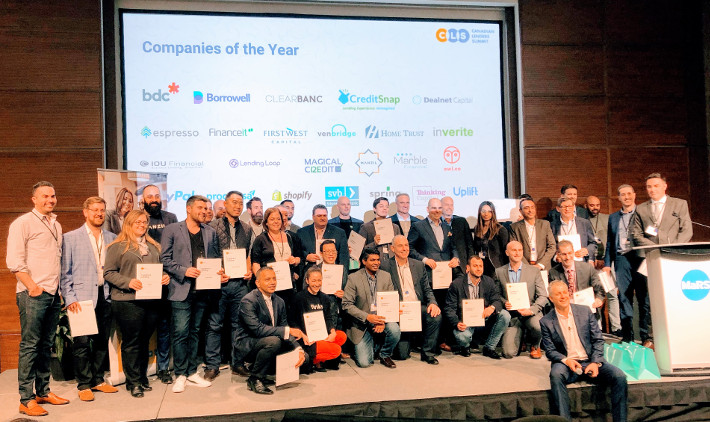
November 23, 2019 The Canadian Lenders Association’s largest annual event brought together hundreds of executives from the fintech and lending industries. It was hosted at MaRS, a dedicated launchpad for startups in Downtown Toronto that occupies more than 1.5 million square feet and is home to more than 120 tenants, many of which are global tech companies.
After OnDeck Canada CEO Neil Wechsler was introduced as the new chairman of the association, the day kicked off with a presentation by Craig Alexander, the Chief Economist of Deloitte Canada. Alexander explained that after some major warning signs sounded off late last year and early this year, Canadian growth and positive economic indicators have returned. He opined that politics in Canada and the United States will play a strong role in the economic outcomes of both countries going forward.
Panels on a variety of topics dominated the rest of the day with an interlude keynote from author Alex Tapscott who spoke about the financial services revolution.
The sessions concluded with an award ceremony focused around the Top 25 Company Leaders in Lending and the Top 25 Executive Leaders in Lending. The Canadian Lenders Association will make videos of the sessions available online. deBanked was in attendance.
Google to Begin Offering Checking Accounts in 2020
November 16, 2019 This week Google announced that it plans to offer checking accounts to customers in 2020. The news comes after the release of the Apple Card, Apple and Goldman Sach’s controversial joint project, in August; this week’s release of Facebook Pay; and the mass exodus by payments companies from Facebook’s Libra Association last month.
Titled as Google’s ‘Cache’ project, the accounts will be the result of a partnership between the tech giant and a selection of banks and credit unions. Thus far, Citigroup and a credit union based in Stanford University have been confirmed as partners, with more to be announced. Speaking on the venture, Citigroup spokesperson Liz Fogarty said the “agreement has the potential to expand the reach and breadth of our customer base.” Whereas Joan Opp, President and CEO of Stanford Federal Credit Union, remarked that the deal would be “critical to remaining relevant and meeting customer expectations.”
As of yet, not much is known beyond these partners and that the checking accounts will be in some way “smart” according to Google spokesperson Craig Ewer. Whether or not there will be fees attached to the accounts, or who will be the target audience remain unsure. The latter especially given Google Pay’s poor take up in America.
As well as all this, it is equally unclear what exactly Google will be bringing to banking that is new. In his statement, Ewer said that “we’re exploring how we can partner with banks and credit unions in the US to offer smart checking accounts through Google Pay, helping their customers benefit from useful insights and budgeting tools while keeping their money in an FDIC or NCUA-insured accounts.” Such “insights” and “tools” are yet to be expanded upon and may give cause to alarm, as the company has recently come under fire for its questionable use of data after it was revealed that Google has secretly gathered the personal medical data of 50 million Americans from healthcare providers; and has recently been accused of using both human contractors and algorithms to tweak search engine results, potentially exhibiting favoritism as well as a willingness to change results related to at least one major advertiser.
When asked by CNBC about Google’s plans to enter finance, Senator Mark Warner (D) was apprehensive, remarking that “large platform companies have not had a very good record of protecting the data or being transparent with consumers.” Warner, who was a tech entrepreneur before entering politics, believes more regulation should be in place as the number of tech companies looking to enter finances continues to increase, saying, “once they get in, the ability to extract them out is going to be virtually impossible.”
Such comments come in the wake of Facebook CEO Mark Zuckerburg’s testimony to Congress last month, in which he told the representatives: “I view the financial infrastructure in the United States as outdated.” Just how outdated Zuckerburg and his contemporaries believe it to be will become clearer as more of these Big Tech-Wall Street hybrids are released.
BlueVine to Enter Banking in 2020
October 28, 2019 BlueVine Capital, the Redwood City-based alternative funder, has announced today that it will launch its BlueVine Business Banking product in 2020, which will offer checking accounts that come with debit Mastercards, checks, and ATM access exclusively to small businesses. And just like many of the new competitors in the banking space, BlueVine Business Banking will be app-based, with access also being available through an online dashboard.
With the financial infrastructure and regulatory framework being provided by The Bancorp Bank, BlueVine is the next alternative finance company to look toward becoming a bank, a move which has proven difficult for companies who already tried, such as SoFi and Square.
“Historically, banks have under-invested in small businesses and as a result, small businesses have been left with products and services that don’t meet their needs,” said BlueVine CEO and Co-founder Eyal Lifshitz in a press release that claims only 9% of small businesses believe their banks meet all of their needs. “Credit is a core part of banking and with the addition of checking accounts to our existing suite of financing products, customers can have a truly seamless banking experience.”
Such seamlessness spawns from BlueVine’s goal to promote an integrated and instant banking model, Lifshitz told me. “No more waiting for ACH for two days, or for wires to come in. You press a button, you draw from your line of credit, and magically it’s in your checking account … It’s the way that we believe it should be. The fact that it’s not currently like this is incredible in our eyes. This is what we believe the future looks like.”
BlueVine Business Banking will offer customers 1.00% interest rates on their savings and aims to cut out many of the fees associated with checking accounts, as Lifshitz explained that there will be no monthly, excess, or ACH charges; and that wire fees will be a fraction of what they cost with traditional banks.
“We feel we have the ability to build a true small business bank. Finally, one that is built and designed for small businesses rather than one that is having them as the third or fourth priority on the list, which many of the larger banks do … We believe the reason we’re here providing alternative finance is because banking is broken, and our goal is to build better banking, not just financing, but overall better banking.”
National Business Capital & Services Expands into Cannabis Funding with CannaBusiness Financing Solution
October 15, 2019 Today National Business Capital & Services (NBC&S) announced it has begun serving cannabis companies. Through its new program, CannaBusiness Financing Solution, NBC&S is now accepting applications for loans starting at a minimum of $10,000 from firms in the industry that are over one year old.
“The CannaBusiness Financial Solution will allow business owners to seamlessly obtain the capital they need, and allocate funding toward either hiring new employees, purchasing inventory, marketing strategies, or any other business need right away, without government regulations hindering growth opportunities or having to give up equity,” explained NBC&S President Joseph Camberato. “We’re not a bank and the lenders we work with aren’t banks either, so it falls into a different area of commercial lending.”
CannaBusiness is available in the 33 states where cannabis is legal, be it for medicinal or recreational uses, as well as in Canada.
“It’s a rapidly growing space, no pun intended,” joked Camberato when asked about the differences in funding cannabis companies compared to the industries NBC&S has served in its 12 years of business. “It would still be underwritten, just like one of our normal businesses. But we’re definitely going to want to know a little bit more about the business and understand what exactly they’re doing, how they’re operating, and exactly what are they’re focused on.” They’ll also examine if the business is in compliance with state laws. Qualifying cannabis companies must be in business for at least 1 year, with a minimum of $10K in monthly revenue. There is no minimum FICO score requirement.
 While it’s not the first funder for cannabis companies, NBC&S views the move as a step in the right direction to “get ahead of the curve” according to Camberato. “We’re living through a modern-day prohibition, I think in 20 years we’ll look back on it and talk about it with our grandchildren and be like, ‘wow’ … I don’t think people realize how big of a deal this really is, but it is a business and it is another industry that has bloomed in front of us, again no pun intended. I think it’s fascinating that we get to witness this and that we’re really at the forefront of it and helping folks get the funds they need to grow.”
Jumping off from the politically charged word of ‘prohibition,’ NBC&S’ Vice President of Marketing, T.J. Muro, noted that he believed cannabis legislation to be one of the few issues that can be bipartisan, saying, “Out of everything today in our political climate, I think it’s the one thing that has unified people in the political parties. The liberal side appreciates the cultural influence and significance there, and then on the more conservative side it’s the tax revenue.”
The upcoming Senate vote on the SAFE Banking Act will put this theory to the test. The bill, which would allow the cannabis industry wider access to banking, has already passed the House.
No Fees, Ever – Is Goldman Sachs Winning Or Losing The Online Lending Battle?
September 30, 2019 Peer-to-Peer lending in the United States died the day Goldman Sachs launched a rival online lending company in 2016. Armed with a low cost of capital and the trust of a household name, Marcus, as Goldman Sachs referred to themselves, sought to further disrupt consumer lending by eliminating every type of fee including late fees. Its pitch was simple, “No fees. Ever.” Three years later, the company still hasn’t caught up to competitors like Lending Club in origination volume (Marcus’ loan book is $5B vs. Lending Club’s $15B). Its fee-less model may also be backfiring.
Goldman’s consumer lending business has racked up major losses, according to the WSJ. “It spent heavily to buy startups and cloud-storage space, hire hundreds of techies, and build call centers in Utah and Texas. Loans have gone bad at a higher rate than that of rivals.”
For all of the bank’s early bluster, they were so afraid of negative PR, that they launched without a collections department, leading to significantly high bad debt, the WSJ reports. That has since changed. But where Goldman Sachs appears to have lost, they may still be on track to win. As a consumer “bank” Marcus can also accept deposits. It had collected $36 billion as of year-end 2018 and added another $14 billion this year so far. Goldman also scored a valuable partnership with Apple on a branded credit card. The pitch is a familiar one, “No fees. Not even hidden ones.”
 Apple promotes its card as “Created by Apple, not a bank,” yet The WSJ ironically reports that Goldman spent $300 million creating the card for Apple.
In a Q2 earnings call, Goldman CFO Stephen Scherr said that the bank was shifting its consumer lending focus from Marcus to the Apple Card. “I’d also say that if you look at the level and rate of growth in the Marcus loan business, while it continues to grow and perform well, we have slowed the increasing growth in that in contemplation of taking on increasing consumer credit through the card business,” he said. “What’s important for us is that we look at this on a risk-adjusted return basis not simply on a return on asset construct.”
Competitively, however, Scherr couldn’t answer if the consumer lending business’s costs will ultimately look more like a fintech lender or a bank as they scale. “What I can tell you is that what we have built jointly with Apple both on the front end and on the back end is intended to be operationally resilient, but equally is intended to be efficient both in terms of the application all through the delivery and on the back-end and so my expectation is that the efficiency will be reflected in that, but again premature to sort of put numbers around it.”
Of note is that Goldman acquired or acqui-hired from Clarity Money, Bond Street, and Final.
Head of MyPayrollHR Charged in Massive Nine-Year Bank Fraud
September 23, 2019 When MyPayrollHR left thousands of companies and their employees high and dry without their paychecks earlier this month, suspicion grew that the company’s rather mysterious owner, Michael Mann, may have been involved in some unsavory business. New information has emerged that around that time, Mann voluntarily checked in to the US Attorney’s office in Albany and admitted to a fraud he’d been running for 9 long years.
Since then, according to the Department of Justice, “Mann fraudulently obtained at least $70 million in loans from banks and other financial institutions. He created companies that had no purpose other than to be used in the fraud; fraudulently represented to banks and financing companies that his fake businesses had certain receivables that they did not have; and obtained loans and lines of credit by borrowing against these non-existent receivables.”
He has not paid them back. By the end, Mann resorted to kiting checks, the DOJ claims, in that he wrote checks back and forth to himself at different backs to inflate the balance of one or more accounts.
His largest creditor, Pioneer Bank, is owed tens of millions. Earlier this month, Mann attempted to route funds meant for his customers’ payrolls to an account at Pioneer Bank. Pioneer Bank responded by freezing all of the funds, causing all of MyPayrollHR’s clients to get caught in the crossfire.
Mann is charged with Bank fraud. If convicted, he faces up to 30 years in prison and a maximum $1 million fine.
PNC Bank Launches Fintech Startup numo
September 3, 2019 Last week, PNC Bank announced its latest venture, numo, which aims to function as an internal startup, developing apps and other services to expand PNC’s operations.
The first such app is indi, a bank account for gig workers that is exclusive to mobile phones. Offering customers tax calculators, tax savings goals, and dynamics adjustments that react to how much they’ve saved, PNC is joining the list of financial institutions which are doubling down on banking apps. The numo accounts are FDIC-insured, are held at PNC, and include a Visa prepaid debit card.
Speaking on the benefits of indi, numo CEO David Passavant said, “How do you estimate your tax liability when you don’t have an employer doing it for you? We built a system with intelligence to estimate what you should set aside for taxes.”
Beyond indi, numo has two other projects in the pipeline. One of these is unknown as of yet, but the next to be launched will be a service for companies that run portfolios of retail properties.
Not the only announcement to come from PNC last week, the bank also revealed its partnership with the RippleNet blockchain network. Joining together to offer swift cross-border payments for PNC’s commercial clients, the news comes almost a year after the bank stated that it planned to partner with RippleNet in September 2018.
“The speed of doing business continues to accelerate,” explained PNC Treasury Management Executive Vice President and Head of Product Chris Ward in 2018. “And the efficiencies of RTP [real-time payments] allow our clients to not only keep pace, but stay ahead.”