

Commercial Finance Coalition Emerges – An All Inclusive MCA Industry Trade Group
March 16, 2016 A new trade association hopes to bring together every type of company in the alternative-finance industry to form a united front capable of managing state and federal regulation.
The fledgling Commercial Finance Coalition (CFC) welcomes potential members that include funders, brokers, payments processors, data providers and collection agencies, said Matt Patterson, CEO of Sioux Falls, SD-based Expansion Capital Group LLC and a board member and organizer of the new trade group.
Patterson began thinking about forming an association early last year when he learned that the established Small Business Finance Association (SBFA), formerly the North American Merchant Advance Association, wasn’t communicating with legislators and regulators on behalf of the industry. “When I talked to them six or nine months ago, they had no road map for affecting legislation or regulation,” he said.
Since then, the SBFA has hired an executive director with legislative and association experience to tell the industry’s story on Capitol Hill. (See here.) So, two industry groups now plan to begin contacting government officials to educate them on the cause of small-business alternative finance.
The decision to create the CFC came at a dinner meeting convened Dec. 3 in New York. That gathering came together after several months of conference calls and videoconferences, Patterson said.
 The CFC is working with two well-established lobbying groups, Patterson noted. Both organizations advised the CFC during its formation, he said.
Law firm WilmerHale was selected to represent the CFC. The combination of Polaris and WilmerHale will give the association an immediate Washington presence, he noted.
The group intends to write best practices for its members but doesn’t contemplate starting a trade show, trade publication or merchant watch list, Patterson said.
The CFC is beginning its journey with nearly 20 member companies, according to Patterson. Recruitment of additional members is scheduled to intensify after the association has been operating for a while.
Inviting members from all facets of the industry indicates a philosophy that differs from that of the SBFA, which includes only funders on its roster, Patterson said. “We want to be inclusive,” he said. “We’re interested in building a broad base of constituents that all have an incentive to see that the industry survives and thrives.”
The coalition’s trusted service providers include:
- Arena Strategies
- Catalyst Group
- Polaris Consulting
- Wilmer Cutler Pickering Hale and Dorr
“Me, Too” Lenders Something to Worry About, Says Former OnDeck Investor
March 11, 2016 Lending Club, SoFi and OnDeck will endure, wrote Matt Harris, a former OnDeck board member and investor, and current Managing Director for Bain Capital Ventures. In a blog post that approached 4,000 words, Harris admits that he has not invested in a single lender since OnDeck.
“It is still possible, though I believe increasingly unlikely, that marketplace lending will be a durable innovation,” he wrote. He bases that on the assumption that origination platforms with no skin in the game are not sustainable over the long term and that what really made companies like Lending Club special is that it has “scale, a brand in the capital markets for producing high quality assets, and an unbelievable management team.”
All of the other perceived advantages don’t make sense, he argues. The average cost of funds for a bank “is 0.06%, assuming they fund their loans using deposits. OnDeck’s funding costs for its assets averages 5.3%. Lending Club has paid a median return to its asset purchasers of 7.4%.” Banks have lower operating costs as well. “I’ll point out that most of the bank expenses they highlight are fixed expenses like branches and compliance, which makes that expense burden irrelevant to the profitability of the marginal loan,” he wrote.
Even on technology, Harris says banks spend less, and on big data credit scoring, he says a lot of the factors marketplace lenders might find useful in predicting performance cannot be used legally because they end up correlating with a protected class such as race, whether it’s directly or indirectly.
“Things are going to get harder before they get easier,” Harris wrote, though he thinks companies like OnDeck and Lending Club are positioned to last. Everyone else who copied their model is in shaky territory. And yet through it all, he is optimistic. “For the first time in a decade, I’m feeling like it’s a great time to be starting a lending company,” he said.
Square’s Merchant Cash Advance Program Now Among Biggest in the World
March 10, 2016Square originated more than $400 million worth of merchant cash advances advances in 2015, according to their Q4 earnings report. Their average deal size was just shy of $6,000. The result is a 300% increase year-over-year and makes them one of the largest players in that industry worldwide.
RANKINGS
| Company Name | 2015 Funding Volume | 2014 Funding Volume |
| OnDeck | $1,900,000,000 | $1,200,000,000 |
| CAN Capital | $1,500,000,000 | $1,000,000,000 |
| Funding Circle | $1,200,000,000 | $600,000,000 |
| PayPal Working Capital | $900,000,000 | $250,000,000 |
| Bizfi | $480,000,000 | $277,000,000 |
| Fundry (Yellowstone Capital) | $422,000,000 | $290,000,000 |
| Square Capital | $400,000,000 | $100,000,000 |
| Strategic Funding Source | $375,000,000 | $280,000,000 |
A much longer list will be available in deBanked’s March/April 2016 Magazine Issue. SUBSCRIBE FREE to make sure you obtain a copy.
MFS Global Co-founder Launches Own Brokerage
March 9, 2016 Co-founder and COO of MFS Global, Robert Abramov launched his own ISO brokerage called Flow Rich Capital and departed from his role at MFS.
The new company based in Las Vegas has already signed on partners like CAN Capital. Abramov wants to keep the business small and minimal, with not more than five lenders. While he will exit from MFS Global’s day-to-day business, he will continue to hold equity and be part-owner in the company.
“He is pretty much transitioned out but he is still an active member of the executive staff,” said Tom Abramov, founder and CEO of MFS Global. “I am sure he is going to knock it out of the park and I hope he sends us deals.”
Tom added that as an older brother, he is happy that his brother is pursuing his dreams. “I know that Robert wanted to do this for long. He wanted to pursue his passion and we are wholeheartedly behind him,” he added.
For Abramov, experience working with merchants coupled with marketing experience gave him the confidence to start his own shop. “I have fun working with merchants and clients and have been running an ISO shop for five years now,” he added.
Flow Rich is in the process of setting up a team and and building a lender database.
As the industry expands and catches the eye of the big banks, competition will continue to breed. “While competition is on the rise, it will finally weed out the smaller guys tarnishing the image of the industry with little experience,” Abramov said.
Is now a good time as any to enter the business?
Herio Capital Breaks $20 Million in Funded Deals
March 9, 2016 It might feel like 1997, but in early 2016 Herio Capital has surpassed $20 million in funding since inception. Co-founded by Sherif Hassan, the company’s chief executive, Herio launched only one year ago. Hassan was one of OnDeck’s first employees who stayed with the company all the way up until just before they went public.
Today, Hassan does not appear to be regretting that choice. “We have lots to be grateful for and even more to be excited about in 2016,” he said.
The company’s chief product officer and co-founder, Patrick Janson, summed up their vision like this, “When we started Herio, we saw a huge opportunity to improve upon the software that currently supports the marketplace lending industry.”
The Herio team will be attending the LendIt Conference in San Francisco next month.
“Reaching the $20 million funding milestone is a testament to the execution, creativity, and diligence of everyone at Herio. We are grateful to our team and our loyal industry partners. We are excited about the advancements our industry will make in the next period as we continue to design the future of credit,” concluded Hassan.
Yellowstone Capital Welcomed to New Office Location By City Mayor
March 8, 2016 It’s a change of scenery, insiders at Fundry subsidiary Yellowstone Capital say about their new office.
The company has officially relocated from 160 Pearl Street in Manhattan to 1 Evertrust Plaza in Jersey City. On their first day in the new location, Jersey City Mayor Steven Fulop made an appearance and posed for a photo with company executives Isaac Stern and Jeff Reece to celebrate their arrival. Aside from outgrowing the NYC office that they operated from for years, Yellowstone was wooed to the State by the New Jersey Economic Development Authority to create jobs in the area in exchange for a tax incentive. The hundreds of employees they bring with them to the neighborhood now will also serve to stimulate Jersey City’s burgeoning economy.
The company originated close to half a billion dollars in funding for small businesses in 2015.
 Just one stop from the Path Train’s World Trade Center station, Yellowstone’s new office environment makes it feel as if the company has been transported a million miles away. deBanked was given a tour of the new space, which at 25,000 square feet, was easy to get lost in. One employee said the upgrade from their previous location felt so immense, that it felt like they had moved to Japan.
A clear view of NYC’s Freedom Tower from many of the floor’s windows assures them that they are not that far.



Merchant Cash Advances Costly But Not Opportunistic, Fed Study Finds
March 6, 2016Only 71% of business owners that apply for a merchant cash advance actually get approved for them.
Equipment loans, commercial mortgages, and company vehicle loans all have higher approval rates than merchant cash advances, a comprehensive Federal Reserve study revealed. Lines of credit were approved just as often as merchant cash advances. Right behind them were business loans and SBA loans at approval rates of 69% and 59% respectively.
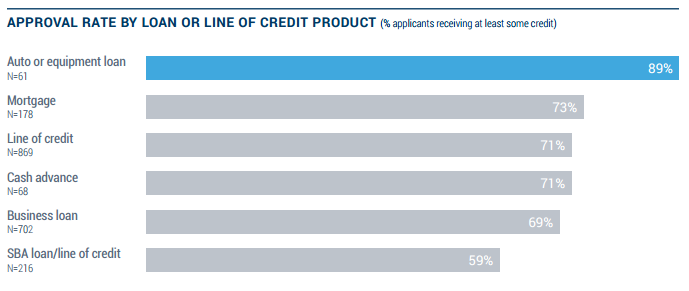
The statistics disprove the theory that merchant cash advance companies don’t underwrite or that they are doing so recklessly at the expense of their small business customers.
Only 7% of small businesses have ever even applied for a merchant cash advance.
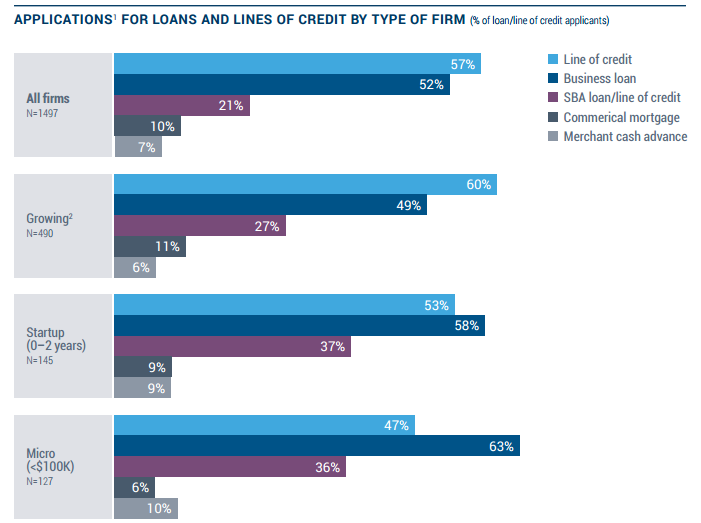
The propensity to apply for a merchant cash advance ranked higher among businesses less than two years old and those seeking less than $100,000.
Notably, small businesses reported being much less satisfied with online lenders than banks, but overwhelmingly cited cost as the reason behind it. Big banks scored worse on transparency than online lenders among dissatisfied borrowers.
The findings are not surprising. 35% of small businesses said that speed of the decision process was a factor influencing where they applied. 37% said ease of the application process was a factor and 40% said the perceived chance of being funded played a role.
In these areas, online lenders walloped small and large banks. More than 50% of dissatisfied bank borrowers fingered a difficult application process as a reason and more than 40% said it was the long wait for a credit decision.
The results fall in line with expectations, that speed and ease often come at a cost. However, merchant cash advance companies do not appear to be approving applicants just to opportunistically charge a high fee. The approval rates are in line with other types of financial products, and are even less likely to be approved than a mortgage.

PayPal’s Merchant Cash Advance Program Grows, Performance Improves
February 27, 2016The PayPal Working Capital program has advanced more than $1 billion to small businesses since inception. Rooted in merchant cash advance methodology since PayPal withholds a percentage of each transaction until receiving payment in full, they are not actually buying future receivables. Rather, they originate loans through WebBank, the same Utah-chartered industrial bank that OnDeck uses. But OnDeck’s payments are fixed and PayPal’s are tied to sales activity.
PayPal’s loans therefore don’t have a fixed term but they evaluate historical sales activity and use that to project a loan payoff usually within 9 to 12 months. According to their Q4 2015 earnings report, their 2015 results performed just as well if not better than their 2014 results.
$421 million was outstanding at the end of 2015 compared to $103 million at the end of 2014. 77% of the $421 million was on pace to pay off within 30 days of their planned projections. 11.16% was on pace to finish 30-59 days beyond them. PayPal broke it down by dollars in their earnings report.
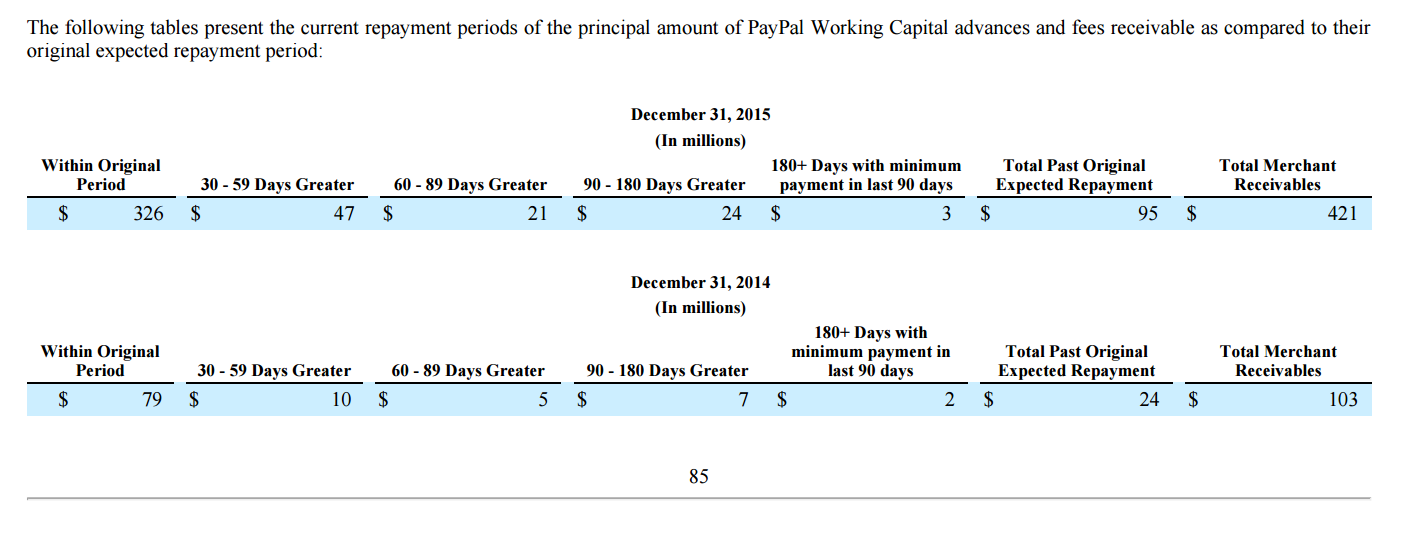
But we’ve broken it down into percentages below:
| Total outstanding balance | Within Projections | 30-59 days greater | 60-89 days greater | 90-180 days greater |
| $421 million | 77.43% | 11.16% | 4.99% | 5.70% |
| Total outstanding balance | Within Projections | 30-59 days greater | 60-89 days greater | 90-180 days greater |
| $103 million | 76.70% | 9.71% | 4.85% | 6.80% |
PayPal borrowers cannot simply stop accepting PayPal payments in order to avoid loan repayment. They are required to pay at least 10% of their total loan amount (loan + the fixed fee) every 90 days so that they make consistent repayment progress regardless of their sales volume. Notably, their website warns, “If you do not meet the requirements in the above policies and your loan goes into Default status, your entire loan balance could become due and limits could be placed on your PayPal account.” For businesses that depend on PayPal sales, that is certainly a downside worth avoiding.