

Alternative Small Business Financing Company Secures $70 Million
April 22, 2016Brean Capital has successfully helped an alternative small business financing company secure $70 million. While the name was purposely undisclosed, sources say it was a Delaware-based company.
According to the announcement, “the financing round consists of a $50 million senior credit facility provided by a multi-billion dollar credit fund, and a $20 million equity investment from a middle-market private equity sponsor.” Proceeds from the transaction will be used by the Company to execute its strategic growth plan.
Brean Capital served as exclusive financial advisor to the Company.
Splits Glitz or Fritz? – Transact 16 highlighted strange chapter in merchant cash advance history
April 21, 2016
It’s Opposite Day in the alternative business funding industry. Lenders are splitting card payments and merchant cash advance companies are doing ACH debits.
Jacqueline Reses was not an odd choice for Transact 16’s Wednesday morning keynote. Square, the company she works for, has continued to be a hot topic in the payments world for years. But what was striking is that Reses heads the lending division, the group that allows merchants to pay back loans through their future card sales. If that sounds very merchant-cash-advance-like, it’s because that’s exactly the product they used to offer before changing the legal structure behind them.
Split-payments, not ACH payments, have literally propelled Square and PayPal to the top of the charts of the alternative business funding industry. One individual on the exhibit hall floor posited that Square’s ability to originate loans through their payments ecosystem was the company’s real value; Payments itself was secondary. It’s a testament to the opportunities that split-payments affords to (as I argued 3 years ago on the ETA’s blog) a company well positioned to benefit from it.
Meanwhile, the companies at Transact that one would have historically described as merchant cash advance companies have mostly transitioned away from split-payments to ACH. Essentially, Square and PayPal embraced splits as an incredible strength while yesterday’s merchant cash advance companies viewed splits as a handcuff that limited scalability. The payment companies became merchant cash advance companies and the merchant cash advance companies became something else entirely, a diverse breed of loan and future receivable originators operating under a label people are now calling “marketplace lenders.” But even Square and PayPal, arguably the two companies at Transact doing the most split-payment transactions, claim to make loans, not advances.
Merchant Cash Advance as anyone knew it previously is dead
Ten years. That’s the average age of the small business funding companies that exhibited at Transact this week. They are but the last remaining players that probably considered the debit card interchange cap imposed by the Durbin Amendment of Dodd-Frank as being among the most significant legislation that affected their businesses.
A senior representative for one credit card processor told me at the conference that their biggest gripe with new merchant cash advance ISOs today is that they know almost absolutely nothing about merchant accounts. It’s not that they know less, they know nothing, he said.
One company was notably absent from the floor this year, OnDeck. They’ve since embraced the marketplace lending community as their home, just as many others have.
Nine years ago, I overheard a very influential person say that the first company to be able to split payments across the Global, First Data and Paymentech platforms would be crowned the “winner” of the merchant cash advance industry and by extension the wider nonbank small business financing space.
If one were to define the winner as the first company from that era to go public, well then those 3 platforms played no role. OnDeck was the first and they relied on ACH payments the entire way. They also refer to themselves these days as a nonbank commercial lender. If that doesn’t sound very payments-like, it’s because it’s not.
What cause is being Advanced?
At least four coalitions are currently advocating on the marketplace lending industry’s behalf, the Coalition for Responsible Business Finance, the Marketplace Lending Association, the Small Business Finance Association, and the Commercial Finance Coalition. The Transact conference is put on by the Electronic Transactions Association whose tagline is “Advancing Payments Technology.” In an age where new merchant cash advance ISOs know nothing about payments, it’s no wonder there’s a growing disconnect.
Could Transact now be one of the best kept secrets?
A few people from companies exhibiting say that they believed they stood a better chance to land referral relationships from payment companies by being there and that there was still a lot of value in landing those deals. Partnerships like these may be why the average exhibitor has been in business for 10 years while today’s new companies relying solely on pay-per-click, cold calling, or handshakes are falling on hard times.
Some payment processors acknowledged that merchant cash advance companies were still a good source to acquire merchant accounts, though the process by which that happens is not the same as it used to be. A lot of it is referral based now, according to one senior respresentative for a card processor. The funding company funds a deal via ACH and then refers them to the payment guy to try and convert that as an add-on. The residual earnings may not be as good as they used to be but that’s because they don’t have to do any work in this circumstance. In a sense, funders are still leading with cash but instead of the boarding process being mandatory, it’s an entirely separate sale that sometimes works and sometimes doesn’t. In that way, small business funding companies can be a good lead source for payments companies.
When I asked the senior representative if they really had success closing merchant accounts just off of a referral from a funding company, he looked at me incredulously, and said, “you used to do this, of course we do. that’s how this whole industry started.”
“What industry?” I asked.
What industry indeed…
Square Capital’s Jackie Reses Reveals Why They Really Gave Up Merchant Cash Advances
April 14, 2016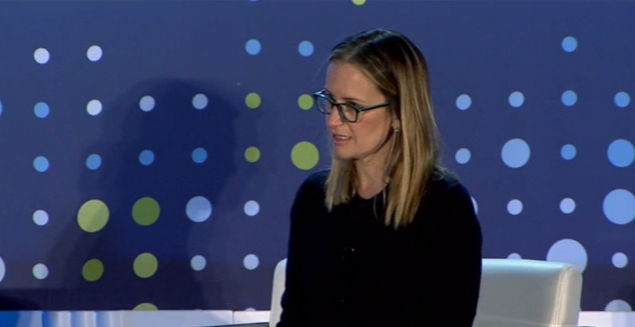 At Lendit, Bloomberg Reporter Emily Chang asked Square Capital head Jacqueline Reses to explain the real reason behind Square’s shift from merchant cash advances to loans.
Reses said that it was not a customer issue, but an investor one. “This industry and this conference more than anyone understands the nuance between MCAs and loans,” she said. “From an investor side, that’s really where the savings are between the form of an MCA and the form of a loan, in that there’s an actual repayment date.”
Reading between the lines, she seemed to be saying that investors like certainty and exact terms whereas the traditional merchant cash advance product was harder to sell off or securitize because they lack a defined element of time.
Fast loan approvals shouldn’t be criminalized
Referring to the criticism that online lenders have been getting recently for their fast approvals, Chang specifically asked if companies like OnDeck were approving loans too quickly.
Reses responded, “I don’t think the ability to execute something quickly, smoothly, transparently, should be criminalized as something that requires oversight, and so I think being good at something should be well regarded.” She later added, “I think the notion that credit decisions being swift is a problem is just misguided.”
Transparency
Reses used the word “transparency” several times but in explaining such did not reference the disclosure of Annual Percentage Rates even once. Instead she mentioned the importance of spelling out the total dollar cost to the merchants, subtly reconfirming the findings that are coming from many other alternative lenders.
Was the move from MCA just about investors though?
Read our initial assessment and expanded theory.
Watch the full “fireside chat” video below:
Becoming a ‘Certified’ Merchant Cash Advance Professional is Just Around The Corner
April 11, 2016
Update: 11/4/16 – THE ONLINE COURSE IS HERE. The final version offers test takers the chance to earn a certificate in MCA Basics, specifically the characteristics that make loans different from purchases of future receivables.
A survey conducted last year by deBanked has contributed to the development of a training and certification course for merchant cash advance salespeople. Co-produced by Hudson Cook LLP, deBanked, and other industry veterans, sales representatives that offer the merchant cash advance product will have the opportunity to learn from an online tutorial complete with training videos and quizzes to achieve a new standard of educational excellence.
Being able to expertly understand and communicate the differences between loans and purchases is among the courses’s main goals. Funders and ISOs can supplement their own training procedures with the course. Those that complete and pass it should expect to receive a certificate.
While it’s not ready to go live just yet, Hudson Cook partner Robert Cook, says he will be available at the Lendit Conference should anyone wish to discuss or share their input. He can be reached at rcook@hudco.com.
Why Square Ditched Their Merchant Cash Advance Program
March 27, 2016 Square did $400 million in merchant cash advances last year. Now they are no longer even offering them. To fill the void, they’ve partnered up with Celtic Bank to issue a unique kind of merchant loan, one in which borrowers have a fixed term to repay but make their payments daily by diverting a percentage of every transaction they process to Square.
But why make this change? After all, Square reported that its merchant cash advances typically tended to cycle through to completion in approximately nine months despite there being no fixed term. Their loans will have terms of 18 months, almost ensuring that money will turn over slower, not faster.
Todd Baker, the managing principal of Broadmoor Consulting LLC, says it’s a P/E play. That’s because as part of the change, Square will not be keeping the bulk of the loans on their balance sheet. Instead, they’ll be bundled together and sold to institutional investors. That positions them to be an originator or marketplace dependent on fee income instead of a lender. “Banks and lenders trade at 12x-15x p/e while tech trades at infinity,” Baker said.
Square likely encountered trouble trying to bundle up merchant cash advances because their legal standing across states is not as defined. Celtic Bank-issued-loans however are considered to be rather protected under federal preemption laws established under the Federal Deposit Insurance Act.
But that’s not the whole story either
Online lenders were widely criticized in the wake of the San Bernardino attacks after it was learned the terrorists obtained a loan from Prosper. “The issue may end up being whether marketplace lenders are too easy of a source of cash to finance terrorist attacks,” said Guggenheim Partners analyst Jaret Seiberg in a research letter back in December.
Square’s merchant cash advance program had very little underwriting. The focus was almost entirely on a merchant’s historical sales activity. No credit check was required, nor did applicants have to supply a photo ID or financial statements. This one-click process may have played a major role in originating $400 million in merchant cash advances in 2015, but it probably raised red flags with regulators.
Notably, the new Square Capital application page makes light of this issue. “To help the government fight the funding of terrorism and money laundering activities, Federal law requires all financial institutions to obtain verify and record information that identifies each person who opens an account,” it says. “What this means for you: When you open an account, we will ask for your name, address, date of birth, and other information that will allow us to identify you. We may also ask to see your driver’s license and other identifying documents.”
There’s easy and then there’s too easy. For Square, $400 million a year in merchant cash advances may have been proof of concept for demand but also proof that it was time to slow it down just one notch and make sure they aren’t being reckless.
Few would be impressed by one-click no-underwriting funding if it meant money flowed into the coffers of terrorists even once. Similarly, institutional investors would not be too happy if it was deemed that all of the California merchant cash advances in a bundle they bought were subject to a class action lawsuit. Square can now focus on what they are known for, technology, and perhaps improve their market cap.
By moving away from merchant cash advances, Square has killed at least three birds with one stone. Long live the bank charter model.
Square Swaps Out Merchant Cash Advances for Business Loans
March 25, 2016 Square’s merchant cash advance program is already among the biggest in the world, but they’ve got even bigger plans, or maybe just different ones.
The company announced on Thursday that they will now be offering true business loans as well through a partnership with Celtic Bank, an industrial bank chartered by the State of Utah. The WSJ reports that loan payments will also be made via a split of future credit card sale activity but with the caveat of there ultimately being a fixed term. This is coincidentally how PayPal’s loan product works.
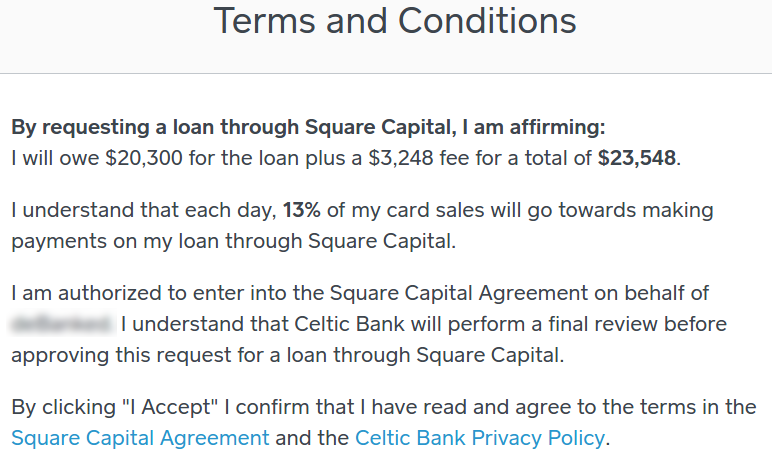
The WSJ makes it seem as if both products will run alongside each other, but a Square merchant revealed to deBanked that all of the language on Square Capital’s application portal has changed from advances to loans. Even the promotional materials have changed to reflect that it may take more than just an automated review of historical credit card sales activity to get approved and funded. Also, all Square loans are subject to credit approval, whereas no credit check was required for merchant cash advances. Applicants may be required to produce a photo ID and other documents for further verification. North Dakota businesses are prohibited from borrowing altogether.
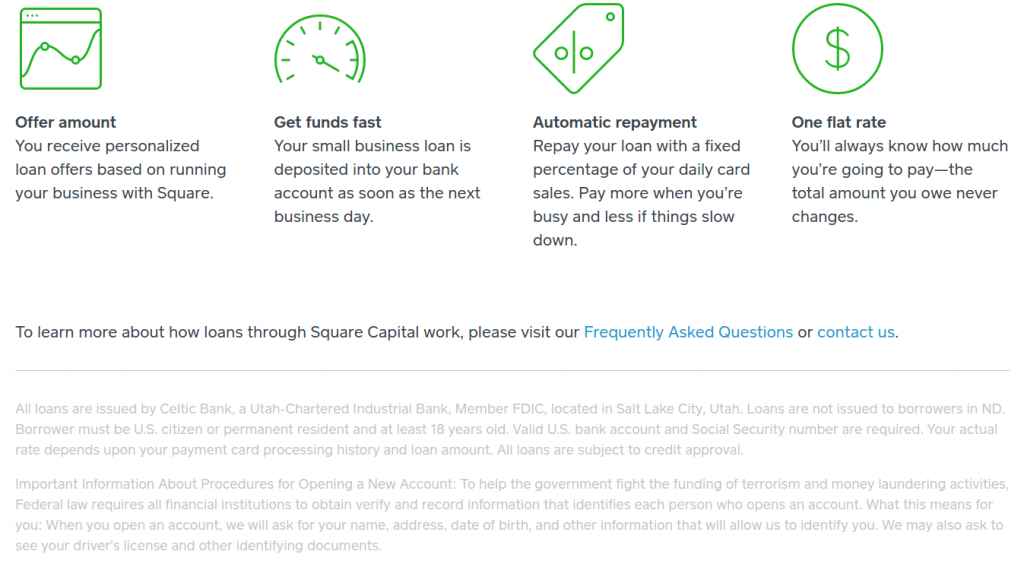
Square’s loans require that merchants process at least $10,000 or more a year. Borrowers must pay at least 1/18th of their initial loan balance every 60 days. PayPal by comparison requires that their borrowers pay down 10% of their loan amount every 90 days.
A Square merchant was not able to locate any mention of the merchant cash advance program. It’s all loans now.
Did Square really just add business loans to their arsenal or have they traded MCAs for the bank charter lending model?
Update: 3/25 2:54 PM Square confirmed that they have indeed replaced their merchant cash advance program with the loan program.
Our Square Capital program is transitioning from merchant cash advances to flexible loans. https://t.co/oUyRtNgVSS pic.twitter.com/ELXC7ayJyU
— Square (@Square) March 25, 2016
Bizfi Partners With West Coast Banking Group
March 17, 2016Bizfi will be the exclusive alternative finance solutions provider for small businesses that are members of the Western Independent Bankers, a trade association of community banks in the west coast.
Small businesses in the midwest and west coast in states including Alaska, Arizona, California, Colorado, Hawaii, Idaho, Montana, Nevada New Mexico, Oregon, Utah, Washington and Wyoming can benefit from this partnership. Bizfi’s marketplace partners with lenders like OnDeck, Funding Circle and Kabbage.
“WIB member banks are the leading funders of America’s small businesses,” said Michael Delucchi, President and Chief Executive Officer of WIB and WIB Service Corporation. “With Bizfi as a WIB Premier Solutions Provider we are able to offer their expertise in alternative financing and superior technology to our member banks and deliver a complete solution for small business funding.”
Earlier this month, Bizfi partnered with The New York State Restaurant Association to provide business financing for its 2,000 small businesses in the restaurant space.
Merchant Cash Advances Not Governed by Truth in Lending Act, Fed Says
March 16, 2016 Ellyn Terry, an Economic Policy Analysis Specialist at the Federal Reserve Bank of Atlanta, wrote on the Fed’s blog that merchant cash advances are not governed by the Truth in Lending Act.
“Because an MCA is structured as a commercial transaction instead of a loan, it is regulated by the Uniform Commercial Code in each state instead of by banking laws such as the Truth in Lending Act,” wrote Fed analyst Ellyn Terry on March 15th. “Consequently, the provider does not have to follow all of the regulations and documentation requirements (such as displaying an APR) associated with making loans.”
While Terry applies some incorrect characteristics to describe the nature of the parties in a future receivable purchase transaction (by calling them a lender and borrower instead of a buyer and seller), she was able to broadly describe the nature of MCAs.
“MCAs have been around for decades, but their popularity has risen in the wake of the financial crisis,” she wrote. “Typically a lump-sum payment in exchange for a portion of future credit card sales, the terms of MCAs can be enticing because repayment seems easier than paying off a structured business loan that requires a fixed monthly payment.”