

Sean Murray is the President and Chief Editor of deBanked and the founder of the Broker Fair Conference. Connect with me on LinkedIn or follow me on twitter. You can view all future deBanked events here.
Articles by Sean Murray

A Merchant Cash Advance Fad or Future?
May 11, 2012We were recently asked the following questions:
What do you think has caused this explosion of bank-only and loan products in the MCA space? Will they last?
 It’s said that 50% of all marriages end in divorce. So after years of a happy marriage and several offspring (starter advance, premium advance, and lockbox), the Merchant Cash Advance industry is seemingly ready to part ways from merchant processing. Back in the Mid 2000’s, the two did everything together. But now it seems every time a funder receives an application, there’s a note attached to it from the reseller that says “this needs to be ACH.” What began as a temporary work around for POS equipment that couldn’t be converted, has turned into a full blown fixed debit ACH love affair. Will this product boom last? How did this even happen?
Here are several of our theories, some of which may even contradict each other:
1. The Merchant Cash Advance industry has grown uninhibited for so long, that some companies do not see any harm in collecting fixed payments. A projected 6 month advance could take 18 months to complete due to a slowdown in merchant account sales, a risk that some funders are no longer willing to take.
2. At least one state (::cough:: California ::cough::)has been nagging Merchant Cash Advance providers to obtain a lending license even if they’re truly purchasing future revenues. If you have a lending license, you might as well actually lend money. Hence, more fixed term and fixed payment deals are being done.
3. Sales agents are constantly talking about upfront commissions and closing fees. It seems like none of them are earning merchant account residuals anymore or don’t see the long term value in them. Should we be surprised if an agent pushes to get an account funded on ACH instead of waiting 6 weeks to convert a Micros POS?
4. Payment technology has evolved too much. There are tons of ways to circumvent a funder’s split. Anyone can whip out their smart phone and swipe a card through an attachable device. There’s also the ability to get terminals and POS technology for free from virtually ever merchant services provider in the country. Instead of worrying about whether or not the merchant is going to secretly use Square or PayPal to bypass the split, it’s beginning to make more sense to pull funds from the bank account instead. At least if they end up using Square, PayPal or 10 other processors, those sales will end up in the bank account anyway.
5. “I have to change my processor? Ugh!” How many times have sales agents heard that? It only takes 1 sales agent in a 5 way deal competition to ruin it for everyone else by offering a fixed debit repayment program. No one wants to be caught without the ability to present the same alternative.
6. There are so many businesses that don’t accept credit cards, accept them with such low frequency, or in such a small proportion to their cash sales. It may seem like everyone is doing fixed debit ACH deals now, but in reality a lot of these businesses would never have qualified for a Merchant Cash Advance previously. The merchant pool has grown to include anyone that owns a small business instead of anyone that owns a small business that does at least $5,000 a month in credit cards and batches out 15x times consistently.
We think #6 is the biggest part of it, but certainly this shift in the parameters of eligibility and the widespread ability to ACH is cannibalizing the sector that would normally qualify for split-funding. The rate at which the industry is doing ACH deals may slow down but it’s very unlikely it will ever go away. Is this is all a fad? We think not…
– deBanked
https://debanked.com
Job Losses Possible Threat to MCA Industry / Google Penguin Kills Survivors / No Debit Card Savings
May 6, 2012How sure is this recovery?
A few months ago, all signs pointed to a roaring recovery. As the data comes in each month, it’s looking less and less like a definitive thing. Sure the unemployment rate is going down, but mainly because hundreds of thousands of people are giving up on searching for jobs. The Wall Street Journal recently analyzed a less popular statistic, the civilian labor participation rate. At present, the percentage of Americans working is at its lowest point since 1981.

At the same time, the nation’s largest banks are cutting back on loans to businesses yet again. It makes one wonder if the explosive growth being experienced in the Merchant Cash Advance industry will start to fizzle out in the 2nd half of this year.
Google Penguin wipes out the survivors
 If you used blog networks like BuildMyRank to game Google into ranking your site higher, you probably noticed your website got whacked in late March. After years of spending precious money on marketing, 2012 brought upon the realization that leads generated from organic searches are not only possible, but free. This is of course before you factor in the thousands and tens of thousands that MCA funders and ISOs are spending a month on SEO. But since many SEO tactics are doomed to fail and because Google’s algorithm can change at any time, investing in organic rankings is incredibly risky.
For example, one mid-sized MCA provider secretly shared that they had spent two years and nearly a hundred thousand dollars to get the rankings for the keywords they wanted on Google. Leads were just finally starting to come in on a daily basis when out of nowhere, they got thrown back to page 25. Blog networks were a big part of their strategy and when Google cracked down on them, the MCA provider’s presence on the Internet went down with the ship.
Some MCA companies survived the blog network armageddon only to become extinct on April 24th when Google made a key algorithm change to help defeat web spam. This major update has become notoriously known as Penguin. If you were a victim, you may need an SEO crisis management plan.
In any case, the changes at Google immediately affected unemployment in India, the country that most U.S. companies turn to for SEO services. As their clients sites disappeared from search results, so too did their contracts. At least that is the gag story surrounding a photoshopped image that has been going viral around the Internet.

Read our previous coverage on Merchant Cash Advance and SEO:
The SEO War for Merchant Cash Advance
The SEO War Continues
Debit card savings not being passed along
Remember when all those small business owners got their swipe rates reduced? Oh wait, that didn’t happen. The Durbin Amendment limited the interchange rates, which are the fees that acquiring banks pay to card issuing banks. The rates and fees charged to the small business are still left to the discretion of Merchant Service providers. Sure they can lower the cost if they so choose, but there’s no law that dictates they have to. It seems the Durbin Amendment victory was all one big misunderstanding for America’s retailers. We’ve been following this law since December, 2010. ISO&Agent Magazine just published an article titled, Unintended Results Plague Durbin Amendment. Are they seriously just figuring this out now?
Published by: Merchant Processing Resource
https://debanked.com
Cool Stuff | ISO Extinction | Ignorant Media
April 27, 2012What’s new in the Merchant Cash Advance arena?
Cool Stuff
FundersCloud is making waves in the industry with their Peer2Peer/Crowdfunding platform. We’ve finally gotten a chance to speak to their team, do a walkthrough, and aim to release an independent review of their cloud next week. However, for the moment we would like to take this time to gloat that another one of our predictions is being proven right.
On December 1, 2010, we explained that the Direct Funder model was quickly becoming a thing of the past. (The Direct Funder Model is Sooo 2009). How many of your friends and colleagues have at some point considered leaving their current job to go and start a funding company? Tired and worn down agents are all prone at some point to say “screw this! I want to be the funder so the agents can send the deals to ME instead!” Now it makes increasingly less sense to start a funding company. Why would you do that when you can just syndicate on your own deals or on the deals of other funders? You can earn the same return they enjoy but without having to pay the nasty overhead. In some aspects, being the funder has disadvantages, unless they’re making a hefty amount on management fees.
 ISOs Facing Extinction
According to an article in ISO&Agent Magazine, it’s not practical to compete on just price anymore:
The internal threat lies in continuing to base the ISO business model solely on selling card services at the lowest price and failing to offer the latest payment technology, Helgeson cautioned the packed session room.
“They should be talking innovation,” Helgeson said of ISOs. “If they’re only talking rates, they’re already out of business”
Basically, if two merchant account representatives walk into the corner deli and one offers to lower the processing rates by 15 basis points and the other offers a state of the art POS cloud that can accept payments through the merchant’s smartphone, home computer, and in-store touch screen device, what’s going to happen? So many merchants have been tricked into higher rates under the guise that their rates would be lower that they’re beginning to tune out the low rate pitch already anyway. They want the technology now.
Could the same issue begin to plague the Merchant Cash Advance industry? In the last two years, new funders have popped up with the strategy to acquire marketshare by undercutting the competition. That works until the next guy undercuts the first guy, and the next guy undercuts the second guy. Pretty soon, we’ll have funders purposely operating in the red just to have a share of the market. Some are bleeding red ink already but not because they want to be. 🙁
They key is to give merchants added value with the financing program. This doesn’t mean trying to sell them insurance and warranties and trying to pass this off as some kind of value. Those are junk costs and extra fees for the funder, not value for the merchant. Anything you can contribute that would drive more customers to their business or make their business operate more efficiently is value.
Ways Merchant Cash Advance Companies Can Provide Additional Value to Their Clients:
- Provide them with POS software
- Provide them with SEO services to increase their exposure to customers in search engines
- Create a custom tailored marketing campaign for them to reach more customers
- Create and execute an e-mail marketing campaign for them that would be sent to either previous customers, potential customers, new customers, etc.
- Rent a few billboards and allow merchants to opt-in to have their business advertised on these billboards
- Copy Groupon
- Etc., etc., etc.
If you can’t come up with anymore ideas here on your own, you’ll probably be out of business by 2015. If the items you add to this list include ways to make yourself more money and not the merchant, you’ll probably be out of business by 2015.
Ignorant Media
In our own opinion, the petition set up to automatically e-mail the Huffington Post in response to their article about businesses having no choice but to pawn jewelry was a success. The Huffington Post may feel differently because they didn’t respond to us at all.
It figures that websites that receive millions of views daily really don’t bother to care about actual facts or information. They’re entertainment sites and for-hire PR mechanisms. Every time we see a friend’s company mentioned in the news, we shoot them an e-mail or call them up to offer them congratulations on getting noticed. They always respond with some version of, “Don’t congratulate me. I had to pay $30,000 to some PR company to try and buy placement.” Oh well… At least there’s the Merchant Processing Resource to fulfill all your Merchant Cash Advance information needs. 🙂
– deBanked
https://debanked.com
The ETA Continued… Part 3
April 20, 2012
Ooo La La! We’re talking about the orange circle in the back that says ‘Pricing as low as 14.9%’. Swift Capital was in attendance at the ETA expo this year and they have been aggressively marketing on the basis of transparency.
Also on the scene was Ilya Fridman, the CEO of Entrust Cash Advance. According to Entrust, “The main focus of his meeting was to come up with ideas for serve merchants in order to better protect their investments. Fridman sat in on a meeting whose goal was to understand the specific needs of merchants in order to tailor a program that will make the cash advance process easier for them and more compatible with their business. Fridman also helped generate ideas about how to protect advance lenders from fraud, which in turn will make cash advances less costly for the merchant, and therefore better for both parties in the long run.”
It’s like we said previously, you get out of major trade shows like this what you put into it. Some people scored serious business, others were in town to party.
BTW, we’re playing some serious phone tag with the founders of FundersCloud, the company that unveiled an awesome syndication platform at the show, but stay tuned because it warrants its own individual write up.
Below are some more photos of the ETA Expo in Las Vegas, which have been provided to us by Swift Capital:




See Our Previous 2 Posts Covering the ETA Expo in Las Vegas
More Photos From the ETA Expo
April 19, 2012The ETA Expo has been quite an experience. ISOs came in droves, with one privately sharing with us that the past two days have generated a tremendous amount of business. Others have used the time less productively and at least one business development manager who sat this year out said he purposely did not go because there was “too much partying last year.”
You get out of it what you put in to it. Tony Syracuse, the Sr. VP of Sales for GBR Funding, is on the scene and says the expo is “a lot better than last year. The venue is a lot better. San Diego’s show was way too spread out.” He added, “It’s a good show overall. [There are] lots of ISO’s in attendance, both from the payments industry and merchant cash advance.”
Tony was nice enough to send us some additional photos of the show:






Subprime Lending and The ETA Expo in Vegas!
April 12, 2012Are we really still saying “banks aren’t lending”? We are, and apparently everybody else is too, because it’s still true. Time Magazine just published a piece that promotes the idea that bank lending is so dead that people wouldn’t even lend money to themselves. Could this be more evidence that banks are no longer necessary to a recovery or economic growth?
We recently scolded the Huffington Post over an article casually claiming that businesses had no financing options other than to pawn off their jewelry. That led us to create a mini-petition in which many players within the Merchant Cash Advance industry could politely inform them of their omission. We are happy to report that individuals from more than 40 MCA companies have participated in the petition so far. “40?! Only 40?!!” If you think 40 is small, you should keep in mind that there are only so many MCA companies in the country. We encourage anyone who has not participated to do so HERE.
Huffington Post hasn’t responded yet but we expect they will be forced to as the emails keeping rolling in!
————————
Woo-hoo! Vegas!! YEAHH!!! (April 17th – April 19th)
As the Merchant Cash Advance industry has evolved, we find it kind of interesting that the we have adopted the Electronic Transactions Association Expo has our own official trade show. Split-processing or ACH collection are both electronic payments, but we believe piggybacking on other industries could potentially be keeping MCA in the shadows. Whenever there’s a trade show, whether it be payment processing, restaurant associations, or other, the Merchant Cash Advance guys seem to show up but they’re never hosting the event.
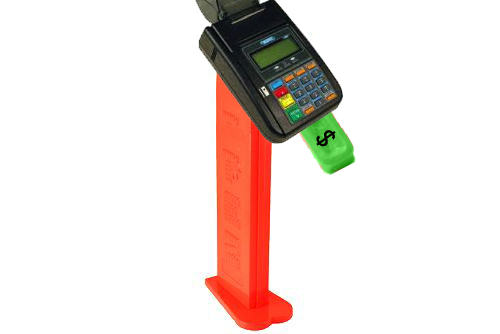 Now that the volume of MCA transactions per year is in the billions of dollars, it may be time to starting pulling ourselves out of the booths and onto the big stage. Don’t get us wrong. The ETA Expo is the most valuable place for the MCA space to meet, greet, close deals, learn, partner up, promote yourself, and party, and it’s important that we maintain a big presence there. We can’t help but imagine what could be if wholesalers, equipment vendors, distributors, and retail business owners were coming to the Annual Merchant Cash Advance Industry Expo. Attendees would get pez dispensers shaped like credit card terminals and the candy would be green and shaped like money. As long as we had pez, we wouldn’t need a big fancy dance show:
Thoughts on this anyone? Are you going to be at the ETA Expo? Comment below.