
Archive for 2018
The Google Battle for Lending & SMB Finance Keywords Revisited
August 29, 2018When it comes to Google’s organic search for major keywords, companies like Nerdwallet and Fundera still dominate. A few players, however, have gained or lost significant ground since last year.
The Small Business Administration relinquished its place on the first page for words like “business loan” and “business line of credit” while PayPal and Credit Karma have begun to make major appearances as their activity in these markets increases.
Take a look:
| Keywords | Fundera | Fundera | PayPal | PayPal | Credit Karma | Credit Karma | Kabbage | Kabbage | OnDeck | OnDeck |
| Date | 9/14/17 | 8/29/18 | 9/14/17 | 8/29/18 | 9/14/17 | 8/29/18 | 9/14/17 | 8/29/18 | 9/14/17 | 8/29/18 |
| business loan | 1 | 1 | 2 | 3 | 4 | 5 | ||||
| merchant cash advance | 3 | 2 | 2 | 4 | ||||||
| working capital | 8 | 9 | ||||||||
| commercial loan | 3 | 1 | 5 | |||||||
| small business loans | 2 | 1 | 3 | 5 | 4 | |||||
| business line of credit | 2 | 2 | 5 | 3 | 3 | |||||
| fast business loan | 4 | 5 | 1 | 4 | ||||||
| business loan with bad credit | 7 | 5 |
| Keywords | Lending Club | Lending Club | Nerdwallet | Nerdwallet | National Funding | National Funding | Traditional Banks | Traditional Banks | SBA.gov | SBA.gov |
| Date | 9/14/17 | 8/29/18 | 9/14/17 | 8/29/18 | 9/14/17 | 8/29/18 | 9/14/17 | 8/29/18 | 9/14/17 | 8/29/18 |
| business loan | 9 | 6 | 3 | 7,8 | 5 | 4,7 | 6 | |||
| merchant cash advance | 4 | 1 | 8 | 9 | ||||||
| working capital | 4 | |||||||||
| commercial loan | 2,7 | 3,8,9,10 | ||||||||
| small business loans | 9 | 3 | 7,8 | 5 | 7 | 1 | 2 | |||
| business line of credit | 11 | 1,4 | 1 | 6,7,8,9,10 | 4,6,7,9,10 | 5 | ||||
| fast business loan | 2 | 3 | 5,6 | 8 | ||||||
| business loan with bad credit | 1,4 | 1 | 2 | 2 | 3 |
As mentioned in previous posts, this is not a scientific analysis. Keywords are measured using a wiped browser on my own computer.
The value of a Page-1 ranking too, is not as valuable as it once was, due to the heavy placement of paid ads above the search results. Ads, however, are not a factor for the keyword “merchant cash advance” since Google banned all advertising for that search term last Fall. Originally it was theorized that the ban was accidental, but ten months later it is still in place.
No such ban exists on Bing.
Read my previous analyses on the industry’s search war over the years:
September 2017 The Google Battle for Lending and SMB Finance Keywords
December 2015 Google Serves Low Blow to Merchant Cash Advance Seekers
March 2015 Google Culls Online Lenders – Pay or Else?
October 2014 Merchant Cash Advance SEO War Still Raging
August 2014 Six Signs Alternative Lending is Rigged: Do Lending Club and OnDeck have a helping hand?
October 2013 Google Penguin 2.1 takes swing at the MCA industry
August 2013 Your merchant cash advance press release may be hurting you
December 2012 Is Google your only web strategy?
July 2012 The other 93% [of leads]
April 2012 The SEO war continues
February 2012 The SEO War for Merchant Cash Advance: The first story on this topic
MCA Companies Have Won a “Sh*t Ton” of Cases, Judge Declares
August 27, 2018 A judge in Buffalo, New York has finally had enough with merchants trying to claim that merchant cash advances are loans.
At issue were defendants who sought to overturn a confession of judgment filed by SOS Capital. The Honorable Catherine Nugent Panepinto, who presided over the case, didn’t like that one bit, but what was more offensive to her was the manner in which the defendants tried to overturn it.
With a shit ton of case law already weighing against the defendants for filing an improper motion, Judge Nugent Panepinto went a step further by reminding the defendants that there is no merit to the argument that the subject merchant agreement was a loan.
The defendants, who seemed completely doomed to pay SOS Capital’s attorney fees, were saved only by the charm of their affable Long Island attorney.
This case was decided in Erie County, NY under Index #803512/2018.
Two-Thirds of Daily Crypto Trade Volume May Be Fake
August 27, 2018 Two-thirds of daily trade volume in cryptocurrency is faked, according to research published this month by the Blockchain Transparency Institute (BTI). This translates to $6 billion a day, according to the report. What this likely means is that the exchanges themselves are quickly buying and selling cryptocurrency to give the illusion of high activity on the exchange when, in fact, there may be relatively little.
The advantage of creating this illusion is to make it more attractive for actual cryptocurrency investors to buy on a given exchange, which is how the exchange makes money – from taking a percentage of each transaction. This practice of buying and selling to oneself (or to colluding parties) in an effort to mislead others, is called “wash trading,” and is illegal.
The report states that “over 70% of the CMC top 100 is likely engaging in wash trading by at least 3x their stated volume.” Given that most cryptocurrency exchanges are not regulated, this alleged wash trading may not come as a surprise to many. But if this is accurate, the magnitude of this fake trading is significant. Coinbase and Binance were not suspected to be wash trading, according to the report.
The exchanges that are considered to be accurate by the report typically have a volume/user to unique visitor ratio of around between 2% and 5%, whereas suspect exchanges ratio ranged from 10% to over 655,000%.
Sylvain Ribes, a Cryptocurrency investor and writer who is cited in the report, wrote in a March 2018 Medium blog post of his surprise between the differences in trading volume among exchanges.
“Where I had expected mild differences between currencies, I found ridiculously massive discrepancies between exchanges,” Ribes wrote. “Not the kind that can be easily hand-waved away (‘oh well, their users must behave differently’), but the kind that can only be explained by some figures being overstated as much as 95%.”
IOU Financial Profitable, Again
August 23, 2018
IOU Financial originated $29.2 million during Q2 2018, according to the company’s quarterly financial statement released today. This is an increase of 11.6% compared to the same period last year, and an increase of 19.1% over originations of $24.5 million from last quarter. This is also IOU’s third consecutive quarter with positive earnings.
“It’s the contribution from our team, our account executives, broker partners [and] product expansion,” IOU CEO Phil Marleau told deBanked as an explanation for the company’s growth.
Marleau said that over the past year IOU has been originating loans for larger amounts and for longer terms, like longer than 12 months. He also said IOU has been expanding into new industries.
Benjamin Yi, who leads IOU’s Capital Markets & Corporate Development efforts, characterized the company’s results as a “mini version of OnDeck,” alluding to OnDeck’s profitable 2018 Q2 earnings report.
Additionally, provision for loan losses (net of recoveries) decreased by 61.2% to $900,000 for the three month period ending June 30, 2018. Marleau said this is largely because the company has been using a more aggressive litigation strategy against businesses that default on their loan obligations.
And the principal balance of IOU’s servicing portfolio (loans being serviced on behalf of third-parties) amounted to approximately $44.1 million compared to $24.1 million in 2017. Marleau said that servicing loans is part of IOU’s business model and that this near doubling of its servicing portfolio in a single year is simply a reflection of the overall growth of the company.
Most of IOU’s revenue comes from making loans, of up to $300,000, to American small businesses. According to the company website, almost half of IOU’s merchants use the business loans to purchase equipment. Other loans are used for business expansion and temporary cash flow. To date, IOU has originated $563 million in loans.
Despite the focus on the American market, the company’s headquarters is in Montreal and its stock is listed on the Toronto Stock Exchange. While IOU’s footprint in the Canadian market is still very small, Marleau expects that to change and is looking forward to expanding in Canada.
“We’re part Canadian,” Yi said.
Marleau, who is Canadian, met cofounder and IOU President Robert Gloer at a fintech conference in San Francisco, and the company’s first loan was made in 2009. Gloer had ties to Atlanta, which is why IOU’s U.S. office is located there. While the company’s headquarters is in Montreal, the Atlanta office is larger and is where the company’s sales operations take place. The company has about 40 employees, but only about ten work at the Montreal headquarters.
Grooming The Best Sales Reps
August 22, 2018The best sales reps have a lot in common – they’re smart, honest, likable, well-organized, thick-skinned and hungry for success. They navigate the difficult early days of their careers in the alternative small-business funding community by persevering despite long hours, countless outbound telephone calls and meager commissions.

“Persistency is really, really the key – putting in the time,” says Evan Marmott, CEO of Montreal-based CanaCap and CEO of New York-based CapCall LLC. “It’s not always easy, but you’ve got to stay late, make the phone calls, send the emails and do the follow-ups. It’s a numbers game.”
Being relentless counts not only when pursuing merchants but also when matching merchants with funders, Marmott emphasizes. “If they can’t get an approval one place, they’re going to shop it out until they get approval someplace else so they can monetize everything that comes in,” he says.
“It’s all mindset and work ethic,” in sales, according to Joe Camberato, president at Bohemia, N.Y.-based National Business Capital. His company works to create a culture that supports the right mindset by working with a firm called “Delivering Happiness.” Together, they forge to a set of core values based on integrity, innovation, teamwork, empathy, and respect for fellow employees, clients and clients’ businesses.
National Business Capital employees learn to live those ideals by working and playing together on the company volleyball team, through work with local and national charities, and at company mixers and staff picnics, Camberato maintains. “We adapt and change, and we’re committed to helping small businesses grow,” he says of the company culture, “and we have fun while doing all that.”
Likeability helps build relationships with customers, says Justin Thompson, vice president of sales for San Diego-based National Funding. “People will do business with people they like and trust,” says Thompson. “It’s really about establishing a relationship first and then establishing quality discovery.” From there, presentation and execution become paramount, he says.

Methodology can make the difference between success and failure in sales, observes Justin Bakes, co-founder and CEO of Boston-based Forward Financing LLC. “Have a defined process and stick to it,” he advises. A well-organized approach inspires trust among clients, establishes and maintains a great reputation; and fosters understanding of the customers’ needs, wants and business operations that help the rep choose the right financing option and appropriate funder. Using technology to wrangle multiple leads and high volume counts for a lot, too, he says.
It’s all part of the consultative approach to sales, says Jared Weitz, CEO of Great Neck, N.Y.-based United Capital Source. Long ago, sales reps may have succeeded by mimicking carnival barkers, sideshow pitchman and arm-twisting medicine-show peddlers. Thankfully, those days have ended – if they ever really existed. Most of today’s successful salespeople earn clients’ respect by becoming knowledgeable, trusted business consultants, says Weitz.
THE CONSULTATIVE SALE
“Someone calls, and there are two ways of handling a deal, right?” Weitz asks rhetorically. Using one method, a salesperson can say, “We’ll fund you this much at this rate today – are we good?” he says. The other way calls for understanding the client’s business – how long has it been open, does it make more cash deposits or credit card deposits, would it be best-served by an advance, a loan, an equipment lease or a line of credit, how much can it afford in monthly payments?

Establishing how the merchant intends to use the funding plays a crucial role in the consultative sale, Marmott agrees. Objections can arise when a merchant learns that receiving $100,000 this week will require paying back $150,000 in four or five months, he notes. So it’s essential to demonstrate that using the money productively will more than pay for the deal. A trucking company can realize more income if it deploys two more trucks, or a restaurant can increase revenue by placing another bar outside for the summer, he says by way of example.
“A lot of salespeople ask a business owner what they need the money for,” observes Thompson. “The merchant says, ‘Inventory,’ and the rep stops right there. I train my reps at National Funding to go two or three clicks deeper.” Examples abound. When does the merchant need the inventory? From whom do they order it? How long does it take to ship? How long does it take to turn it over? What are the shipping terms?
The consultative approach can require salespeople to pose a lot of open-ended questions that can’t be answered yes or no, according to Thompson. Ideally, the conversation should adhere to the 80-20 rule, with the client talking 80 percent of the time and the sales rep speaking 20 percent, he asserts, adding that “a lot of times it’s reversed in this industry.”
Sometimes, however, salespeople should set aside the time-consuming consultative approach and instead find funding for a merchant as soon as possible. That’s true when the business owner can make an opportune purchase of inventory or when it’s time to acquire a competitor quickly. More often, however, it pays to take the time to understand the merchant’s needs and search out the best type of funding for that particular case, top sales people maintain.

Much of the alternative small-business finance industry has caught on to the importance of the consultative approach to sales as the array of available alternative financial products has grown beyond the industry’s initial offerings of merchant cash advances, according to Weitz. The days of scripted pitches and preplanned rebuttals to objections have ended, he says. Today, management trains reps for success.
THE RIGHT TRAINING
Are top salespeople born that way? “Some people hit the ground running, but sales can be taught – that’s for sure,” Weitz says. “The tougher thing to teach is integrity.” Much of the training process focuses on learning the products to enable a rep to make a consultative sale and shoulder financial responsibility, he maintains.
Believing that some people are born to sell provides a crutch to avoid learning what really works, according to Bakes. Training can teach a smart, motivated person how to succeed, he maintains. They don’t have to be born that way.
However, some people do seem born to exert influence, which can translate into sales prowess, says Thompson. Still, those born with a strong work-ethic can overcome other deficiencies, he notes. The work ethic drives them to “come in every day,” he notes. “They’re organized and disciplined. They follow the National Funding philosophy, and they make a ton of money.”

National Funding trains salespeople to view their craft as being defined by two broad elements – art and science, Thompson continues. The science proves easier to master and includes asking the right questions to learn about the customer and the deal. The hard part, the art of the sale, consists of getting to know the business owner, building a relationship and demonstrating expertise. In one example, that’s based on learning how many trucks are in the fleet, whether they’re long-haul or short haul and whether they use dumpsters versus box trailers, he says.
Beyond those important basics, training should be ongoing because selling techniques change slightly as new products and systems emerge, according to Weitz. “One of the things I like about being a broker is the ability to pivot and add another arrow to your quiver,” he says.
Salespeople at United Capital Source talk sales among themselves almost nonstop, which amounts to daily sales training, Weitz observes. That can take the form of describing a challenge and explaining how to overcome it, he notes. A particularly good idea merits an email to the group to share the new piece of wisdom. It’s a matter of constantly refining the approach.
Training can help sales reps understand the businesses their clients run, according to Marmott. Knowing the margins in a restaurant, for example, can help the salesperson explain that the increase in revenue from an expansion will quickly pay the cost of capital, he notes.
Training should teach new employees how business works because common elements arise in enterprises ranging from dog grooming to asphalt paving, Thompson notes. There’s inventory, marketing, employee expense, payroll taxes, insurance and 401k’s in almost any business. “We teach all that to the reps,” he says. Then after conversations with thousands of merchants, reps have a solid foundation in the workings of businesses.
 National Business Capital’s formal two-week classroom training usually lasts three hours a day, focusing on systems, guidelines, product, general business principles and the company’s processes, says Camberato. Teachers include the sales management team, company culture leaders and the managers of IT and Tech, Marketing, Processing, and Human Resources.
New hires spend much of their time working with mentors for the first six months and a team leader who works with them indefinitely, Camberto continues. The company sometimes hires in groups and sometimes hires individually, he notes.
National Funding provides three eight-hour days of regimented classroom training on the fundamentals to each of the four groups of 12 to 17 hired each year, says Thompson. The classes cover processes, sales strategy, marketing and the lender matrix. Next comes three months of working with a sales manager dedicated to working with the class. After a total of nine to 12 months, management knows which reps will succeed.
Some shops operate on the opener-closer model, with less experienced salespeople qualifying the merchant by asking questions like how long they’re been in business and how much revenue they bring in monthly, Marmott says. If the merchant qualifies, the newer salesperson who’s working as an opener then hands off the call to an experienced closer to complete the deal. Good openers become closers, but opening isn’t easy because it requires lots of calls, he notes.
National Funding doesn’t use the opener-closer approach because the company believes reps should Participate “from cradle to grave,” Thompson says. “They hunt the business down, build the relationship and handle the transaction from A to Z.” East Coast shops often focus on cold calling and use the opener-closer model, while West Coast shops tend to invest more in marketing and reject the opener-closer method, he noted.
But where do these top salespeople come from?
THE RIGHT BACKGROUND
Prospective sales reps who have just finished college should have a grounding in communications or business, Weitz believes. Experience in sales and a familiarity with dealing with merchants helps prepare reps, he notes. Job history doesn’t have to be in the finance industry. Someone who’s sold business services in a Verizon store or worked for a payroll company, for instance, has been dealing with small-business owners and may succeed more quickly than those without that background.
Sales experience in other industries counts, Bakes agrees, especially in businesses that require dealing with a large number of leads. “Organization and process is just as important as being born with the traits of a salesperson,” he opines.
Life experience that breeds a positive attitude can prove vital, says Marmott. That’s especially important in the beginning when a new rep might take home a paltry $300 in the first month. Later, when the rep has a $50,000 month, he or she will see that their optimism wasn’t misplaced, he declares.
GUYS WHO ARE HUNGRY”
“The biggest thing I look for is guys who are hungry,” Marmott maintains. I don’t need somebody with a doctorate or a master’s degree or even a degree,” he says. “I need somebody who is going to put the work in.” Of a roomful of 25 new reps, two or three will succeed and stay on the job, he calculates. “You get to eat what you kill. If you’re not killing anything, you don’t get to eat.”
“We look for potential candidates who come from backgrounds of rejection,” says Thompson. Their previous sales experience has taught them not to take the answer “no” personally. “It’s part of the business and you continue to move on.”
Although most regard the financial services industry as a white-collar pursuit, “it has blue collar written all over it,” Thompson says, referring to the work ethic required for success. But it’s not just the volume of work. Sixty good phone calls generate more business than 300 mediocre calls, he emphasizes.
GETTING UP TO SPEED
Succeeding at sales requires taking the time to form relationships, understand guidelines, become familiar with lenders and acquire a working knowledge of how clients’ businesses operate, Camberato says. How long does it take? “It’s a solid year,” he contends while conceding that most who succeed operate at a fairly high level before then.
Others disagree about what constitutes being up to speed and how much time’s necessary to achieve it. “I’ve seen it take 30 days, and I’ve seen it up to 120 days,” says Weitz. “The hope is that it’s within 60.”
A salesperson should start feeling better after 30 days and should start feeling good after 60 days, Marmott says. Management can usually identify the strong and the week reps within two to three weeks, he says. “You get the lazy ones that drop out, the guys who aren’t making any money, the ones who aren’t putting the effort in,” he says. “The first two weeks are the toughest because you’re learning the product and how to sell it.”
“It depends on the person,” Bakes says of the time needed to begin selling successfully. “It takes time. It is not something that will just happen overnight.” About six months should suffice to become confident as a closer, he estimates.
Even when sales reps hit their stride, some outsell others, Marmott notes, citing the 80-20 rule that 80 percent of the business comes from 20 percent of the salesforce. Outbound sales to merchants who may feel beleaguered by offers of funding requires more effort than when a merchant makes an inbound call to seek funding, he adds.
And even the best salespeople need great marketing and tech support from the their companies, sources agree.
INVESTING IN SALES
A shop just starting out might have a marketing budget as low as $2,500 a month, which won’t do much more than pay for direct mail pieces that might prompt a few potential clients to pick up the phone, Weitz says. With a little more money to spend, a shop can begin buying leads, he notes. “Don’t break the bank before you understand what formula works for you,” he advises.
“The key to sales is marketing,” says Marmott. “You can be the best sales guy but if you don’t have anything qualified to call or follow up with, it’s a waste of time.” Social media doesn’t work as well for business-to-business contact as it does for business-to-consumer marketing, he says. Pay per click and key words have become more expensive and isn’t as cost-effective as it once was, especially for smaller shops, he contends. Mailers can work but require heavy volume and repetition, he says, adding that could mean at least 25,000 pieces and at least three mailings.
Besides allocating marketing dollars, companies can invest in sales by paying new sales staffers a salary instead of forcing them to rely on commissions to eke out subsistence during the tough early days. National Business Capital pays a salary at first and later switches reps to commissions and draw, Camberato says. “An energetic person interested in sales can plug into our platform, get trained and do very well,” he continues. “We believe in you, as long as you believe in us.”
National Funding provides recruits with a salary and commissions so that they have enough income to get by and still reap rewards when they help close a deal, Thompson says.
Investment in technology can help salespeople set priorities, eliminate some of the drudge work in the sale process, measure the sales staff member’s success or lack of success, and provide a consistent experience for customers, notes Bakes. “Because of the way our technology is set up we can hold people accountable,” he adds.
Every salesperson and every shop should organize the workflow by using a lead-management system or customer relationship management tool (CRM) – such as Zoho or Salesforce –instead of operating with just a spreadsheet, Weitz says.
Brokers can invest in sales through syndication, which means putting up some of the funds involved in a deal. Forward Financing favors syndication in some cases because it aligns the salesperson and the funder, thus demonstrating the sales rep’s belief in the validity of the deal and ensuring a willingness to continue servicing that customer, Bakes says.
Some shops offer monthly bonuses for outstanding sales results, but Weitz believes awarding incentives weekly makes more sense. With a monthly cycle, some reps tend to slack off for the first week or so because they believe they can make up for lost time later. With weekly rewards, there’s not much room for downtime, he notes.
Whatever form investment takes, it can help build a sterling reputation and a free-flowing “pipeline.”
THE RIGHT REPUTATION
“Reputation is huge,” especially for repeat business and referrals, Marmott says. Once a merchant has received funding, a blizzard of sales call can follow. Treating customers right by maintaining ethical standards and helping them during hard times can guard against defection to a competitor touing low prices, he says.
Reputation requires differentiation, which usually occurs online, by email or over the phone, notes Bakes. Factors that enhance reputation include referrals by satisfied customers and real-world testimonials from actual customers and good ratings on social media sites, he says.
While it’s still uncertain what role social media plays in the industry’s reputation-building efforts, it appears that text messages elicit quick responses if the client has agreed to communicate with the company via that format, Bakes says. He notes that unwanted text messages won’t work. Email messages provide more information than text messages but seem less likely to prompt response, he says.
THE RIGHT GOAL
So, where does the effort to succeed at sales lead? It’s the foundation for building “the pipeline” – the name given to the flow of renewals, referrals and leads that makes every day not just busy, but busy in a productive and profitable way. As a rep’s pipeline takes shape, the cost of acquiring new business also goes down, Marmott says. “It just grows from there,” he says of the successful salesperson’s endeavors at building a pipeline of business. It’s what successful salespeople seek.
Two Commercial Finance Consultants Charged By SEC in Ponzi Scheme
August 22, 2018Two commercial finance consultants were charged by the SEC earlier this week for their alleged role in soliciting investors to place their savings into mortgage-backed securities issued by Woodbridge Group of Companies, LLC, a company revealed to be a $1.2 billion ponzi scheme.
Barry Kornfeld and Ferne Kornfeld of Parkland, Florida, allegedly earned $3.7 million in commissions by selling unregistered securities to more than 500 investors. Barry Kornfeld was already barred by the SEC for previous securities violations, the complaint states. The Kornfelds taught a “conservative retirement, income planning and social security” class at Florida Atlantic University, where the investments were pitched, the SEC says.
FEK Enterprises, Inc. DBA First Financial Tax Group, the company the Kornfeld’s operated, is also named in the complaint.
Their LinkedIn profiles, however, currently list them as the owners of Value Capital Funding, a small business financing broker in Boca Raton, FL.
UCS-BizBloom Deal Could Be First of Many
August 21, 2018United Capital Source (UCS) was chosen to service BizBloom’s book of business, according to UCS CEO Jared Weitz. After BizBloom’s president, Thomas Costa, stepped down, the company’s main investor assumed control and arranged for the company’s portfolio of merchants to be serviced by UCS. Weitz told deBanked that he was familiar with the BizBloom investor previously.
“When [they] reached out to me, I knew it was something we would be able to do,” Weitz said. “Between the experience of our account reps, our CRM, our technology that helps us, and our existing relationships, we knew we could take on the additional work, no problem.”
UCS will now control servicing BizBloom’s old portfolio, helping to place renewals. Weitz said he has a confidential financial arrangement with them.
“This type of arrangement is extremely common in finance,” Weitz said. “For instance, when Bizfi went out of business, Credibly was servicing their portfolio.”
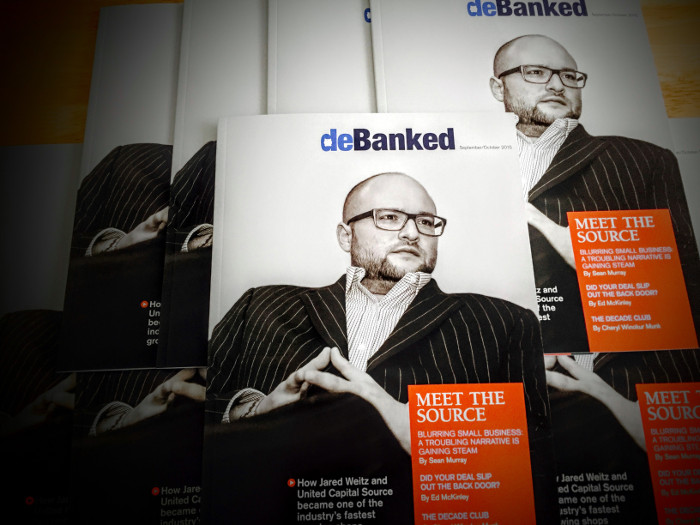
While UCS is not known as a servicing company and Weitz said that he is not looking to turn UCS into a servicing company, he said that he is interested in doing more of this.
“It got me thinking that if there are any additional ISOs out there that aren’t growing, aren’t happily performing, or are just looking to get into something else, but have an existing book, UCS would look to service that as well,” Weitz said.
It turns out that BizBloom’s merchants are very similar to the ones that UCS services. And many of the merchants are funded by the same companies that UCS already has relationships with. When UCS opened in 2011, they initially brokered cash advance deals exclusively. But since then, they have added equipment financing, business term loans, business lines of credit and factoring, among other products. They service merchants in a variety of industries, from fitness centers to hotels to gas stations. According to Weitz, 98% of the company’s leads come from its internal marketing team.
Merchant Cash Advance Company Wins in Bankruptcy Court After Judge Rules It’s an Ordinary Part of Business
August 21, 2018 Last week, a bankruptcy judge in the Northern District of Illinois ruled that a merchant had used so many merchant cash advances that it had become a normal part of their business.
At issue was Network Salon Services, a business founded in 2004 that was brought back from the brink of insolvency in January 2013 by a merchant cash advance. That advance, coupled with dozens of advances from more than 14 MCA companies over the following 3 and a half years would keep Network Salon on life support until it finally failed for good.
At the end, Network Salon had just $200 to its name and nearly $4 million in outstanding future receivables due to MCA companies.
After the Chapter 7 proceedings commenced, the bankruptcy trustee came knocking on the doors of several MCA companies to give back the funds it believed had been fraudulently transferred and obtained through criminally usurious means.
One of those companies, NY-based LG Funding, pushed back hard, and on August 15th the judge ruled in LG’s favor. In a carefully considered decision, The Honorable Jacqueline Cox said that an exception applied to LG Funding. Unlike a normal creditor where certain property obtained leading up to a bankruptcy becomes returnable to the trustee, Network Salon relied on MCAs in its normal course of business for years and thus the transfers of funds to LG Funding was the ordinary course of business not subject to return.
So ordinary was it in fact that Network Salon used MCAs to make payments on other MCAs, going so far that at one point one of its bank accounts showed no deposit activity for a month except for deposits from MCA companies and online lenders.
Ultimately it didn’t matter if LG Funding was actually debiting the deposits made by rival companies rather than the actual proceeds of sales, Judge Cox opined, because this deviation from the contract was not fraudulent and both parties benefited from it.
The usury arguments, as usual, failed, because New York courts (The state governing LG Funding’s contracts) have already determined that MCA transactions are not loans and therefore can’t be usurious.
“The Trustee has failed to meet her burden to establish by a preponderance of the evidence that the transfers were preferential or constructively fraudulent and therefore subject to avoidance,” The judge ordered. “LG Funding has succeeded in establishing that the transfers were made in the ordinary course of business, defeating the Trustee’s 547(b) preference claim. The constructive fraudulent conveyance claim fails because Network Salon received reasonably equivalent value in the transactions in issue. Judgment will be entered in favor of Defendant LG Funding on all counts.”
This post is an oversimplified explanation. Download the 24-page decision HERE for the full facts and details.