Banking
Avant CEO: Colorado Decision Framework for Bank Fintech Partnerships
October 13, 2020 After three years of litigation, in August, the Colorado “true lender” case settled with an agreement between the fintech lenders, bank partners, and the state regulators. Along with lending restrictions above a 36% APR, the fintech lenders will have to maintain a state lending license and comply with other regulatory practices.
The decision has been called unfair regulation and a bad precedent for other similar regulatory disputes across the country.
But James Paris, the CEO of Avant, sees the decision as a victory for fintech lenders. Paris said the decision was an excellent framework for fintech/bank partnerships across the nation and a sign that regulators are finally taking the benefits of alternative finance seriously.
“For us, the case also involved being able to continue to provide these good credit products to deserving customers who maybe weren’t being served as well through some of the legacy providers,” Paris said.
Paris called back to the Madden vs. Midland Funding case in the US Court of Appeals Second Circuit decided in 2015. That case called into question if loans made in fintech bank partnerships in the state of New York were valid at the time of origination. Regulators charged that though national banks can create loans higher than state regulations allow, fintech partners buying those loans to take advantage of higher rates were skirting state regulations.
“The ruling was essentially that the loan would not continue to be valid,” Paris said. “Because the individual state in question, which was New York’s local usury law, would apply because it was no longer a national bank that held that loan after it had been sold.”
The decision called into question loans made in the fintech space. Paris said that the Colorado true lender Case was not about whether the banks were even making loans. Instead, fintech lenders were called the true originators and therefore didn’t have a license that allowed them to make loans at higher rates than the state allowed.
Paris said the decision showed confidence that fintech bank partnerships were not exporting rates, and that by limiting lending to under 36%, regulators were protecting bank fintech partnerships and consumers.
“All of the lending Avant does is under 36%, and that’s been the case for years,” Paris said. “In the space where we do play, from 9% to just under 35%, through our partnership with WebBank, we are confident in running a portfolio extremely focused on regulatory compliance.”
Colorado went from not allowing partnerships at all, to working with fintech companies to developing a set of terms that allowed partnerships to function, Paris said. He added that Avant’s products have always been to customers below nonprime credit, from 550 to 680 Fico scores, serviced by up to 36% APRs.
Paris said he does not know about customers outside of this range, or how they are affected by limiting APR to 36%, but he cited a study done by economist Dr. Michael Turner. Turner is the CEO and founder of the Policy and Economic Research Council (PERC), a non-profit research center.
The study compared lending after the Madden case in New York with how customers can be served after the Colorado true lender case. In the credit market Avant serves, Turner found that customers are better off with access to regulated fintech loans, as opposed to not having access at all.
The study looked at the average borrower credit score, APR, and loan size of Avant and WebBank borrowers, and found that if WebBank loans through Avant were prohibited, borrowers would be forced to access other means of credit, through much higher rates.
“Should WebBank loans be prohibited in Colorado, then we can reasonably expect that some non-trivial portion of the WebBank loan borrower population, as well as prospective future borrowers, will be forced to meet their credit needs with higher cost products,” Turner wrote. “This outcome is financially detrimental for this borrower population, most of whom have no access to more affordable mainstream alternatives.”
Given this data, Paris is happy to comply with the regulation. Without the framework Colorado has provided, Paris said borrowers would be worse off. Paris hopes that this decision will precede other state frameworks because what fintech bank partnerships need the most are consistent regulatory practices.
“I’m hopeful that to the extent there are ongoing concerns around bank models across other states, that this type of safe harbor model that Colorado helped develop is something that others could look to as a precedent or a model. Because I think the more that we can have consistency across the relevant jurisdictions, the better.”
Software That Automatically Fights For Bank Refunds Adds “PRO Index”
October 1, 2020 Harvest fills a unique role in the fintech world. The platform is an automatic banking advocation software that fights on behalf of users for the best deals possible.
Connect your bank information and the Harvest AI will fight late fees and overdraft fees. Customers are only charged a portion of funds returned, and if the program does not succeed at getting money back, it doesn’t cost the user a cent.
Automatically arguing for better deals, the platform last year saved customers a collective $2 million, and manages $500 million in debt to date.
The brainchild of CEO and founder Nami Baral, Harvest released a new “PRO Index” that builds a credit profile for each customer to pair with information from FICO scores. Harvest created the index to help lenders get better information and for customers to track their financial health. Baral hopes the data will help lenders find a reason to continue credit flowing to those who have hit hard times but still can make their payments.
“In the post-COVID recessionary environment, the creditworthiness of customers continues to plummet,” Baral said. “[Harvest] saw that traditional credit scores do not provide enough of a picture about a customer’s actual worthiness and potential.”
This announcement is not just a press release, but a continuation of the founding premise of Harvest: to help the average American overcome debt and build financial health.
Baral, a Nepali native, came to America during the last financial crisis on a scholarship to study ovarian cancer at Harvard medical school. Expecting the country to be a utopic economic powerhouse, Baral instead saw lost jobs, defaulting mortgages, and debt.
“In many ways, America is one of the most wonderful places in the world,” Baral said. “But at the time it was a complete departure from what I’d hoped the US to be, because what I saw was, people were losing their jobs, losing their homes in the financial crisis.”
 She decided to work toward fixing the problems she saw, pivoting to study finance. Graduating with an applied math and economics degree, Baral then trained in investment banking. She worked on an auto-advocation software for a digital advertisement startup that was eventually bought by Twitter.
She had seen a company’s growth from IPO to merger and stayed at Twitter for four years. When she left, she began market research, talking to everyday Americans about what they needed to improve their finances.
“In those conversations with people from all over the US, Alaska, Oklahoma, San Francisco, New York everywhere,” Baral said, “I realized that the issues plaguing Americans in the last financial crisis had not gone away.”
Baral said these issues had intensified over this past decade. Incomes were volatile and stagnating, student loans had risen, and the people Baral talked too were getting more and more into debt.
“So I thought what the average American needs today is not another savings product, not yet another investment product,” Baral said. “But something that can help them reduce the debt that they have in their lives. That’s the genesis of Harvest.”
With the addition of the PRO Index, Baral is excited to offer another way Americans can maintain their financial health. She said that during the pandemic, every day could be a challenge for the average American, but the new platform can act as a barometer and compass.
“A lot can change between the time you extend a loan to the customer versus when they have to pay,” Baral said. “We call that Ability-to-pay as-a-service, and that’s where the PRO Index is used, determining: ‘is this customer still healthy? is my overall portfolio still healthy?'”
If the customer is no longer healthy, the info gathered to form the PRO Index, like transactional cash flow data, can supply lenders with information on improving their health. Baral says the platform encourages lenders to keep customers and shows borrowers how to improve their credit standing.
BlueVine is Back and Now With Business Checking Accounts
August 28, 2020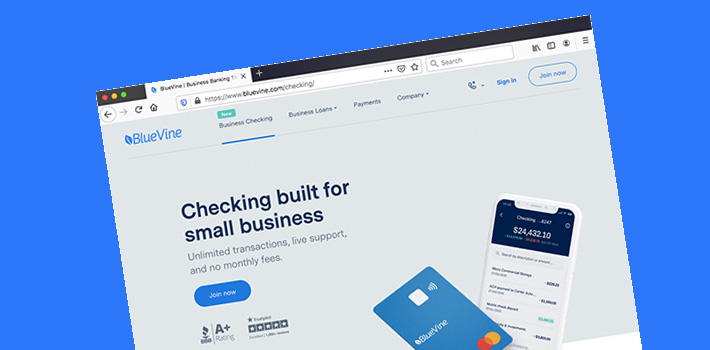 BlueVine, a leading small business lender, has resumed its normal services after generating $4.5 billion in PPP loans to more than 155,000 businesses. The company had continued to offer its normal lending products even while others in the industry paused completely, the company says. Herman Man, the chief product officer, said that BlueVine has also fully launched a small business checking account platform.
“Our goal always was to be that small business banking platform,” Man said. “Last year at Money 20/20 we announced we were going to build a small business checking account. Recently, we launched it post-COVID, derailing our plans. We have a breadth of offerings now, and we are that small business platform.”
BlueVine also released a survey this week of more than 800 small business owners to learn what they need most in an ever-changing market. Their findings supported their online product offering. Distressed by COVID-19, the respondents reported an overwhelming interest in reliable customer service, day to day support, and fee-less transactions.
77% of small business owners surveyed reported demand for direct guidance in day-to-day accounting. In the face of an emergency, many respondents noted that banks were more interested in new customers than servicing current customers.
Following this emergency support trend, nearly nine out of ten or 87% of small business owners said access to emergency credit was necessary from the same bank providing them regular service. Accessing credit from the same provider was not just important, but over half or 64% reported it was exceptionally so.
Finally, 58% of business owners reported that a lack of overdraft, monthly, or maintenance fees were the essential features a business checking accounts could offer.
With the launch of a checking account platform, BlueVine can service the needs of these businesses, offering one common platform that connects factoring services, payments services, and now credit and banking services.
“If a small business wanted to take a line of credit and do it on a Friday night, using our algorithm and things that are automated, it could run through our system; if they get approved, money would be transferred into their checking account instantaneously,” Man said. “This isn’t something they have to wait until Monday morning. It will land immediately, so that’s a huge game-changer.”
ODX Introduces New Contact-Free Banking Platform
August 26, 2020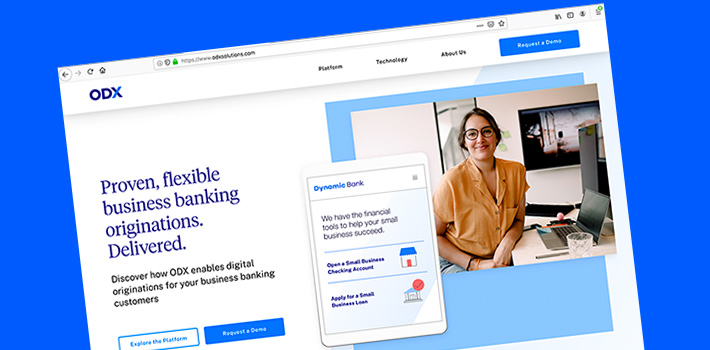 ODX, a banking originations platform, announced the launch of a new service this week—a Digital Account Opening (DAO) experience. With billions of dollars in successfully facilitated loans, the subsidiary of OnDeck made a move beyond origination; to offer banking account solutions.
Announced Tuesday, the new platform marks another addition to the ODX digital suite that enables financial institutions to reach customers digitally. DAO helps both customers and banks set up checking and savings accounts, filling the need for contactless banking in today’s market.
Brian Geary, the President of ODX, said the DAO’s release is a culmination of over a decade of customer experience merging with the company’s robust technology platform.
“We’re basically hosting the application experience, either web-enabled or mobile-enabled, as well as the workflow platform that is automating and streamlining,” Geary said. “So things like anti-fraud, compliance checks, ID verification, and in the lending case, credit decisioning, all happens on our platform.”
The new platform goes hand-in-hand with the already in place Know Your Customer (KYC) and Anti-Money Laundering (AML) programs proprietary to ODX.
This addition comes at a time when the niche of digital banking has become a necessity. Geary said in the past six months the long laid plans of financial institutions to transition their experience into digital solutions were accelerated by COVID-19. Now institutions and consumers alike are widely adopting contactless commerce.
“When branches closed or were limited in some of their face-to-face interactions, it accelerated that move to digital as well,” Geary said. “So from the customer side there was changing preferences and adoption of digital channels, and from the bank side, they are accelerating investment into digital.”
Independent Community Bankers Express Doubt PPP Can Be Rolled Out As Is
April 2, 2020Update: The interest rate has increased to 1%.
 The nation’s voice for community banks, the Independent Community Bankers of America, penned a letter to Treasury Secretary Mnuchin and SBA Administrator Carranza yesterday to urge them to make immediate changes to the planned PPP program slated to be rolled out tomorrow.
“We strongly recommend that you make changes to the guidelines before the Program goes live so that it will work as intended by Congress,” the letter states.
It goes on to explain that the proposed .5% interest rate is below the break-even cost for a bank and should be raised to 4% to allow them to break even. Further, that the loan terms of 2 years should be extended to 10 years to alleviate the hardship the short duration will create for small businesses, and that the restrictions on the use of the loan proceeds be amended.
The ICBA also expressed frustration with the lack of detail afforded to documentation required as well as to the uncertainty of how and when the SBA will reimburse them for losses.
European Challenger Bank Revolut Launches in US
March 25, 2020 Yesterday Revolut, the London-based digital-only bank, announced the public launch of its app in the United States. The news came as a surprise to the thousands of potential American customers who signed up to the company’s waiting list with no details of when exactly to expect the bank’s arrival.
Founded in 2015 and valued at $5.5 billion, Revolut offers customers a debit card and a bank account controlled solely through its app; no brick-and-mortar branches being all the more timely during the coronavirus pandemic. The challenger bank joins its competitors, Monzo, N26, and Chime, in offering more sleeker and streamlined experiences compared to legacy banks.
While the European version of the app allows users to invest in stocks, trade cryptocurrencies, and buy insurance, the US edition will launch with limited capabilities, instead planning to roll out such features when they are available. The reason for this likely being that Revolut has yet to agree to deals with third parties to provide these features through partnerships. However, American Revolut users will be able to receive their salary two days in advance if they share their Revolut bank details with their employer, an ability that has yet to be launched in Europe. As well as this, the US version still offers the expense management, payment alerts, and currency exchange features that are in the European app.
Much like other fintechs who dabble in American banking, Revolut has circumvented the issue of acquiring a banking charter by instead partnering with a domestic bank, such as the New York-based Metropolitan Commercial Bank in this case. As such, accounts are FDIC-insured for up to $250,000.
“As the cost of living increases disproportionately to people’s take-home salaries, now more than ever, people need to know exactly what is coming in and out of their account. They should have the tools to help them manage their money more conveniently and accurately,” Revolut Founder and CEO Nik Storonsky said in a statement. “When spending or transferring money overseas, most people are unaware of the hidden fees that banks are charging them. The world is becoming more connected, and financial services should be supporting this notion, not hindering it.”
Square is About to Become a Real Bank
March 18, 2020
Square is on its way to becoming a bank. The payments and online lending company was approved by both the FDIC and the Utah banking regulator this week to create a de novo “industrial” bank. The company has been trying to accomplish this for more than two years. The news means that Square will likely no longer rely on a relationship with Celtic bank to make loans, while also being able to take on deposits.
The FDIC said in an announcement that, “The bank, Square Financial Services, Inc., will originate commercial loans to merchants that process card transactions through Square, Inc.’s payments system.”
Another fintech company, Nelnet, was also granted approval for an industrial loan charter at the same time.
Square and Nelnet’s move to become a bank is similar to the path taken by LendingClub. Rather than become chartered themselves, LendingClub recently agreed to acquire a chartered bank. However, LendingClub still must wait approximately 12 months for the deal to go through the process of regulatory approval.
2020 and Beyond – A Look Ahead
March 3, 2020 With the doors to 2019 firmly closed, alternative financing industry executives are excited about the new decade and the prospects that lie ahead. There are new products to showcase, new competitors to contend with and new customers to pursue as alternative financing continues to gain traction.
Executives reading the tea leaves are overwhelming bullish on the alternative financing industry—and for good reasons. In 2019, merchant cash advances and daily payment small business loan products alone exceeded more than $20 billion a year in originations, deBanked’s reporting shows.
Confidence in the industry is only slightly curtailed by certain regulatory, political competitive and economic unknowns lurking in the background—adding an element of intrigue to what could be an exciting new year.
Here, then, are a few things to look out for in 2020 and beyond.
Regulatory developments
There are a number of different items that could be on the regulatory agenda this year, both on the state and federal level. Major areas to watch include:
- Broker licensing. There’s a movement afoot to crack down on rogue brokers by instituting licensing requirements. New York, for example, has proposed legislation that would cover small business lenders, merchant cash advance companies, factors, and leasing companies for transactions under $500,000. California has a licensing law in place, but it only pertains to loans, says Steve Denis, executive director of the Small Business Finance Association. Many funders are generally in favor of broader licensing requirements, citing perceived benefits to brokers, funders, customers and the industry overall. The devil, of course, will be in the details.
- Interest rate caps. Congress is weighing legislation that would set a national interest rate cap of 36%, including fees, for most personal loans, in an effort to stamp out predatory lending practices. A fair number of states already have enacted interest rate caps for consumer loans, with California recently joining the pack, but thus far there has been no national standard. While it is too early to tell the bill’s fate, proponents say it will provide needed protections against gouging, while critics, such as Lend Academy’s Peter Renton, contend it will have the “opposite impact on the consumers it seeks to protect.”
- Loan information and rate disclosures. There continues to be ample debate around exactly what firms should be required to disclose to customers and what metrics are most appropriate for consumers and businesses to use when comparing offerings. This year could be the one in which multiple states move ahead with efforts to clamp down on disclosures so borrowers can more easily compare offerings, industry watchers say. Notably, a recent Federal Reserve study on non-bank small business finance providers indicates that the likelihood of approval and speed are more important than cost in motivating borrowers, though this may not defer policymakers from moving ahead with disclosure requirements.
“THIS WILL DRIVE COMMISSION DOWN FOR THE INDUSTRY”
If these types of requirements go forward, Jared Weitz, chief executive of United Capital generally expects to see commissions take a hit. “This will drive commission down for the industry, but some companies may not be as impacted, depending on their product mix, cost per lead and cost per acquisition and overall company structure,” he says.
- Madden aftermath. The FDIC and OCC recently proposed rules to counteract the negative effects of the 2015 Madden v. Midland Funding LLC case, which wreaked havoc in the consumer and business loan markets in New York, Connecticut, and Vermont. “These proposals would clarify that the loan continues to be ‘valid’ even after it is sold to a nonbank, meaning that the nonbank can collect the rates and fees as initially contracted by the bank,” says Catherine Brennan, partner in the Hanover, Maryland office of law firm Hudson Cook. With the comments due at the end of January, “2020 is going to be a very important year for bank and nonbank partnerships,” she says.
- Possible changes to the accredited investor definition. In December 2019, the Securities and Exchange Commission voted to propose amendments to the accredited investor definition. Some industry players see expanding the definition as a positive step, but are hesitant to crack open the champagne just yet since nothing’s been finalized. “I would like to see it broadened even further than they are proposed right now,” says Brett Crosby, co-founder and chief operating officer at PeerStreet, a platform for investing in real estate-backed loans. The proposals “are a step in the right direction, but I’m not sure they go far enough,” he says.
Precisely how various regulatory initiatives will play out in 2020 remains to be seen. Some states, for example, may decide to be more aggressive with respect to policy-making, while others might take more of a wait-and-see approach.
“I think states are still piecing together exactly what they want to accomplish. There are too many missing pieces to the puzzle,” says Chad Otar, founder and chief executive at Lending Valley Inc.
As different initiatives work their way through the legislative process, funders are hoping for consistency rather than a patchwork of metrics applied unevenly by different states. The latter could have significant repercussions for firms that do business in multiple states and could eventually cause some of them to pare back operations, industry watchers say.
“While we commend the state-level activity, we hope that there will be uniformity across the country when it comes to legislation to avoid confusion and create consistency” for borrowers, says Darren Schulman, president of 6th Avenue Capital.
Election uncertainty
The outcome of this year’s presidential election could have a profound effect on the regulatory climate for alternative lenders. Alternative financing and fintech charters could move higher on the docket if there’s a shift in the top brass (which, of course, could bring a new Treasury Secretary and/or CFPB head) or if the Senate flips to Democratic control.
If a White House changing of the guard does occur, the impact could be even more profound depending on which Democratic candidate secures the top spot. It’s all speculation now, but alternative financers will likely be sticking to the election polls like glue in an attempt to gain more clarity.
Election-year uncertainty also needs to be factored into underwriting risk. Some industries and companies may be more susceptible to this risk, and funders have to plan accordingly in their projections. It’s not a reason to make wholesale underwriting changes, but it’s something to be mindful of, says Heather Francis, chief executive of Elevate Funding in Gainesville, Florida.
“Any election year is going to be a little bit volatile in terms of how you operate your business,” she says.
Competition
The competitive landscape continues to shift for alternative lenders and funders, with technology giants such as PayPal, Amazon and Square now counted among the largest small business funders in the marketplace. This is a notable shift from several years ago when their footprint had not yet made a dent.
This growth is expected to continue driving competition in 2020. Larger companies with strong technology have a competitive advantage in making loans and cash advances because they already have the customer and information about the customer, says industry attorney Paul Rianda, who heads a law firm in Irvine, Calif.
It’s also harder for merchants to default because these companies are providing them payment processing services and paying them on a daily or monthly basis. This is in contrast to an MCA provider that’s using ACH to take payments out of the merchant’s bank account, which can be blocked by the merchant at any time. “Because of that lower risk factor, they’re able to give a better deal to merchants,” Rianda says.
Increased competition has been driving rates down, especially for merchants with strong credit, which means high-quality merchants are getting especially good deals—at much less expensive rates than a business credit card could offer, says Nathan Abadi, president of Excel Capital Management. “The prime market is expanding tremendously,” he says.
Certain funders are willing to go out two years now on first positions, he says, which was never done before.
Even for non-prime clients, funders are getting more creative in how they structure deals. For instance, funders are offering longer terms—12 to 15 months—on a second position or nine to 12 months on a third position, he says. “People would think you were out of your mind to do that a year ago,” he says.
Because there’s so much money funneling into the industry, competition is more fierce, but firms still have to be smart about how they do business, Abadi says.
Meanwhile, heightened competition means it’s a brokers market, says Weitz of United Capital. A lot of lenders and funders have similar rates and terms, so it comes down to which firms have the best relationship with brokers. “Brokers are going to send the deals to whoever is treating their files the best and giving them the best pricing,” he says.
Profitability, access to capital and business-related shifts
Executives are confident that despite increased competition from deep-pocket players, there’s enough business to go around. But for firms that want to excel in 2020, there’s work to be done.
Funders in 2020 should focus on profitability and access to capital—the most important factors for firms that want to grow, says David Goldin, principal at Lender Capital Partners and president and chief executive of Capify. This year could also be one in which funders more seriously consider consolidation. There hasn’t been a lot in the industry as of yet, but Goldin predicts it’s only a matter of time.
“A lot of MCA providers could benefit from economies of scale. I think the day is coming,” he says.
He also says 2020 should be a year when firms try new things to distinguish themselves. He contends there are too many copycats in the industry. Most firms acquire leads the same way and aren’t doing enough to differentiate. To stand out, funders should start specializing and become known for certain industries, “instead of trying to be all things to all businesses,” he says.
Some alternative financing companies might consider expanding their business models to become more of a one-stop shop—following in the footsteps of Intuit, Square and others that have shown the concept to be sound.
Sam Taussig, global head of policy at Kabbage, predicts that alternative funding platforms will increasingly shift toward providing more unified services so the customer doesn’t have to leave the environment to do banking and other types of financial transactions. It’s a direction Kabbage is going by expanding into payment processing as part of its new suite of cash-flow management solutions for small businesses.
“Customers have seen and experienced how seamless and simple and easy it is to work with some of the nontraditional funders,” he says. “Small businesses want holistic solutions—they prefer to work with one provider as opposed to multiple ones,” he says.
Open banking
This year could be a “pivotal” year for open banking in the U.S., says Taussig of Kabbage. “This issue will come to the forefront, and I think we will have more clarity about how customers can permission their data, to whom and when,” he says.
Open banking refers to the use of open APIs (application program interfaces) that enable third-party developers to build applications and services around a financial institution. The U.K. was a forerunner in implementing open banking, and the movement has been making inroads in other countries as well, which is helping U.S. regulators warm up to the idea. “Open banking is going to be a lively debate in Washington in 2020. It’ll be about finding the balance between policymakers and customers and banks,” Taussig says.
The funding environment
While there has been some chatter about a looming recession and there are various regulatory and competitive headwinds facing the industry, funding and lending executives are mostly optimistic for the year ahead.
“If December 2019 is an early indicator of 2020, we’re off to a good start. I think it’s going to be a great year for our industry,” says Abadi of Excel Capital.