

Sean Murray is the President and Chief Editor of deBanked and the founder of the Broker Fair Conference. Connect with me on LinkedIn or follow me on twitter. You can view all future deBanked events here.
Articles by Sean Murray

SoFi Plays It Safe With Super Bowl Ad – And Kind of Wants to Be Your Bank
February 6, 2017“Here’s to conquering more together in 2017,” SoFi’s Super Bowl ad asserts. The company wants to help you own a home, start a family and see the world. They essentially want to be your bank for life, and now that their acquisition of Zenbanx allows them to offer checking accounts, they pretty much can be. It was no surprise then that their infamous tagline “Don’t Bank” was nowhere to be found in their Super Bowl ad. Watch below:
The ad they ran last year received criticism for labeling people as either great or not great. Maybe it wasn’t the best approach, but it was a very SoFi thing to do at the time.
This year, the only thing missing from their feel-good we-want-to-be-with-you-through-all-your-life-milestones ad is a voice coming on at the end to say “There are some things money can’t buy, for everything else, there’s MasterCard.”
Perhaps SoFi will consider changing their slogan from Don’t Bank to Bank With Us. It’s only a matter of time.
New York’s Proposed Budget Slips In Sweeping Regulation of Non-bank Business Lending and Finance
January 28, 2017In New York, Governor Cuomo’s 309-page budget proposal includes a handful of sentences tucked in towards the end (Part EE) that would revise Section 340 of the state’s banking law. And the implications are broad, given that it calls for any person or entity involved in the soliciting, arranging or facilitation of business and consumer loans or other forms of financing to be licensed in order to engage in such activity. It appears that MCA companies as well as business loan brokers and ISOs would be directly impacted.
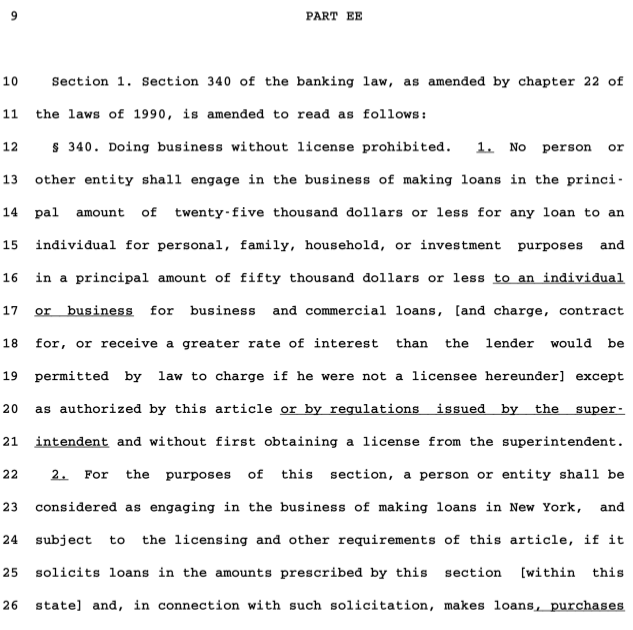
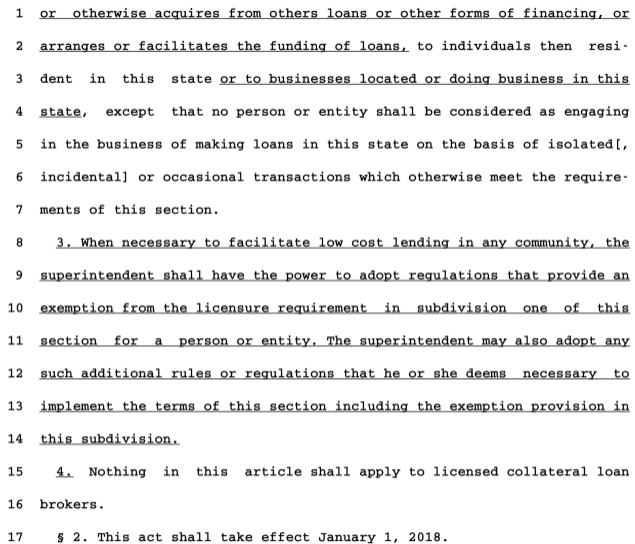
If it passes, the regulator tasked with overseeing that would be the New York Department of Financial Services. It would be effective January, 2018.
For consumer loans, it applies to loans $25,000 and under. For business financing, $50,000 and under.
If a Bank Made the Loan in California, It Doesn’t Matter What Happened Next, Federal Court Holds
January 27, 2017There’s no reason to examine whether a party intended to enter into a usurious loan if there is a constitutional exemption that permitted the lender to make the loan in the first place, a federal court in California’s central district ruled. In Jamie Beechum et al. v. Navient Solutions, Inc. et al, a student loan borrower argued that loans made by Stillwater National Bank and Trust Company, are a sham because the defendants who bought the loans from Stillwater (who were not a bank) originated, underwrote, funded, and bore the risk of loss on the loans.
Beechum asked the court to examine the substance and intent of the agreements between the bank and the defendants, which they claim were designed specifically to evade state usury laws. The court did not believe it was necessary to look beyond California’s constitutional exemption since both plaintiff and defendant agreed that Stillwater Bank was the lender. The complaint was therefore dismissed.
As a secondary defense, defendants had also contended that as a national bank, Stillwater was also exempt from state usury laws under the National Bank Act, but the court did not even have to consider that to arrive at their conclusion.
A good analysis of the case (including why buying a loan from a bank differs from buying a loan from a tribe) was written in Leasing News by Tom McCurnin, a partner at Barton, Klugman & Oetting in Los Angeles, California.
This So-Hot Robot Is Launching a Marketplace Lending Hedge Fund
January 26, 2017 LendingRobot has come a very long way since I first connected with them two years ago. Back then, CEO Emmanuel Marot was simplifying access to marketplace lending for individual investors by automating the decisions and executions. A year later, they were the first in the industry to introduce that technology via a mobile app. As someone who has used their service for a long time, one thing was always the same, the company helped you invest and monitor performance but they didn’t have custody of the actual money.
That’s all changing with the announcement of their new hedge fund (“LendingRobot Series“), which will actually be separate and only open to accredited investors. The fund is managed by LendingRobot’s robo-advisor technology which scores, invests, and even manages secondary market activity without any need for human advisors. Basically the robots are doing the heavy lifting and they’re only investing in loan marketplaces such as Lending Club, Prosper and Funding Circle. Because of that, the fund only charges 1.00% of assets under management, and caps fund expenses at 0.59%.
The way Marot tells it, they’re taking the mystery out of a hedge fund. There’s no “black box,” he says. Instead, the fund uses Blockchain technology to deliver a public, unalterable ledger, so that LendingRobot Series investors see exactly which loans the fund is invested, where the defaults are, and exactly what the costs are across the fund.
 One of the biggest allures of investing in marketplace loans in this fashion is the liquidity offered. Investors don’t need to wait 3-5 years to wait for the loans to fully mature to take their money out. Investor money is converted to Units of ownership in these Series that are issued on a weekly basis. By default, loans payments keep being re-invested and the Units value increases.
Marot said that the company only has 7 employees, yet they’ve managed to rack up more than 6,500 clients (myself among them) for their original service and have helped those clients deploy more than $120 million in assets along the way. They claim that they’ve been able to improve returns in alternative lending by more than 2.5%.
Founded in 2012, the company raised $700K in seed funding and $3M series A from Runa Capital.
As mentioned, LendingRobot Series is available to accredited investors only, and they’ll initially only allow 99 investors to participate in the fund with a minimum investment amount of $100,000.
Why Funding Circle Exited Spain
January 24, 2017
Funding Circle operates in the US, UK, Germany, and the Netherlands. Up until recently, they also counted Spain among its active European markets, but no longer. The timing is curious, right after the company raised $100 million through a round led by Accel, but upon a closer look, Spain was never really their thing to begin with.
“We inherited Spain following our acquisition of Zencap in 2015,” Funding Circle Samir Desai said. “We decided to pause new lending in June last year and we have now taken the formal decision to stop all new loans for the foreseeable future. We continue to invest in Europe in Germany and the Netherlands where we are growing fast, and expect to enter more countries in the future.”
Zencap was once said to be the fastest growing online lending marketplace in Continental Europe. In August 2015, Victory Park Capital had agreed to invest up to €230 million in loans originated by Zencap over a three year period. Funding Circle acquired them a mere two months after that, inheriting their operations in Germany, Spain and the Netherlands.
 “Funding Circle will continue working on behalf of all investors to service the existing loan book,” the company said. “In total €16 million of loans have been completed in Spain, which is approximately 0.1% of cumulative global originations. Alternative roles in the company have been offered to the team and the company will retain part of the team to service the existing loans.”
Ryan Weeks of AltFi, wrote of the decision to exit Spain, that it was a combination of limited awareness around P2P lending there and low quality loan applicants.
With more resources at their disposal now to focus on Germany and the Netherlands, the company also announced two new senior appointments. Thorsten Seeger has joined as Managing Director for Germany and Belkacem Krimi has joined as Chief Risk Officer for Continental Europe. Thorsten Seeger joins from Lloyds Banking Group, where he was Head of Financial Markets for SMEs and was responsible for driving and delivering access to financial markets for small businesses. Belkacem joins from GE Capital and brings extensive experience in credit risk and operational risk management, developed over 17 years across multiple countries in Europe and Asia. In his last role, he was the CRO for GE Capital France, based out of Paris – managing risk for over $10Bn consumer and commercial assets.
Desai, of Funding Circle, said, “We’re delighted to welcome Thorsten and Belkacem to the team. Both are hugely talented and have extensive experience and understanding of small business lending across Europe.”
But for now, it’s Adios to Spain.
New Regulations, Section 1071 of Dodd-Frank Among Them, Temporarily Frozen By Executive Order
January 23, 2017
Update 2/1/17: Disagreements abound over whether or not Trump’s recent regulatory freeze can affect the CFPB. According to the WSJ, part of this stems from the CFPB’s uncertain status as an independent agency after the the recent court decision in PHH Corp v. CFPB. “The CFPB is following a hiring freeze ordered separately by the Trump administration,” the WSJ states. This may be a signal that they do not feel totally insulated.
Section 1071 of Dodd-Frank had expanded Reg B of The Equal Credit Opportunity Act and granted the CFPB the authority to collect data from small business lenders. It’s all-encompassing considering that it oddly defined a small business lender as “any entity that engages in any financial activity.”
Although Dodd-Frank was passed in 2010 and the CFPB created in 2011, Section 1071 has been lying in wait. But just a month ago, the Federal Register said that its implementation was under way, with a pre-rule timetable of March 2017. “The Bureau is starting its work to implement section 1071 of the Dodd-Frank Act, which amends the Equal Credit Opportunity Act to require financial institutions to report information concerning credit applications made by women-owned, minority-owned, and small businesses,” it says.
And that work is no doubt a big undertaking, especially if it is really supposed to cover any entity that engages in any financial activity.
“The amendments to ECOA made by the Dodd-Frank Act require that certain data be collected and maintained, including the number of the application and date the application was received; the type and purpose of loan or credit applied for; the amount of credit applied for and approved; the type of action taken with regard to each application and the date of such action; the census tract of the principal place of business; the gross annual revenue of the business; and the race, sex, and ethnicity of the principal owners of the business. The Dodd-Frank Act also provides authority for the CFPB to require any additional data that the CFPB determines would aid in fulfilling the purposes of this section.”
Fear exists in the commercial finance community that the CFPB will use such data in a misinformed way to levy penalties and exert control over business-to-business transactions even though its statutory power is limited to just the collection of information.
Although the CFPB is still in the information gathering stage on Section 1071, the President’s regulatory freeze is likely only the first step of many to delay or dismantle their rules. And that’s at a minimum. Presently, the CFPB is faced with the threat that Trump will fire its director or abolish the agency altogether. There is strong support for this among Republicans, especially given that a federal court recently held that the CFPB’s structure is unconstitutional. In PHH Corp v. CFPB, the court offered two ways for the agency to come into compliance with its order, either reconfigure into a multi-member directorship or yield the director’s power to the President of the United States. Sitting CFPB Director Richard Cordray rebuffed the order as “wrongly decided” and declined both. His term ends in 2018.
The CFPB’s brash refusal to make concessions or accept court orders has made it a prime target of Trump’s administration. Because of the battles with the agency still to come, it is possible that Section 1071 may not begin to see the light of day for at least another four years.
The Leads Are Weak, Court Rules
January 21, 2017 One disagreement that has come out of the Argon Credit bankruptcy case is the value of the consumer loan leads that the company has in its possession. Argon argued that it has 300,000 leads worth $5.5 million based on its alleged cost to acquire them.
In a court filing, Fund Recovery Services, LLC (FRS), a creditor, called that valuation “absurd on its face,” explaining that these were prospects that Argon had already declined for a loan and that they had not been able to sell these leads previously. A representative for FRS testified that the leads might be worth somewhere between a 1/2¢ and 1¢ each, giving them a value of only $1,500 on the lower end.
Presented with two completely different valuations for the leads, one for $1,500 and one for $5.5 million, the court ruled that it did not find Argon’s valuation credible and could not attribute any significant value to the leads.
Argon had hoped to use the leads’ value as collateral to keep the creditor at bay so that it could continue to spend its cash while the proceedings play out. The bankruptcy has been changed from Chapter 11 to Chapter 7.
The court has yet to rule on the motion to preclude non-closers from drinking the coffee.
If You Don’t Make Loans, You’re Not a Lender (And definitely not a ‘direct lender’)
January 19, 2017 Small business owners in multiple states are arguing that the contracts they engaged in were loans despite the agreements specifying otherwise. In one case with multiple defendants that was filed two weeks ago in federal court, the plaintiff attached emails from the ISOs and funders they allegedly communicated with as evidence, several of which purportedly used the words “loans” or “lender.” That on its own might not be so bad except that the plaintiff entered into contracts for the purchase of future sales, in which case the words would not make sense.
While that matter and others will be litigated and decided on the merits, this should be a wake-up call for any ISO or funder that thinks the use of proper terminology is best left for lawyers and fine print in contracts. A court ordered recharacterization of a contract could have very negative consequences (if you want to know what kind, speak with an industry attorney).
Imagine working for a small ISO and one day being subpoenaed to do a deposition and potentially facing liability because of something you said on the phone or in an email. The easiest way to avoid this is to use the proper terminology at all times. If the product you sell or underwrite is a standard merchant cash advance (purchase of future sales), then it will never make sense to say loan, lender or any words related such as repay in any communication regardless of whether or not it’s with a customer or internally. Calling yourself a “direct lender” for example, is especially illogical.
If you’re at all confused, seek out your company’s manager or compliance officer for additional training. Another helpful resource is Merchant Cash Advance Basics, A certification course offered by CounselorLibrary and deBanked to help explain the differences between loans and MCAs. Given the challenges taking place in courts around the country, it’s never been more important to be knowledgeable on the products you offer.