

Sean Murray is the President and Chief Editor of deBanked and the founder of the Broker Fair Conference. Connect with me on LinkedIn or follow me on twitter. You can view all future deBanked events here.
Articles by Sean Murray

Ready to Trade ONDK and LC?
November 16, 2014 On November 10th, OnDeck Capital finally made their S-1 public. Immediate reactions from inside the industry were mixed. The bears criticized the years of losses while the bulls pointed out that the tide is turning. With a profitable 3rd quarter, OnDeck’s bet on the long game might finally be proving itself.
And without delving into their S-1 for now, the industry should be bracing itself for change. The mysterious world of daily funders (financial companies that deal in daily payments) is about to come under the scrutiny from another body, stock analysts.
Unlike journalists which have bruised the industry with sensational headlines and surface level criticism (high costs, light regulation), analysts will be tasked with truly understanding the fundamentals of nonbank business lending. Not to mention that everyday retail investors looking for an edge will want to learn more about the industry than what a single company’s quarterly financials will tell them.
Daytraders might make decisions based on melodramatic stories but those buying and holding for the long run will be conducting something that’s rarely taken place in this industry, research. Expect these questions to be asked and deeply considered:
- Who are OnDeck’s competitors? (and not just the top 3, but the hundreds that follow them)
- What are ISOs/brokers and how do they operate?
- How do they generate deal flow?
- What is Merchant Cash Advance and how is it similar or different to OnDeck?
- What is the real regulatory environment? (Because there are actually applicable regulations despite articles that say there aren’t any)
- Why does OnDeck collect payments daily?
- Why is OnDeck’s model so much different than Lending Club’s?
Look for the last bullet point to be explored greatly. If OnDeck and Lending Club are both innovative small business lenders broadly targeting the same market, why is OnDeck charging an average of 50% APR paid daily over 6 months and Lending Club charging as low as 5.9% APR paid monthly up to 5 years?
Their products couldn’t possibly be more different. And while Lending Club’s IPO path has curiously stalled, there is nothing to indicate that it will not proceed. That means we should expect comparisons between the two upcoming tickers LC and ONDK, a lot of them.
Details about commissions, closing fees, marketing practices, and transparency will be talked about in open forums by the general public. If it’s controversial, it will be debated. If it’s unique, it will be scrutinized. To an extent, OnDeck, Lending Club, and many of their competitors will cede control of their destiny to the general investing public.
There are folks in the industry giddy over the chance to buy and sell stock in both companies. They have years of experience on the front lines. But just as they’re gearing up to trade ONDK and LC, so too is everyone else.
Get ready for major change…








Merchant Cash Advance Risks and Myths
October 24, 2014 The Lend360 Conference in New Orleans last week had a different vibe from the five other conferences I’ve attended this year. For one, I was a partner in it through DailyFunder. And further, there was a huge focus on best practices, ethics, and regulations. Expert speakers and panelists aired it out to dispel myths and disclose risks.
Most telling about the future was a response from Victory Park Capital’s Brendan Carroll about whether or not he feared looming regulations could hurt the merchant cash advance and alternative business lending industry. As someone who has invested heavily in Kabbage and more recently in Square Capital, he expressed concern about regulations in general but clearly was not convinced they were on the immediate horizon for the industry.
Lisa McGreevy, president of the Online Lenders Alliance moderated the two-man panel which also consisted of John Hecht of Jefferies and she did a great job of digging out the true thoughts from one of the room’s most powerful investors. It’s unlikely a company like Victory Park Capital would invest hundreds of millions of dollars in an industry they believed faced imminent regulatory upheaval.
Merchant Cash Advance regulation is not on any regulator’s immediate agenda but they are doing their homework. At Lend360, it was revealed that several members of the North American Merchant Advance Association met with the Federal Reserve in Washington D.C. months ago for a Q&A. There’s communication occurring now on some levels. Even I’ve been contacted by the Federal Reserve to comment as a part of a broad research assessment.
Eventually I believe the CFPB will try to play a role in the industry through Section 1071 of the Dodd-Frank Act. We’re a long way from there though and it doesn’t mean they’ll be successful. Even internal operatives have expressed doubt on business-to-business jurisdiction.
In the meantime, it’s not all blue seas and sunny skies. Robert Cook, an attorney at Hudson Cook, LLP explained at the conference that the industry is already in many ways supervised by the FTC. And with the FTC, it’s not a question of how high the costs are, it’s about how transparent those costs are. If they’re high, fine, but do the customers understand them and are they marketed accordingly?
Terms like guaranteed, 99% approval rate, and lowest rates can be deemed deceptive if not true.
 Transparency, ethics, customer experience, that’s what people in the business need to be focused on right now. Stacking, while a polarizing topic, seems to be a matter of contract law. Everybody’s caught up in the stacking debate believing it’s the lightning rod that will attract regulation. If left unchecked, it might draw interest, but it’s the fundamentals that get overlooked that could draw the ire of an agency like the FTC.
If your marketing says “rates from 1.10 and up”, while actually contracting 99% of your customers with 1.49s, that’s something you’ll probably want to address now. Think about the net cost your customer is likely to be charged. If a 1.10 is a buy rate and there’s a 10 point upsell, a 10% closing fee, and 10% origination fee that makes the end cost closer to a 1.40, you probably don’t want to market the cost as 1.10.
Right now it all basically comes down to doing good business in a transparent manner. Costs may be high but explain those costs, make sure the customers understand them. Don’t be deceptive. There will always be critics of high costs, but rational people are being exposed to the sober reality that you can lose money even at a 50% interest rate.
As a word of advice for new ISOs and brokers, stay away from funding companies that don’t even have a paid email account. If a funder is too financially strapped to afford a web domain, they probably are going to cut corners in other places too. The story about working off a gmail or hotmail account in the interim while they try to get their website set up is indicative that they’re getting ahead of themselves. There are way too many solid funding companies to choose from for you to entertain doing business with hotFunding4ISOsNow@hotmail.com. Even middlemen are accountable in the grand scheme of best practices and the customer experience.
Fund intelligently…
– deBanked
Also read:
4/11/14 Regulatory Paranoia and the Industry Civil War
8/13/14 Should Licensing and Accreditation come to Merchant Cash Advance?
Did Google Penguin Hurt Your MCA Website?
October 22, 2014 Google struck again late on Friday the 17th with a refresh of the Penguin Algorithm. As posted on Search Engine Roundtable, the algorithm is still rolling out and will continue to do so over the next few weeks.
Those familiar with Penguin know that it targets backlinks, specifically: paid links, spam links, bad links, the whole gamut. Hit the trigger and your site can virtually disappear from search.
I monitor several keywords in our niche and I haven’t noticed much of a change between what I see now and what I saw prior to the 17th. Truthfully, some of the companies I see popping up now in the first 2 pages are exactly the type of companies I’d expect to see on a list offline. That’s a good indicator that something is going right.
The exact search results are different for everyone but amongst the top 20 results for the search term merchant cash advance, I get:
- OnDeck
- Kabbage
- AmeriMerchant
- Business Financial Services
- Capital for Merchants
- CAN Capital
- Merchant Cash and Capital
- Retail Capital
Years ago through spam manipulation, the first few results were dominated by random lead generation sites like fastcashfunding4unow.com. I see very few sites like that these days ranking well.
If you were wondering where your organic site traffic went in the last week, there’s a good chance you got Penguined. Good luck getting out of that!
Keeping Lending Club (and others) Honest
October 19, 2014 Now that institutional money is flowing into the alternative lending industry, some retail investors are starting to express concern that the rules are changing. Lending Club for example is no longer considered a peer-to-peer lending platform, but rather an online credit marketplace.
Investors don’t exactly make loans to individuals in that marketplace, but that’s sort of how the concept began. Today, a bank issues the loan to the borrower, Lending Club buys the loan and creates a note tied to the performance of the loan, and then sells that note to investors.
Lending Club holds all the power and that worries retail investors who believe that the company is not always forthcoming about what they’re doing. It’s not easy to find dissenting voices when the market is growing rapidly especially since the media is cheering the revolution on.
But in the back corners of the Internet there are groups of investors growing suspicious, if not downright paranoid that all is not right in Lending Club land.
On Peter Renton’s Lend Academy forum for example, healthy discussions are being replaced by collaborative investigations into Lending Club’s practices. As a retail investor myself, I can’t help but be drawn to it. Below is a list of some of the issues:
The Borrower Member ID number is never reused
If a consumer borrows money from Lending Club in 2013 and again in 2014, it would probably be useful for investors to know about the previous Lending Club loan. Instead, borrowers are issued additional Member IDs with each successive loan, masking the history of past loans.
Borrowers may be taking two loans simultaneously
Acknowledging that Member IDs can never be reused, curious retail investors used other data points disclosed by Lending Club to link borrowers together. They believe they discovered a number of borrowers who got two Lending Club loans back-to-back, sometimes within days of each other.
The concern here is that the borrowers were taking on much more debt than the investor was led to believe. For instance, an investor might feel comfortable with the borrower taking a $10,000 loan, but has no idea that another $20,000 is being issued to them days later under another Member ID number.
Whether or not this is actually happening and the scale of how often it is happening is tough to say, but a little detective work by others indicates that it has possibly occurred.
What happens if Lending Club goes bankrupt?
While a poll with so few responses (52 total) on the Lend Academy forum may not be statistically relevant, 75% of the respondents claimed to be concerned in some capacity that Lending Club has no Bankruptcy Remote Vehicle for retail investors. 21% said they were extremely concerned. Absent a BRV, a Lending Club bankruptcy endangers all retail investors from getting paid regardless of whether or not the borrowers are actually paying their loans.
Anil Gupta, the founder of PeerCube wrote the following on the Lend Academy forum in response to the BRV issue:
You are not alone. I am also in the extremely concerned category when it comes to BRV for LC. This segment has been wild-wild west and reminds me of combination of dot-com bubble in 1999 and housing bubble of 2007. Overall, I am very concerned with platform risks.
Premature IPO attempts by p2p platforms is also concerning. I am taking that as indication of founders, VCs and early employees want to cash out and exit while the market is hot. They may be seeing the growth reaching a plateau and increased competition. I believe we will see a lot of shake out when interest rate start to rise. Potentially stepped up government regulations of p2p platforms once investors lose money.
Startup woes?
Retail investors, particularly those that have deployed a substantial amount of their capital in Lending Club notes gripe that sometimes the financial reports they get are missing data, experience glitches, or are just totally wrong. While usually resolved to everyone’s satisfaction, as a seven year old company, one might expect for Lending Club to be much more careful at this stage in the game. With an IPO in the works at this very moment, they should be way past problems such as data in the downloadable files not matching the website.
New fees
In August, Lending Club announced they would begin charging investors 18% of the delinquent amount recovered if the loan is at least 16 days late and no litigation is involved. When investors pushed back, it turned out that was always their written policy, they were just waiving it for everyone’s benefit until now.
While the move means a few more dollars out of every investors pocket, it was noticed that loans that have been restructured at the borrowers request are not marked as current for the duration of the payment plan even if they are in fact current on the payment plan itself. So when loans get restructured, Lending Club begins taking 18% of every payment as if it were a continuing collections problem.
From a firsthand perspective, I had several loans entering into payment plans almost immediately following the issuance of the loans. Basically the loan would be issued, the borrower would make their first payment, they’d plead hardship, go on a payment plan, and then Lending Club would begin deducting 18% of every payment going forward.
In these situations, our interests are not aligned. By entering a payment plan, not only is the amount the borrower is paying monthly reduced, but 18% of each of my payments now belongs to Lending Club instead of me. Basically, the appearance that Lending Club has a personal incentive to place borrowers on a modified plan at my expense and without my consent is a conflict worth monitoring.
Automated Investing under delivers?
For those with too much money or too little time to choose notes to buy themselves, Lending Club offers Automated Investing, a program that will automatically buy notes within parameters you set when they become available. The draw back is that the filters are limited and some investors are complaining that they’re ending up with notes they never would’ve bought manually.
WebBank woes
On October 6th, Lending Club announced that investors would have to sacrifice several days worth of accrued interest to WebBank, the bank that issues the loans for Lending Club.
Citing the move as necessary to keep Lending Club robust in a changing environment, the run up to the IPO has had some investors feel like they are suddenly being nickel and dimed.
Refinanced
Not that this is necessarily bad, but there’s evidence that shows Lending Club is encouraging its own borrowers to refinance their loans to a lower rate. If they do it, it results in the original note being paid off. The payoff returns the cash to the investor who then may have to wait two weeks or more to put that money back into a new note.
It must be said that any time I’ve published a gripe about something Lending Club is doing, my account representative there has called me to try and resolve it. That’s surprisingly good service!
But while I feel safe enough about my investments now to keep them there, there’s nothing wrong with reminding Lending Club and all of the other disruptive financial companies out there that investors are watching their every move.
As long as they have your money, it’s healthy to keep them honest.
Merchant Cash Advance SEO War Still Raging
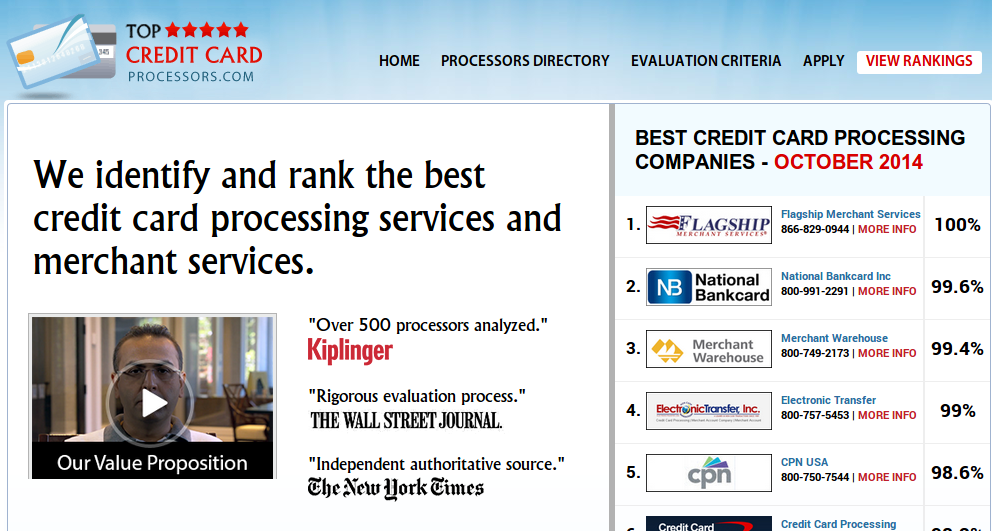
October 9, 2014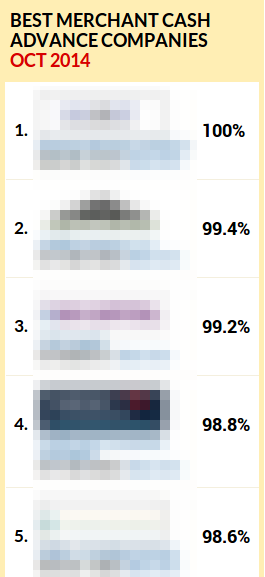 The top ten merchant cash advance companies ranked on a review website must have earned their placements due to actual reviews, right? Not so, say rival online marketers who’ve claimed sites such as topcreditcardprocessors.com are really just part of an elaborate paid lead generation scam.
Mark Jackson, a blogger and marketer, had alleged that a website known as TopSEOs.com had been using deceptive practices for years. Three weeks ago a former employee of TopSEOs.com emailed Jackson to offer damning information that his suspicions had been right. That included a list of 15 other websites related to TopSEOs.com that were running similar review schemes. All are apparently owned by an individual named Jeev Trika.
While I don’t know Trika or if the allegations are true, I do know from what Jackson wrote is that he forwarded the email chain and the website list to Google’s director of web spam, Matt Cutts. That included topcreditcardprocessors.com
In recent years, Google has taken aggressive action to de-rank and de-list sites engaged in bad behavior from their search index. One example of bad behavior is a site that provides a poor user experience. Deceiving users into believing that businesses had been reviewed and ranked accordingly is deceptive if the true model is just about who pays the most to get ranked the best.
In New York State, fake reviews can be a criminal offense. Just ask the 19 companies that were ensnared in a deceptive review sting last year, causing them to be hit with $350,000 in penalties.
In addition to credit card processors, topcreditcardprocessors.com also ranked merchant cash advance companies. What’s rough is that all of the websites Jackson submitted to Cutts have been de-listed from Google’s search index, indicating that Google likely concluded those domains violated their Terms of Service.
 Jackson pointed out that Trika, the mastermind behind it all, was already taking measures to get back up and running in Google’s search index by moving from TopSEOs.com to TopSEOsGlobal.com. Similarly, topcreditcardprocessors.com has already moved their content to topcreditcardprocessorsglobal.com. All their first page search rankings have been lost for now so that probably means fewer leads for many companies over the next few weeks.
Of course there are a few similar websites to topcreditcardprocessors.com that purport to review merchant cash advance companies. The risk if they’re shut down is not just a loss of leads but a potential loss of trust by search engines for anyone that paid to appear on them. Google treats sites participating in link manipulation schemes unfavorably and has expanded the scope of how these schemes are defined a lot in the last twelve months.
@financeguy74 I like the full-size Penguin in the doorway–I think we have one of those!
— Matt Cutts (@mattcutts) September 30, 2014
Unless you’ve been in a coma, Google’s Penguin algorithm specifically targets websites engaged in link schemes. It’s uncertain if paid links on review sites like these would be covered under Penguin, but Penguin’s 3rd major run is expected to roll out any day now.
Google’s director of web spam has a good sense of humor when it comes to Penguin jokes, but Cutts is known to be absolutely ruthless when he discovers actual terms of service violators in their index. Back in December, Cutts articulated that he wanted to break their spirits. As quoted on Search Engine Land, he said:
if you really want to stop spam, it is a little bit mean, but what you want to do, is sort of break their spirits. There are lots of Google algorithms specifically designed to frustrate spammers. Some of the things we do is give people a hint their site will drop and then a week or two later, their site actually does drop. So they get a little bit more frustrated.
Just emailing Cutts evidence of manipulation is enough to put offending sites out of business or at least out of reach from Google searchers. That is what Mark Jackson appears to have accomplished by forwarding an email chain referencing TopSEOs.com and other sites.
A screenshot of the home page of what is now topcreditcardprocessorsglobal.com below:
Review sites might be one way companies are generating leads online now, but check out some of my historical coverage regarding the war for Internet leads in this space:
Six Signs Alternative Lending is Rigged: Do Lending Club and OnDeck have a helping hand?
Google Penguin 2.1 takes swing at the MCA industry
Your merchant cash advance press release may be hurting you
Is Google your only web strategy?
The other 93% [of leads]
The SEO War for Merchant Cash Advance: The first story on this topic
Rapid Capital Funding Acquires American Finance Solutions
October 8, 2014 Miami, Florida-based Rapid Capital Funding will acquire Anaheim, California-based American Finance Solutions today in perhaps one of the most significant deals in merchant cash advance history.
Rapid Capital Funding, not to be confused with RapidAdvance, is led by the company’s founder Craig Hecker. Hecker and AFS’s CEO Scott Griest broke the news to me on a call together. “It’s a roll-up,” Griest said. AFS will continue to operate under their brand name for the time being and Griest will remain a leader in the company.
Meanwhile, the operations of the two companies will begin to merge, with Hecker confirming already that their head underwriter, Andrew Hernandez, was in California getting up to speed on AFS’s operations.
The news comes less than five months after American Finance Solutions struck an equity deal with CapFin partners. I am unsure if CapFin is still involved in the company.
 Griest and Hecker were both excited about working together. “Griest has done a great job managing the sales partner channel,” Hecker said. Griest will continue to develop those relationships for the company.
This is the first major merger in the industry. Historically, just about all of the equity deals in merchant cash advance have been acquisitions by institutional investment groups. This is a consolidation.
RCF, while based in Miami, has an office in New York City. The AFS deal puts them on the ground in the 3rd major industry hub.
The two executives hinted that this deal was just the beginning.
OnDeck Already Filed Form S-1
September 27, 2014 Back on August 14th, the Wall Street Journal reported that OnDeck was preparing to file for an initial public offering. Since then, industry insiders have been bustling with anticipation to see the S-1 filing, the document that would reveal once and for all their true financial standing.
Update 11/18/14: Click to see OnDeck’s Public S-1 Filing
In between then and now, Lending Club, their rival in the business loan market, filed their S-1 on August 27th. The peer-to-peer lending world went nuts and merchant cash advance veterans such as AmeriMerchant’s David Goldin were asked to comment on BloombergTV.
And then… things quieted down. OnDeck went radio silent on August 14th, despite the SEC requiring such only after the S-1 form had actually been filed. Speculation began to build as to whether or not the WSJ report in August was a false alarm or misinformation. And with no word from the industry’s beloved charismatic superstar Noah Breslow, something seemed to be amiss.
And then the Financial Times dropped the bombshell that the registration documents had already been filed… last month… confidentially.
Admittedly, I didn’t even know a company could file confidentially, a process done offline so that it is not recorded electronically. Thanks to the JOBS Act, companies with less than a billion dollars in revenue can submit draft versions of their registration documents to the SEC, allowing the SEC to review, revise, and agree on a final version that will ultimately have to be made public. The takeaway here is that an OnDeck IPO is in the process and the registration documents will eventually be released. The law states that OnDeck must make the documents public at least 21 days prior to pitching investors.
The New Yorker walked readers through confidential registrations back when Twitter was planning their IPO, noting that it was not uncommon to choose this method, “Twitter is much like its peers: most small companies that have gone public since the passage of the JOBS Act have filed their S-1s confidentially,” the New Yorker said.
So why be secretive? The New Yorker continues to explain:
From the perspective of companies, the new rule has a couple of virtues. First, it allows companies that are thinking about going public to test the waters—they can gauge investor reaction, get feedback from the S.E.C. on their filings, and so on—before deciding if they want to go ahead with an I.P.O. If a company goes through that process publicly, and then decides to abandon the offering, its reputation gets damaged, even though it often makes sense for a company not to go public. Do it privately, and no one gets hurt.
-Source: http://www.newyorker.com/business/currency/the-virtues-of-twitters-confidential-i-p-o-filing
OnDeck’s biggest critics are their competitors, naysayers convinced that they are recklessly undercutting pricing to acquire market share. Indeed FT reported that OnDeck posted annual losses of $16.8m and $24.4m in 2012 and 2013, and losses of $14.4m in the first half of 2014.
 With $1.3 billion funded since 2006, an independent report cited in the registration by Oliver Wyman estimates the untapped market to be between $80 billion and $120 billion.
There’s plenty of runway left, but OnDeck has yet to turn a profit. In An Insider’s Perspective, I wrote, “What scares their competitors though, is that this strategy has been intentional. Very few if any players in the industry have had the luxury, guts, or the purse to lose money for seven years as part of a coup to conquer the market.”
If the IPO goes through, we can all place actual monetary bets on the company’s future. What a trip that will be. I expect the stadium of insiders to get loud once the public documents are released. Good luck OnDeck.