
Sean Murray is the President and Chief Editor of deBanked and the founder of the Broker Fair Conference. Connect with me on LinkedIn or follow me on twitter. You can view all future deBanked events here.
Articles by Sean Murray

Confessions of a Bitcoin Miner
December 18, 2014If you’re even vaguely familiar with Bitcoin, you’ve probably heard that you can mine them. It’s one of Bitcoin’s most unfortunate pieces of jargon because it sounds like a scam. We can’t mine U.S. Dollars so there’s no frame of reference for what enthusiasts are talking about. We can mine gold and silver of course, but how the heck can one mine a digital currency? It’s clear there’s more to Bitcoin than just being a form of money and that frightens people. It certainly frightened me.
 The first time I imagined bitcoin mining, I pictured sentinels from The Matrix drilling down with unrelenting intensity towards the last human city of Zion. Perhaps the humans were hoarding a vast trove of valuable bitcoins and a war was being waged to achieve digital hegemony. Like Ray in Ghostbusters, I couldn’t help it. The thought just popped in there.
The next thought was that I better stay away from Bitcoin. It was easier to take the blue pill where “the [Bitcoin] story ends, you wake up in your bed and believe whatever you want to believe.” That’s what many consumers have done in the past. And who could blame them? I liked my life without Bitcoin in it, so why mess it up?
But the maniac I am, I took the red pill and explored just how the deep the rabbit hole goes.
I mined some bitcoins and the machines didn’t kill me, at least so far. I’m mining them right now as I type this. If you’re getting excited that I’m about to tell you that I’m getting rich while you fools sit on the sidelines, you’re going to be disappointed. There is no actual mining. It’s just slang for facilitating bitcoin transactions over the Internet. Womp womp. If people weren’t sending bitcoins back and forth, then there would be nothing to facilitate and therefore nothing to mine.
 To illustrate simply, I’ll start off by reminding you that Bitcoin has no central authority. There is no Visa, no banks, and no Federal Reserve to sign off on a transaction. Instead Bitcoin transactions are validated by computers connected to the Internet running free Bitcoin software.
If I have 5 bitcoins and I send 3 to you, computers all over the world running this software are processing algorithms to validate this and make them permanent in a global ledger. The computers make sure you really have those bitcoins to send and then transfers them. You can’t create a fake bitcoin or spend one you’ve already spent because the Bitcoin system will know about it.
On just a single day there are nearly one hundred thousand bitcoin transactions. That’s too much for just a few computers to handle, not to mention that the processing power required to validate them is intense. Validating transactions requires lots of processing power and utilizing processing power has a cost in electricity.
So it pays
The Bitcoin system has a built in reward system to incentivize people around the world to keep the system in order. If your computer achieves a specific milestone while facilitating transactions, you are rewarded with bitcoins. Again, don’t get excited. These milestones are extremely rare to reach and totally random (for the record it’s called solving a block). You could facilitate transactions for 200 years and never get any bitcoins back as a reward.
But while random, it’s a probability game. The faster your processing power, the better your odds of being the lucky computer to receive the reward. That’s a necessary but unfortunate component to Bitcoin because there’s a built-in arbitrage opportunity. Why be a passive facilitator when you could arm your computer with a faster processor and rig the odds in your favor? If your computer was significantly faster than the other ones on the network, you could potentially get rewarded bitcoins often enough and with enough consistency to cover both the cost of your upgraded computer and the electricity to keep it cranked up.
And with that understanding, an international arms race began for increased processing power. Up until early 2013 you could quite easily profit from being a facilitator. Those folks didn’t see themselves as facilitators anymore but as miners. It wasn’t a passive activity. It was a business, like hauling ore out of a silver mine.
Today, so many people have tricked out their processors that it’s nearly impossible to get an edge. In fact, mining often results in losses. I have experienced a net loss in actual U.S. dollars through mining even though I’ve acquired fractions of bitcoins. Net loss? whuh?!
Forget about using your desktop or laptop to mine bitcoins. That’s so 2011. Engineers went on to build special hardware chips much better than household computers that do nothing other than process calculations for bitcoin transactions. Then came small boxes of chips, then large ones…
And when everyone started buying large bitcoin processing boxes, they began to buy two or three of them…
Then a stack of them…
Then a room full…
Then a warehouse full…
And of course a lot of additional money had to be spent on cooling, ventilation, and protecting against fires.
This is where a little problem started. Once everybody was using a million dollars worth of specialized hardware for speed and was spending tens of thousands of dollars per month on electricity, the edge was constantly being neutralized. Worse, the frequency that bitcoins are awarded per day does not increase. There will only be 21 million bitcoins ever placed in circulation. They’re awarded through mining at a fixed frequency. You can try to be the recipient of each reward but the frequency of which they’re awarded doesn’t increase.
Bummer for those that have amassed nuclear arsenal sized mining operations.
But also bummer for me. This is the extent of my mining equipment.
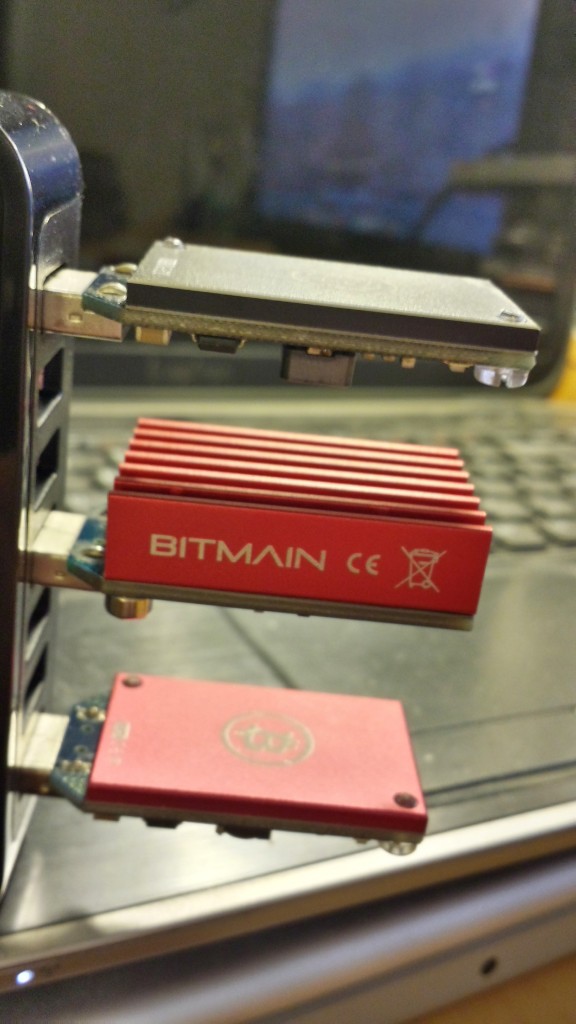
I have three small mining chips all connected via a USB strip. The outer pieces are ASICMiner Block Erupters and between them is a Bitmain Antminer U2. They run 24/7 connected to my home laptop. I can monitor their activity through this little window on my screen:
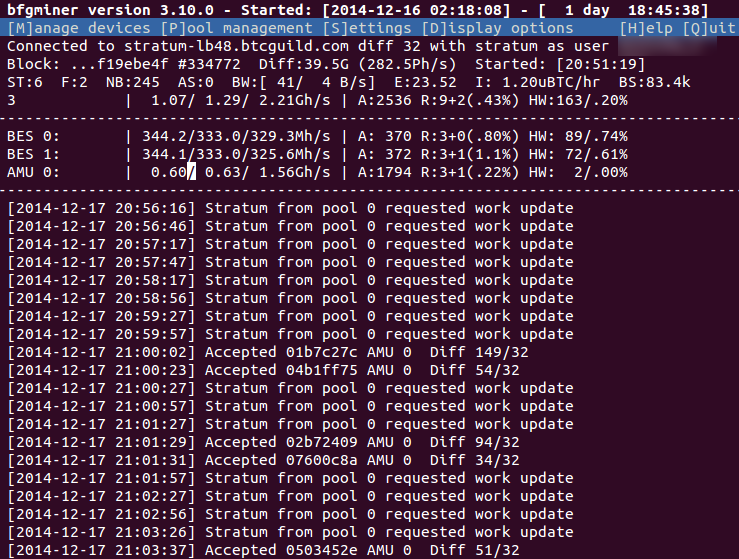
Combined they are crunching out an average of 2.2 Giga hashes (GH/s) per second, a speed so insignificant compared to the network’s competition that I will probably die without ever receiving a reward of bitcoins.
Unless…
Join forces
There’s a trick to mining to ensure you don’t die rewardless. You can combine your processing power with other miners and leverage your chances. Then if the group’s effort yields a reward, it’ll be distributed on a prorated basis. Someone got this idea a long time ago and in today’s ultra competitive environment, it’s practically a must.
They’re called mining pools. Pools aren’t just a couple of friends, they’re nearly small cities of miners working together collaboratively. The pool I mine in (BTC Guild) has 14,000 to 16,000 users mining together at any one moment and a single user could have an entire warehouse full of mining equipment. In the last hour, the fastest user provided 1,047,666.38 GH/s worth of power to our pool. That’s 476,211x more than what I contributed and he is just 1 of 15,000 users in our pool. woah!
What’s even more wild is that BTC Guild only makes up 5% of the world’s Bitcoin mining power. And yet because I am part of that pool I am paid a prorated amount for every reward the team earns. Surprisingly, that number is not zero. Running 24/7, I am earning an average of 60,000 satoshis a month.
The exchange rate of Bitcoin is extremely volatile but at this moment 60,000 satoshis is equivalent to 19 cents. Yes, 19 cents per month!
And don’t forget that the mining chips cost money to buy and running them 24/7 runs up more than 19 cents worth of electricity used. This means Bitcoin mining isn’t about getting rich. I’m losing money mining. It’s a hobby or benefit conferred upon the digital currency system to keep it running smoothly and accurately. Well at least for me…
Remember that miner that’s out-processing me on a scale of 476,211 to 1? He’s earning about $90,000 per month. I don’t know what his expenses are to run an operation like that but I’m sure it’s not cheap. His biggest enemy is that the value of Bitcoin to the dollar has fallen pretty heavily this year. $90,000 a month in revenue could become $45,000 a month just through exchange rate risk. Those are pretty high stakes to gamble with. But it could also become $180,000!
And whether the big players like that mine or don’t is irrelevant. Whether he makes money or not doesn’t matter. Arbitrage opportunities in the facilitation of transactions is for ultra geeks with big bucks. Mining as a hobby is for regular geeks. It’ll cost some money to do but you get to contribute to a system you believe in.
As for you, the potential average currency user, mining is not really of any consequence. The facilitation of digital transactions already happens with dollars, euros, and pounds. In My Journey to Bitcoin, I explained that buying a cup of coffee with a credit card requires 8 people to get paid for the transaction. Sure the process is completely different for Bitcoin but so what? Bitcoin is unique.
The problem is the mining terminology. It should be called facilitation but that doesn’t sound sexy especially if you are trying to convince an investor to give you $1 million to take advantage of potential arbitrage opportunities on the network.
And that’s about it. The real story behind mining isn’t so scary and you won’t necessarily be at any disadvantage if you still have no idea what the hell mining is. Bitcoin is full of technical nonsense best left to geeks, but you as an actual currency user do not have to worry about a lot of it.
If you’re at all like me though, obsessively curious about how things work and excited to try them out, I’m happy to clue you into the mechanics of mining and even get into the finer details behind it.
An ASIC Block Erupter costs about $10 on Amazon or eBay. I run Ubuntu Linux as my native desktop OS at home (geeky I know) but you should be able to do it with Mac or Windows. The mining software I use is BFG Miner 3.10 and I use BTC Guild as my pool. Admittedly, I am waiting for a delivery of two more Antminer U2s (5x faster than the Erupters but just as cheap) and a delivery of two Antminer U3s (210x faster than the Erupters). I will in all likelihood not achieve a profit even with the additional equipment. And that’s okay, it’s enjoyable just messing with the gizmos.
The best way to learn about Bitcoin is to try it yourself. Hey maybe you’ll hate it, but at least it’ll be based off experience. You can buy fractions of a Bitcoin, even just a few dollars worth from Coinbase. From there you can shop online, convert them back to cash, or send them all to me. 😉
I’m not afraid to say that I mine bitcoins, even if it’s infinitesimally small amounts. What else did you expect from a guy running the deBanked website?
I put my bitcoins where my mouth is. If you’re into alternative finance too, it’s finally time you gave in and tried it.
Through OnDeck Capital, An Industry Wins
December 16, 2014 Call it merchant cash advance, non-bank business lending, or financial disintermediation. Whatever floats your boat. On December 17th an entire financial methodology will be validated, the daily repayment method. Daily payments don’t exist anywhere else in lending but ’round these parts it’s the standard. It’s what makes unbankable businesses bankable.
OnDeck is a lender. They target small businesses. The costs are high. Anyone could feasibly do those things and plenty are doing them, but only a certain segment of fintech companies utilize daily payments and most of those are merchant cash advance companies. OnDeck is a lender but like it or not their core repayment mechanism overlaps with an industry well known for being even more expensive.
Daily payments are so unique and so revolutionary that it hasn’t sunk in to the masses yet. Even the press glosses over this fine detail to instead dwell on things like APRs and social media’s role in approvals. Daily payment and daily repayment look like tech jargon, some kind of code for a backend computer process to hotwire an anomalous rate algorithm.
Daily payments mean borrowers have to make payments every single business day. It’s daily, get it? If the sun rises and it’s not Saturday or Sunday, it’s time to make a payment. I’m not saying there’s something wrong with this. I’m a proponent of this mechanism. It works for business owners that struggle to make a single lump sum payment each month and it works for lenders who need to mitigate and monitor their risk as much as possible.
 I feel it’s better to know there was a problem that started yesterday than to learn there was a problem that started 29 days ago. That’s how OnDeck thinks too. And business owners can incorporate the daily deduction into their normal business operations instead of fretting to cover the balance for a big debit the day before a monthly payment is due.
This isn’t just a theoretical design that can’t function in practice. It’s been working for lenders and factors since AdvanceMe (Now CAN Capital) started doing it in 1998. The daily payment methodology has survived the Dot Com Bust and the Great Recession. It’s grown to a $3 – $5 billion a year industry. By some measures, it’s taken a hell of a long time to go this mainstream.
But it’s here. The press will call OnDeck a lender, a tech company, or a combination of both. They’re a sign of the times but they are unique in that they will show the world that daily payments have a place in the modern economy. With OnDeck leading the way, traditional lenders may consider leveraging their methodology to serve categories of risk they usually shy away from.
I’ve never heard of a business credit card that required payments to be made every day. Some might think that defeats the purpose of credit. OnDeck proves it doesn’t. And 100+ merchant cash advance companies serve as a secondary validation. Perhaps there are lenders that have considered a daily payment system previously and feared the political or legal environment was too risky. But OnDeck is making no apology about what they’re doing or how they’re doing it. They’re putting themselves on the open market, surrendering themselves to total scrutiny.
 CAN Capital is gearing up to follow them, the pioneers who first experimented with daily payments 16 years ago. And while OnDeck bemoans their loan program being compared to merchant cash advance, CAN is made up of two departments, one of which is undoubtedly a merchant cash advance service provider.
And there you have it. It’s not all about algorithms or tech or using facebook activity to judge a borrower. Those are old ideas now. OnDeck smashes down the door with something completely different, something that nobody is even talking about, daily payments.
December 17th is Wednesday and just about all of OnDeck’s borrowers will be making a payment. A good many of them won’t even notice. That’s the great part about layering it in as a daily cash flow expense. There’s no worrying about it at the end of the month. If they underwrite the borrower financials well enough, it should be completely painless. That’s not always the case, but it’s the goal.
You can’t possibly understand OnDeck until you understand daily payments. With this IPO, an entire industry wins.
How to Use Bitcoin
December 8, 2014 The best way to get comfortable with bitcoin is to just try using it yourself. Even though there are many technological, mathematical and confusing layers to bitcoin, the currency aspect of it is by far the easiest to use and understand.
With that said, here’s how you can dip your toes in and become a big bitcoin kahuna:
1. Open an account on Coinbase.
2. You will need to buy/exchange bitcoins using your regular currency such as US dollars. To do this you will need to connect your bank account to Coinbase. This is what I did. Also it will ask you to enter your cell phone number for two-factor password authentication to prevent hacking.
3. Decide how many bitcoins you want to buy. I bought 1 whole BTC but you can buy fractions of 1 if it makes you feel comfortable. Choose whatever amount you want. You can always buy more or sell your bitcoins back into dollars.
4. Bitcoins will be deposited in your account. Coinbase will store them for you along with the private key to use them. You can choose to export your bitcoins but you don’t have to. I keep mine at Coinbase.
5. Shop anywhere that accepts bitcoin. I shopped at overstock.com.
6. On overstock.com, I selected the item I wanted and placed it in my shopping cart. For payment method, I selected bitcoin.
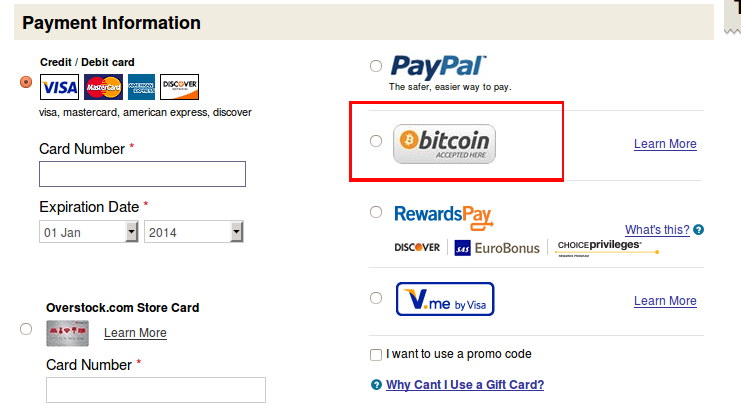
7. There are two ways you can initiate the bitcoin payment to overstock:
— A. Manually send bitcoins to the address provided. A random receiving address is created for each transaction.
— B. Use your Coinbase wallet (the option on the left. This is easiest and what you should do)
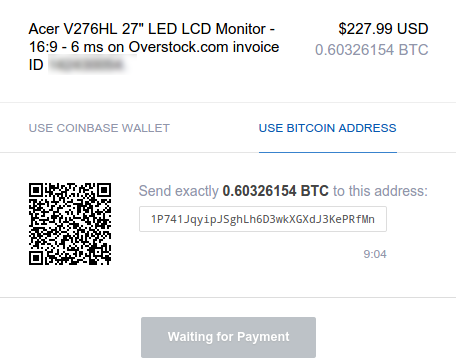
8. If you used option B above, Coinbase will automatically transfer the bitcoins to overstock.com and your order will be placed instantaneously.
All finished. You’ve officially joined the world of bitcoin!
—————–
Need to send a payment manually? It’s easy!
1. Log on to Coinbase.
2. Click “My Wallet” on the left hand side.
3. Click “Send”

4. Make sure you know the recipient’s bitcoin address. If you are making a payment to advertise here on debanked.com, this is an address I will supply you with. Some parties create a unique receiving address for each transaction but they can be reused.
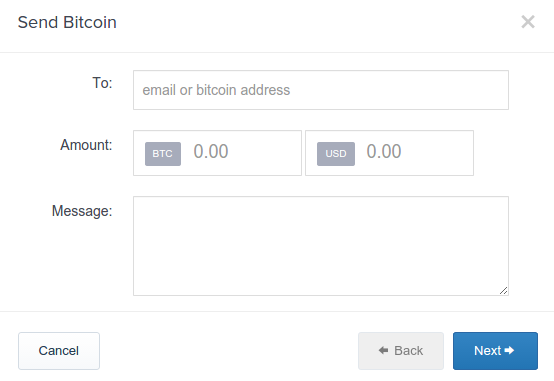
5. Internet connected bitcoin miners around the world will automatically facilitate the transaction. This should take about 10 minutes at most. There is nothing you need to do other than wait for the receiving party to confirm. It is impossible for them to deny receipt of the bitcoins as all transactions are verified and public in the Bitcoin Blockchain.
All finished. You’re now a pro!
Getting in on the ONDK and LC IPO
December 4, 2014According to Investopedia, “Getting a piece of a hot IPO is very difficult, if not impossible.”
The Motley fool says:
If the bankers think a stock will soar, they earmark much of the shares for their favorite institutional clients (ones that bring in the most in commissions). In a sense, brokerages use lucrative IPOs to curry favor with big clients, to win and retain their business. When brokers aren’t so confident about the company’s prospects, they will try to sell the stock to less-favored institutional clients.
Admittedly these are generalities, not unyielding truths.
But when Lending Club mass e-mailed all their platform lenders on November 17th that they would be rewarded with a chance to get in on the IPO, people got excited. They wouldn’t just automatically get stock though, they’d be given the chance to buy it. An allocation was not guaranteed and a limit as to how much was not immediately disclosed, though it was recently revealed that platform lenders could buy up to a maximum of 350 shares.
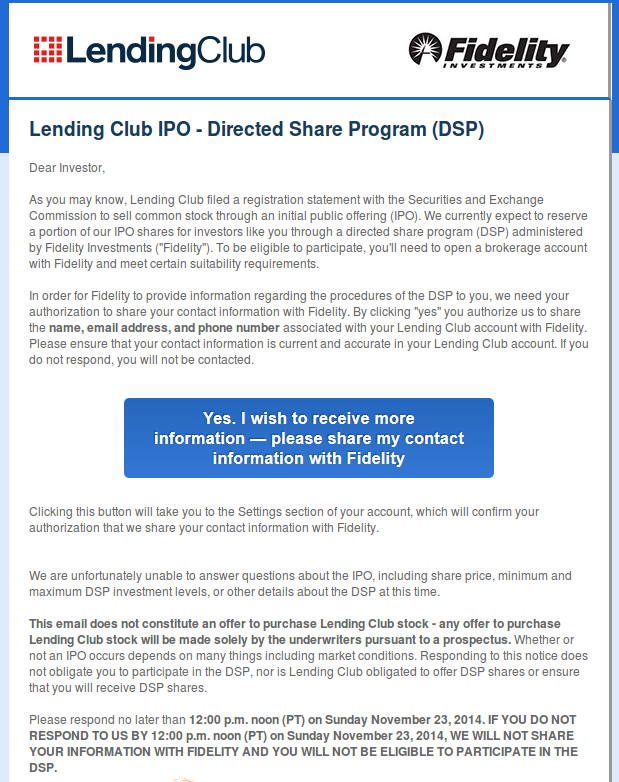
At $10-$12 a share, that’s an opportunity to spend a max of $3,500 to $4,200 on the IPO. Getting in won’t make you a millionaire but it’s a little way for Lending Club to say thank you to all those who invest on their platform.
I got the offer and turned it down. I’m very bullish on Lending Club stock but I feel like I’m already invested enough in them as a company through platform lending to need to get even more in. For those not sure how Lending Club really works, their system is not actually peer-to-peer. Investors buy Lending Club notes that are tied to the loans they issue. You are ultimately only investing in Lending Club with every note you buy. You have no relationship or claim to the borrower.
With that being the case, my tens of thousands invested in them is enough, especially from a retail investment standpoint. But I enjoyed the proposal nonetheless because it felt like a gift for getting in on the ground floor of something huge.
I also liked telling people over the last two weeks that I could get in on the Lending Club IPO.
“You hear about Lending Club going public?” I’d ask a friend. And then brag, “Yeah, well I have a chance to get in on the IPO if I want. I could talk to my guy to try to get you in but I don’t know if I can swing it. Maybe though.”
I was pretty damn important.
Until someone told me they could get in on the OnDeck IPO today. He apparently had an inside guy and that inside guy was E*Trade, as in he could apparently get in on OnDeck’s IPO just for having an E*Trade account.
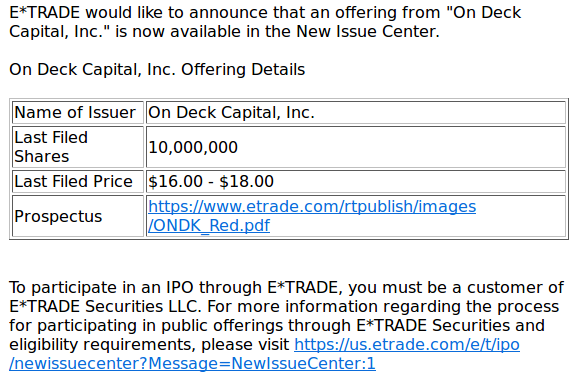
One had to wonder why any schmo with a brokerage account was being asked to buy in. It didn’t sound good for OnDeck but I let my friend have his moment. His guy could try to get me in, etc.
The mass blanket invitation to get in might appear that brokers aren’t so confident about the company’s prospects. But actually back in January of this year E*Trade forged a “retail alliance” with middle-market investment bank Jefferies LLC. A Reuter’s story said that, “E*Trade is betting that it can score points with investors by guaranteeing access to IPOs that brokerage firms normally reserve for their best customers.”
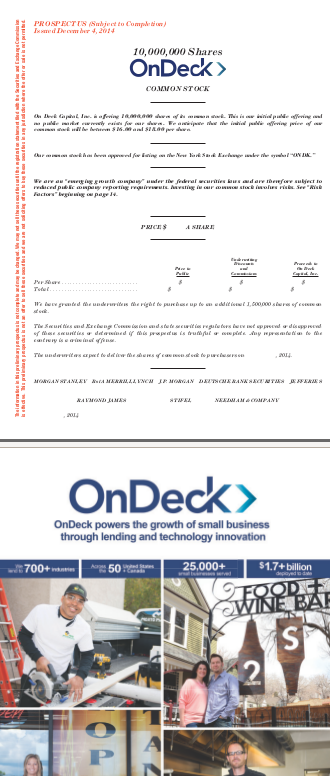 OnDeck’s underwriters include Morgan Stanley, Bank of America Merrill Lynch, JPMorgan Chase, Deutsche Bank and Jefferies. This is in line with “giving its customers access to initial public offerings and follow-on offerings underwritten by middle-market investment bank Jefferies LLC” though I haven’t confirmed the alliance is the cause of this.
Just as with Lending Club’s allocation offer, no one is guaranteed anything with OnDeck through E*Trade. There’s a required approval process which may ultimately yield nothing.
And yet it still feels a little weird, maybe because I’ve been hearing about an OnDeck IPO for years now and I just can’t grasp it’s actually happening. It’s one thing for a big banker to talk about it and another for an old college buddy, my doorman, and Jim who’s the cashier at the local hardware store ask me if I know anything about this OnDeck loan stock advance thing they heard about.
All I know is that sentiment on them is mixed but that ultimately insiders believe it’s great for the industry.
As for both of these the IPOs? I don’t know. I’m not getting in on either of them but it has nothing to do with how I feel about the companies. I can’t wait to watch this all unfold though.
Check out the 224 page OnDeck Prospectus!
Lending Club’s Site Went Down
December 3, 2014A week away from IPO day, Lending Club is undergoing a supposed unannounced mid-day prolonged “upgrade”. There is no word about it on their twitter account. As many probably know, this down time coincides with one of the day’s four normal feeding times when fresh loans are loaded onto the platform in bulk.
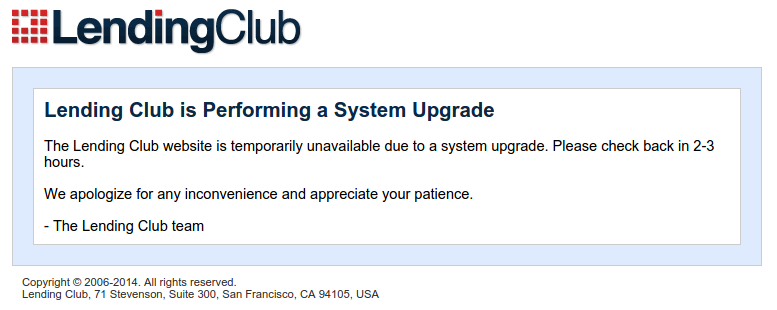
Are they just polishing up the old gears before IPO time or did something happen?
The 3rd revision of their S-1 registration was published two days ago.
My Satoshi Monday
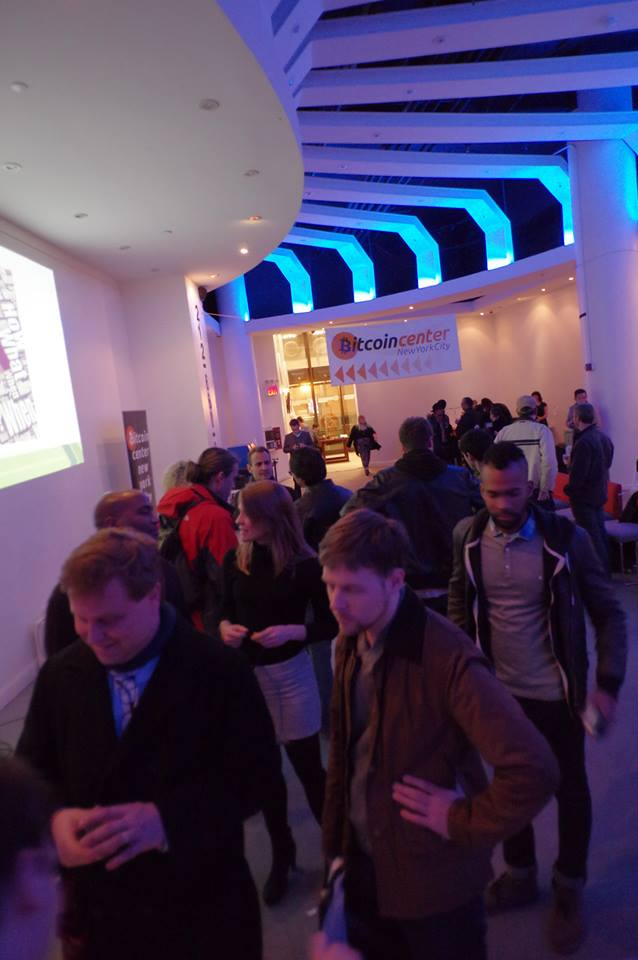
December 3, 2014Call me brave, batshit crazy, or deBanked in the modern era. Earlier this week I wound up at the Bitcoin Center in NYC, a place I didn’t really believe existed. They supposedly host events downtown by Wall Street every Monday and Thursday nights with free alcohol and food.
I don’t believe it, I thought. I called the place ahead of time, twice, half expecting the second attempt to reveal the number was actually out of service. Nevermind the fact that the first time I called, an enthusiastic gentleman was eager to have me stop by.
These bitcoin events start at 7pm. I got there 10 minutes early just to scope the situation out, that way I could escape before anyone knew I was there. Can’t take any chances with these bitcoin people.
But it looked safe. Well, safe enough. The Bitcoin Center is a giant open room on the first floor of 40 Broad Street. The lighting is dark and the floors are pure cement. It could easily double as a handball court or a trading floor, which it kind of is.
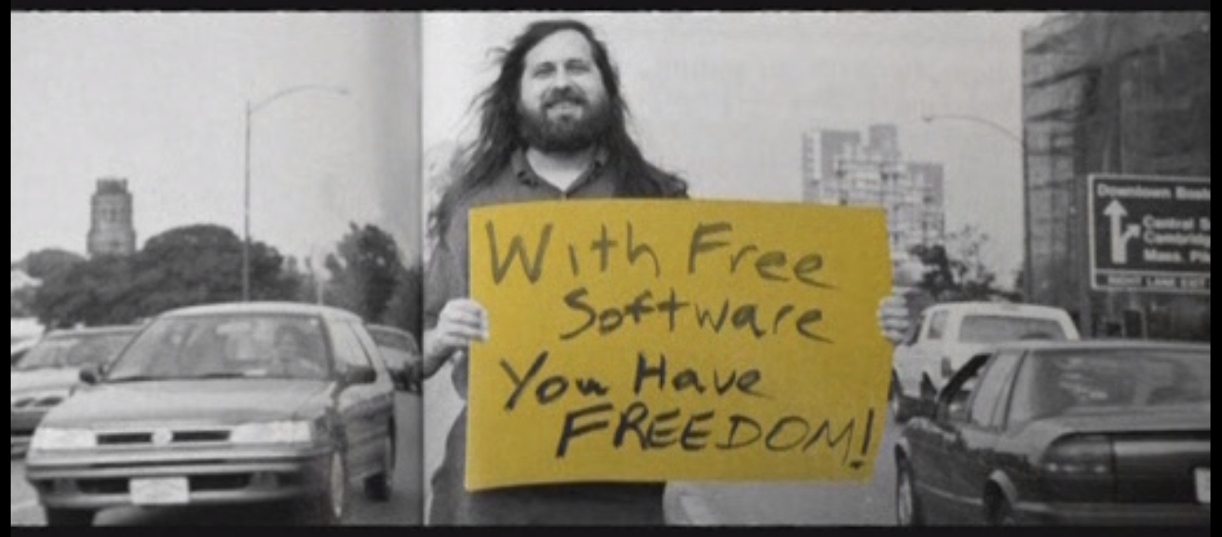 And so I kicked off a Satoshi Monday with a crowd that looked like they were doing unix programming in the 1980s. I was glad I dressed casual. We may have been physically near Wall Street but mentally it was light years away. I half expected Richard Stallman, the legendary icon of the free software movement to pop in and start handing out bitcoins, digitally of course, through some kind of cool free software.
I’ve seen mainstream bitcoin enthusiasts at payments conferences around the country, you know, banker types, but the Bitcoin Center keeps it real. Within 15 minutes of my arrival, I had already had conversations that involved taking down the Federal Reserve, the Koch Brothers, and overthrowing the government. I learned that bankers were poisoning nature and that nature was gearing up for revenge. A war was brewing and you didn’t want to be on the wrong side. “You don’t want to f*ck with nature!” someone screamed.
I had no idea what any of it had to do with bitcoin but the crowd wasn’t all like that. Thank God.
Others gave me the inside scoop on Gems, a company that wants to be the “Bitcoin of social networks”. One fellow bought XGEMS early and if I was smart I should try to pick some up too. Maybe another time…
Cryptocurrencies and cryptoassets of all kinds were uttered. Of course each one seemed to be in presale, was only being offered for a low rate today, or was only open to a select few and for a limited amount of time. If you didn’t get in now, it was too late. The more seemingly elusive they were, the more people wanted to buy them, regardless of whatever they were.
Just as I was beginning to question My Journey to Bitcoin, shit got real. “You selling?” a guy asked me. I assumed he meant drugs. But when he saw how paralyzed I had become, he started to laugh. “I’m talking about bitcoin dude,” you have any to sell?
He wouldn’t be the first to ask me that night. In fact there’s a sizable group of folks that attend just to trade bitcoin. There was even an opening bell and an honorary guest bell-ringer guy to kick off trading.
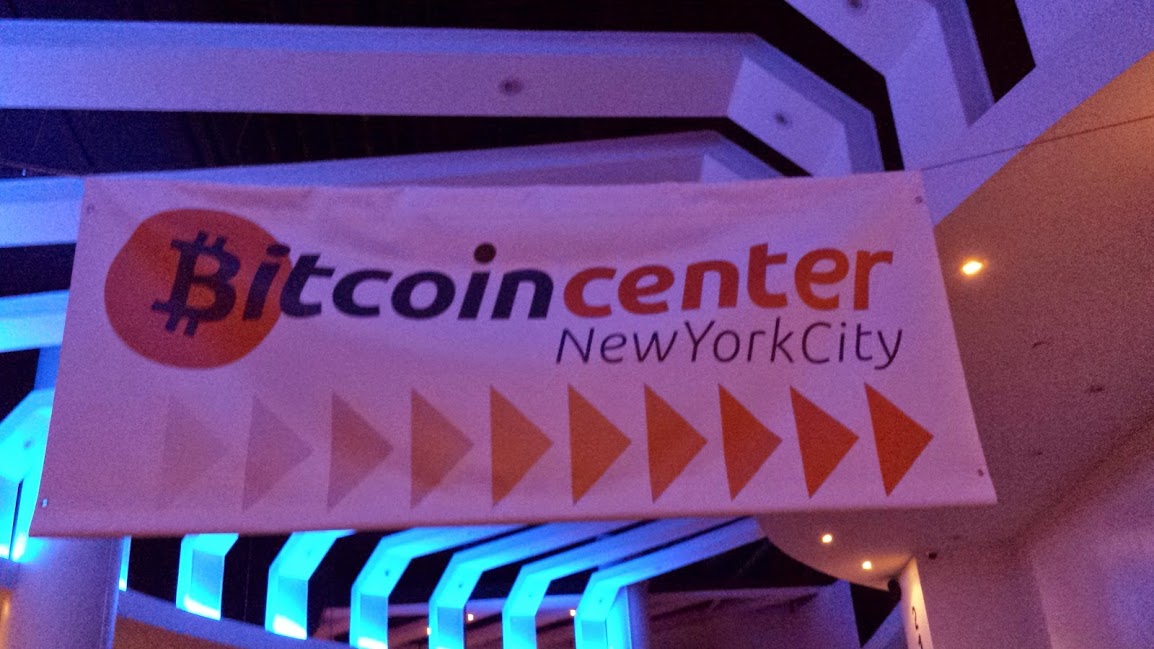 The Bitcoin Center isn’t an exchange though. Any deals made and arranged are between you and another party. Online exchange prices affect the price on the floor but deals made on the floor don’t affect online exchange prices. On Satoshi Mondays, bitcoin goes for cash money.
I thought it was dumb at first so I asked the next guy that was looking to trade, “Why would I buy bitcoin from random people like you in person when I could just do it online?” I should’ve seen it coming. “Must be easy for people like you who have a bank account,” he responded.
I let that one sink in. Just the day before I had blogged that 25 million Americans are unbanked, meaning they don’t have bank accounts or even access to banking products. This fellow was one of them. He lived off cash but wasn’t letting that stop him from shopping online. He gave you cash, you gave him bitcoins. He stayed unbanked but not cut off from the Internet connected world.
I wanted to ask him why he chose that route over a prepaid debit card, but cards are not a cure-all. Other attendees told me that they buy products overseas and that they were either being charged a huge percentage on top to cover the card processing fees or that merchants had stopped accepting cards altogether. Sure they could make an international wire transfer but even that was a headache for merchants looking to conduct an automated business online.
 Bitcoin was said to be simpler for all involved, something I believe because I purchased a new monitor using bitcoins on Overstock.com just last week. It was actually faster and easier than using a credit card. Seriously. I also saved Overstock on the processing fees. See what a good citizen a bitcoin buyer can be?
An in-person bitcoin exchange also prevents the parties from having to pay an online exchange fee, not to mention that you can gain an edge through negotiating. The liquidity of cash on the spot can create some serious arbitrage opportunities.
People threw down thousands of dollars to buy bitcoins which were then transferred via a mobile app. I probably had enough to do some trading but I didn’t need the cash.
When the free pizza arrived, the crowd turned into a mob. The underbanked it seemed were also underfed and a life of living bitcoin to bitcoin meant this might be the only meal they had for some time. I pushed their weaker counterparts, the unbanked, out of the way to get a hot slice and they pushed me right back.
“Bank account lover!” they shouted. It was a harsh indictment, but they knew. As deBanked as I was, they knew that ultimately I was banked.
Damn.
Some people left right after they ate. Those that remained began to tell me about their digital mining operations, a necessary component of the Blockchain technology that cryptocurrencies like bitcoin are built off of. Bitcoins don’t just magically appear. Computers on the Internet perform wildly difficult mathematical calculations in order to facilitate the creation and transfer of bitcoins. This design is partially why nobody can beat the Bitcoin system.
 One guy told me that he had his basement completely redone so that he could turn it into a mining center. Most mining is done with specialized computer hardware that can perform nothing other than mining. You can actually buy such machines at the Bitcoin Center. If your mining is productive for the system, the system will reward you with bitcoins. The processing power required to solve the complex mathematics makes the odds of being rewarded very low. As time goes on, the system’s equations get more and more difficult to crack.
 Some miners are backed by billion dollar investment funds and have a serious advantage in the mathematics arms race. But for those that just casually dabbled in mining, they seemed to be getting a little something from doing it, even if it was small.
Admittedly one guy talked me into buying mining equipment, something miniscule and inexpensive, a novelty almost. It of course packs so little power that its contribution to the Bitcoin system will be insignificant and will likely yield nothing. I didn’t buy it from him though, I bought it on Amazon. Not taking any chances with the bitcoin weirdos.
I used a prepaid debit card to buy an Amazon gift card which I then used to buy a bitcoin mining machine, or something. I swear I’m not crazy. The moment I clicked buy though, something happened to me. My beard got a little more scraggly, the designer label on my pants faded away, all my past presidential votes magically got switched to Ron Paul, and I finally understood that nature was coming to kill us all.
Well, that’s almost what happened.
The Bitcoin Center might bring out the the industry’s worst stereotypes but between the lines, there’s something there. The unbanked, the merchants/consumers dealing with the costly nightmares of credit card processing, and the freeing feeling of operating outside the traditional banking system. I get it.
And they got me because I was one of the last people to leave that night. Before I knew it, Satoshi Monday almost became Satoshi Tuesday. “Party’s over buddy,” said one of the important Bitcoin Center people. I was ready to go. I really was. I had absorbed a lot. But I had just one more question for him.
“You selling?”
—–
Want to just try it out? Buy just $1 worth of bitcoin on Coinbase. You have nothing to lose by learning.
Merchant Cash Advance Now In-Depth
December 1, 2014For quite possibly the first time ever, Google has blessed merchant cash advance with its own array of In-depth articles. What are In-depth articles? Why, they’re featured stories at the bottom of the normal search results. The In-depth feature launched in 2013 and has only worked for certain keywords.
Today it appeared for the very first time for the keyword merchant cash advance
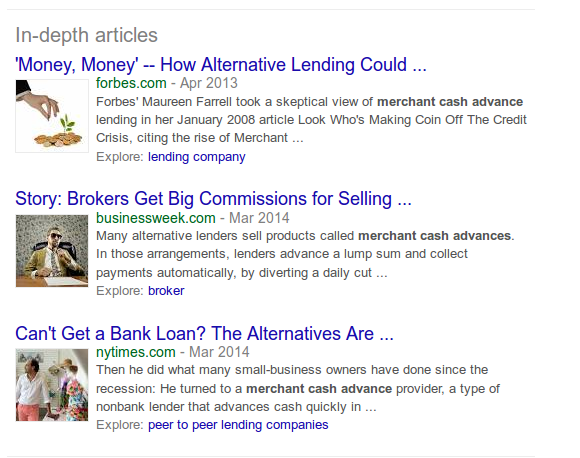
Since Google experiments constantly and shows different results to everyone, it’s possible that you’ve been seeing this for some time already.
I had this to say about the feature 16 months ago:
If you’re wondering how websites can prepare themselves to benefit from such rich snippets, I published Schema.org Markup and Rich Snippets for the Little Guy back in August 2013.

Businessweek, NY Times, and Forbes… I’m not surprised that they’re the chosen publications. Truth be told, there may not have been enough written about merchant cash advance to implement this feature until now. Consider this a milestone.

Merchant Processing Resource is Now deBanked
December 1, 2014 Back in July 2010, I launched www.merchantprocessingresource.com as an independent resource for merchant processing and merchant cash advance. At that time I was celebrating my 4th anniversary of working in the merchant cash advance business and realized there was little to no information about the industry online.
For the last 4 and a half years, this website under that name has been visited by hundreds of thousands of people, many of whom were new to the business or interested in getting into it. I’ve received thousands of emails and responded to an insane amount of questions.
In 2010, 95% of all merchant cash advances relied on merchant processing. For those that remember, funding was in many ways secondary to acquiring merchant accounts. But the industry has evolved and other related financial alternatives have sprouted up around it.
Over time I found myself exploring new avenues and relaying what I’ve learned or what I knew with the rest of the world.
Merchant Cash Advances may have started off as a product for those underserved by banks but it has morphed into an option for bankable businesses that would rather skip the bank. In a sense, today’s capital-seeking merchants are deBanking.
Consumers too are turning to peer-to-peer platforms and crowdfunding campaigns instead of credit cards and bank loans.
And then there’s myself. I started buying into Lending Club loans in January of 2014, almost a year ago. The returns crush what I could earn with a savings account or CDs. The bank is the least attractive option if you want to earn a return on your money.
But it goes beyond lending and earning interest. All the big conferences this year were filled with bitcoin enthusiasts, a payment technology and currency that is not only independent of government, but of banks. Of course I gave it a look and loved it. I shared my feedback in a post titled, My Journey to Bitcoin.
Merchant Processing and Merchant Cash Advance may have kicked off this blog, but four and a half years later, it’s time to acknowledge the other forces, many of which I have already been covering for quite some time.
With 2015 right around the corner, the world is deBanking in more ways than one.
I’m deBanked.
Are you?