Sean Murray is the President and Chief Editor of deBanked and the founder of the Broker Fair Conference. Connect with me on LinkedIn or follow me on twitter. You can view all future deBanked events here.
Articles by Sean Murray

OnDeck to Announce to Q2 Earnings
August 3, 2015 OnDeck will announce their second quarter earnings today at 5:00 PM EST. Anyone can dial in by calling (877) 201-0168 and using conference ID 80861672.
The company’s executives may have to endure more questions than in previous calls because of the low stock price and the curious guidance reversal issued two weeks ago. After Q1, OnDeck projected Adjusted EBITDA for Q2 to be a loss of $3 million to $4 million. But on July 15th, they revised that to a GAAP net income of between $4 million and $5 million.
The sudden change was attributed to a one-time sale of loans in which the proceeds were booked as revenue.
Compass Point analysts Michael Tarkan and Andrew Eskelsen wrote in a note to clients, “if we exclude the one-time gains, core revenues came in well below our expectations, suggesting a meaningful deceleration in loan origination growth and/or another decline in yields.”
OnDeck closed Friday at $13.37, down 33% from its IPO price, though it’s higher than its all time low of $11.15.
The depressed value has invited a slew of ominous sounding press releases from law firms that questioned whether or not previous statements about the company’s prospects were false or misleading.
The distractions may have been compounded by the false rumor picked up by most of the web that claimed OnDeck was scheduled to release earnings last month on July 6th.
Notably, most analysts have issued Buy recommendations for the stock. Deutsche Bank analyst Ross Sandler set a price target of $18 and Stifel Nicolaus has it at $22. For now, Wall Street is still bullish about OnDeck.
Yellowstone Capital Continues to Reach New Heights
August 2, 2015 An anonymous source inside NYC-based Yellowstone Capital revealed the company had recently reached two milestones. One was that they had funded more than 50,000 deals since inception. The other was that they had funded just a hair shy of $40 million in the month of July, a new internal record.
The monthly figure puts them on pace with their competitor Merchant Cash and Capital, who announced having funded $115 million across the second quarter of this year.
Yellowstone’s $1.1 billion+ funded since inception raised eyebrows at the recent AltLend conference in NYC when Lendio’s Brock Blake put deBanked’s industry leaderboard up on the big screen during the event’s opening presentation.
Since then, other funders have shared their figures through public announcements. Coral Springs, FL-based Business Financial Services officially joined the billion dollar club just a few days ago.
Yellowstone’s continued rise can likely be attributed to the expansion of their risk box from high risk to moderate risk. Back in March, company CEO Isaac Stern led a management buyout backed by a private family office that brought on a new executive team. Private equity turnaround expert Jeff Reece came on as the company’s President. Reece is a former Director of Cogent Partners, a boutique, private equity-focused investment bank and advisory firm.
The company is also reportedly on a massive hiring spree after having leased another floor at 160 Pearl Street in Manhattan.
Yellowstone has a strategically diverse business model that allows them to either fund small businesses in-house (on their own balance sheet) or broker them out to other funders. My source says that the 50,000 lifetime deals funded figure includes both.
What’s in the SoFi AAA Rated Bonds?
July 30, 2015 Should you buy student loan debt from a startup tech-based lender? DBRS is signaling yes with a AAA grade to $387 million of the notes in a $418 million offering. To put that into perspective, the U.S. Dollar was given the same grade just months before. Bonds issued by Goldman Sachs however were rated two levels lower at A on July 6th.
As Safe as the U.S. Dollar?
Founded just four years ago in 2011, SoFi has already made more than $2.3 billion in student loans. The company CEO Mike Cagney is a regular fixture at FinTech trade shows and I myself admittedly often wear a SoFi t-shirt on hot summer days around the city.
Of all the loans to invest in though, I would’ve put student loans at the very bottom of my list. Everywhere I turn, recent college grads and the elderly alike are lobbying against what they perceive as an unfair system.
In a bombshell article in the New York Times last month titled, Why I Defaulted on My Student Loans, author Lee Siegel argued that repaying student loans will lead to “self-disgust and lifelong unhappiness, destroying a precious young life.”
The story ignited a political firestorm across social networks. But Siegel was unapologetic and encouraged others to follow his example of defaulting.
“I chose life,” he wrote. “That is to say, I defaulted on my student loans. As difficult as it has been, I’ve never looked back. The millions of young people today, who collectively owe over $1 trillion in loans, may want to consider my example.”
He’s found sympathy from millennials who came of age right during or after the financial crisis, since many of them have struggled to find jobs or move out of their parent’s homes.
And it’s not just them, “Over 16% of the $1.2 trillion in outstanding student loan debt belongs to individuals over 50 years old.” According to Forbes, the epidemic of student loan debt is even affecting seniors in retirement, some of whom are facing garnishment of their social security checks.
The outlook isn’t good either. According to the Wall Street Journal, the Class of 2014 is the most indebted ever, that is unless the Class of 2015 steals the title.
 And there’s another statistic to consider. “The problem developing is that earnings and debt aren’t moving in the same direction,” reports the WSJ. “From 2005 to 2012, average student loan debt has jumped 35%, adjusting for inflation, while the median salary has actually dropped by 2.2%.”
But the SoFi rating is based on data, not on emotionally charged arguments over social networks regarding the morality of paying for college. Obviously the numbers must indicate something to give them a creditworthiness equal to U.S. Dollar, at least for the pool of notes that earned the grade.
Across the entire offering, dubbed 2015-C, there are also notes with a BBB grade. Altogether, the portfolio contains a weighted-average credit score of 777 and a weighted-average borrower income of $143,132. This isn’t exactly a group of poor struggling borrowers.
100% of the loans were refinanced from another lender so they had a prior track record of making payments.
“Refinancing Loan borrowers have already graduated, have proven well-documented incomes and have stronger credit profiles as compared with typical newly originated student loans,” the DBRS report states. “Further, such borrowers have demonstrated an ability to gain employment and repay their student loan debt.”
And yet a large portion of borrowers have a variable rate loan, with the average balance on those being $74,315. It’s a recipe that could shake the system years down the road.
A AAA rating is an eye-opening assessment even with the quality of borrowers. The final maturity dates for those notes are in August, 2035, a full two decades from now. SoFi has only been in business for four years.
Technologists and scientists say to trust in the data, but there’s got to be credibility afforded to the noise coming from millennials over the last few years. That message, at least the one that I’ve heard, has been that student loans are ruining lives.
Breaking news stories about predatory colleges feed into this narrative. Just last month, the NYT alluded that as many as 350,000 students were scammed by Corinthian Colleges. “Corinthian was a longtime target for federal and state regulators, with a host of investigations and lawsuits charging falsified placement rates, deceptive marketing and predatory recruiting, targeting the most vulnerable low-income students,” the NYT stated.
A Corinthian College graduate would probably not qualify to be a SoFi borrower. 3.5% of borrowers in 2015-C graduated from NYU and 2.5% from Columbia. 59% have an MBA, law, or medical degree.
If the DBRS report makes anything absolutely clear, it’s that these are the types of borrowers you’d bring home to meet your parents.
The irony is not lost however that Lee Siegel, the NYT author that encouraged kids to default on student loans like he did, is a graduate of Columbia.
Perhaps for that reason, competing ratings agency Moody’s graded the senior notes only AA2, two notches below what they consider perfect.
Yesterday I would’ve told you that I would never consider student loans as an investment, but now I’m not so sure.
The data and the review by the ratings agencies definitely conflict with what I hear from real life borrowers and their attitudes about student loan debt.
What are your thoughts?
Double Factoring Puts Business Owners in Jail
July 29, 2015 It’s a case of receivables being sold to two parties at the same time. According to the FBI, Brian Newton and Victoria Snow were convicted last week on 1 count of conspiracy, 13 counts of mail fraud, and 11 counts of wire fraud. They face a combined 40 years in prison.
The pair owned a company called Dataforce International in Clearwater, FL and began factoring their invoices in 2003 through a firm called Amerifactors. “As part of their scheme, Newton and Snow submitted a series of invoices for factoring to Amerifactors that were inflated and that did not reflect work that had been performed by Dataforce,” the report says. “In addition, the two engaged in ‘double factoring,’ which involved submitting the same Dataforce invoices for factoring to both Amerifactors and Prestige Funding.”
That aspect of the crime is significant because of how closely it relates to a questionable practice in the merchant cash advance industry known as stacking. Traditional merchant cash advances are purchases of future receivables and stacking is the instance of when a merchant allegedly sells those receivables to more than one party.
The practice is part of the reason the International Factoring Association actually voted to ban merchant cash advance companies from their trade association last year. “The merchant cash advance financing arrangement often leads to breaches of factoring agreements, because the factor client granted junior liens against the factor’s collateral or took on additional debt without the factor’s consent and knowledge,” wrote Steven N. Kurtz, Esq. last year in The Commercial Factor.”
Notably, Newton and Snow did more than just double factor invoices. Newton was secretly a partner in Prestige Funding, one of the factoring companies. Prestige Funding had raised more than $8 million from over 50 investors according to the FBI’s report and the scheme allowed Newton to divert more than $3 million into his personal bank account.
Sentencing has been set for October 9, 2015.
Business Financial Services Joins The Billion Dollar Club
July 29, 2015 Yet another small business financing company has surpassed a historic milestone. Representatives for Coral Springs, FL-based Business Financial Services, Inc. confirmed that they have funded $1 Billion since inception. BFS, as they’re known in the industry, was founded in 2002, though nearly half of their volume was funded in just the past two years.
deBanked had recently speculated that BFS had funded somewhere between $700 million and $1.2 billion in their lifetime. They are now one of seven companies confirmed to have reached the billion dollar threshold.
New York City-based Merchant Cash and Capital announced hitting the billion dollar mark only four months ago.
“This milestone is indicative of how much demand there is for working capital among small businesses, the backbone of the U.S. economy,” said Marc Glazer, CEO and co-founder of BFS.
BFS/Boost Capital CEO Marc Glazer on Bloomberg London in 2013Much like Capify, a newly-formed lending conglomerate with operations in multiple countries, BFS has a presence in Canada and the United Kingdom. In the U.K., where they operate as Boost Capital, they’ve got an active relationship with the press.
Norman Carson, director of business development for Boost Capital, recently told The Telegraph, “Smaller companies in Britain have been told for too long that they’re inadequate in some way, operating in too risky a field, lacking in assets, or trading in the wrong way.”
Several commercial finance brokers put BFS in the same league as OnDeck and CAN Capital competitively. Referring to BFS, Arty Bujan of New York City-based Cardinal Equity told deBanked, “I think they’re great and serve a specific sector of our industry for merchants that need more money and are willing to prove they’re worthy of it.” He added that the documentation requirements at least in his experience can be a little bit more stringent than for competing companies that promise to fund almost immediately.
And Chad Otar, a Managing Partner of Excel Capital Management, also of New York City, said, “Business Financial Services is a great addition to have in your pocket for the longer deals.”
 In April of this year, BFS extended its credit line with its bank group led by Wells Fargo Bank, N.A. “We are excited to reach this milestone, as it is fueled by our ability to meet the financing needs of so many businesses of different sizes across more than 400 industries,” said Glazer.
BFS is the only billion-dollar-plus funder on the deBanked leaderboard to be based outside of New York City or Silicon Valley. South Florida is widely considered to be one of the top three hubs for tech-based lending. This milestone for BFS is a validation of that.
“With a high percentage of our customers renewing with us, and doing so at higher amounts, we are well-positioned for continued growth,” Glazer said.
SBA 7(a) Loan Program Saved by Congress
July 28, 2015The SBA’s famous 7(a) program which hit its annual allotted cap last week was saved yesterday by Congress. The SBA’s fiscal year, which resets on October 1st, was given an emergency budgeted increase of nearly $5 billion. That brings the 2015 cap to $23.5 Billion.
2015 has brought a surge of business lending in all shapes and forms, including SBA loans. At least one tech-based lending platform, SmartBiz, was potentially in limbo when the cap was reached since their model is almost entirely dependent on the 7(a) program.
Join @SmartBizLoans & @FitSmallBiz – plz sign this petition to keep the SBA 7(a) loan programming running http://t.co/TSAQ0Cytn4 #smallbiz
— SmartBiz Loans (@SmartBizLoans) July 26, 2015
We reached out to SmartBiz last week to get their thoughts about the program’s suspension but before they could respond, Congress acted to keep the program running.
The dollar amount of 7(a) loans issued each year under $150,000 is about equal to the total dollar volume of loans business lender OnDeck will do in 2015. As of July 11th, that figure for the SBA was at $1.69 Billion.
A Square IPO Would Be Alternative Lending’s Third
July 26, 2015 First Lending Club, then OnDeck, and now… Square? The news media was flooded with stories late last week that payments company Square had filed their S-1 in secret. The move can be done under a JOBS Act provision that allows companies that grossed less than $1 Billion in revenue in the most recent fiscal year.
Square’s merchant cash advance arm, Square Capital, reportedly funded $100 million to small businesses in 2014, a figure large enough to earn them a spot on the deBanked leaderboard.
While often reported as a lending program, Square’s own website describes their working capital transactions as sales of future credit card receivables. At face value, and aside from what their contracts might actually say, it’s a textbook merchant cash advance.
While some publicly traded companies have dabbled in merchant cash advances, the financial product is one of Square’s two major products, the first obviously being payments.
And while OnDeck offers loans that are very similar to merchant cash advances, Square could potentially be the first true merchant cash advance IPO.
Also on the IPO watch list is CAN Capital, a company that offers both loans and merchant cash advances. In November of last year, Bloomberg and WSJ claimed the company was already working on it. While it has been eight months since that news came out, word on the street is that a CAN Capital IPO is still very much a possibility.
Unfortunately, because of the same JOBS Act provision that allowed Square to file an S-1 (if they actually did) also applies to CAN Capital. There is no way to know what’s going on behind the scenes until the filing is made public or leaked to the media.
Either way, the end of 2015 will likely end in at least one more IPO for the commercial side of alternative lending.
Could Jack Dorsey and his wacky beard be the future face of the merchant cash advance industry?
BREAKING: JACK DORSEY’S BEARD pic.twitter.com/Quv8nVG9PZ
— Nicholas Carlson (@nichcarlson) June 12, 2015
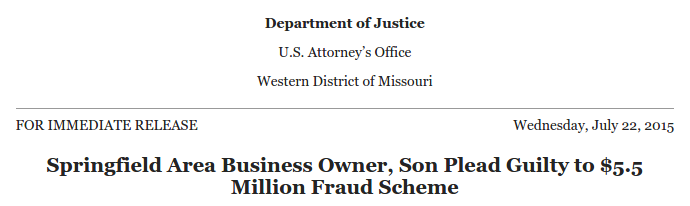
Merchants Behaving Badly: Swisshelms Defraud Bank, Obtain at Least One Merchant Cash Advance
July 24, 2015It’s another case of fake financial documents. Bruce Swisshelm, of Battlefield, Mo., and his son, Bruce Swisshelm II, of Springfield, both pleaded guilty the other day in a loan fraud scheme. The elder Swisshelm pled guilty to bank fraud and money laundering. His son, to misprision of a felony.
According to the Department of Justice, the Swisshelms owned and operated restaurants including Burger Kings and Macaroni Grills throughout Missouri. The scheme was carried out with the submission of fake financial statements to Great Southern Bank to obtain four commercial loans for nearly $5.5 million from February to June of 2011. The docs claimed a net income of $780,000 for 2010 when the actual filed returns stated a $1.8 million loss.
Not mentioned in the Department of Justice report is that the Swisshelms obtained at least one merchant cash advance tied to six of their restaurants from a Long Island, NY-based company in February of 2011 according to state UCC records. While it is unclear if the MCA company was also defrauded, it is notable that it was obtained in the same month that the Swisshelms began their scheme to defraud banks with fake documents.
The UCC was terminated by the MCA company 18 months later, indicating that perhaps the transaction had a positive outcome.