
Industry News
Wonga Retreats
January 30, 2013 For about a month, we’ve discussed the merger negotiations between On Deck Capital and UK based lender, Wonga. It seems now that our quest to evaluate Wonga’s potential success in the US was all for naught. BusinessWeek reported yesterday that the deal is off after a price disagreement. The only figure known to us is the amount originally publicized in November at $250 million. We hope our readers realize that we made a lot of fuss about this merger because it was said to be in an advanced stage months ago.
With the deal dead, it has become evident that something was gained by all of this, and that is the valuable insight from Merchant Cash Advance (MCA) veterans on a range of topics. LinkedIn lit up like a light bulb when it came to debating UK lending practices and algorithmic underwriting. Below are a few snippets from the conversation:
There are significant cultural and other differences between MCA and small business lending in the UK and the US that work against a purely algorithmic MCA underwriting model in the US. In the UK, most small businesses have been established or owned for generations – or longer. Imagine underwriting a pub that has been in existence for 200 years, or a bucolic inn in the Scottish highlands that has been owned by the same family for over 100 years. The entrepreneurial culture in the US where anyone who needs a job starts a small business – and applies for a cash advance – doesn’t exist in the UK.
The rates MCA companies charge is less of an issue in the UK, there is more alternative finance that is generally accepted and rates are not objected to, which is probably why Wonga doesn’t have an issue with the rates they charge, and when borrowers don’t have a problem with the rate they are less likely to feel entitled to default. Also borrowers don’t move as much in the UK and tend to be much more stable in their communities and banking relationships which is correlative to default in the US. Lastly we saw very little fraud in the UK, which is a significant underwriting issue in the US. It will be interesting to see if this deal gets done and what Wonga might do in the US market with their business intelligence, but it may not be as easy as they think.
Our company uses a algorithm to help with our underwriting practices, but there is something to be said about the personal touch when it comes to merchant cash advance space.
After several years of researching the U.K. marketplace and preparing for significant differences—including no UCC filings–what I found were striking similarities. These included resistance to higher (than bank) fees, switching processors, mistrust of terms or the agreement (sale and purchase of future credit card receipts), difficulty recruiting referral partners or ISO s, etc. There were, however, two very important differences between the U.S. and European business models. The first, as J. Brown points out, is cultural. The European attitude toward debt assumption and repayment is more “responsible” than it is in the U.S. Many Pubs and Inns in the U.K. have been in the family for generations. Additionally, there are over 10,000 India restaurants in the U.K. most are run by hard working families. These are considered “honorable” professions and defaulting on an obligation is not “proper.” The second is product distribution and monitoring the performance of the distribution channels. In the U.K. distribution channels were “business referral partners.”
Automation and the proper utilization of technology is certainly the backbone to having a viable and more importantly scalable lending business. I do have however disagree that algorithms and data can completely eliminate the review of a file by a human brain. The ability to ascertain the credit worthiness, borrowing ability and most importantly likelihood of repayment of a business differs vastly from the consumer finance space.
Credit goes to J. Brown, F. Capozza, M. Landau, H. Francis, and everyone else for excellent input on these subjects.
Previous Wonga Articles:
Made for Each Other? 12/12/12
Funding Down to a Science 12/21/12
Not Science 1/14/13
– Merchant Processing Resource
https://debanked.com
MPR.mobi on iPhone, iPad, and Android
Not Science
January 14, 2013 We’ve published 2 articles recently about UK based lender, Wonga. In both, we expressed awe at their scientific algorithm that makes loans in 15 minutes without human interaction. Now we’re not sure that praise is deserved. A Guardian article recently revealed that their top secret super computer racked up 41% bad debt in 2011 as a percentage of annual revenue. 41%, a number that equates to 76.8 million pounds in write-offs. That’s apparently 4x higher than what it was in the previous year.
Is this science? Charge a high enough interest rate and you’re bound to find a balance between bad debt and profit. This isn’t science. This is what the average man calls rolling the dice. The problem with this strategy in the US is that most states cap the maximum interest rate so you can’t force a profit by charging an unlimited APR. Besides, there is proof that the worse the economy gets, the more their defaults pile up. Shouldn’t their algorithm factor in an economic downturn? What will their P&L look like in 2012 and 2013?
For years, we’ve made the case that aggressive lenders who make a point to grab market share while boasting of their dominance are the first to get smoked in the market. For some reason we let our guard down on this one. Maybe it had something to do with it being a British company. Believe it or not Wonga is still profitable, but to claim there is some kind of magic behind what they do is wishful thinking. To take a blogger’s words about this:
I’m sure Wonga would much rather it could know in advance who was going to default. Then it could charge its non-defaulting customers a lot less for its service.
Wonga apparently can’t do what it claims it is best at. Congrats on earning a profit Wonga, but here’s some words of advice about lending in the US. Technology is great, but don’t lend without humans. Trust us.
—–
Previous Wonga Posts:
Funding Down to a Science
Made For Each Other?
Surprise! We Are the Market
January 13, 2013Merchant Cash Advance (MCA) is an alternative to a small business loan. Look around. MCA players have spent so much energy on gaining mainstream acceptance, that we’ve become oblivious to reality. We ARE the small business lending market. There are alternatives out there such as credit cards and SBA loans, but they are industries of their own. Small businesses in 2013 really only have one place to obtain fast unsecured short term financing, and that’s here, the MCA industry. That assumes of course that you agree with our definition of MCA, which we stopped limiting to a purchase of future credit card sales some time ago.
Over the past few months, we began to realize that the only small business lenders making headlines are people we know. Is the country that small or does MCA dominate the market that much?
A glimpse at the sponsored advertisements on Bing in the NYC region:
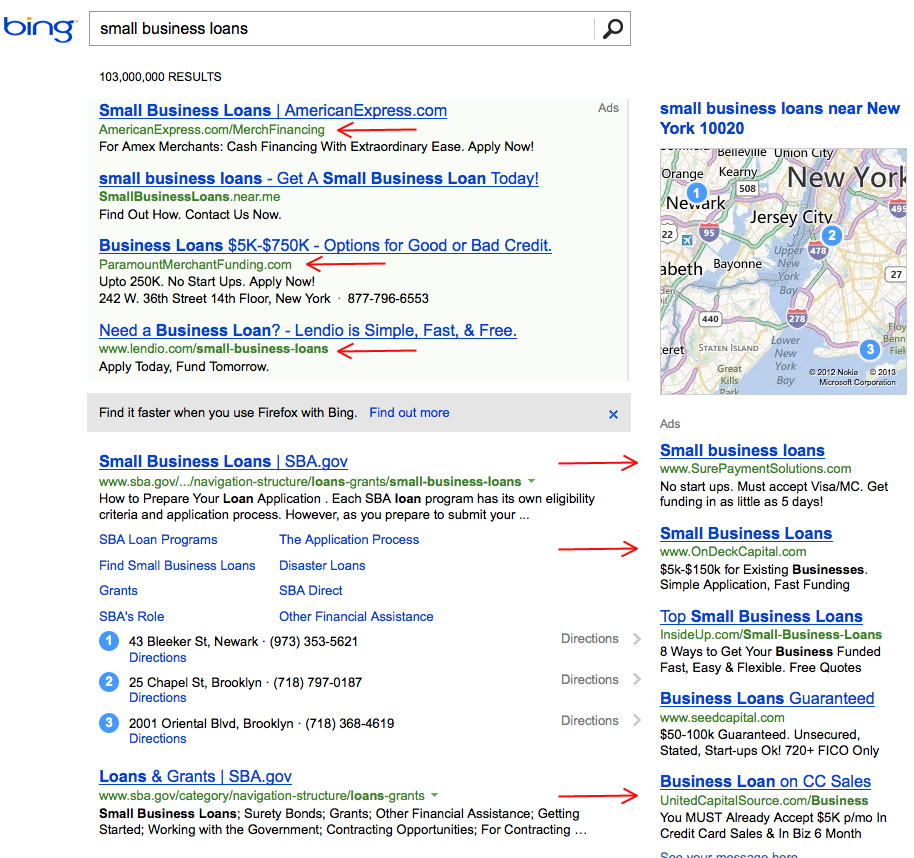
Where are the multi-billion dollar banks? If $15 a click isn’t in their budget, something is wrong, and it may possibly be due to the fact that business loans aren’t on their priority lists.
Lenders, brokers, and bankers on the front lines can’t stop talking about MCA. It is a recurring theme in their columns:
The alternative financing industry is growing rapidly and, I believe, will continue to grow in 2013. These lenders are extremely entrepreneurial and are leaving the banks behind with their speed and use of technology. Many are backed by premier investment banks and Silicon Valley venture capital powerhouses — investors who understand that entrepreneurs and small-business owners are throwing up their hands in frustration over how long it can take to get a loan from a bank, especially if the loan is backed by the S.B.A. More and more businesses are willing to pay the price of the alternative lenders just to be able to get their capital and move on.
-Ami Kassar
The State of Small Business Lending – NY Times 1/8/13
Ami’s Column on NY Times
Cash advance companies, accounts receivable financiers, factors, and micro lenders all have become increasingly more attractive funders for three reasons: flexibility, use of technology, and speed.
-Rohit Arora
Three Reasons for the Rise of Alternative Lending – Fox Business 11/29/12
Rohit’s column on Fox Business
Here’s a dilemma that might have contributed to the growth of MCA… Banks don’t like offering loans and business owners don’t like applying for them if it’s hard:
There’s a large small business segment that needs and wants to borrow on a commercial basis, but their needs are very small. Business owners want $10,000, $20,000 or $30,000 loan–the average is somewhere around $25,000. Traditionally, that’s been a very unprofitable business for a bank. Some banks argue that they are willing to lose money on those loans because they can make it up in deposits. But what happens when the borrower has no deposits? It’s a very tough balancing act.
– The Federal Reserve Bank of San Francisco
A newsletter report that reveals banks lose money on small business loans
Community Investments Volume 8; No 4; Fall 1996
Business owners say the documentation involved is overwhelming. They’ve also found the qualification terms almost impossible to meet.
– Catherine Clifford
Feedback reveals that a burdensome application process and extensive paperwork requirements are enough to discourage business owners even if the loans carry 0% interest.
CNN 1/26/10
Thousands of researchers publish statistics on bank lending every month. Not only do they all contradict each other but journalists that use this data to make bold claims often fail to acknowledge that an increase in bank lending has nothing to do with the applicants, the economy, or the banks themselves. It has to do with the Government. We all know that the SBA will cover the losses banks incur, but there are programs that go one step further. The Federal Government actually bribes banks to make loans. For example, the Small Business Lending Fund is a dedicated investment fund that encourages lending to small businesses by providing capital to community banks. Meaning, covering the losses on defaults doesn’t seem to be enough, so they’ll actually provide the money to make the loans as well.
Click to see full size on mobile
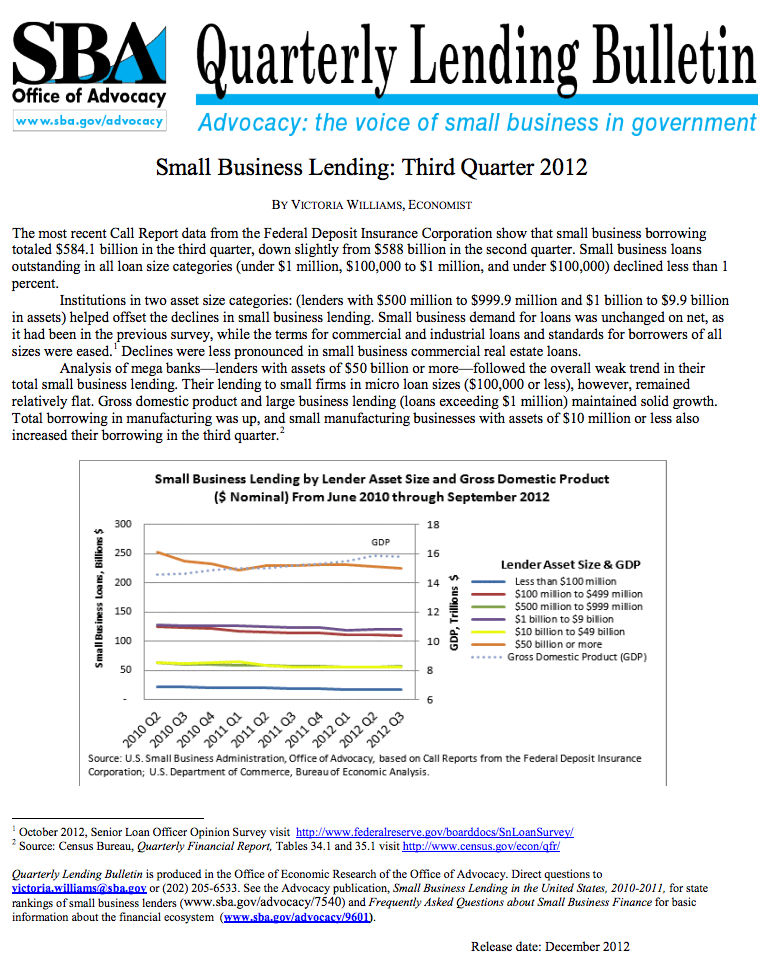 According to the SBA, small business bank borrowing totaled $584.1 billion in the third quarter of 2012. That number dwarfs the volume produced by the MCA industry, but its not an apples to apples comparison. A loan of $1 million dollars is within the range of a small business loan by the SBA, an amount atypical (though not impossible) in the MCA world. Banks are also prodded and coddled by the Government so much that it has reached the extent that we dare claim they are an extension of the Federal Government itself. There’s some food for thought for the Occupy Wall Street movement! They also conveniently got bailed out when they were on the verge of failure, a safety net that MCA companies don’t have.
Subtract the Federal Government’s meddling and there is only one profitable form of B2B lending, Merchant Cash Advance. That is of course again if you accept our definition. There are many young B2B lending firms that claim to be an alternative to MCA, who then go on to describe their product in a manner that is textbook MCA.
Our thesis may be debatable and lacking in concrete proof, but we’re not writing dissertations here. Business owners are increasingly looking to the Internet for loan information and it’s obvious what they’re finding. One would expect a quick Internet search to bring up ads for the billion dollar powerhouses, you know the ones that are given millions to lend out and then millions again when the loans go bad. Instead we find companies owned by friends or friends of friends. The small business loan market isn’t run by anonymous Wall Street kingpins, it’s run by a small community of entrepreneurs that all started from the ground up. Only the community isn’t so small anymore. There was once a handful of MCA companies claiming to be an alternative to a small business loan. Now there are a handful of companies claiming to be an alternative to MCA. It doesn’t take a genius to figure out why that is. After years of fighting to be recognized in the market, something remarkable happened, we became the market itself…
– Merchant Processing Resource
https://debanked.com
Funding Down to a Science
December 21, 2012Account rep: Congratulations, you’ve been approved for $27,000!
Merchant: How did you come up with these figures?
Account rep: It was science. Science did this.
Funny? Maybe not, especially since an underwriting super algorithm may be on its way to the United States. In the days after we posted Made for Each other?, friends, acquaintances, and strangers have been telling us to keep an eye on Wonga’s potential acquisition of On Deck Capital. “It’s not just a european company’s gateway to the US. They’re going to change everything,” a few have said. Aside from their background of being a payday lender, having prestigious VC backing, and the resources to throw a quarter billion dollars at a main street lender in a takeover bid a lot of people didn’t see coming, apparently there is much more to be seen.
Just like MCA in years past, Wonga has worked hard to repel a negative image. Not easy stuff, especially considering they embrace their hefty costs wholeheartedly. Sure, it’s easy to calculate an APR equivalent of a very short term loan and spin whatever number you come up with as the symbol of something evil. If I let a stranger borrow $100 today with the stipulation that they pay me the whole thing back tomorrow plus 1 dollar extra to make it worth my while, would I be evil? That’s an APR of 365%. If I did the same thing with 100 strangers, what are the real odds that all 100 would actually pay me back? Somewhere along the line because of a borrower’s circumstances, bad decisions, or even malicious intent, I’m going to lose the entire $100 I lent out. Others might need more time to pay me back. If one person out of those hundred doesn’t pay back, I break even. If two people don’t pay back, I lose money. If one person doesn’t pay back and another can’t come up with the whole thing, I lose money. You can lend money at 365% APR and lose BIG.
So how do banks manage to charge 4, 7, and 10% APR? Is it just because they’re smarter? No. They don’t make money off loans at these rates either. In the US, interest rates are distorted by government guarantees. Politicians have decided that certain interest rates sound “fair,” then push big banks to lend money at these low unsustainable rates. But of course it doesn’t work and so government agencies sweeten the deal by reimbursing banks for up to 90% of the losses on the borrowers that default. Banks make money on the loan closing fees and other services they sell to the businesses. The loan is the doorbuster offer the bank puts in the storefront window. Once you come inside, they try to sell you on other things so that you don’t walk away with just the loan, otherwise they’re losing money.
So when you hear “banks aren’t lending,” don’t be so surprised. Lending money means giving it away to someone that might not pay it back. That’s a really tough business to be in, no matter how qualified the borrowers are or how good the underwriters are supposed to be.
But somewhere in between the opinions of the Merchant Processing Resource staff and government bureaucrats over what is fair, is a special recipe that determines once and for all what works best. It’s science. Wonga’s lending success is rooted in science and propelled by an advanced algorithm that can systematically calculate risk better than any bank in the world, or so they say.
 One of Wonga’s major investors, Mark Wellport, is a knighted renowned immunologist and rheumatologist that has defended Wonga’s methods against regulation. He believes their data-based process and strong motivation to make their borrowers satisfied places them in an entirely different category than payday lenders.
Wonga takes a human-free approach, something no MCA provider in North America does regardless of how automated their process may seem. In the UK, their business loan application process takes only 12 minutes and the funds are wired 30 minutes later. That’s it. Their max loan is £10,000 but just think about how that compares to MCA in the US. How much time and overhead is being spent on printing documents, underwriters, conference room meetings to discuss deals, setting up the merchant interview, trying to reach the landlord, trying to get page 7 of a bank statement from 6 months ago and the signature page of the lease, etc. etc. Funders might have had the wrong approach all along.
Wonga’s founder, Errol Damelin believes in data. According to some quotes in The Guardian, Damelin believes interacting with the borrower actually impairs a lender’s judgement.
From the Guardian:
Asking for a loan from a financial institution had traditionally involved making a strong first impression – putting on a suit to see the bank manager – then rigorous questioning, checking your documents and references, before the institution made an evaluation of your trustworthiness. In a way, it was exactly the same as an interview, but instead of a job being at stake it was cash.Damelin found this system old-fashioned and flawed. “The idea of doing peer-to-peer lending is insane,” he says. “We are quite poor at judging other people and ourselves – you get to know that in your life, both with personal relationships and in business. You realise that we’re not as good as we think we are at that stuff, and that goes for almost everybody. I certainly thought I was much better at it.
The 42-year-old entrepreneur grew up in apartheid South Africa, and he believes the experience of living in that country in the 80s has had a significant impact on his outlook. He was active in student politics at the University of Cape Town and marched in civil disobedience protests. So, when it came to deciding who should be lent money, Damelin says he wanted to strip away some of the prejudice – decisions would be taken without a face-to-face meeting; you wouldn’t even speak to an adviser on the phone, because people subconsciously judge accents too. The final call on whether to hand out cash would be based on “the belief that data could be more predictive than emotion”.
According to Wired, Damelin and his team created a system to approve or decline applicants all on its own. They tested it on a site called SameDayCash by using Google Adwords and within ten minutes of their ad going live, their system had already approved its first customer. In its early forms, it wasn’t very profitable from a lending standpoint but it did allow them to collect a massive amount of data.
From Wired
its strategy over this period wasn’t just to disburse money — it was to accumulate facts. For every loan, good or bad, SameDayCash gathered data about the borrowers — and about their behaviour. Who were they? What was their online profile? Did they repay the money on time? The site was feeding an algorithm that would form the basis of Wonga, launched a year after the beta experiment that was SameDayCash.
MCA has utilized Adwords for lead generation for years with mixed success, but few have used it for the purpose of accumulating facts. This isn’t to say that the firms collecting information for the purpose of leads aren’t sitting on treasure troves of data, it’s just that none of it to date has led to 100% computerized underwriting. The MCA industry is quite possibly about to undergo a major shift in how they promote their product on Adwords as a result of Google’s ominous warning a couple weeks ago. New disclosure requirements may change the way consumers respond and apply, ultimately impacting the data collected.
So will european science work in the good ‘ol US of A? If Wonga acquires On Deck Capital, you can bet they’ll try to replicate their success. There is a gigantic market of really small businesses that aren’t getting funded, and even the ones that are, they’re waiting 3-7 days to deal with the paperwork, handle the phone calls, fax documents, complete a landlord verification, and in some cases, deal with a credit card processing equipment change. If On Deck Capital becomes a household name as Wonga is in the UK, a lot of smaller funders are going to get squeezed.
Wonga claims to have a net-promoter score above 90%, a customer satisfaction metric that beats most banks and even Apple Computer. It’s a company that seems to be winning on every front.
Critics will say that the American lending market is big enough for everyone, that the loans Wonga has done traditionally are really small and therefore not in the same league as MCA, or that their own company has something similar or better. We believe however, that if this deal goes through that it’s a bad idea to get comfortable. There are Wonga-like companies in the US already, data fortresses that will soon revolutionize how loans are issued and determine what makes a successful business. New York based Biz2Credit is one such example.
We’ve been right about a lot of things in the last couple years and wrong about some. But we believe it is inevitable that any lender ignoring the automation revolution on the horizon is not going to last very long. Go ahead, brush it aside and convince yourself that this whole Automation thing is just hype as BusinessWeek did in 1995 about the Internet. “Automation? Bah!”
As Damelin told Wired in June, 2011, “For me the epiphany was right there. People were online, looking for a solution to a problem.” Ask any funder using Adwords or pouring work into SEO and they’ll tell you the same thing. People are looking online for money. What happens after they fill out the form on the website is what makes the USA MCA/alternative lending industry different from Wonga.
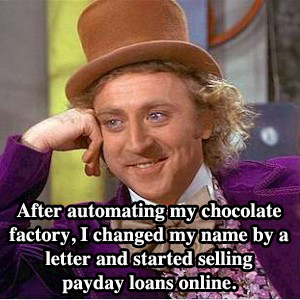 But will a perfected european algorithm work in the US? Americans approach debt and money differently than the rest of the world and small businesses operate in a much more open manner. You never know, the european lab coat wearing scientists could come here and get their butts handed to them. Plenty of smart companies have jumped headfirst into MCA and left after disastrous results. Some veterans that have been in this business a long time will you tell that an impressive resumé, big investors, and a fancy algorithm will help you make it through the first six months. After that, you better know what the hell you’re doing, if you can continue to do it at all.
If in three years the average small business owner thinks Wonga is the last name of a guy that owns a chocolate factory, we promise to write a jingle that admits we were wrong about them. But On Deck Capital has been around the block and knows the business. They would allow Wonga to skip the learning curve and together could quite possibly nail lending down to a science.
Oompa Loompa do-ba-dee-doo, I’ve got another algorithm for you.
– Merchant Processing Resource
https://debanked.com
There is great feedback to this article in a LinkedIn Group HERE
Fantasy Football Championship Begins Tomorrow
December 19, 2012 The MCA Industry Fantasy football league is finally drawing to a close. If you somehow missed the action this season, twelve companies came together to compete for a grand prize donation to a charity of their choice. Each company, in addition to several non-participants pledged funds to the prize. A total of $7,100 was raised!!!
In a winner-take-all format, the two teams competing in the championship this week are:
TakeCharge Capital – Newington, CT
Sure Payment Solutions – New York, NY
A winner will be declared next week. A big thanks to everyone that contributed. 100% of the funds will be donated to the winning team’s charity selection.
- Rapid Capital Funding – $1,000!
- Raharney Capital – $500
- Financial Advantage Group – $500
- Merchant Cash Group – $500
- Sure Payment Solutions – $500
- Meridian Leads – $500
- Merchant Cash and Capital – $500
- NVMS – $500
- United Capital Source – $500
- RapidAdvance – $500
- Capital Stack – $500
- Swift Capital – $250
- Strategic Funding Source – $250
- Entrust Merchant Funding – $250
- Paramount Merchant Funding – $250
- TakeCharge Capital – $100
– Merchant Processing Resource
https://debanked.com
Made for Each Other?
December 12, 2012You want fast cash loan? “We have Short term loans online from £1 – £1000 with no fax required. Instant approval, 24 hour self-service account access and 15 minute cash payout guaranteed.” Not exactly the kind of advertising you’d see in the Merchant Cash Advance Industry. It sounds like a payday lender headline, the kind of marketing that critics would jump on and rally regulators to put an end to. It’s the antithesis of what many alternative loan providers that operate in the MCA space have come to stand for. And it could be coming to a theatre near you.

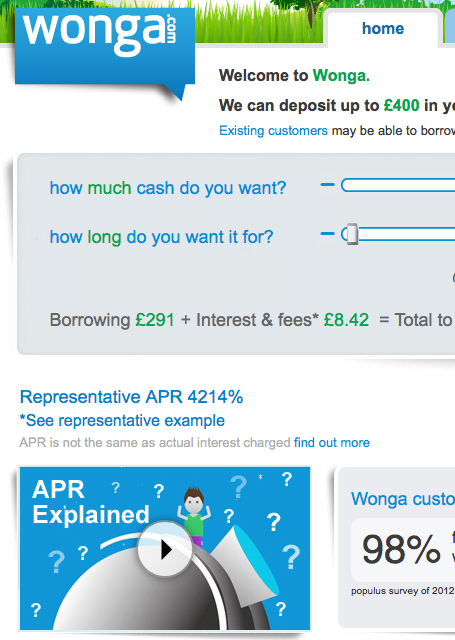 Meet Wonga, an online payday loan company in the U.K. with a representative APR of 4,214%. According to many news sources, they’re looking for an entry point into North America and they may have found one (Watch out Silicon Valley, the Redcoats are coming!). In a deal that would be valued at around $250 million, Wonga is getting cozy with On Deck Capital (ODC). It was only a few years ago that former ODC CEO Mitch Jacobs was warning the public about the high costs of Merchant Cash Advances. It appears their views may be evolving. Not that we have anything against either company, because we don’t. It’s just that when you think of how respected ODC is in the market today, it’s hard to picture them being gobbled up by a company that offers fast cash loans from 1£ and up for a four figure interest rate.
Or maybe this is exactly what we’ve been predicting all along. One of Wonga’s primary investors is Accel Partners, the guys that got in early on Facebook and did a nice deal with Capital Access Network. They are joined by Greylock Partners, a self-described “Leading Silicon Valley Venture Capital Firm,” that coincidentally also invested in Facebook. So what the heck are these two companies doing in the U.K.? It sure looks like they are fulfilling our Silicon Valley Invasion prophesy:
How the Facebook IPO Affects the Merchant Cash Advance Industry 5/18/2012
The Bubble That Wasn’t 8/17/2012
The End of an Era 9/19/2012
Ten Days 9/28/2012

You can't get much more Silicon Valley VC than this...
Bloomberg.com’s article about the advanced stage talks between ODC and Wonga came just TWO DAYS after Steven Mandis walked into the room and bought a material stake of the 2nd largest company in the industry, RapidAdvance.
It seems like just yesterday we were all saying something about financing based off of credit card sales, but now? Now… it’s starting to look like you can get fast cash loan 15 minutes, no fax!
This business gets more interesting every day.
—–
Update: 12/13/12
Wonga does make loans to businesses already in the U.K. The application process takes about 12 minutes and funding happens in 30 minutes. This would be a game changer in the U.S. Refer to this article: http://techcrunch.com/2012/05/07/wonga-extends-its-payday-loans-to-small-businesses-in-uk/
– Merchant Processing Resource
https://debanked.com
Movember Rocked!
December 1, 2012 Movember: Mo’ Merchants, Mo’ Deals
The pre-holiday season is usually big in the Merchant Cash Advance (MCA) industry but this year seemed different. We’ve been saying that we’ve entered a new era for a long time, but it’s finally starting to seem real. It feels like 2007 again in a way, when everybody was getting rich and nobody even knew what the heck they were selling. It took years for account reps to finally stop referring to advances as loans and by then it was too late because the ACH loan industry was born.
E-mails like this don’t happen very much anymore:

You know… the ones where the deal would be blatantly shotgunned to multiple companies at once. The major broker shops would “accidentally” CC everyone instead of BCC to let the funders know who was in charge.
That’s not to say that deals don’t get shopped, Some do, but the circumstances have changed. To minimize the risk of being flooded with bad paper, funders ask resellers to put their money where their mouth is. The syndication game has become THE game in town and it’s led to Super ISO networks like the Factor Exchange. A user on the DailyFunder that seems to be intimately familiar with Factor Exchange is quoted as explaining the model like this:
The “mom and pop” ISOs and “Onesy-Twosey” brokers are backed by one giant ISO network and The Factor Exchange assumes half of the risk by syndicating 50% on nearly ever deal…
The massive volume of FEX submissions to lenders gives the ISOs power to negotiate for better rates and terms, One point of submission reaches 15+ lenders, the merchants credit is only pulled once, and the commission is passed straight through to the ISOs because FEX makes their money from participation.
Companies like this empower the smaller brokerages…

Who Did Mo’ Deals in Movember?
Yellowstone Capital broke their single day funding record… TWICE. This actually happened on back to back days. Executive management reported that they funded approximately $3 million in 48 hours.
Who Got Mo’ Money?
Wall Street wizard and business professor, Steven Mandis acquired a stake in Bethesda-based RapidAdvance. The news is all the more interesting with the fact that RapidAdvance is easily one of the top 5 largest players in MCA. Single individuals don’t exactly just walk through door and buy a stake in companies like this. Mandis is taking on a Strategic Advisor position and it’s our guess Rapid is about to enter another major phase of growth.
Who Got Mo’ Likes?
Merchant Cash and Capital’s (MCC) facebook fan page has gotten thousands of Likes since the third week of Movember when they announced their charity campaign. For every new Like until December 7th, MCC is donating $1 to the American Red Cross to help people that were affected by Hurricane Sandy.
Who Got Mo’ Wins?
RapidAdvance was the first team to clinch the playoffs in the MCA industry fantasy football league for charity. Something tells us that Mandis is behind their incredible winning streak.

Who got Mo’ Leads?
You did if you bought leads from either one of our lead advertising partners, Meridian Leads or SmallBusinessLoanRates.com.
Lendio has also been making a splash on the MCA lead scene with Dave Young being a big contributor on DailyFunder. To discuss pricing, he can be reached at dave.young[at]lendio.com
Who lied Mo’?
According to CNN’s statistics, 247 million people in the U.S. went shopping on Black Friday. That’s equal to the entire American population over the age of 14. Something doesn’t smell right with these numbers. It’s our guess that CNN is using Mitt Romney’s polling experts. 😉
But someone else lied just a little bit Mo’. On Movember 26, 2012, PRWeb published a release that claimed ICOA Inc., a small tech company in Rhode Island was acquired by Google for $400 Million. The release turned out to be a hoax as part of a stock pump and dump scheme. Many critics have been left wondering why PRWeb didn’t do anything to verify its authenticity. Considering PRWeb is such a widely used PR service in the MCA space, we can testify that they’ll pretty much publish anything so long as you pay the fee. Some smaller companies use it as part of their SEO campaigns, which explains why there are so many strange looking releases out there that seem to repeat the same keyword in every sentence.
ABC Funding Co Just announced a program that will help small businesses in need of cash by providing these small businesses in need of cash with a special type of financing that will hep them if they are a small business in need of cash. Not exactly New York Times material…
Will Movember be followed by Make-a-lot-of-Doughcember? We’ll find out!
– Mo’chant Processing Resource
https://debanked.com
MCA History in Honor of Thanksgiving
November 21, 2012
Before fax, e-mail, and e-signatures, merchants used to travel up to 400 miles to fill out a funding application.

The famous response to a British sea captain by John Paul Jones is actually believed to be a misquote. 'Fund' was changed to 'fight' to better preserve his memory but it is theorized that he predicted the birth of Merchant Cash Advance. He died in 1792, two hundred years before the first small business got funded based on their credit card sales

In 1621, the local merchants were funded on the third Thursday of November, just narrowly beating the wire deadline. This feast was almost not possible.

The first underwriters. Yeah... they were British.

The first collections department.
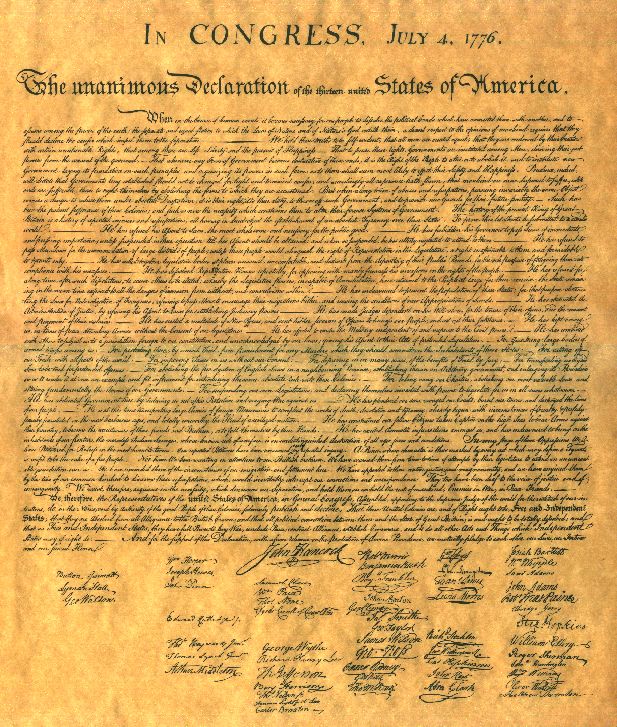
Back then you needed a lot more than just a payoff letter to change companies...

This merchant successfully opened his 2nd location.

This winery just refi'd again last week. $132,292,222,144,923,383,293,819,183,189,380,678 was withheld and credited to the outstanding balance.

Reason for Advance: Need to stock up on more tea inventory.

We apologize if our history is a little off 😉
– Merchant Processing Resource
https://debanked.com