

Sean Murray is the President and Chief Editor of deBanked and the founder of the Broker Fair Conference. Connect with me on LinkedIn or follow me on twitter. You can view all future deBanked events here.
Articles by Sean Murray

Madden v Midland Has Already Hurt Riskier Borrowers, Study Finds
May 28, 2016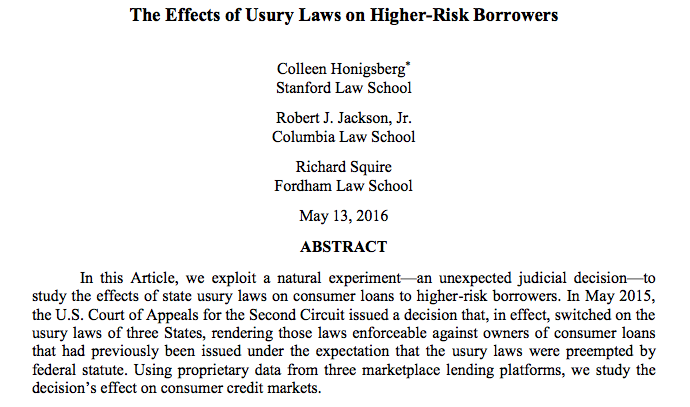 If you thought the Madden v Midland decision was a future risk for marketplace lenders alone, think again. According to a joint study by law professors from Stanford, Columbia and Fordham, one group is already suffering as a result of the decision, people with lower FICO scores.
Since the Second Circuit’s decision only affected borrowers in New York, Vermont and Connecticut, researchers were able to monitor behavioral changes there against other states. They used data from three of the nation’s top marketplace lenders.
In the Second Circuit’s jurisdiction, approved borrowers showed a significant increase in annual incomes, years of employment and FICO scores compared to other districts. Specifically, growth was concentrated among borrowers with FICO scores over 700. Approvals for borrowers with scores below 644 “virtually disappeared” while literally zero loans were issued to borrowers with FICO scores below 625.
“Madden’s effect on loan volume grows as the borrower’s FICO score falls,” the data reveals.
But even though lenders became afraid of the usurious implications in these states, borrowers did not take the Madden decision as a signal to stop payment. “[We] are unable to find any evidence of strategic delinquencies,” researchers concluded after a series of tests.
We find, consistent with basic economic theory, that the sudden enforceability of usury laws had the greatest impact on higher-risk borrowers. In a market where consumer loans are generally increasing in volume, the Madden decision disproportionately affected loan volume for borrowers with the lowest FICO scores.
Read the full study titled, The Effects of Usury Laws on Higher-Risk Borrowers
Second Circuit Incorrect on Madden Case, US Solicitor General Opines
May 25, 2016
Given the Madden v Midland decision, does the National Bank Act continue to have preemptive effect after the national bank has sold or otherwise assigned the loan to another entity?
This question was presented to the US Solicitor General, the person appointed to represent the federal government of the United States of America in Supreme Court cases. The US Supreme court had asked the Solicitor General to weigh in before deciding to take on the case. And the answer is in:
The US Court of Appeals for the Second Circuit was incorrect in its ruling, the federal government believes.
Nevertheless, the US Supreme Court should not even hear the case, they say, because there is “no circuit split on the question presented” and “the parties did not present key aspects of the preemption analysis” to the lower courts. Put simply, “The court of appeals’ decision is incorrect,” they explain, and the heart and soul of preemption itself has never been in question.
The message from the US Solicitor General is clear, carry on friends, nothing to see here with Madden v Midland.
The US Supreme Court could still opt to hear the case but that is very unlikely at this point. Lawsuits filed against alternative lenders such as Lending Club in recent months had used the Madden ruling as evidence to support usury complaints. The connection between a case where a debt collector bought a charged off credit card debt from a bank (which is what Madden was about) and the business model of Lending Club was already weak, but several plaintiffs hoped to use it as a stepping stone. The Solicitor General’s opinion could likely derail attempts by other plaintiffs to cite Madden.
Of notable mention is that many of today’s alternative lenders have relationships with state chartered banks that are covered under the Federal Deposit Insurance Act, not the National Bank Act which the US Supreme Court was asked about. While the two laws are very similar, it did put alternative lenders at an additional arm’s length from Madden.
You can read the Solicitor General’s full brief here.
Read revious posts about this case:
3/22/16 Plot Twist: Obama Administration to Comment on Madden v Midland
3/2/16 Lending Club Class Action Lawsuit Predicated on Madden v Midland Risk
2/26/16 Lending Club Shifts Fee Arrangement With WebBank
2/18/16 Without Scalia, Media Outlets Reporting Marketplace Lenders Supposedly Doomed With Supreme Court Case (They’re Wrong)
11/15/15 Madden v. Midland Appealed to the US Supreme Court
8/13/15 Madden vs. Midland Funding, LLC: What does it mean for Alternative Small Business Lending?
8/13/15 Madden v. Midland Appeal Rejected
8/8/15 Renaud Laplanche on Madden v. Midland
7/28/15 Blyden v. Navient Corp: A Glimpse of a Post-Madden Future?
6/11/15 Legal Brief: Madden v. Midland Funding
Moodys, New Securitization Deals Absolve New Age Lenders
May 21, 2016
You can’t keep a good industry down. Despite the turbulence caused by Lending Club on “marketplace lenders,” ratings agency Moodys rated SoFi’s latest $380 Million bond offering AAA, equivalent to the safety and soundness of the United States Government. That feat is all the more incredible considering that the full faith and credit of the good ‘ol USA doesn’t even enjoy a rating that high with Moodys’ competitor Standard & Poor’s.
Not that the rating should come as any surprise since SoFi borrowers tend to be super-prime credit risks with six-figure incomes and postgraduate level educations. It’s a group that one might call America’s elite, a characterization that SoFi has even gotten in trouble with for capitalizing on. In February, they ran a Super Bowl ad that seemed to taunt viewers that they were “probably not” great enough to borrow from them.
Still, a AAA-rating, whether warranted or not, will be a welcome antithetical headline to the lenders who are being forced to play defense amidst news of layoffs and scandals elsewhere.
OnDeck too, just announced the closing of a $250 Million securitization. DBRS, another ratings agency which has long played a role with new age lenders, rated OnDeck’s Class A notes in this transaction a Single-A, two levels below the highest. The Class B notes scored a Triple-B. (You can view a list of some of DBRS’s ratings history with OnDeck and others here.)
DBRS states that the personal guarantors of the loans pooled in OnDeck’s notes could have FICO scores as low as 500, but that overall they have an average FICO score of 676. OnDeck’s borrowers are therefore worlds apart from the ones SoFi caters to. But the distinction is greater still when considering that SoFi is mainly in the student lending business and OnDeck in the commercial lending business.
The positive marks bestowed upon each during a tumultuous time however, is evidence that confidence exists across the spectrum of today’s new age lenders.
Fora Financial for example, another business lender, announced days ago that they had secured a $53 million credit facility to facilitate continued growth.
On Friday, Lending Club closed at $3.99, still down more than 70% from its IPO price. OnDeck closed at $4.69, down more than 75% from its IPO price.
Has the market gone too far in punishing them?
It’s Time to End the Phrase ‘Marketplace Lending’ – Because it’s Insane
May 19, 2016
Nobody knows what “marketplace lending” means, including me. That’s kind of ironic considering deBanked is for the most part a publication dedicated to it. In fact, the cover of the March/April issue featured a big yellow robot sporting a name tag that actually said, “Hello, my name is Marketplace Lending.” Even the letter I penned that introduced readers to the issue used the phrase not once, not twice, but FIVE TIMES.
The FDIC basically defined it as encompassing all types of financing that include the practice of pairing borrowers over an online platform. Eager to be hip to the industry’s newest lingo, I got on board, and unfortunately perpetuated something that makes almost no sense.
Many companies operating under the marketplace lending umbrella don’t even know that they’ve been lumped into it. It’s become a media buzzword, something to help the simple masses understand so that they will click on a news headline without worrying if the content will only be geared toward the financially savvy.
Imagine shopping for a loan at a supermarket, but ONLINE, and voilà, marketplace lending!
But there are virtually no online platforms that work like that. The simplest explanation to describe a dizzyingly diverse industry is the most incorrect one. Lenders set rates and terms, borrowers don’t choose exactly what they want from a virtual shelf and put them in an imaginary shopping cart. There are however, portals where prospective borrowers can review different offers from different lenders in an Expedia-like environment, but this is really just Online Lead Aggregation 2.0, not a new-age system of lending.
Of course, some adopters of the phrase will point out that the marketplace was supposed to refer to the investor side, not the borrower side. It is investors that can shop for loans or notes that they want to invest in. Indeed, on platforms like Lending Club and Prosper, investors can select individual notes with terms befitting their desires and place them in an online shopping cart for purchase. Behold, the marketplace!
But what if you didn’t deal with retail investors hand-selecting $25 notes at a time? Notably, some online platforms that sell their loans to institutions in giant pools by the thousands or millions believe that such activity constitutes a marketplace because somebody is buying what they’re selling. And so long as somebody is selling something to somebody else at some point, the whole thing might as well be a marketplace. And even if it’s not, referring to it as such anyway will garner more press, attract more investors, and boost valuations.

I mean, would a site like TechCrunch be more likely to write about a FinTech Marketplace Lender or a generic financial company that sold a batch of loans to a bank?
I can tell you firsthand that if a press release submitted to us used the term “marketplace lender” instead of “finance company,” we’d at least check it out, or at least we used to. These days, we are becoming numb to its overuse.
 Peer-to-Peer lending was an awesome term and it was descriptive too. Everybody could understand it. But then those platforms had to go and start selling their loans to Wall Street instead of peers and come up with something else to still sound trendy, techie, and disruptive. There’s nothing trendy of course about selling loans to financial institutions. It is a quintessential boring business activity of Wall Street. It is the opposite of disruptive, except in the events where all the loans go bad and the entire economy collapses like in 2008.
The FDIC specifically said that marketplace lending can encompass unsecured consumer loans, debt consolidation loans, auto loans, purchase financing, real estate loans, merchant cash advance, medical patient financing, and small business loans. This wildly diverse list, which even includes a non-loan product, will obviously have platforms in every category where people or businesses can get paired with a source of funds via the Internet. It’s 2016. It’d be weird if you couldn’t search for financing online. You can do everything else on the Internet. Just because a search happens online shouldn’t mean that the resulting options should be thrown together in some special broad category of lending and then be judged according to what all the other sectors do.
None of this is said to diminish the technological feats that many platforms have achieved. People and businesses can access capital in much faster and more convenient ways than ever before. Their growth and success is America’s economic gain. Jobs have been created and borrowing costs reduced. Hooray, perhaps, for marketplace lending.
The problem is merely the characterization that anyone lending to anyone else these days must also be a marketplace. That makes no sense.
Who will be the first to stop the madness?
Lending Club Faces Another Subpoena, This Time It’s NY Regulators
May 18, 2016
Adding to its list of woes, New York financial regulators have subpoenaed the lender on its interest rates charged to borrowers in New York. CNBC reports that this matter is unrelated to Laplanche’s exit.
From its CEO resigning on May 9th to being slapped with a Justice department notice the same week, the lender’s reputation has been through a lot of trauma. Its stock tanked more than 8 percent on Tuesday and opened under $4 on Wednesday.
And to add to the heap of bad news, the company evaluated its staffing needs and cancelled its 10-week summer internship program.
Lending Club received a Department of Justice grand jury subpoena on May 9th, according to the company’s quarterly earnings report, the same day that the resignation of their iconic CEO was announced. Grand juries are selected to decide if a criminal indictment should be brought against a party. The timing of the subpoena is suspicious because it leads one to suppose that a federal prosecutor had listened in on the May 9th earnings call, read news reports, decided there might be criminal activity, summoned jurors and issued a subpoena all within hours of the original announcement.
The WSJ, which did a great job reporting the details of the events leading up to Laplanche’s ouster, was not able to pin down the smoking gun that “convinced directors that more drastic action was needed,” just that the board had been “presented with evidence” that Laplanche knew many details of the $22 million loan sale.
A highly likely possibility (and this is just my theory) is that someone at Jefferies, the investment bank that Lending Club fudged the numbers on and ultimately bought $22 million worth of loans back from, tipped off federal authorities as to what took place with the loan sale.
Contrary to what people think about Wall Street, many bankers are scared to death about having knowledge of something that could lead to investors being harmed. Someone at Jefferies (and again just my theory) very well could have been so bothered by what Lending Club did, that they made sure the authorities knew what transpired. In doing so, they would probably have been viewed positively for blowing the whistle on bad behavior.
 Cue a prosecutor’s interest, a grand jury, and likely a subpoena to individuals who would’ve had direct knowledge of the transaction. In my opinion, nothing would convince a board of directors more to give their famous CEO 24 hours to resign or be fired than having acquired knowledge of a grand jury investigation.
According to the WSJ, by Thursday, May 5th, Laplanche was removed as board chairman. On May 6th, he resigned. Over the weekend, he emailed friends from a new personal address, and on May 9th it was announced that he had resigned. That same day, Lending Club (the company), received a grand jury subpoena, of what I theorize was probably part of an investigation that was already in progress.
We may never know the full truth, but a seemingly innocent chain of events has clearly spiraled out of control to the point where over the course of a single week, Lending Club’s business model is seemingly coming undone. If nobody wants to buy loans or notes from their marketplace, then they are essentially out of business.
The dearth of interest in buying the loans they originate given the recent news has forced the company to disclose that it might actually have to use its own money to fund loans. No buyers, no business. So what else can they do? For one, they admit that they may need to reduce the volume of loans they originate, and that in doing so, it would likely have material adverse impact on their business.
These consequences have been predicted for years. What happens when investors just don’t want to buy the loans? How could a company where 90% of the income comes from loan origination fees provide continuous value to shareholders in an environment where there are no longer buyers?
Notably, veteran banker Todd Baker has been one of the most vocal on this issue. Six months ago, he publicly challenged SoFi CEO Mike Cagney about the viability of the marketplace model. Cagney had previously addressed Baker in an American Banker article by writing, “It is true that an MPL [Marketplace Lender] needs a buyer to originate loans — without one, the marketplace needs to raise rates until a buyer emerges. If there is no buyer, MPLs simply stop lending — they won’t start originating underwater loans.”
Stop lending?
Seemingly willing to undermine his own assertions, Cagney told the WSJ less than a year later a different story. “In normal environments, we wouldn’t have brought a deal into the market, but we have to lend. This is the problem with our space.” The environment of which he spoke then of course, was one where loan buyer interest was simply not as high as they would’ve liked, and thus it was becoming a “problem.”
Cagney’s reversal played right into Baker’s point, that a marketplace lender has to keep issuing loans to survive. When those loans don’t have organic buyers, at least in SoFi’s case, the weird idea of launching a hedge fund to potentially artificially keep up loan originations was proposed.
For Lending Club, their Plan B to keep things going is to simply buy their own loans if no buyers are available. Lending Club has a strong balance sheet and could potentially have success with this, for a time of course. The problem is that it would be taking on the credit risk of those loans as a result and put its retail note buyers at risk in the process.
Here’s why: When investors use the Lending Club platform, they are lending money to Lending Club and Lending Club is using that money to lend to borrowers. Investor yield might be tied to the performance of the notes they acquire but the credit risk is ultimately Lending Club itself. If Lending Club goes kaput, note holders would have a major problem, one that hasn’t really been a possibility until now because Lending Club hasn’t kept much risk on its balance sheet. That might soon change, according to their recent quarterly earnings report, where they say they might have to balance sheet some loans. Investors then wouldn’t really be participating in some disruptive peer-to-peer sharing economy revolution, but rather become very much like bondholders in an unregulated non-depository financial institution. And that smells horrifyingly risky. Throw in the fact that Lending Club is facing class action lawsuits, one of which alleges them to be a Racketeer Influenced Corrupt Organization. Does this sound like the kind of bond you want to invest in if you’re an unaccredited retail investor?

What Laplanche actually did or what a grand jury finds are unimportant in the grand scheme of what’s already been revealed. The only thing that matters is that when buyers dry up (whether for rational or irrational reasons), the entire system’s foundation shakes. The marketplace as it was supposed to be anyway, certainly can’t forever operate as a marketplace when it has shareholders who expect ever-increasing revenues and profits. According to Cagney’s original libertarian fantasy, nothing should theoretically be going on balance sheet. Lending Club should just be lending less, and if there are ultimately no buyers, the company should shut down until such a day that buyers return. One could only imagine that conversation with shareholders.
At the LendIt Conference last month, Renaud Laplanche joked with the crowd about cutting off the sleeves of his Lending Club jacket to make the Lending Club vest he sported on stage during his keynote speech. But was it just the sleeves that were missing? Speaking so confidently, Laplanche projected the authority of an emperor, perhaps one we’ve all been introduced to before.
“Was it really just the sleeves that have been cut away?” You may have thought to yourself for a split second. Or is it possible that the emperor of the marketplace, unbeknownst to the crowd, was simply wearing no clothes at all?
Business Loan Brokers and MCA ISOs Call it Quits
May 17, 2016
Hard times reported just a month ago are already turning into farewells
Hard times for those facilitating small business financing solutions are starting to cause a visible exodus from the space. In their wake, industry vendors have told deBanked of unexpected credit card charge disputes for leads long past purchased or for ISO software previously paid for.
One failed ISO who lasted just 14 months aired it all out on an industry forum. “I do have to say the entire journey was not fun or lucrative. I lost $250,000 of my own money [and] could not broker a deal to save my life,” he wrote. From what he could also tell during his experience, is that nobody else around him was really making any money either.
He’s not alone in feeling this way. Another user just two months earlier started a thread with this title, “Does anyone really make money in merchant cash advance?” In it, he wrote, “The merchant cash advance industry sucks. I’ve been in this business for now 1 year after 20 years of sales experience and what I find is that this industry is the craziest thing I have ever seen.”
Some sales reps or ISO owners are simply venting frustrations and continuing on but others are writing real goodbye letters. A few days ago for example, one long-time MCA industry consultant wrote on LinkedIn that he was “done with merchant cash advance” and that he had finally moved on to something that made him happy, which from the looks of it, is a career in playing Poker full time.
Gil Zapata of Lendinero wrote to deBanked in an email about what’s happening out there. “Lead generation is expensive,” he said. “Most people think that obtaining a new client is just cold calling. Wrong. There is a cultivation process.”
And part of it may be a misunderstanding of what the sales process is like, he insinuates. “Many people who have tried entering this industry think it’s the mortgage business,” he said. “It’s not.”
On forums, users often attribute some of the issues to “low grade professionals,” salespeople who would clearly benefit from more training. They’re part of the reason why an official training course is in the works and should be available some time this year.
“Good agents are not easy to find. Recruiting, hiring, and training is costly,” said Zapata.
And even then with the right salespeople, he added that “a lot of the internet leads are dead deals or not the best leads. Forming partnerships is not easy if you are looking to generate massive deal flow.”
Bright Spot
Unlike some who are throwing in the towel, Zapata is not going anywhere. Neither is another sales rep who contacted deBanked off the record. Just 16 months in to the business, he’s reportedly funding more than $500,000/month just from cold calls and claims that he is not stacking any deals. He admittedly says that he eats at his desk and never leaves. Being an equity trader in a prior life is what helped him succeed at this, he said.
“Some ex-stock brokers who can pound the phones can do very good,” Zapata said. “We only lose deals to hot shot brokers in N.Y. who were aggressive stock brokers or sold some sort of financial product out of Wall Street.”
 Indeed, just last week deBanked learned that a sales rep from NYC that we had previously spoke with had just bought a red Lamborghini to celebrate his long and hard fought success. He’s not even 30-years-old yet and business is obviously going well.
More than a year ago, I wrote that it had become much too late to get into this business if all you had was a couple thousand bucks in startup funds. At Transact 16, one attendee told me they believed that the absolute minimum needed to stand a chance in setting up your own ISO shop at this point was $250,000, purely because marketing costs have skyrocketed.
Might it really take the cost of a new Lamborghini to start an ISO these days? If true, that would ironically mean that as a generation of disenchanted brokers make their way for the exits, they may be passed by an entirely new generation of brokers riding exotic Italian cars on their way in.
Even so, they should heed caution from those that have spent years in the trenches. “This industry is not as easy as it seems,” Zapata wrote. “Cost can eat you up alive.”
GAME OVER: Is The Marketplace Lending Model Dead?
May 17, 2016
Lending Club received a Department of Justice grand jury subpoena on May 9th, according to the company’s quarterly earnings report, the same day that the resignation of their iconic CEO was announced. Grand juries are selected to decide if a criminal indictment should be brought against a party. The timing of the subpoena is suspicious because it leads one to suppose that a federal prosecutor had listened in on the May 9th earnings call, read news reports, decided there might be criminal activity, summoned jurors and issued a subpoena all within hours of the original announcement.
The WSJ, which did a great job reporting the details of the events leading up to Laplanche’s ouster, was not able to pin down the smoking gun that “convinced directors that more drastic action was needed,” just that the board had been “presented with evidence” that Laplanche knew many details of the $22 million loan sale.
A highly likely possibility (and this is just my theory) is that someone at Jefferies, the investment bank that Lending Club fudged the numbers on and ultimately bought $22 million worth of loans back from, tipped off federal authorities as to what took place with the loan sale.
Contrary to what people think about Wall Street, many bankers are scared to death about having knowledge of something that could lead to investors being harmed. Someone at Jefferies (and again just my theory) very well could have been so bothered by what Lending Club did, that they made sure the authorities knew what transpired. In doing so, they would probably have been viewed positively for blowing the whistle on bad behavior.
Cue a prosecutor’s interest, a grand jury, and likely a subpoena to individuals who would’ve had direct knowledge of the transaction. In my opinion, nothing would convince a board of directors more to give their famous CEO 24 hours to resign or be fired than having acquired knowledge of a grand jury investigation.
According to the WSJ, by Thursday, May 5th, Laplanche was removed as board chairman. On May 6th, he resigned. Over the weekend, he emailed friends from a new personal address, and on May 9th it was announced that he had resigned. That same day, Lending Club (the company), received a grand jury subpoena, of what I theorize was probably part of an investigation that was already in progress.
We may never know the full truth, but a seemingly innocent chain of events has clearly spiraled out of control to the point where over the course of a single week, Lending Club’s business model is seemingly coming undone. If nobody wants to buy loans or notes from their marketplace, then they are essentially out of business.
The dearth of interest in buying the loans they originate given the recent news has forced the company to disclose that it might actually have to use its own money to fund loans. No buyers, no business. So what else can they do? For one, they admit that they may need to reduce the volume of loans they originate, and that in doing so, it would likely have material adverse impact on their business.
These consequences have been predicted for years. What happens when investors just don’t want to buy the loans? How could a company where 90% of the income comes from loan origination fees provide continuous value to shareholders in an environment where there are no longer buyers?
Notably, veteran banker Todd Baker has been one of the most vocal on this issue. Six months ago, he publicly challenged SoFi CEO Mike Cagney about the viability of the marketplace model. Cagney had previously addressed Baker in an American Banker article by writing, “It is true that an MPL [Marketplace Lender] needs a buyer to originate loans — without one, the marketplace needs to raise rates until a buyer emerges. If there is no buyer, MPLs simply stop lending — they won’t start originating underwater loans.”
Stop lending?
Seemingly willing to undermine his own assertions, Cagney told the WSJ less than a year later a different story. “In normal environments, we wouldn’t have brought a deal into the market, but we have to lend. This is the problem with our space.” The environment of which he spoke then of course, was one where loan buyer interest was simply not as high as they would’ve liked, and thus it was becoming a “problem.”
Cagney’s reversal played right into Baker’s point, that a marketplace lender has to keep issuing loans to survive. When those loans don’t have organic buyers, at least in SoFi’s case, the weird idea of launching a hedge fund to potentially artificially keep up loan originations was proposed.
For Lending Club, their Plan B to keep things going is to simply buy their own loans if no buyers are available. Lending Club has a strong balance sheet and could potentially have success with this, for a time of course. The problem is that it would be taking on the credit risk of those loans as a result and put its retail note buyers at risk in the process.
Here’s why: When investors use the Lending Club platform, they are lending money to Lending Club and Lending Club is using that money to lend to borrowers. Investor yield might be tied to the performance of the notes they acquire but the credit risk is ultimately Lending Club itself. If Lending Club goes kaput, note holders would have a major problem, one that hasn’t really been a possibility until now because Lending Club hasn’t kept much risk on its balance sheet. That might soon change, according to their recent quarterly earnings report, where they say they might have to balance sheet some loans. Investors then wouldn’t really be participating in some disruptive peer-to-peer sharing economy revolution, but rather become very much like bondholders in an unregulated non-depository financial institution. And that smells horrifyingly risky. Throw in the fact that Lending Club is facing class action lawsuits, one of which alleges them to be a Racketeer Influenced Corrupt Organization. Does this sound like the kind of bond you want to invest in if you’re an unaccredited retail investor?
What Laplanche actually did or what a grand jury finds are unimportant in the grand scheme of what’s already been revealed. The only thing that matters is that when buyers dry up (whether for rational or irrational reasons), the entire system’s foundation shakes. The marketplace as it was supposed to be anyway, certainly can’t forever operate as a marketplace when it has shareholders who expect ever-increasing revenues and profits. According to Cagney’s original libertarian fantasy, nothing should theoretically be going on balance sheet. Lending Club should just be lending less, and if there are ultimately no buyers, the company should shut down until such a day that buyers return. One could only imagine that conversation with shareholders.
At the LendIt Conference last month, Renaud Laplanche joked with the crowd about cutting off the sleeves of his Lending Club jacket to make the Lending Club vest he sported on stage during his keynote speech. But was it just the sleeves that were missing? Speaking so confidently, Laplanche projected the authority of an emperor, perhaps one we’ve all been introduced to before.
“Was it really just the sleeves that have been cut away?” You may have thought to yourself for a split second. Or is it possible that the emperor of the marketplace, unbeknownst to the crowd, was simply wearing no clothes at all?
The Direct “Lender” Test – For ISOs/Brokers
May 16, 2016
ISOs/Brokers: Unsure if the company you’re speaking with is a direct lender? There’s a few ways to immediately spot a faker. Fakers are often confused between loan products and sales of future receivables, an issue that will likely open them up to all kinds of legal liabilities. For this reason alone, you don’t want to end up working with the wrong company. In some states brokering a deal to an unlicensed lender could have severe consequences.
First, if anyone tells you they are a direct lender, a popular phrase these days, ask them how it is they lend. Do they comply with lending laws on a state-by-state basis or do they have a bank charter relationship? If a bank charter, ask them what bank. Verify it. If they have a lending license in a single state or multiple states, verify it. You can look up licensed California lenders here for example.
If they don’t know what you are talking about when you ask about chartered banks or state licensing, you should end the conversation.
If they’re supposedly only in the business of purchasing future revenues or receivables but call themselves a direct “lender,” you should run away as fast as you can. If a company buying future receivables believes they are indeed a lender, they and anyone working with them could face all sorts of penalties, up to and possibly including criminal charges. No amount of commission is worth this.
If a company is only in the business of buying future receivables (what some would call a true or traditional merchant cash advance), a more proper title would be a direct “funder.”
Keep in mind that a lender reliant on a bank charter relationship technically would not qualify as being a “direct lender” either since the bank itself would be the lender.
The differences between loans and sales will be taught in the industry’s upcoming online certification course. I highly recommend that newcomers sign up for it.