
Sean Murray is the President and Chief Editor of deBanked and the founder of the Broker Fair Conference. Connect with me on LinkedIn or follow me on twitter. You can view all future deBanked events here.
Articles by Sean Murray

Got a Mantle, Bryant, or Mahomes Card? This Company Wants to Fund You
September 12, 2022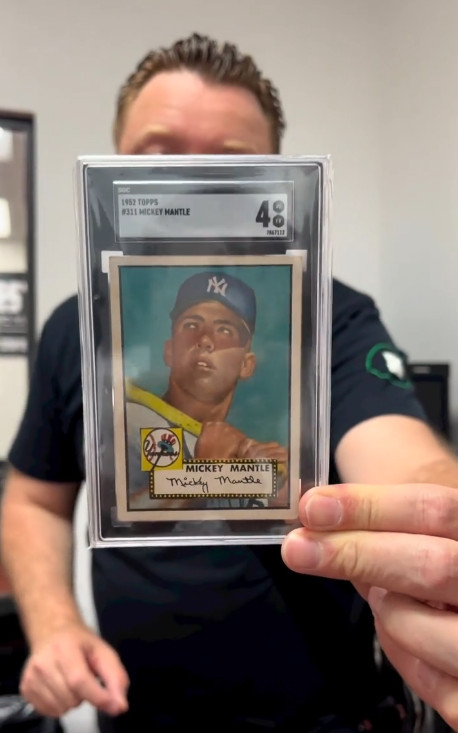 Last month, an anonymous bidder paid $12.6M for a 1952 mint condition Topps Mickey Mantle baseball card, the highest amount ever fetched for a piece of sports memorabilia at an auction. Understandably, the news electrified a fast growing market of collectors, traders, and financiers that predicted the next big asset class wasn’t just going to be real estate or crypto or NFTs, but physical sports trading cards.
The value of the Mantle sale came as no surprise to one budding entrepreneur in South Florida. On Instagram, he’d been talking about Mantle cards for weeks, even going so far as to hold up another ’52 Topps Mantle card to the camera to promote what his company can do, which is provide quick cash advances to owners of valuable sports cards.
The entrepreneur’s name is Edward Siegel, CEO of Card Fi. Siegel’s no stranger to the alternative finance space because he spent about a decade in the MCA industry, most recently as the founder of Bitty Advance, which he sold in 2020. Since then, Siegel returned to his roots and early passion of his youth.
“I had a background in sports cards as a collector, you know as a kid, but then in my early twenties, I was promoting card shows at malls,” Siegel said. “I was heavily into the hobby, setting up the card shows and promoting them and doing player appearances where players come in and do an autograph appearance.”
That was back in the late 80s, early 90s, according to Siegel.
When Covid hit and he exited his most recent company, he noticed a massive resurgence in the sports trading card market. His next business ultimately became Card Fi, a company that will evaluate the market value of a card and make an advance against it. There’s obviously risk involved so they take possession of the card for the duration.
“We have to get a hold of these cards and we’re responsible for them and then we vault them in our in-house bank vault,” Siegel said. The cards are stored in a highly secure climate controlled environment. Card Fi shows the vault off frequently in its Instagram videos.
Such a business requires large amounts of capital so Siegel went searching for investors, a pursuit that led him to a unique place, an Instagram Live pitch competition hosted by famed CEO and reality TV star Marcus Lemonis. Siegel entered himself in as a contestant, knowing full well that the odds of even being chosen to present his business to Lemonis were about a million-to-one.
Somehow, he was called up to pitch.
“So [businesses] went on there during the quarantine and you pitched your business,” Siegel explained. “I went on there and I pitched it […] And he understood it and he thought it made sense.”
The moment eventually led to a deal with Lemonis’ company and Card Fi was on its way.
 Siegel, meanwhile, dispels the notion that the burgeoning trading card industry or his business hinges upon old vintage cards or that it’s a baseball-card-centric universe.
“If we look at it, there’s two different markets, you have the modern card market [where] I would say it’s basketball [that leads the pack],” he said. “For the vintage card market it’s baseball.”
Football is huge as well, he explained. A Patrick Mahomes rookie card, for example, an NFL Quarterback that’s still currently playing, recently fetched $861,000. There are only one of five like it in the world, the scarcity playing a major role in the value. Meanwhile, a Justin Herbert rookie card, an NFL Quarterback who’s only in his third year was already receiving bids above $1 million at the time this story was being written.
“It really depends on the card itself,” Siegel explained. “Some players might be known for having better careers but then you have cards that have more scarcity to them. Something that’s a one of one or maybe a very low populated card and a graded PSA 10 could very well be worth more than a [Michael] Jordan rookie because it has scarcity in it.”
PSA refers to cards that have been verified as authentic and graded on the condition of the card itself. Ten is the highest level a card can receive. Card Fi will only work with graded cards to avoid any funny business when it comes to advancing funds based upon the value.
 Siegel explained that Card Fi’s average advance is about $40,000 – $50,000. The max right now is $500,000. There’s a big market for this type of funding it turns out because Card Fi’s much larger rival, PWCC, just raised $175 million to make similar offerings to sports card owners.
“This financing benefits the market as loans and cash advances have become an increasingly asked-for offering among trading card collectors,” said Chad Fister, PWCC’s CFO in a story that originally appeared on Sportico. “Enabling our clients to access liquidity through a menu of capital offerings is key as trading cards continue to prove themselves to be a valuable tangible asset class.”
For Card Fi, customers that take an advance can track everything through an online portal, including details about their cards, payments, and balance.
“We want to note that we built a full-service automated underwriting and collection platform to where, whether it’s the customer or the broker, they can log into our system and put the description of the card into the system and it’s going to automatically underwrite it and price it out,” Siegel said.
That description sounded like something straight out of the fintech industry of his past, especially the component about brokers.
“Just like the MCA space, we have a whole partnership side, a broker side, where brokers can refer us customers just as an affiliate where they just send the info over,” Siegel said. Similarly, they can earn a commission if a transaction is completed, he explained.
In this industry, brands like Topps, Upper Deck, and Panini have become the bread and butter for Card Fi. Even though it’s all business for Siegel these days, he couldn’t help but mention a particular card he had a personal attachment to.
“My personal favorite card in my collection is the 1965 Topps Joe Namath rookie card,” Siegel said. “Of course being a die hard New York Jets fan, that has to be my favorite card.”
Inflation? So What – SMBs Are Bullish On the Rest of 2022
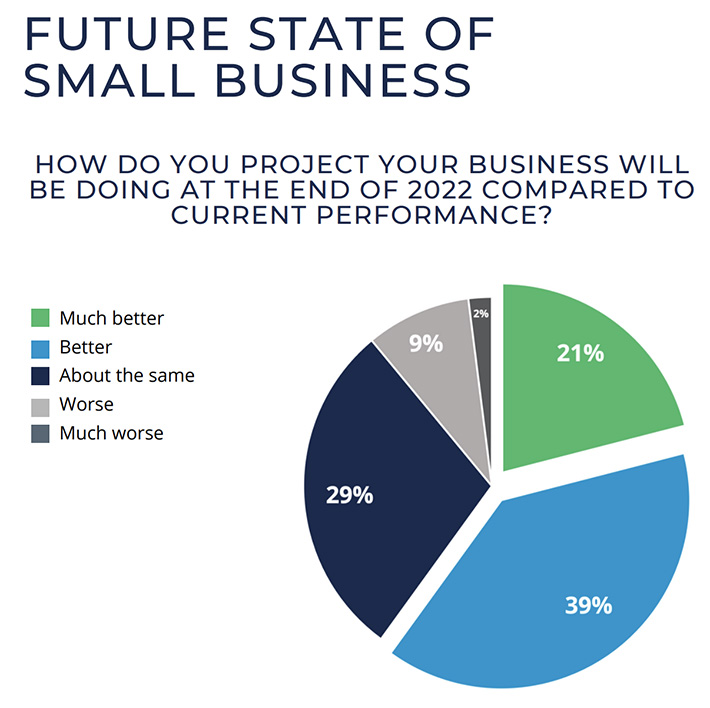
August 17, 2022Eighty-nine percent of respondents projected that their small business will be doing the same, better, or much better by the end of the year, according to a recent survey conducted by IOU Financial. The majority of those polled actually selected better (39%) or much better (21%). Twenty-nine percent said they expected to be about the same.
The sentiment is significant given that 84% said that they were somewhat concerned or very concerned about rising inflation and 85% said that they were somewhat concerned or very concerned about a possible recession.
This data is in line with responses found from other surveys like the recent NFIB study that determined that inflation was the single most important problem that business owners were facing. But even that study revealed a sense of persistent optimism, similar to the IOU survey, when respondents said that financing and interest rates ranked the lowest on their selected list of problems.
 All of which means that the biggest challenge small businesses are facing right now is not viewed as a mortally perilous one. Indeed, 74% of respondents to the IOU survey said that they plan to invest in their business in the next six months.
“They plan to fund expansion, make equipment or inventory purchases as well as put money into staffing and marketing,” the IOU report states. Only 5% flat out said that they do not plan to invest in their business in the next 6 months. The rest said that they might invest.
The optimism that is there is cautious, however. Seventy-five percent of respondents said that the covid pandemic is not fully over and 32% said that they would rate the current state of their business as somewhat negatively or very negatively.
The damage from the last two years lingers on but business owners are looking at what’s ahead of them and signaling that it’s onward and upward regardless.
The full IOU Small Business Survey can be downloaded here.
Is Your Big Brand a Bank? You Can Turn it into One
August 16, 2022
“Any entity that has employees, customers, and fans can create a banking infrastructure that looks just like a bank,” said Yuval Brisker, Co-founder and CEO of Alviere. Founded in 2020 as a spinoff of Brisker’s previous firm, Mezu, Alviere is ringing in the next generation of fintech through its embedded finance solutions.
Brisker wasn’t talking about turning the corner diner into a bank, but rather about providing the infrastructure to enable the largest companies and brands in the US to be one-stop shops for financial services, including banking.
“[It could look] like a bank in every sense,” he said, “FDIC insured, providing a savings account with yield, being able to ultimately give them a credit card, that is not a co-branded credit card, but it’s a single brand…”
Alviere has already spent loads of time dealing with the hard parts, building the tech, but also navigating the regulatory framework to make this concept a reality.
“We are a 100% regulated entity, meaning we’re not piggybacking on a banking license,” Brisker said. “We are actually licensed across the United States in every state that takes a license (except Montana). We are licensed with the federal government in Canada and Quebec and in the English speaking provinces, we’re in the process of completing our licensing in Mexico, and in Europe and in the UK.”
Brisker says this proactive approach is a “big differentiator” against the competition because they really want to provide the full services end-to-end. And that’s a big range given that it spans from bank accounts to payments to cards to cryptocurrency.
 In making this possible, partnerships are key. Alviere has multiple bank partners across the globe, the company claims, one among them being Community Federal Savings Bank in the US. Alviere even solidified a deal with Coinbase back in March that enables brands to provide crypto services to their customers all through their own branded technology.
Retail customers might not ever know the name Alviere because they remain in the background, Brisker explained. The brands would, but the customers would only see themselves interfacing with the brand, which is basically the whole point.
“We tell [brands] those customers will never be our customers,” Brisker said. “We’re never going to take over the customer relationship.”
Larger companies have probably entertained this whole idea at some point already, according to Brisker. The potential to capitalize on a loyal customer base by trying to offer them financial services is increasingly being looked at.
“If you’re one of those companies and you also look at the same time how difficult it is to get into this business, both from a regulation, an ecosystem, and a technological point of view, then you’re probably putting that on your back burner and saving this for another day,” he said. Alviere, however, can make this a reality right now.
“We have all the contracts, we have all the relationships, you just need to have one point of contact, one API, one relationship, one contract, and that’s us,” Brisker said. “And we take care of everything else.”
But perhaps it’s all a big bet, because would customers actually use financial services offered through non-bank brands that they’re fans of otherwise? Technically, they already are.
When Alviere launched two years ago, more than 1 out of every 2 Americans had already used a Buy-Now-Pay-Later (BNPL) service, an embedded financial concept that’s taken off around the world. BNPL sales amounted to $100 billion in 2021 in the US alone.
“We believe that there’s a huge opportunity for more traditional beloved and essential brands to become the financial service providers for [people] coming of age,” Brisker said. “And then of course there’s a huge unbanked population that for whatever reason has not entered the financial system here and abroad, which we think that through the affinity with sort of less foreboding, less anxiety, stress-ridden relationships like some people have toward banks that they will be more inclined to come into the financial system through the back door of the system, the front door of the brands they already know and patronize.”
Turning Businesses into Funding Warriors
July 27, 2022 The downside to offering any small business a loan to grow is that they might not necessarily know how to do the growing part. And so for years, that’s what a Tempe, AZ headquartered company called Business Warrior had been focused on, helping small businesses grow and become more profitable. If businesses needed funding, Business Warrior could certainly provide that too, but the key was in maximizing the value of that.
It all seemed a swell fit until the company became further intrigued by the value proposition of one of its vendors, Alchemy, an “embedded finance” company headquartered in nearby California. deBanked had interviewed Alchemy CEO Timothy Li via Zoom back in August 2020 and the tech company had only grown since then. After reconnecting in April of this year, Li described Alchemy as the “Salesforce of embedded finance.”
Embedded Finance sounds altogether buzz-wordy, but Business Warrior smelled opportunity. In June, Business Warrior announced that it had acquired Alchemy. Since then, Alchemy’s Li has become a warrior and he is working hard to roll out Business Warrior’s next generation of products.
Among the first on the horizon is an Alchemy specialty, giving small businesses the tools to become lenders themselves. It sounds like Buy-Now-Pay-Later, and to an extent it is, but the difference is that a furniture store, doctor’s office, or repair shop would be the one extending the credit, not a faceless third party on Wall Street hoping to win big.
Li explained the advantage of this by using a doctor’s office as an example. “So the creditors, the banks, don’t understand [the customer] just from reading the credit report, but the doctors understand them, they’re local people, they might have seen this patient before,” said Li. “Now [that patient] wants to do a $10,000 procedure and nobody under the sun will underwrite them.” When this happens, the doctor’s office might try to arrange some type of private financing arrangement, “but they don’t have the software to do it,” Li stated.
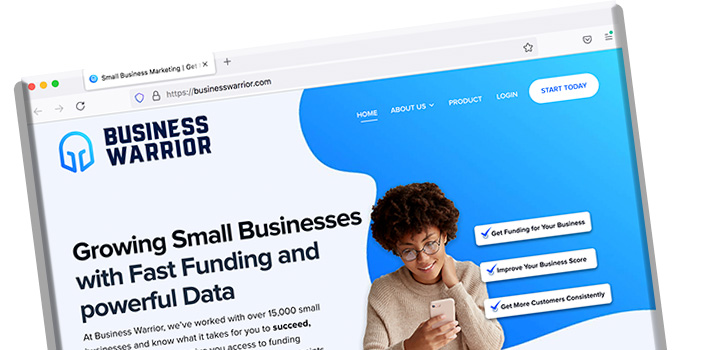 Business Warrior’s software solves this. The platform will be free for the business and Business Warrior will process the customer payments, which is where they’ll earn their revenue, on transactions fees.
In one respect it reduces two risks for the business: (a) A third party BNPL lender dictating future approval, supply, and cost of financing, and (b) credit card companies cutting the lines of their customers that they would otherwise normally use to pay for services. The downside, so to speak, is that the business itself is tasked with being its customers’ creditor.
But ultimately, just like BNPL, such a service is likely to lead to a boost in sales, which is what Business Warrior’s mission had always been from the start.
“This tool is a tool for the small business to do more business,” Li said.
The Alchemy name will remain as far as Li knows, because they still have a lot of customers using its original products. Day to day now, Alchemy is also working with Helix House, an online marketing company that Business Warrior also acquired. They’re all leveraging each other’s resources.
Li concluded the interview by sharing a recent real world experience, he himself going to a dental office to get some work done.
“They have every single imaginable technology, schedule appointments, all the tech,” he said. “They don’t have something that manages payments. It’s either a credit card, cash, or it’s nothing.”
Referring to the financing capabilities that Business Warrior can bring to the table in those very circumstances, “I feel like it should have been there already.”
Is MCA Still New?
July 19, 2022 Recently, I had the pleasure of someone telling me that they were happy to be getting in on the MCA industry while it’s still very new. While I appreciated the irony given that it’s an industry that’s been around for more than 20 years, it prompted me to take a walk down memory lane to understand why someone might truly believe that. On the one hand, industry insiders long ago predicted that the product would prompt new regulations. They were right, but they were just 17 years off, literally. In 2022, new regulations that were imagined in 2005 are FINALLY starting to become reality. Maybe it is still all very new indeed?
But more ironic than that is how certain some people were that the industry had already matured 15 years ago, that it had peaked in 2007. The story was that MCA was some legacy product borne out of the dot com bubble of 2001 that never had a sustainable future and that 2009 and beyond would usher in the era of in-person sales for what would remain of those that didn’t change careers. Computers didn’t even factor into the vision.
Apparently, change and adoption can be slow, but certain products, if they’re meeting a need, have staying power. Below is a few quotes I pulled from the earlier years from various places. I hope you enjoy them:
“The merchant cash advance industry is growing at an astonishing clip.” – October, 2005
“The merchant cash advance industry only has a max of two years left.” – June, 2007
“Once our splits are compatible with First Data, then that means we win. We’ll have conquered the merchant cash advance space.” – July, 2007
“The merchant cash advance space is just a fad.” – August, 2007
“I think the [merchant cash advance] boat has come and gone and I missed it.” – August, 2007
“The cash advance business is going through the tech bubble phase.” – November, 2007
“The merchant cash advance industry has grown too large…” – February, 2008
“Cash advance is clearly a growing trend in the payments industry. But, down the road, will cash advance reach a saturation point at which the value proposition to ISOs and MLSs is no longer a winning proposition?” – February, 2008
“Gone are the days of call centers, phone/fax blasts and mailings and in are the days of meeting and greeting merchants face to face.” – March, 2009
“[Merchant cash advances] are definitely not going to grow like people had hoped, and it’ll be very rare that you’ll find a company like mine really making its money or building its future around this product.” – November, 2009
deBanked Happy Hour is SOLD OUT
July 17, 2022The deBanked happy hour scheduled for July 28th in NYC has hit its registration limit.
Missed out? Register for Broker Fair 2022 taking place on October 24 at the New York Marriott Marquis in Times Square. This is one event that small business finance brokers won’t want to miss!
The Highway to Quality Leads and Closing Deals
July 13, 2022 In the early months of 2020, twenty-two year-old Gary Parker found himself on a nature walk along a stretch of highway in Canada. As a savvy marketer in the medical spa field, the wide grip of Canadian pandemic lockdowns had quickly turned his thriving business into dust.
Swept off of his feet by the suddenness of his predicament, he turned to nature to clear his mind and found his next venture in the unlikeliest of ways.
“I went for a walk outside, and so I saw these trucks,” Parker said, “just like trucks on the road just driving. I was like, ‘everything is shut down but there’s trucks just moving things across the country.'”
Parker’s verbal description of the moment was enhanced by his scenic Zoom background when he was interviewed for the story. Parking his laptop on the hood of his car next to a real life mountain range along a Canadian highway, he explained that he didn’t have to tell me how that walk felt because he could show me. Moving his laptop camera around to show off tractor-trailers behind him in the distance, the inspiration that had come to him in 2020 was still present.
Though the country was supposedly closed for business back then, he couldn’t help but notice how many trucks were still on the highways shuttling supplies around.
“I’m a bit of a curious guy,” Parker said, “so I started Googling, like, ‘How much for a truck this big?’ and you know, they were like 70,000 bucks, 100,000 bucks. And I was like, ‘how do people even purchase these trucks?'”
Parker went on a research mission and discovered that few people, if any, were buying large trucks outright with cash, that so much of it was done through financing.
“And so I look up ‘what’s financing? How do people get truck financing?’ And then I recognized that other than truck-sales groups, there’s a section of people where their job is just to help people find the right financing methods.”
Parker thought he might be able to work with the latter group, given his marketing background, to help connect truckers with financing, but discovered the market in Canada was relatively small.
 “Things really started to boom when I met my first USA client,” Parker said, because the demand in the US for truck financing seemed endless. “…in one day you could generate 100 inquiries of people who wanted financing for trucks,” he said.
Parker soon figured out that trucks were just one market in a wider industry of equipment financing, a rabbit hole of endless opportunity that led him to other big name entrepreneurs in the space like Josh Feinberg and Cheryl Tibbs. Feinberg, coincidentally, was a featured cast member in deBanked‘s recently produced equipment finance sales reality show.
Parker found common synergy with both and with their help was further introduced to the entire gamut of small business financing solutions.
“And that’s when I got fully immersed,” he said.
He didn’t want to be a broker or a lender, however, so instead he set out to focus on one very particular area of the process, lead generation. First, he built a system to help others, and then he gravitated towards creating a matchmaking system where brokers could connect with businesses that came to his company for help. The end result is his current company that many brokers have now become aware of, Fundly.
“So Fundly is an online marketplace,” he said, “where we have two things. Right now we have real-time matches, so [merchants] who are looking for funding every single day can come in free-of-charge and submit their inquiries, and we have funding members who can join for $1 a month who can see all these inquiries come in and then decide whether or not they want to pitch or share their profile with someone for five bucks.”
Parker explained it as a Tinder-style system where brokers can see the inquiries but can’t talk to the merchants unless the merchants also choose to engage with them. The upside is that when merchants say ‘yes,’ the brokers get to speak to someone that is interested right at that moment and with them specifically.
But Parker is a marketing guy, not a developer, and the execution of this required additional people to put the vision together.
“So we have a team now. Before when we just started, it was just me,” he explained. “If you’re going to write anything, let them know [about the team], because I have a hard working team who is behind every single thing and it wouldn’t have been possible, the technology wouldn’t have been possible without the team.”
Despite the business being born in Canada, Fundly is only targeting the US market because of its scope. Finding interested business owners is not even the hard part of his job, he explained, but rather the hard part is about educating brokers about how to communicate with businesses.
“I’m trying to teach our community members as they come into our orientation, what they think small business owners care about,” he said.
A big mistake for a broker, he explained, is starting off with a pitch about how many lenders they work with.
“Small business owners do not care about how many lenders you have in your back pocket,” he stated. “We’ve come to recognize a small business cares about one thing, what can you do for them? speak in terms of them.”
He imbues them with this marketing wisdom not just because he wants to improve their success rate, but also because he is adamant about making sure the businesses that come to his company get access to the right people with the right programs and prices. He doesn’t want to see these customers get a bad deal.
That Parker is a 24-year old former medical spa marketer hardly matters to brokers who recognize talent when they see it. When deBanked asked a senior executive of one reputable broker shop off the record what they thought about Parker, they responded by saying “he’s a genius.”
And besides, he’s not exactly that far off from where he started.
“The machines that some of the brokers finance, like laser therapy machines, stuff like that, I was working on the flip side, from the consumer perspective, having people sign up for high ticket packages from these machines,” he said.
And yet he’s very appreciative of how far he’s come since he went for that walk to reflect on his loss.
“God helped me. It was, it was rough, man. Yeah, not going to lie,” he said. “It was really rough.”
Toward the end of the interview, Parker had already shifted into marketing teacher mode.
“What really sets us apart is psychology,” he said. “Most people think that to get a business owner, you have to hit them and say, ‘Are you looking for the lowest terms? And you know, X, Y and Z??'”
The better approach, he explained, is to tell them that you will get them answers quickly.
“That results in a lot more funding,” he said, “because it’s not making a promise upfront, saying ‘let’s get you funds in 24 hours,’ it’s saying ‘let’s get you answers. And here’s someone to help you find these answers.'”
Thoughts on Inflation, a Recession, and Regulation From Someone Who’s Seen ‘This Movie’ Before
July 7, 2022 “I can tell you that in the US that originators are starting to adjust their underwriting policies,” said David Goldin, CEO of Capify and Head of Originations at Lender Capital Partners, “I don’t know about pricing. I haven’t heard that yet.”
Goldin, who has been a small business finance chief executive for 20 years, believes that the economy, inflation, and interest rates are front-and-center issues that the industry should be thinking about right now. In the UK, one region that Capify operates in, Goldin said that several small business finance executives there are already talking about raising margin and doing shorter term deals to prepare for the increased risk.
“Some originators are smart enough to be proactive and others are saying, ‘oh we’ll just watch it.’ So it’s either going to take trickling down through the economy globally or defaults to go up for these adjustment to happen,” he said.
During the Great Recession of ’08/’09, Goldin was right in the thick of it as the CEO of AmeriMerchant, one of the first MCA companies in the US. He explained that there’s a notable difference between now versus then.
“One of the things that didn’t exist back then, someone doing a second [position] was like unheard of in 2008,” he said. “Now, what is it now? first, 2nd, 3rd, 4th, 5th? 6, 7, 8, 9. It’s like a horse race. Ten horses in the race in some cases. […] You have to be careful, right? You have to make sure you’re covering your margin by charging enough and going shorter.”
But in a competitive environment where nobody wants to reveal their cards or risk losing business, not every funder is keen to start making changes right now. Goldin said that many funding companies will wait to see if their competitors start tightening up first especially if they’re driven by their ISOs and brokers. The downside of becoming more conservative is that brokers might just decide to take all of their business elsewhere.
But a looming recession isn’t all bad. “There are some positives,” he said. “The positives are the banks do tighten up. It’s just a question of when not if. So, you may get applicants that come to alternative financing that may have never taken or considered these types of products because they got bank financing.”
Complicating the landscape now, however, is that funding companies are wrangling with new state regulations. Goldin is aware of several originators that have temporarily paused business in Virginia, for example, where a disclosure requirement went into effect just last week. The soon-to-be implemented New York and California laws are also causing rumblings about funding suspensions respectively. In each of those states it was “sales-based financing” products that were specifically targeted, a trend that looks sure to continue as states like Maryland, Connecticut, and others are determined to reintroduce disclosure legislation next year.
“I think more and more originators will eventually get away from the MCA model,” Goldin said, “and go more towards the business loan model by partnering with a bank. I think you’re going to see more companies trying to implement bank programs to become full business loans and not deal with all the nuances of a state by state and MCA program.”
 Goldin’s point of view, wisdom, and predictions are aggressively sobering. Only three months ago, industry sources were telling deBanked that their outlook for 2022 was optimistic and that the end of covid-era government stimulus suggested that there would be growth for non-bank finance companies. Suddenly the tone has shifted, the stock market has plummeted, and interest rates are rising.
“I think if you resurveyed originators now, I think you’d get a different response than you did eight weeks ago or even four weeks ago,” Goldin said. “I can tell you right now that capital providers are asking their originators about how they’re making adjusments in this environment…”
Indeed, deBanked did speak with several players just last week and did notice that the general sentiment had shifted to one of concern and caution.
“I think funders should be thinking about redundancy,” Goldin said. “More than ever the best time to raise capital is when you don’t need it. And I don’t know if [funding sources] will pull lines, yes if defaults go up, but they may not be as inclined to enter into new relationships in this environment.” Because of that, now might be the last best opportunity to secure additional credit sources even they’re not necessarily needed, he suggested.
With that, he said that funders should be thinking about tightening up the bottom of their credit profile, increasing their margins, doing shorter term deals, looking for more mature businesses, and working with businesses with higher credit scores.
“I think that those that don’t make credit adjustments, raise margin, and go shorter are going to have their you-know-what handed to them,” he said. “I’ve seen this movie too many times. It doesn’t have to be called a recession. […] It’s all about affordability to repay, and the more debt [the customers] have, and the more their margins are squeezed, or the more their sales go down. That’s when problems begin. You’re less likely to have a problem if you’re only out six months instead of eighteen months. I’ve used this saying a million times: ‘When the ships are too far out to sea and it’s a tidal wave, you can’t get them back.'”