Sean Murray is the President and Chief Editor of deBanked and the founder of the Broker Fair Conference. Connect with me on LinkedIn or follow me on twitter. You can view all future deBanked events here.
Articles by Sean Murray

Deal Gone Bad? Next Stop Arbitration
June 20, 2022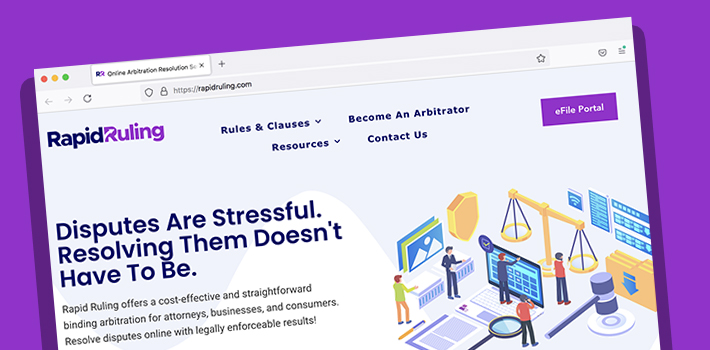 When a funder is unable to resolve a breach of contract with a customer on its own, litigation may seem like the only option left. But there may be an alternative, a process known as arbitration.
“Arbitration is a creature of contract,” said Zachary Meyer, a partner at a law firm. Meyer is also the co-founder and Chief Administrator of RapidRuling, an arbitration forum that has recently experienced an uptick in cases from the small business finance space. An arbitration forum is an alternative to the courthouse, where disputes are adjudicated by an arbitrator instead of a judge. It’s binding. The prevailing party, for example, can take an arbitrator’s award to the Court and turn it into a judgment.
Meyer told deBanked that part of the original vision for RapidRuling was an entirely online system that would prevent one or both parties from having to incur travel costs to participate. The overall cost of arbitration for a respondent in Montana, for example, would go up if they had to pay for a flight to New York City just to appear for it. “It’s beneficial for the [respondent],” Meyer said.
But in 2019 when RapidRuling first launched, the industry was already well accustomed to relying on AAA, the acronym for the American Arbitration Association. AAA, which was founded in 1926, resolved more than 300,000 total cases in 2019 alone. But then, Covid hit.
“It was like a perfect storm,” Meyer said. As the court system ground to a halt and struggled to move online, an all-online arbitration forum like RapidRuling suddenly had significant appeal. Meyer explained that the forum’s low filing fee compared to alternatives also grabbed attention. It understandably took off.
But the path to arbitration, including which forum to rely upon, may all hinge on the original contract itself, which a funding company’s attorney should carefully draft. Copying and pasting a random contract off the internet, for example, carries great risk, Meyer explained, because one may later discover a boilerplate arbitration clause to be limiting or disadvantageous.
RapidRuling’s website describes its arbitration process in four steps:
1. Submit Your Dispute
2. Wait For Opposing Party To Respond
3. Arbitrator Reviews Submissions
4. Receive An Arbitration Award
Contrast that value proposition to litigation, which depending on the circumstances could be drawn out for years.
RapidRuling seeks out arbitrators that are well-qualified, fair-minded, and diverse. “We have a panel of six arbitrators right now,” Meyer said, “and we’re looking to add more.”
David Picon the Recipient of the Greg Nowak Impact Award
June 16, 2022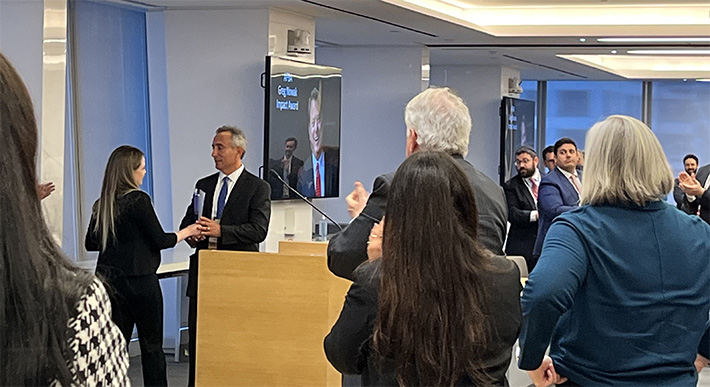 The Alternative Finance Bar Association named Proskauer partner David A. Picon the recipient of the AFBA Greg Nowak Impact Award. Picon, who was also the keynote speaker of the AFBA conference, was selected by the association’s members for his all-around efforts for the legal community both on matters of law and outside of it.
Greg Nowak, who passed away suddenly last year, was a partner of Troutman Pepper and a beloved founding member of the AFBA. His wife and son were both present for the heartfelt moment in Nowak’s honor.
New Owner of Loan.eth Says its Worth Millions
June 8, 2022 Less than two months after spotlighting a new domain name market linked to the Ethereum blockchain, the name loan.eth was sold on a secondary market for the equivalent of $45,000. It’s not a website domain like one would expect with a .com or a .net, but rather a crypto wallet address shortener that can double as a screen name and authentication service on web 3.0. That’s just the tip of the iceberg of the utility that a .eth domain can offer.
Although most people may not be familiar with .eth domain names, the new owner of loan.eth, who goes by @BloomCapital_ on twitter, is so confident that such names will be adopted in the future, that he believes the value of this one will be many times what he paid for it.
“Just so it has to be said, Loan.eth won’t be sold for less than $10M,” Bloom wrote. Bloom said he considers loan to be the top .eth name that he has.
The Alternative Finance Bar Association Conference is SOLD OUT
June 7, 2022Next week’s Alternative Finance Bar Association Conference has already sold out. The exclusive go-to event for industry attorneys takes place on June 15th and 16th in New York City.
Thirteen organizations are sponsoring it, including deBanked. The AFBA provided the attached graphic to showcase who they are:
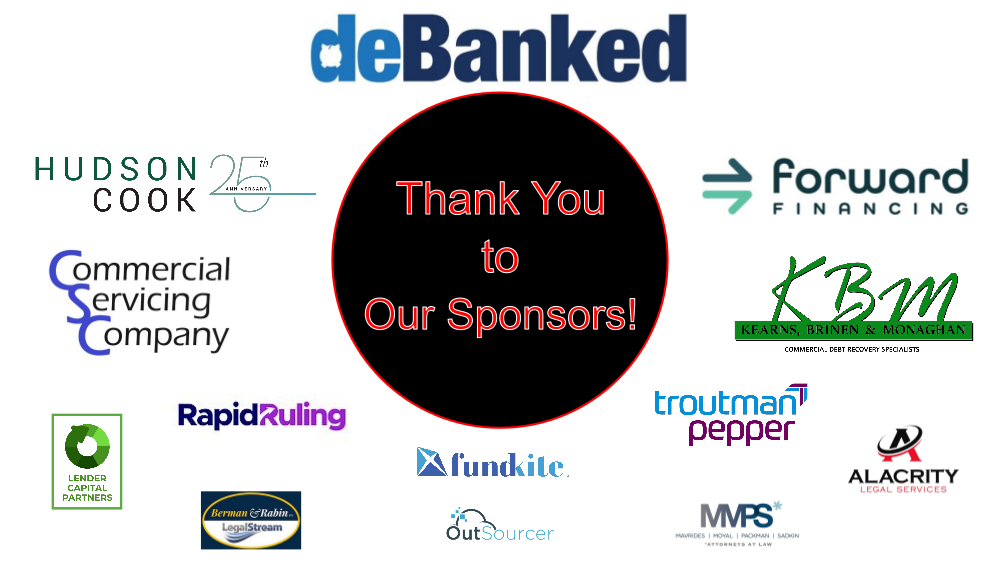
deBanked plans to have three representatives present. For information and inquiries about the event, please contact Lindsey Rohan at lindsey@lrohanlaw.com. This event is sold out.
Grand Opening of Latin Financial’s New Office Joined by Public Officials, Family, and Friends
June 4, 2022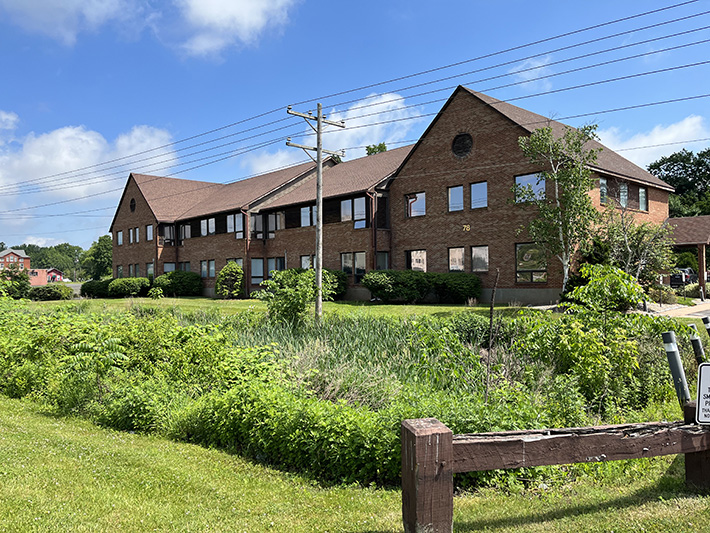 Just a few miles outside of Hartford, cars exited the highway and advanced towards a quieter part of Connecticut. The aptly named “Beaver Road” is home to Wethersfield’s US Postal Service building on one side and the Connecticut Farm Bureau building on the other. Drivers veered towards the latter and pulled into a parking lot situated behind a literal babbling brook. There are other tenants besides the Farm Bureau in the expansive brown-bricked commercial-use building as indicated by a sign outside, but the business that people had come to celebrate hadn’t even been added to it yet.
Nevertheless, the blue and white balloons waving in the wind outside the back entrance were a clue that this was the right place. Inside, on the first floor, a line of people found the large plated logo of Latin Financial, a small business that helps other small businesses obtain working capital.
Already personally acquainted with the firm led by Sonia Alvelo, she led myself and others on a tour of the company’s new space. Latin Financial employees were easily identifiable by their blue company shirts, but others wore green to signal that they were part of a sister company named Sharpe Capital. Sharpe is spearheaded by Brendan P. Lynch.
Both brands previously operated in nearby Newington but outgrew what they had. When the ceremony officially kicked off with some impromptu speeches, the prominence of those assembled became evident. It included, among others, the Better Business Bureau, the local Chamber of Commerce, and the Connecticut Children’s Hospital.
Wethersfield’s mayor, Michael Rell, was also there. Rell welcomed Latin Financial to the neighborhood, echoing the note sang by other government officials.
Connecticut State Senator Matthew Lesser shared his appreciation for Alvelo and her company’s mission to provide capital to underserved small businesses both in the state and across the nation. Lesser explained that the state legislature had recently decided to delay a proposed commercial financing bill (Senate Bill 272) so that it could further assess the input from companies like Latin Financial and the potential impact it would have before moving forward. A version of the bill will be reintroduced next year.
Meanwhile, Joseph Rodriguez, Deputy State Director for US Senator Richard Blumenthal’s office, said that he was impressed by the company’s accomplishiments and contributions to the community. He presented Alvelo with a Certificate of Special Recognition signed by Blumenthal in honor of her new office and for her service to Connecticut Small Businesses.
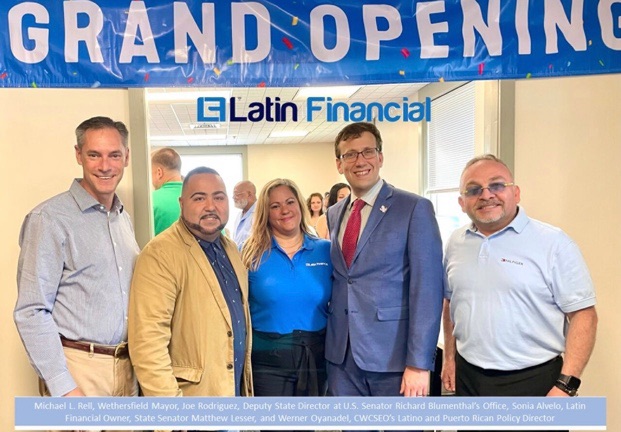
Werner Oyanadel, Latino and Puerto Rican Policy Director at the Connecticut General Assembly’s Commission on Women, Children, Seniors, Equity & Opportunity, said that Alvelo had “been a good partner of [their] work at the Capitol” and that “Latin Financial is filling a big void assisting new businesses and Latino entrepreneurs’ access to needed reources.”
Employees of both Latin Financial and Sharpe appeared excited by all the fanfare while friends and family members were proud to share in the moment. Alvelo ceremoniously cut a blue ribbon for the cameras and in conversations that followed it became known that they were hiring.
Alvelo has previously spoken at Broker Fair in New York and deBanked CONNECT Miami. She has been a primary source of information for deBanked since 2016 on matters regarding small business financing in Puerto Rico.
Who Needs The Merchant Cash Advance Keyword Anyway?
May 31, 2022 Almost five years since Google banned its search engine from displaying ads when queries contain the phrase “cash advance,” the loss of business attributed to that has probably been nil to the small business finance space.
According to Google, despite there being between 100,000 to 1 million searches for “cash advance” each month on average, only 1,000 to 10,000 searches per month are specifically for “merchant cash advance.”
People are ~10x more likely to search for business line of credit, business loan, working capital, or business credit card, according to Google’s estimates.
This is somewhat in line with findings from the Federal Reserve, whose recent study determined that 7x more business owners seek out a loan or line of credit than they do a merchant cash advance.
But putting that aside, the ban on paid advertising for all things cash advance has had an upside for some lucky companies. Without ads, Google has inadvertently (or maybe intentionally) elevated funding providers that are local to the searcher to the top of the organic results. That means listings on Google Maps that contain keywords matching the search queries are reaping the benefits of being prominently placed at the top of the page and are potentially capturing all the clicks along with it. The end result is an old-fashioned SEO war to win what few searches there are.
Compare that to a search for sba loan where paid advertising is fair game. In the era of PPP and EIDL, it’s perhaps no surprise that there are between 100,000 to 1 million searches per month for that keyword on average. Many of those searchers will probably not be eligible for an SBA loan so perhaps the next best fit would be equipment leasing or invoice factoring, two queries that are on par with merchant cash advance in average monthly searches, meaning volume is relatively low.
But how does low search volume turn into the large volume of funding originated? Well, another factor has changed since Google implemented the cash advance advertising restriction in 2017, and that is that Google is not as relevant as it used to be. Business owners are more likely to discover a potential capital source from social media or a fintech platform they already have a relationship with than ever before. According to a recent study, 25% of people claimed they had actually used either Alexa, Siri, or another voice assistant to find information about financial services, signaling a major departure from how traditional searching used to be conducted.
All of which means that the paid advertising restriction on a niche keyword on Google is unlikely to make any kind of difference in the big picture. Odds are you might not have known this restriction even existed. Bing, on the other hand, has no qualms with cash advances and allows paid advertising on it.
Lender / Broker Ecosystem Transparency Solved
May 4, 2022What happens when a broker sends in a deal and is told it’s declined, only to find out that it was approved and funded for another broker? Usually, a very angry post on social media. The problem is that everyone wants maximum transparency, but how to get it? Who can trust who? What can be done? When will someone do it?
Well, call me insane, but I’ve taken a crack at solving it. And don’t get mad at me because I use the word blockchain because I promise this is not about crypto. Everything would still be ACH-based and recorded just as you already do it, but this little piece of tech would sit underneath it without any manual effort. All automated. No work. Also, it’s possible I’m just totally wrong or have missed some possibilities. You be the judge. Realistic or dream world?
1. Brokers and Merchants don’t need to use the blockchain or know how to use it.
2. A dev at a lender justs need to understand digital wallet addresses and a little feature about them called Non-Fungible Tokens to build or implement a third-party add-on of this. (These “NFTs” have nothing to do with art, they are just uniquely identifiable text files logged into the blockchain with metadata inside them.)
First, here’s my diagram:

Here’s what it’s doing:
1. When brokers sign up with a lender, the lender assigns a uniquely identifiable blockchain wallet address to them on an automated basis.
2. When a broker sends in a deal, the lender creates a unique encrypted hash of the applicant’s bare minimum identifiable data (like last name and EIN #). This hash is placed into a text file in plain english along with the applicant’s application data encrypted. (also automated).
3. The lender creates a Non-Fungible Token from the broker’s wallet address and sends it to the lenders’s official submission wallet. (automated). This wallet will show the NFTs for every deal ever submitted to this lender. Nobody will be able to reverse engineer info about the deals and only the broker who submitted the deal will be aware of what the hash of the deal is. This gives them a chance to view exactly when their deal was logged and if there’s any duplicate hashes in the wallet that would signal that same deal had already been submitted by someone else and when it was submitted.
4. If the deal is approved by the lender, the lender pays the broker and funds the merchant via ACH like normal. Then the lender creates an NFT with the same public hash and sends that one to its approval wallet. The original NFT sent to its submissions wallet is now sent to the broker’s wallet, signaling that they have been awarded the commission on this deal. (automated).
5. If the deal is declined, the lender creates an NFT with the same public hash and all the NFTs for this deal are sent to the decline wallet, signaling that the deal was killed and nobody was awarded the commission on it. (automated).
Every deal’s NFT has to eventually be moved to approved or declined. They can’t sit in submissions in perpetuity.
End result: brokers that submit deals can see if their deal has been submitted before and when it was submitted. Brokers can verify if the deal was funded, when, and if commissions were paid to someone. No actual money is changing hands via crypto (though there might be transactions fees to move NFTs around.) Investors and regulators can also examine the flow and if necessary, be given access to a private key so that they can unlock and view the metadata in the submissions, approvals, and declines themselves.
Naturally, everyone’s first question is: what happens if the lender tries to bypass this?
1. A broker who submits a deal that does not see an NFT created for it in the lender’s submissions wallet, already knows that the lender is trying to operate outside the system. Time to move on!
2. A lender that shows a deal was declined and commissions paid to nobody could be easily discovered if the borrower shows a statement with proof that they received a deposit. No need to speculate what happened. Time to move on!
3. A broker that submitted a deal first can show that its deal was logged first in the submissions wallet. Anyone on social media or the public square could also confirm that and the lender could not manipulate the data to play favorites.
4. Lenders that operate outside of it would show little-to-no submissions or approval volume, signaling to a broker that for some reason they do not want the anonymized data auditable.
5. Lenders that are not real that go around pretending to be a lender just to scoop up deals would be hard-pressed to provide the three verifiable wallet addresses showing the volume of submissions, approvals, declines, and the respective ratios for the latter two. If they can’t show that they’ve ever done any deals or paid commissions, even if you can’t see what the individual details are, they’re not real.
6. After a lender moves the deal’s NFT to a broker’s wallet to signal they’re being awarded the commission, it’s possible the lender does NOT actually ACH the broker the commission. In that case, the broker would have a nice verifiable public display that shows it was supposed to be paid the commission for all to see. Public pressure ensues.
7. If the lender secretly pays a broker the commission but then publicly marks the deal as declined so that another broker who sent in the same deal doesn’t suspect what happened, well then the broker who got paid is going to be suspicious that the lender could do the same thing to them. There’s an incentive to be honest.
8. Merchants need not know about any of this. It doesn’t concern them.
9. The broker does not interact with the blockchain in any way except in the case it just wanted to view the data.
10. The lender does not have to manually interact with the blockchain at all. The system would just be bolted on to an existing CRM. It would do all the above by itself.
New Domain Name Gold Rush Sets Up Possible Battle for Future of SMB Finance
April 25, 2022 If you could have businessloan.com or businessloans.com as your website, would you jump on the opportunity to get it?
It’s evident that the market for keyword-based domains has evolved over time. Couldn’t get the .com? You could’ve tried to get the less coveted .net or .org. Don’t like those? Today, you can get the .business, .deals, .financial, .loan, .loans, or hundreds of other customized tlds. With so many to choose from, most experts in the field would advise that if you don’t own the .com version, to not even bother getting cute with customizations for your brand or keyword because customers will just get confused.
But recently, another domain name market has quietly been gaining steam. It’s for something called a .eth, an Ethereum blockchain-based crypto address shortener by the Ethereum Name Service. It’s not necessarily something one could use to build a website with, at least not yet. Originally envisioned as a way to condense long impossible-to-remember crypto wallet addresses into memorable words, users have started to buy up a bunch of keywords that may be familiar to deBanked readers. Just to name a few:
- businessloan.eth
- businessloans.eth
- smbloans.eth
- merchantcashadvance.eth
- ach.eth
- syndication.eth
- lending.eth
- ppploan.eth
- underwriting.eth
- brokers.eth
- loanbroker.eth
- mca.eth
- factoring.eth
- funding.eth
- backdoored.eth
At face-value, this might appear to be a vanity crypto play, one in which one could send crypto to your-name-here.eth instead of trying to type out a long address like: 0x64233eAa064ef0d54ff1A963933D0D2d46ab5829. But an ENS domain name holds much more potential than just that. It’s moving towards becoming the backbone of one’s identity in the upcoming era of the web called web 3.0 (web3 for short). Instead of having to remember passwords for hundreds of websites, identity can be validated through one’s digital wallet. Such a concept is not theoretical. It’s already being used.
 Take seanmurray.eth for example. You could send eth, bitcoin, litecoin, or dogecoin to it, but at the same time it’s connected to an email address and a url (this one). Plus it’s linked to an NFT avatar (broker #7 from The Broker NFT collection) which is in that wallet. I can use it to do an e-commerce online checkout in 5 seconds without ever needing to enter any payment information even if I’ve never visited the site before. It’s faster than PayPal and with less steps involved. I can connect it to my twitter account, OpenSea, or use it to vote in an official poll without ever having to create an account on something. The wallet is the identity verification. The .eth name, therefore, has the potential to become the defining baseline of who or what one is on the internet. Not theoretically. It’s already happening.
Crypto is already starting to creep into the small business finance industry. In August, a funding company announced that it would begin offering commissions and fundings in crypto because of the speed potential. Far from being a gimmick, brokers started to choose crypto payments over ACH or a wire because of how fast it would be. There’s also no chargeback risk with crypto.
Currently, the owner of mca.eth has listed the domain for sale on OpenSea at a price of 20 eth (approximately $60,000). That’s less than what MerchantCashInAdvance.com sold for in 2011. Perhaps the value of an Ethereum Name Service domain holds less promise than a website that ranked well on Google in 2011. But then again, being well ranked on Google is not as important as it used to be. It’s impossible to say what, if any impact web3 will have on the small business finance industry long term, but for now there are those out there quietly buying up names like ach and funding and syndication on the chance that they will become something.