Qwave Fails to Acquire IOU Financial, But Becomes Major Shareholder
September 24, 2015 After some tense fanfare, Qwave Capital failed to acquire a controlling stake in IOU Financial but has succeeded in becoming a major shareholder. In a published statement, Qwave manager Serguei Kouzmine said, “As a significant shareholder in IOU, I plan to work constructively with the Board of Directors to ensure the company is focused on growing profitably and creating value for all IOU shareholders over the long term. I appreciate the support my offer has received and look forward to helping IOU realize its potential.”
Nearly 15% of the company’s issued and outstanding shares were acquired under the offer.
Qwave stands to materially benefit in the long run especially since the timing coincides with IOU Financial hitting historic milestones.
“The Company’s loan originations for the months of July and August, totaled US$31.3 million, representing a year over year increase of 150% in comparison to the same period in 2014,” IOU announced.
They also funded more than $100 million in 2014 and if that volume is a metric that anyone is measuring then IOU is substantially undervalued.
If the takeover attempt accomplished anything, it may have stirred IOU from a slumber at just the right moment in alternative lending history. They’ll be a lender worth keeping an eye on.
5 Signs Your Merchant Needs to Go To a Collection Agency
September 23, 20151) Merchant avoiding phone calls, emails being returned and no live voice when a call is made

2) ACH accounts being closed with promises to open another that never happens

3) Mail being returned and when you speak to landlord they say “they left in the middle of the night”

4) Claims of Bankruptcy filings but does not provide attorney information

5) Merchant shows signs of stacking
These are just a few red flags that indicate an agency specializing in your industry needs to get involved immediately.
BFS Capital Joins the Ranks of Consolidated Powerhouses in Alternative Lending
September 21, 2015 Coral Springs, FL-based Business Financial Services has joined the ranks of consolidated powerhouses with the announcement of their rebrand to BFS Capital. As part of the move, the company has unified its North American business affiliates.
Entrust Merchant Solutions, GBR Funding and Premium Capital Group will now also use the BFS Capital name. Entrust, who was acquired by BFS Capital on August 26th, has become the firm’s direct sales division. Ilya Fridman, Entrust’s former CEO, is now a Senior Vice President of BFS Capital and will oversee sales.
Boost Capital, their UK arm, is not changing its name.
BFS Capital is the latest small business funding provider to consolidate their affiliates and change their name.
Already this year, Merchant and Cash and Capital became Bizfi, AmeriMerchant became Capify, and RetailCapital became Credibly. Industry insiders have noticed one thing in common about all these changes, that they’re memorable.
“I think people are thinking about going public and want names that are easily identifiable more than wanting to sound techy,” said John Celifarco, Sales Manager at NY-based Sure Payment Solutions. “Maybe a little of both.”
When deBanked previously asked Rory Marks, a Managing Partner of NY-based Central Diligence Group, about the name recognition-value of certain funders in the industry including Business Financial Services, he said “when choosing to use words that are ubiquitous in the industry, it could be difficult to distinguish yourself. Ultimately this could potentially impact the customer’s ability to fully understand the nature of your business.”
Business financial services could be confused as a genre or a category, a few insiders commented, instead of a company name.
The BFS Capital brand should remedy any confusion, although Justin Benton, Executive Loan Producer of Lenders Marketing shared, “a simple name that conveys what you do has value, not only in the eyes of your potential clients, but in the eyes of search engines like Google. At the end of the day, if you do your job well and the client is pleased with the loan product and service you provide, your name will be positively associated as a trusted resource.”
Business Financial Services has long been referred to as BFS by industry insiders so unlike other funders that completely transformed during their rebrand, BFS Capital may retain more of their previous name’s goodwill.
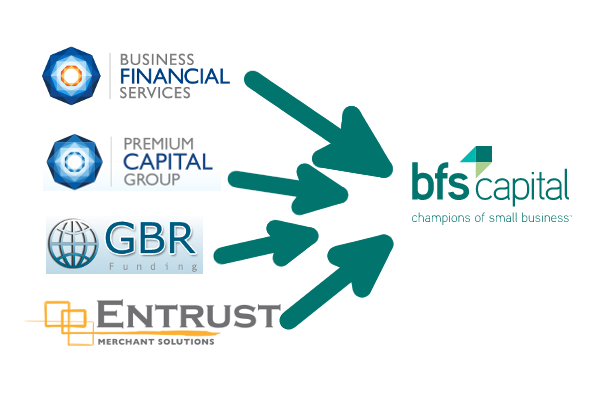
“Bringing all your companies under one umbrella can bring each company’s unique strengths together in one collective effort, rowing towards one common destination,” said Benton.
BFS Capital has been a hot news item this summer. In July, they surpassed $1 billion in lifetime funding.
IOU Financial is Playing Offense in 11th Hour
September 19, 2015 Perhaps jolted awake by corporate raiders attempting a hostile takeover, IOU Financial is making some bold moves and issuing some optimistic news. Yesterday on September 18th, IOU announced that they took home a profit for the months of July and August and in addition signed a letter of intent for a credit facility of up to $50 million. They also said that the board has received an offer to proceed with a private placement of up to $10 million in principal amount of convertible debentures, with committed subscriptions in excess of $7 million.
It should be noted that neither is guaranteed and a letter of intent is not a closed deal. The lender’s loan originations for the months of July and August, totaled US$31.3 million, representing a year over year increase of 150% in comparison to the same period in 2014.
IOU is fighting to stave off Qwave Capital, a VC firm that recently made a formal bid to buy a controlling stake for $17 Million CAD. IOU’s board has adamantly rejected the offer and has been urging share holders to turn it down.
The offer expires at 5pm EST on Tuesday, September 22nd.
“We continue to believe Qwave’s Offer provides IOU shareholders with excellent value, liquidity and opportunity,” said Serguei Kouzmine, a manager of Qwave Capital in a release dated September 17th. “The IOU board has failed to deliver an alternative offer, has repeatedly refused to act in the best interests of all shareholders, and has approved related-party transactions that put insiders first. We think IOU shareholders deserve better, and we’re asking them to tender their shares and partner with us to help IOU realize its full potential.”
Lead Management Fundamentals: How to purchase qualified leads
September 16, 2015 “I’ll never buy another lead again,” says a disgruntled sales person after failing to close quickly leads. Being in the lead business, I hear this all the time. Rarely do you hear, “I’ll never advertise again.” Yet, in many cases 99% of the people who see your ad won’t buy your product or your service. (Advertising serves other purposes like branding, but for most small businesses, advertising is to produce sales.)
I once did a consulting job for a company that sold uniforms to Fire and Police depts. Their shtick was to send out catalogs every quarter and hope that 0.25% of those receiving the catalogs bought. Compare that to the Victoria’s Secret catalog that gets 11% of its catalog receivers to purchase. Uniforms are not as sexy as lingerie. But there is a huge gap between 11% and .25%. Even with such a small return on its catalog, this company was profitable.
In the lead business, the standard is raised even higher. A 0.25% response rate on leads does not work because you will typically pay a higher cost for a lead campaign than an advertising campaign. Besides, lead campaigns are a more targeted approach rather than the rapid fire shot gunning of advertising.
A good lead campaign should be bringing the buyer and seller together. A good lead campaign may only close 5% to 25% of the leads purchased. The percentages vary according to the industry. By comparison, on average only 2% to 3% of the clicks in a Google Merchant Cash Advance PPC campaign convert to sales. A reputable lead generation company can provide better averages than Google and in the MCA industry, it can deliver leads at a lower cost. There is real value in purchasing qualified leads.
Where I see most companies make a mistake in purchasing leads is that they focus on price rather than qualitative aspects of the leads. One of the most basic questions to ask is how the lead generation company defines a lead. (Data brokers like to say they are selling leads. Instead they are selling you contacts. Contacts are not leads. Contacts are information.)
A lead is a merchant who is in the market to buy a product or a service and is somewhere along the buying cycle and is willing to discuss purchasing the product or service with vendor(s). The real key phrase is “somewhere along the buying cycle and is willing to discuss with vendor(s).” This implies intent on the part of the merchant. Without intent to purchase, the merchant is simply window shopping.
The second area to focus on when purchasing fresh leads is to find out how the leads are qualified and optimized. Many lead generation companies rely on data scoring to qualify their leads. They simply scrub the leads against a database and those leads that meet a certain score are considered qualified. There is no attempt made to discover the intent of the merchant.
Lead generation is a people to people business. Phone qualification is the best qualifying approach. Phone qualified leads are some of the best optimized leads on the market because a good lead company will make sure that the merchants meet the minimum standards, that they have demonstrated intent to purchase, and that the expectations have been set on what is to happen next. (As can be expected, phone qualified leads offer some of the highest contact ratios as well.)
If you want to close more leads, make sure that the leads you are buying meet the criteria above. If you do, you will see your sales soar.
Who’s On Your Fantasy Funding Team?
September 14, 2015 A few years ago, a friend of mine was dropped by the funding brokerage he worked for and put on the waiver wire. He was promptly picked up by a competitor and today ranks among one of the top closers in the industry. It was one of the strangest moves of the season because his numbers had been really good month after month. It turned out that he was turned loose for earning too much money, something the firm wasn’t content with.
Even though he was compensated on a commission-only basis, he was apparently putting the company over their salary cap. That of course begged the question, why was there a compensation cap for a top performer, somebody who was directly leading to the firm’s growth? For what it’s worth, he was entitled to approximately 20% of the company’s gross commission revenue. So on every deal funded the company took home the other 80% of the commission. This worked for both parties until the closer started earning well into the six figures, at which point they told him he wasn’t allowed to earn more than a certain amount.
Although discouraged by the sudden limitation, he continued to work hard to prove why the cap should be removed. It wasn’t. Soon afterward he found himself on the waiver wire.
He was replaced by two rookies fresh out of college who were willing to do the same job for a lot less, but neither had any experience in the field.
As someone who has been active in this industry for nearly a decade, I’ve watched this scenario play out dozens of times.
- Firm needs top talent to grow
- Firm hires Talent
- Talent produces
- Firm grows
- Firm doesn’t like that Talent is making so much
- Firm fires Talent or Talent quits
As the firms gallop off to the next scouting combine to find somebody younger and more malleable, the pool of experienced talent is dispersed across a sea of competitors. A consequence of this is that each of those companies become more evenly matched and it becomes increasingly difficult to stand apart from the crowd.
At trade shows and happy hours, it’s not uncommon for top players to openly question what would happen if they all joined forces to create a funding dream team of sorts. And while such cohesion rarely actually happens, I can’t help but imagine if given the opportunity to build the best team to win, who I would pick.
Top talent is expensive. I know this because I recently spent 89% of my budget in a fantasy football auction draft to acquire just three players. And last year I spent a similar percentage on only four players and won the entire league. My thought process was to build a team that was centered around the best of the best. Previous years of conservative play led to mediocre results and I wanted to change that.
Today, there are hundreds of alternative business financing companies and thousands that can be considered brokers. There’s a lot of decent teams out there but few that are built around a group of all stars. And oddly, some companies seem to be dumping their best and brightest on purpose, just like I described previously. That might lead to improved margins for the firm, but probably won’t help them win in the long run.

Here’s something to think about while you’re watching Monday Night Football. If you had to build your company around a core group of talented people, who would you pick? Don’t worry about whether or not they’re available or if they fit into your budget. Those are obstacles that can be overcome.
Here’s a list of positions to help you imagine your fantasy funder:
- 1 Senior Manager
- 2 Underwriters
- 2 Closers
- 1 Flex Spot
- 1 Admin
- 1 Collector
- 1 Tech Person
Good luck!
Yellowstone Capital to Drive Job Growth in New Jersey
September 11, 2015 According to Business Facilities Magazine (BF), NYC-based Yellowstone Capital is considering a move to Jersey City and was approved for up to $3.3 million in Grow NJ tax credits over 10 years.
Grow NJ is a New Jersey job creation program that is designed to give the state a competitive economic edge against surrounding states.
BF says that Yellowstone Capital would create 45 jobs.
The move would loosen the grip that Manhattan’s financial district has on the fast growing alternative business financing industry. Currently located at 160 Pearl Street, just steps away from Wall Street, Yellowstone surprised many industry insiders several months ago when their lifetime funding figures of $1.1 billion were published on the industry’s leaderboard.
A move to the Garden State would not be surprising in the midst of all the infrastructural improvements the company has made in 2015.
Competing Factions Hurt Alternative Lending’s Message
September 10, 2015 It’s over. Legislators and regulators in Washington DC know alternative lenders exist, and there’s no going back. There will be regulations that impact the industry in some way. That seems to be a definite at this point. What aspects will be regulated and to what extent however is yet to be determined.
And here’s the important thing you need to know about that impending conversation with folks in DC; They’re not up to speed on many of the issues being debated between industry insiders, and honestly probably won’t be for a long time, if ever.
They’re literally on square one. So if you were secretly hoping that regulators were on the verge of outlawing stacking, excessive broker fees, or high interest rates, you’re going to be very disappointed. I would argue that more than likely they’d have no idea what you were talking about if you broached these issues with them and it would come across like this:

And that’s because they’re trying to fully understand more basic things such as, why would a small business borrow money online as opposed to a bank? And what does marketplace lending really mean and how does it work?
Folks in DC are genuinely curious about the basics. They want to understand because they don’t want to be caught not understanding and ignorantly lead the nation into another financial crisis. That’s why the Treasury recently issued a Request For Information. You should notice how there’s nothing about stacking in it, but rather more fundamental issues like whether or not marketplace lending is helping borrowers that were historically underserved.
You have to applaud the Treasury’s approach because informed regulations, if that’s what this all leads to, would be much better than uninformed regulations.
The process could easily be jeopardized however if everyone’s so caught up in choosing teams, sides, and points of view that they believe are the “right” ones with the hope of scoring nothing other than perceived political points.
If this is what folks in DC see while they are in the information gathering stage, well then it’s probably not going to be a good outcome for anyone:







Companies that buy future receivables with daily payments and lenders originating 3-year loans with monthly payments actually have a lot in common on the fundamental level. They’re both bank alternatives. And for a number of reasons, small businesses are choosing them over more traditional sources. That’s where the conversation needs to begin.
The opportunity to communicate with rule-makers shouldn’t be squandered on complaints about what other people are doing, but rather on the what, why, and how for small business.
The worst thing that could happen is that divisive language within the industry leads to a regulatory result that negatively impacts all the parties involved, including the small businesses that benefit from this improved system of accessing capital.
Surely there is a way forward for everyone…