
Stop Saying Alternative Lending Isn’t Regulated
October 7, 2015 I cringe every time I hear someone say that alternative business lending or merchant cash advances are completely unregulated. It’s true as a generality that there are fewer restrictions on commercial transactions than there are on consumer transactions, but fewer doesn’t mean none. If you are operating your funding business with the impression that it’s all unregulated, then you’re probably doing it wrong and should hire a lawyer (or several) immediately.
Things like interest rates, truth in advertising, and the banking system are already regulated. Who can invest and what has to be disclosed in an investment is regulated. Email marketing and telemarketing are regulated. The ACH network is regulated. Credit card processors and payment networks are regulated. Credit reporting and the process of declining someone for credit is regulated.
As de-banked as merchant cash advances and non-bank loans look, they all go through the traditional banking system and still obviously operate under state and federal laws just like everyone else. That means compliance with the OCC, OFAC, FED, FCC, FTC, SEC, IRS, state regulatory bodies and more. So when critics say there are no regulations in place for these products, one has to wonder what the heck they’re talking about.
In the context of merchant cash advances, there’s a pervasive myth that the process of purchasing future assets is really all just a loophole to charge Annual Percentage Rates (APRs) in excess of state usury caps. I can’t speak on behalf of all purchase agreements in general since every financial company structures theirs differently, but in a true purchase of future assets, it is literally impossible to calculate an APR. It’s not just a matter omitting the word loan from the agreement either, it’s the uncertainty of the seller’s future sales to which the agreement ultimately hinges upon (among other factors), that make such a calculation indeterminate even if one wanted to generate one just for comparison’s sake. These are purely commercial transactions that fall under the umbrella of factoring and they have no basis for comparison with loans. Oh, and they’re not new.
According to wikipedia, “factoring’s origins lie in the financing of trade, particularly international trade. It is said that factoring originated with ancient Mesopotamian culture, with rules of factoring preserved in the Code of Hammurabi [about 4,000 years ago]. Factoring as a fact of business life was underway in England prior to 1400, and it came to America with the Pilgrims, around 1620.”
 While the subtle nuances of merchant cash advances may only be a couple decades old, the system on which they’re based precedes the arrival of Jesus. That makes the concept understandably new… if you’re a Stegosaurus.
But here in modern times, the courts in many states have reviewed these agreements and generally respect the arrangements when they are well-defined and compliant with state and federal laws. There’s that regulation thing again…
For funding companies that deal in actual loans, the industry is heavily regulated. The non-bank lenders we hear about on a daily basis have to acquire state licenses where applicable or forge partnerships with chartered banks to create a relationship in which the banks themselves are the ones that actually originate the loans. That means despite the excitement and fanfare of tech-based disruption, many of these lenders are really just servicing loans made by traditional banks. Kind of a bummer, isn’t it?
And when it comes to sales tactics, it’s important to remember that deceptive advertising is already illegal.
The regulation and compliance hurdles in FinTech are cumbersome even if some of the companies involved in the business appear scrappy and amateurish. According to a report that was recently published by accounting firm KPMG, titled Value-Based Compliance: A Marketplace Lending Call to Action, they offer a non-exhaustive list of federal legislation and networks:
- Anti-Money Laundering (AML)
- Bank Secrecy Act (BSA)
- Blue Sky Laws
- Card Act (CARD)
- Dodd-Frank Wall Street Reform and Consumer Protection Act
- Electronic Funds Transfer Act (EFTA)
- Electronic Signatures in Global and National Commerce Act (ESIGN)
- Equal Credit Opportunity Act (ECOA)
- Fair and Accurate Transactions Act (FACTA)
- Fair Credit Reporting Act (FCRA)
- Fair Debt Collection Practices Act (FDCPA)
- Fair Housing Act (FHAct)
- Financial Crimes Enforcement Network (FinCEN)
- Gramm-Leach Bliley Act (GLBA)
- Know Your Customer (KYC)
- Service Member Civil Relief Act (SCRA)
- Truth in Lending Act (TILA)
- Unfair, Deceptive or Abusive Acts or Practices (UDAAP)
- USA Patriot Act
Completely unregulated you say? You are sadly mistaken. =\
Federal Reserve Governor Lael Brainard Speaks About Alternative Lenders
October 4, 2015Federal Reserve Governor Lael Brainard gave the September 30th closing keynote address at the Community Banking in the 21st Century 2015 Conference and here are some of the highlights of what she had to say about online lenders and merchant cash advances:
The data that are available suggest that the various types of online alternative lenders have captured a small but rapidly growing share of lending since the financial crisis. In aggregate, the outstanding portfolio balances of these lenders have doubled every year since the mid-2000s. It is estimated that online alternative lenders originated $12 billion in 2014, with unsecured consumer loans representing $7 billion and small business loans accounting for approximately $5 billion.13 While this amount represents only a small fraction of U.S. unsecured consumer and small business lending overall, the rate of growth is notable.
Although rates vary by platform and borrower characteristics, when taking into account origination fees and repayment periods, the average annual cost of borrowing, or APR, associated with loans and credit products offered by online alternative small business lenders tend to be higher than those associated with traditional bank products. Reports suggest that some borrowers are willing to pay a higher price in exchange for an easy application process, a quick decision, and rapid availability of funds.
While some see online alternative lenders as a disruptive threat to traditional lenders, banks increasingly are finding ways to partner with online alternative lenders, including through loan purchases and referral agreements. Loan purchases by community banks of loans originated by online alternative lenders have been focused on unsecured consumer debt. As the percentage of unsecured consumer debt outstanding held by community banks has been declining in recent years, several banks have partnered with online alternative lenders to grow and diversify their portfolios of unsecured consumer debt.
In contrast to the consumer loan activity, the small business partnerships that have developed so far are largely fee-based referral partnerships. In these partnerships, banks refer to online alternative lenders some of their small business customers who are usually seeking loan amounts that the referring banks may see as too costly to underwrite and service, particularly in the size range below $100,000.
Across the Federal Reserve System, we are actively following developments in the alternative online lending space and have engaged with several alternative online lenders over the past few years to learn more about the industry, the technology, and the business models as well as engaging with bankers to understand how these developments are affecting their markets.Most recently, several alternative lenders have participated in events where we have joined with community development finance experts to discuss ways to adopt platform lending technology to better serve low- and moderate-income borrowers and small business owners.
We want to better understand the opportunities presented by technological advances that may bring new data to bear and help lenders make available credit to a more diverse set of small business borrowers. In some cases, partnerships between community banks and online platforms may help expand access to credit for consumers and small businesses, and help banks retain and grow their customer base.
As regulators, we also want to help the various stakeholders anticipate and carefully manage the associated risks. Of course, third-party and vendor risks are factors that banks should always take into account when introducing new products and services. Taking the time to identify and mitigate risks is a prudent step that banks can take to avoid unintended consequences when entering into partnership agreements with alternative online lenders. In addition, banks should consider whether the partnerships provide new opportunities to diversify their portfolios if they are purchasing loans, and whether the partnerships provide opportunities to offer new products that are a good strategic fit for their bank and their customers.
It is also important for banks to carefully consider regulatory compliance. When purchasing consumer loans originated by online alternative lenders, banks should examine whether fair lending or unfair or deceptive acts or practices issues result from the origination and underwriting methods used by online alternative lenders. To the extent that the underlying algorithms used for credit decisionmaking use nontraditional data sources, it will be important to ensure that this does not lead to disparate treatment or have a disparate impact on a prohibited basis.
Aside from these risks, banks should consider a variety of others, including the implications of credit risk stemming from the purchase of loans and reputational risk if referrals to online alternative lending platforms end badly.
The risks I have described so far have primarily been from the perspective of banks considering partnerships with online alternative lenders. Another important set of concerns are focused on the small business borrowers who may be considering online alternative loans. Some have raised concerns about the high APRs associated with some online alternative lending products. Others have raised concerns about the risk that some small business borrowers may have difficulty fully understanding the terms of the various loan products or the risk of becoming trapped in layered debt that poses risks to the survival of their businesses. Some industry participants have recently proposed that online lenders follow a voluntary set of guidelines designed to standardize best practices and mitigate these risks. It is too soon to determine whether such efforts of industry participants to self-police will be sufficient. Even with these efforts, some have suggested a need for regulators to take a more active role in defining and enforcing standards that apply more broadly in this sector.
Yellowstone Capital and Green Capital Join Family of Companies Under New Brand, Fundry
October 1, 2015deBanked has confirmed that Yellowstone Capital has restructured through the formation of a new parent company, Fundry. Green Capital is also another subsidiary under the Fundry umbrella.
With Yellow and Green together, the business financing industry just got a little bit more colorful.
Yellowstone’s CEO Isaac Stern and President Jeff Reece have become Fundry’s CEO and President respectively.

“We have a solid foundation and a very successful business model,” Stern said. “But to maintain a position of leadership in this industry, we need to grow and we are evolving.”
Yellowstone Capital has been the subject of several news stories lately, most recently by being approved for up to $3.3 million in tax credits to move their business from New York to New Jersey.
In April, it was revealed that Stern had led a management buyout backed by a private family office that made Stern the only remaining co-founder to retain an equity stake. And in June, the industry learned that the company had originated more than $1.1 billion in deal flow since inception, ranking them high above many of their more well-known peers.
The funding leaderboard which debuted in deBanked’s May/June magazine issue and was broadcast to attendees at the 2nd Annual AltLend conference in New York City, was in many ways a turning point for the industry.
“I would think there are many more branded funders that would have made the list but didn’t,” said Arty Bujan, Managing Member of Cardinal Equity. “Most shocking is Paypal’s $500 million.”
Richard Battista, Vice president of Business Development at theLendster commented on the eye-opening figures of the industry’s largest players in general. “This is a reflection of the explosive growth that the industry is experiencing at the present time,” Battista said. There is a huge demand for funding from small businesses, who have consistently expressed interest in trying out new funding options.”
Perhaps the story of Yellowstone Capital’s rise can best be explained by Grant McCracken’s Five Stages of Disruption Denial. McCracken, who is a Canadian anthropologist and author, known for his books about culture and commerce, explained the theory behind these five stages in the Harvard Business Review in April, 2013. They are Confusion, Repudiation, Shaming, Acceptance, and Forgetting.
Yellowstone Capital confused their competitors when they were first founded in 2009 by substituting split-processing payments for ACH to high-risk merchants. Very few people within the industry understood why they were using the ACH network over relationships with credit card processors that everyone else relied on.
That of course led to the repudiation stage where people thought they were crazy and that their model wouldn’t work and segued into shaming where the concept of providing working capital to high-risk businesses was perceived to be something that no one should do.
Through it all, Stern and his team believed many of America’s small businesses were still being overlooked and underserved despite non-bank financing and online lending growing by leaps and bounds.
“At what point do we stop helping small business?” Stern said to deBanked in response to an inquiry about whether or not some businesses are simply unfundable.
Today, we are in between the Acceptance and Forgetting stages. The ACH debit methodology has almost entirely replaced split-processing and dozens of funding providers claim to specialize in high-risk deals, the very same kind that the industry years ago didn’t understand and resisted.
Yellowstone Capital will serve as Fundry’s ISO relationship arm while Green Capital will serve merchants directly.
“2015 is our biggest year yet, but we really see it as a year of block and tackle work to set up for what needs to be done in 2016 and beyond,” said company president Jeff Reece.
“Yellowstone’s success will simply become the baseline for what Fundry is about to do.”
The Bad Merchant Database is Free, But Not the One You’re Thinking Of
October 1, 2015 Now you can find out if merchant cash advance and business loan applicants have engaged in suspicious activity with other funders for FREE.
For years, the only way to access such a database was through the Small Business Finance Association (SBFA but formerly known as NAMAA) and doing that hasn’t exactly been cheap or easy. As the SBFA describes itself as a not-for-profit trade association representing organizations in the United States and Canada, acceptance comes with adherence to certain trade association rules and fees often too high for smaller companies.
Just about every merchant cash advance company is aware of the SBFA’s shared database of bad actor merchants. It’s widely viewed as the biggest benefit to being an association member. It’s exclusive, almost too exclusive, many would say.
Enter DataMerch, the startup that’s disrupting it all by making the system open to funders… for FREE. Founded by merchant cash advance veterans, the company’s co-founders have replicated a product that the industry loved, but many could not afford or be accepted into.
deBanked has learned that DataMerch already has an active community of funding companies submitting suspicious merchant activity to the database.
Naturally, DataMerch’s tech-based platform made it a suitable fit to integrate the deBanked’s news feed into its member dashboard. The companies announced completion of the integration earlier this morning.
To sign up for DataMerch, contact support@datamerch.com
deBanked Magazine Cover Teaser
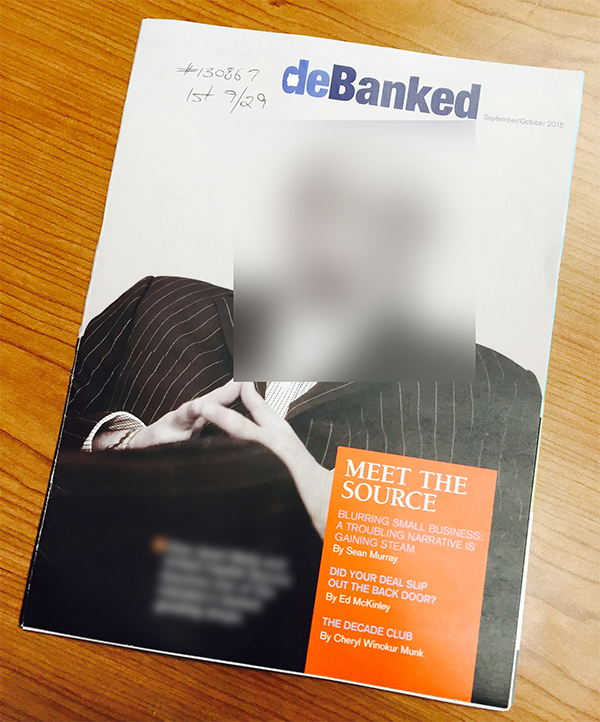
September 30, 2015Can you guess who is on the cover of the September/October magazine issue of deBanked? Make sure you’re subscribed to the magazine to find out who it is!
SUBSCRIBE HERE
What The BFS Capital IPO Announcement Means for the Industry
September 29, 2015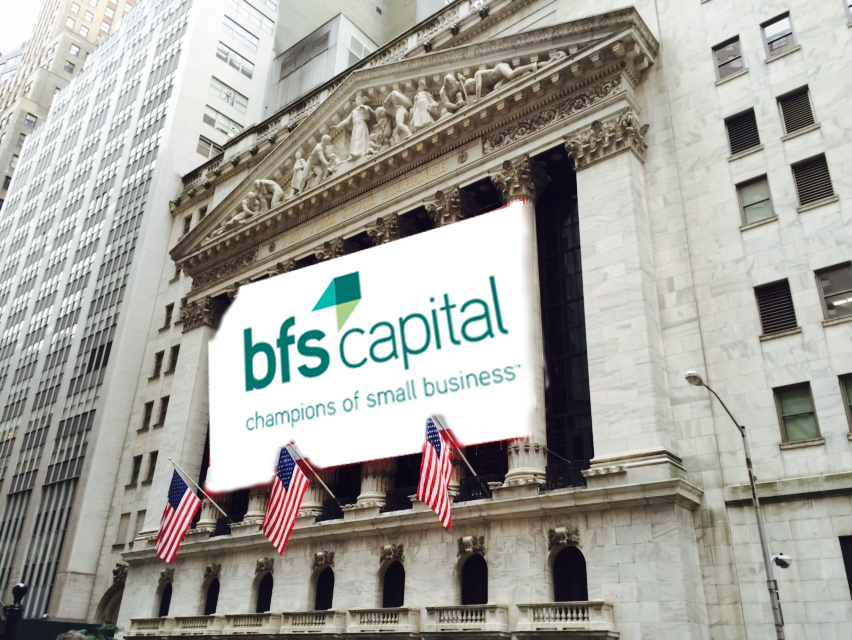 Under the Jumpstart Our Business Startups (JOBS) Act, “an emerging growth company may confidentially submit to the Commission a draft registration statement for confidential, non-public review by the Commission staff prior to public filing.”
According to the New Yorker, this process “allows companies that are thinking about going public to test the waters—they can gauge investor reaction, get feedback from the S.E.C. on their filings, and so on—before deciding if they want to go ahead with an I.P.O. If a company goes through that process publicly, and then decides to abandon the offering, its reputation gets damaged, even though it often makes sense for a company not to go public. Do it privately, and no one gets hurt.”
That’s what makes BFS Capital’s announcement (formerly Business Financial Services) that they had filed a confidential draft registration so bold. Companies normally choose this method if they don’t want anyone to know what they’re up to. But BFS is a different funder than the ones that came before them. OnDeck submitted their original draft registration confidentially for example and actually tried to keep it a secret.
“The initial public offering is expected to commence after the SEC completes its review process, subject to market and other conditions,” states BFS’s September 25th release.
The intent to go public follows a recent rebrand and the announcement that they had crossed $1 billion in funding since inception.
The most shocking part about a BFS IPO is that it’s not a CAN Capital IPO. While CAN is both older and larger, the industry has heard no word about a CAN Capital IPO since rumors leaked in Bloomberg almost an entire year ago. Back on November 20th, 2014, it was reported that the “New York-based company could be worth as much as $2 billion in the share sale.”
There was kind of a universal expectation that CAN Capital would go public immediately after OnDeck and Lending Club. Some insiders have pointed to OnDeck’s disappointing reception and performance as the reason CAN has delayed moving forward. OnDeck is currently trading at less than 50% of its IPO price and is facing a lawsuit from its own shareholders over it.
Others have said that CAN Capital isn’t waiting for anything because the company doesn’t actually need to go public. Long reported to be profitable and self-sustaining, opening themselves up to the volatility and fickleness of the public markets may not be worth the additional capital.
And still more have pondered if CAN Capital has what it takes to excite investors. Unlike some of the brand new tech startups that dominate the headlines, CAN has been operating since 1998, a time when only 42.1% of American households had computers and only 26.2% had Internet access. Of course the company has evolved and these days is as tech-equipped as their young brethren but a 17-year old lender may not be as easy to sell in a market obsessed with companies such as Uber, Snapchat and Airbnb.
BFS Capital was founded 13 years ago in 2002 so they’re not exactly new either. And their CEO, Marc Glazer, has led the company since its beginning.
BFS has been expanding however both here in the U.S. and abroad. In the U.K., they operate under the name Boost Capital. Meanwhile, independent financial brokerage firms such as Entrust Merchant Solutions are being acquired and rolled up into their organization.
What makes BFS different from OnDeck and Lending Club is that BFS also does merchant cash advances, not just loans. The only other publicly traded company that is significantly involved in merchant cash advances is Enova International and that’s only due to their recent acquisition of The Business Backer. The investor uncertainty surrounding lenders and marketplace platforms might not carry over to a company that got its start by purchasing future credit card processing receivables 13 years ago.
It would be safe to say that there’s a whole group of industry insiders who feel that Lending Club is a poor representative sample of the tech-enabled business financing space and that OnDeck’s unique model prejudices investors into thinking all lenders are like them. A BFS Capital IPO could in effect set the record straight for the industry and revive the IPO plans of their peers and competitors.
It might actually take a BFS IPO for us to finally see a CAN IPO, not that there aren’t plenty of other quality candidates right behind them.
What would a BFS Capital IPO mean for the industry? Perhaps a chance at redemption. There’s a lot of great things happening in this industry and investors ought to know about them.
OMG: Same Day ACH
September 25, 2015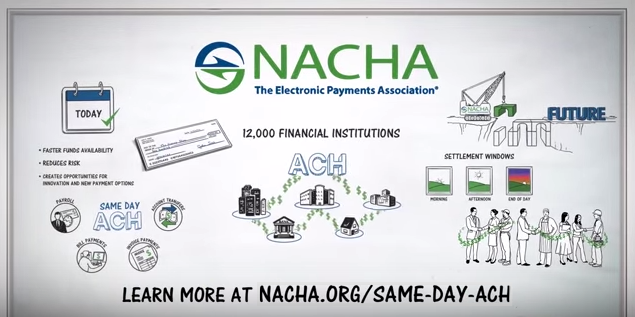 Coming soon, the ability to ACH funds same-day will finally exist. The change will be a boon to tech-based lenders that have become famous (or infamous) for their ability to approve and issue loans quickly. No matter how fast the systems have become however, the ACH network has continued to slow the process down.
Next-day funding has long made borrowers skeptical about the online lenders they apply to and many applicants become anxious when they hear that the funds will be in their account tomorrow rather than today, after the deal has been closed.
Speaking from my own experience, there was almost nothing worse than telling a merchant that the funds had gone out and would be in their account the next day because they would disregard the last part of that statement and check their bank accounts immediately and of course would not see those funds. They’d immediately reach back out to me or the underwriter and say that they had been deceived because no money was there. This scenario played out on at least half of all the deals I ever worked on and it was awful.
And I’d remind them, “It’s an ACH. It’s overnight. It should be there in the morning depending on your bank. If for whatever reason it isn’t, give me a call.”
Even after repeating myself, I’d often get an email later that day at 6 pm (bank closing time) to say that they were at the bank and the teller has just told them that they don’t see any incoming wires.
So many merchants just could not believe that a tech-based funding company could not make the money appear instantly in their account and every passing second caused them more anxiety and fear that they had been tricked.
Enter Same Day ACH, which is slated to launch in September 2016. According to the National Automated Clearing House Association (NACHA), who governs the ACH network, there will be two settlement times.
A morning submission deadline at 10:30 AM ET, with settlement occurring at 1:00 PM.
An afternoon submission deadline at 3:00 PM ET, with settlement occurring at 5:00 PM.
Virtually all types of ACH payments, including both credits and debits, would be eligible for same-day processing, according to their announcement.
The industry can’t get Same Day ACH fast enough!
And if you thought you were excited about ACHing, just watch the below video produced by NACHA about how awesome their network is.
Mr. Merchant: Help ME, Help YOU
September 25, 2015 As we close the 3rd Quarter in the Year Of The Broker, I thought that it might be imperative to blow off some steam. Industry forums, commentators and media reporters often rant on Brokers and Lenders by disclosing the inefficiencies of such parties. But I have yet to see (or hear) of anyone making a particular “rant” on the most crucial element in our industry, The Merchant. So if you would allow me the liberty to do so, I would like to take a couple of moments to provide these rants as many of you might have the same “pet peeves” with the merchants you are currently assisting (or trying to assist).
Help ME, Help YOU
Mr. Merchant please Help ME, Help YOU. We all know the situation of why you returned my call, email, etc., you are in need of some working capital for your business because conventional sources are either not lending to you altogether, or they can’t work within the time frame that you need the capital in.
But I can’t help YOU, unless you first help ME in the process by being as efficient as you can in terms of your level of organization. You operate a $350k – upwards to $10 million business, why is it that you are so unorganized to the point where you can’t seemingly tell your head from your rear? Below are just “some” of things that Mr. Merchant, YOU need to work on.
Not Meeting Basic (Elementary) Deadlines
We would be at the very end of the closing process only for you to send over an expired driver’s license because you never updated it, or your SOS filing is inactive because you didn’t pay the $50 annual filing fee, or you are late filing your taxes and didn’t put in an extension. These are basic (elementary) deadlines Mr. Merchant, how is it that you are not staying on top of them?
Bank Statements Are Out Of Order
We need your bank statements to analyze your sales, cashflow, balances, etc. to determine approval terms/conditions. Why is it that your fax has pages that are totally out of order, pages missing, etc.? Why is it that many times you don’t even know where your bank statements are and we have to wait 3 or 5 days for you to “find” them? We are in the Year of 2015 Mr. Merchant, have ever heard of a tool called “Online Banking”? You can easily log in and forward your statements over in PDF format by email within 5 minutes.
Can’t Find Financials
So Mr. Merchant, you are requesting $200,000 plus from my platform and the Underwriter needs to take a look at last year’s Tax Return, Prior Year Financials and YTD Financials. But similar to your Bank Statements, you have no clue where these documents are. Mr. Merchant, how can you run a $5 million plus business, but not know where your Company’s Financials are?
 Bad Credit
The average FICO score in the country is about 693, yet Mr. Merchant, your FICO score is under 500, or 520, or 575. As an entrepreneur, you know that you are supposed to keep your credit clean as much as possible, yet you routinely tell me that you haven’t pulled your credit in a while and you don’t know what’s on your report. There are free sources like Credit Karma, Credit Sesame and your Credit Card Issuer to get your credit score/reporting ranges for free, yet you don’t use them?
Running The Business On Overdraft Protection
Mr. Merchant, my financing is based on a daily or weekly fixed payment, how can I approve you when you have no money in your business bank account and you run the business on overdraft protection?
Not Disclosing Liens, Bankruptcies, Or Landlord/Mortgage Issues
During my pre-qualification, I asked you if you had any prior liens or bankruptcies, I also asked if you were behind on your landlord or mortgage payments. You flat out said no. Did you not think we were going to find late in the 11TH Hour of the closing process, that you have a $150,000 tax lien without a payment plan on it? Which means we just did all of this work, for nothing?
Excessive Cash Advance Stacking
Mr. Merchant, tell me how does this make sense? Why would you take out excessive advances on top of one another without calculating the fact that you would be paying 25% to sometimes 40% of your gross monthly revenue in cash advance payments? Then after doing so, you come to me complaining about why no one will help you get from under these “evil” Cash Advance companies?
Sending Fake Statements and Financials
And this is the ultimate pet peeve! So Mr. Merchant, you are in such desperate need of a high priced Cash Advance, that you are willing to go to prison for it by sending over fake bank statements and financials? Why on Earth would you risk your freedom in such a manner?
Final Word
As Brokers and Lenders, we are always hammered in the media about our inefficiencies, but nobody says anything about the flat out (sorry to say) stupid behavior of merchants that we serve.
Mr. Merchant, please help ME, help YOU, or should I say help US as an industry help YOU, by just doing the basic (elementary) of things that will assist us in securing the best alternative financing deals in the marketplace, all designed to help grow, develop and sustain your business.