

Revenue Advance Searches Up, Small Business Loan Searches Down
September 8, 2015Back in early 2013, I explored the popularity of Google search phrases related to the industry. At the time, keyword phrases such as merchant cash advance were on a downswing after reaching their peak back in September 2008. Oddly, the keyword hasn’t been able to match the popularity it had seven years ago, but it is on the way back up.
Other keywords are just about dead, but perhaps most interesting of all is that small business loans has been declining consistently for about ten years straight, though it appears to have tapered off a bit.
Take a look:
three additional terms: merchant loans, ach loan, merchant financing
Hanna Kassis of Oarex Capital Markets noticed that the term Revenue Advance is at an all-time high. You can read his thoughts about that here:
Alternative Funding: Over The Top Down Under
September 2, 2015 San Francisco had its gold rush, Oklahoma had its land rush and now Australia is experiencing a rush of alternative funding. After a slow start a few years ago, foreign and domestic companies have been flocking to the market down under in the last 18 months.
As many as 20 new alt-funders are doing business in Australia, but that number could swell to a hundred, said Beau Bertoli, joint CEO of Prospa, a Sydney-based alternative funder. “The market in Australia has been very ripe for alternative finance,” Bertoli, said. “We see an opportunity for the alternative finance segment to be more dominant in Australia than it is in America.”
Recent entrants to the embryotic Australian market include Spotcap, a Berlin-based company partly funded by Germany’s Rocket Internet; Australia’s Kikka Capital, which gets tech backing from U.S.-based Kabbage; America’s Ondeck, which is working with MYOB, a software company; Moula, which began offering funding this year but considers itself ahead of the curve because it formed two years ago; and PayPal, the giant American payments company.
The new entrants are joining ‘pioneers’ that have been around a few years, like Prospa, which has been working for three years with New York-based Strategic Funding Source, and Capify (formerly AUSvance until it was consolidated into the international brand Capify), which came to market in 2008 with merchant cash advances and started offering small-business loans in 2012.
Some don’t take the newcomers that seriously. “There are small players I’ve never heard of,” said John de Bree, managing director of Capify’s Sydney-based office, in a reference to local Australian funders. “The big ones like OnDeck and Kabbage don’t have the local experience.”
But many players view the influx as a good sign. “I think it’s an endorsement of the market,” Bertoli said. “There’s more publicity and more credibility for what we’re doing here in terms of alternative finance.” It’s like the merchant who gets more business when a competing store opens across the street.
Besides, the market remains far from crowded. “I’m not concerned about the arrival of OnDeck and Kabbage because it really does validate our model,” maintained Aris Allegos, who serves as Moula CEO and cofounded the company with Andrew Watt.
The market’s relatively small size – at least compared to the U.S. – doesn’t seem to bother players accustomed to the heavily populated U.S., a development some observers didn’t expect. “I’m very surprised,” de Bree said of the American interest in Australia. “The American market’s 15 times the size of ours.”
Others see nothing but potential in Australia. “This is a market that will evolve over time, and we think the opportunity is enormous,” said Lachlan Heussler, managing director of Spotcap Australia.
Some view the Australian rush to alternative finance not so much as a solitary phenomenon but instead as part of a worldwide explosion of interest in the segment, driven by banks’ reluctance to provide loans since the financial crisis, de Bree said.
Viewed independently or in a larger context, the flurry of activity in Australia is new. “The boom is probably only getting started,” Bertoli maintained in a reference to the Australian market. “Right now, it’s about getting the foundation of the market established.”
To get the business underway in Australia, alternative funders are alerting small-business owners and the media to the fact that alternative funding is becoming available and teaching them how it works, de Bree said. “Half of our job is educating the market,” noted Heussler.
New players are building the track record they need to bring down the cost of funds, according to Allegos. “Our base rate is 2 percent or 3 percent higher than yours,” he said, adding that the cost of funds is more challenging than gearing up the tech side of the business.
Although the alternative-lending business started later in Australia than in the United States and lags behind America in in exposure, it’s maturing rapidly, said de Bree. Aussie funders are benefitting from the lessons their counterparts have learned in the U.S., he said.
 But the exchange of information flows both ways. Kabbage, for example, chose to enter the Australian market with a local partner, Kikka. Kabbage learned from its earlier foray into the United Kingdom that it makes sense to work with colleagues who understand the local regulatory system and culture, said Pete Steger, head of business development for Atlanta-based Kabbage.
Such differences mean that risk-assessment platforms that work in the United States or Europe require localization before they can perform effectively in Australia, sources said.
Sydney-based Prospa, for example, got its start three years ago and has been working ever since with New York-based Strategic Funding Source to localize the SFS American risk-assessment platform for Australia, said Bertoli, who shares the company CEO title with Greg Moshal.
Moula, which has headquarters in Melbourne, sees so many differences among markets that it decided to build its own local platform from scratch, according to Allegos.
One key difference between the two markets is that Australia does not have positive credit reporting. “We have nothing that even comes close to a FICO score,” said Allegos. The only credit reporting centers on negative events, he said.
Without credit scores from credit bureaus, funders base their assessments of credit worthiness largely on transaction history. “It’s cash-flow analytics,” said Allegos. “It’s no different from the analysis you’re doing in your part of the world, but it becomes more significant” in the absence of positive credit reporting, he said.
Australia lacks credit scores at least partly because the country’s four main banks control most of the financial sector and choose not to release credit information, sources said. The banks have warded off attacks from all over the world because the regulatory environment supports them and because their management understands how to communicate with and sell to Australian customers, sources said.
The big banks – Commonwealth Bank, Westpac, Australia and New Zealand Banking Group, and National Australia Bank – set their own rules and have kept money tight by requiring secured loans and long waiting periods, Bertoli said. It’s difficult for merchants who don’t fit into a “particular box” to procure funding, he maintained. “It’s almost like an oligarchy,” Allegos said of the banks’ grip on the financial system.
Eventually, the banks may form partnerships with alternative lenders, but that day won’t come soon, in Allegos’ estimation. It could be 12 months or more away, he said.
Even as the financial system evolves, deep-seated differences will remain between Australia and the U.S. Most Americans and Australians speak English and share many views and values, but the cultures of the two countries differ greatly in ways that affect marketing, Bertoli said. “In your face” advertising that can work well with “loud, confident” Americans can offend the more “laid-back” Australian consumers and business owners, he said.
Australians have become tech-savvy and comfortable with online banking, but they guard their privacy and often hesitate to reveal their banking information to a funding company, Allegos said. The entrance of OnDeck and Kabbage should help familiarize potential customers with the practice of sharing data, he predicted.
Cost structures for businesses differ in Australia from the U.S., Bertoli noted. Australian companies pay higher rent and have to pay minimum wages set much higher than in the United States, he said. Published reports set the Australian minimum wage at $13.66 U.S. dollars. The higher costs down under can take a toll on cash flow. “Take an American scorecard and apply it to Australia?” Bertoli asked rhetorically. “You just can’t.”
 Distribution’s not the same for commercial enterprises in the two countries, Bertoli maintained. Despite having about the same geographic area as America’s 48 contiguous states, Australia has a population of 23 million, compared with America’s 322 million.
No matter how many people are involved, changing their habits takes time. Australian merchants prefer fixed-term loans or lines of credits instead of merchant cash advances, Bertoli said. In many cases Australian merchants simply aren’t as familiar as Americans are with advances, Allegos said.
Besides, the four big banks in Australia tend to solicit merchants for credit and debit card transactions without the help of the independent sales organizations and sales agents. In the U.S., ISOs and agents play an important role in explaining and promoting advances to merchants, Bertoli said. Advances make sense for merchants because advances adjust to cash flow, and they help funders control risk, but just haven’t caught on in Australia, Bertoli said. Australians resist advances if too many fees are attached, said Allegos.
Pledging a portion of daily card receipts might seem too frequent, too, he said. Besides, advances are limited to merchants who accept debit and credit cards, while any business could conceivably choose to take out a loan, said de Bree.
Advances have to compete with inventory factoring, which has become a massive business in Australia, according to Heussler. The business can become intrusive because funders may have to examine balance sheets and talk to customers, he said.
Australia’s reluctance to turn to advances, leaves most alternative funders promoting loans and lines of credit. Prospa, for example, uses some brokers to that end but also relies on online connections, direct contact with customers, and referrals from companies that buy and sell with small and medium-sized businesses.
“Anyone that touches a small business is a potential partner,” said Heussler, including finance brokers, accountants, lawyers and even credit unions, which have the distribution but not the product.
Moula finds that most of its business comes from well-established companies and that loans average just over $27,000 in U.S. currency and they offer loans of up to more than $77,000 U.S. The company offers straight-line, six- to 12-month amortizing loans.
Using a model that differs from what’s common in the U.S., Moula charges 1 percent every two weeks, collects payments every two weeks and charges no additional fees, Allegos said. A $10,000 (Australian) loan for six months would accrue $714 (Australian) in interest, he noted.
 Spotcap Australia offers a three-month unsecured line of credit and doesn’t charge customers for setting it up, Heussler said. If the business owner decided to draw down, it turns into a six-month amortizing business loan for up to $100,000 Australian. Rates vary according to risk, starting at half a percent per month but averaging 1.5% per month.
If companies have all of the necessary information at hand, they can complete an application in 10 minutes, Allegos said. Moula has to research some applications offline if the company’s structure deviates too greatly from the usual examples – much the same as in the U.S., he maintained. The latter requires strong customer-service departments, he said.
Kikka uses a platform based on the Kabbage model, which gives 95 percent of customers a 100-percent automated experience, Steger said. “It goes to show the power of our automation, our algorithms and our platform,” he maintained.
Spotcap prefers to deal with businesses that have been operating for at least six months, Heusler said. The funder examines records for Australia’s value-added tax and other financials, and it likes to connect with the merchant’s bank account. Spotcap can usually gain access to the account information through cloud-based accounting systems and thus doesn’t require most companies to download a lot of financial documents, he noted.
Despite the differences between the two countries, banking regulations bear similarities in Australia and the United States, sources said. In both nations the government tries harder to protect consumers than businesses because they assume business owners are more financially savvy. For consumers, regulators scrutinize length of term and pricing, sources said, and on the commercial side the government is concerned about money laundering and privacy.
Regulation of commercial funding will probably intensify, however, to ward off predatory lending, Bertoli said. Government will consult with businesses before imposing rules, he said. A couple of alternative business funders aren’t transparent with their pricing and they charge several fees – that sort of behavior will encourage regulation, Allegos said.
“I know they’re watching us – and watching us very closely,” he added.
In general, however, the Australian government supports alternative finance, Bertoli said, because they want there to be options other than the four big banks and wants small business to have access to capital. Small businesses account for 46 percent of economic activity in Australia and employ 70 percent of the workforce, he noted, saying that “if small businesses are doing badly, the economy is doing badly.”
Hence the need, many in the industry would say, for more alternative funding options in Australia.
Qwave Capital Steps Up Pressure to Acquire IOU Financial
September 2, 2015 The nuclear scientists in venture capital clothing have laid out their case to IOU Financial’s shareholders that they would be better served if they were running things. In a letter distributed on Monday by Qwave Capital, the firm trying to acquire IOU, they criticized the lender’s state of affairs.
In all, IOU continues to demonstrate that it cannot grow profitably and compete effectively within its current model. This is made worse by the fact that, because IOU does not have sufficient capital, conservative lenders are reluctant to provide IOU access to capital at competitive rates. In comparison, OnDeck, IOU’s major online lending competitor, had raised far more capital when at the same stage of development that IOU is at today. OnDeck can now attract the lower interest funds it requires to lend out to customers and support its profitable growth in the U.S. and Canada.
Qwave chastised IOU’s board members for decisions it didn’t feel aligned with the best interests of the company.
“IOU transactions have allowed Board members and insiders to maintain their dominant interest in IOU and purchase shares for below-market value,” they wrote.
And continued:
“For instance, IOU recently completed a private placement financing at $0.40 per share, a 20% discount to Qwave’s Offer and the private placement’s original $0.50 per share price. IOU completed the $0.40 per share offering even though Qwave’s offer was on the table and IOU had confirmed offers at $0.50 per share on its books. Parties related to IOU management subscribed to approximately 17% of the offering at the discounted offer price.”
Judging by the rest of the letter, IOU shareholders will certainly have a lot to consider. You can read a full copy of it here.
What Does the Federal Reserve Think About When It Thinks About Alternative Small Business Financing?
August 27, 2015 The Federal Reserve Bank of Cleveland recently published results of a focus group it conducted on alternative small business financing. As part of the paper, the Fed included a brief discussion of some of the questions raised by the study. The considerations discussed offered an interesting glimpse of some the legal issues the Fed is thinking about in relation to alternative small business finance.
First, the Fed considered the increasing trend of bank referral partnerships and wondered if such referral arrangements raise disparate impact concerns under the Equal Credit Opportunity Act. It asked:
Do issues of disparate treatment arise if banks refer certain customers to their alternative lending partners, but offer traditional loan products to others?
The Fed’s question seems to suggest that a bank’s referral of some customers to alternative lenders over others could potentially be used against the bank in a disparate impact claim. The Fed’s comment is especially noteworthy given the recent Supreme Court decision in Texas Department of Housing and Community Affairs v. The Inclusive Communities Project, Inc. That decision approved the use of the disparate impact theory under the Fair Housing Act. Many observers had hoped the Court would find that such claims could not be brought under the FHA and thereby limit their use under other federal statutes, such as ECOA.
The Fed was also interested in the effect the use of automated underwriting systems is having on small business lending. It asked:
Does the use of automated underwriting raise or address fair lending concerns?
Unfortunately, the Fed did not specify in what ways it believes fair lending laws may be implicated by the use of automated systems. These concerns could include larger societal issues, such as the effect automated systems are having on credit availability. Or they may involve practical considerations, such as how lenders are meeting their disclosure requirements under ECOA given the increasing number of applications reviewed by automated processes.
While these questions are quite preliminary, they offer interesting insight about how regulators are thinking about the industry and the issues they’re focusing on.
Expansion Capital Group Crosses $50 Million Milestone
August 27, 2015 Move over New York and Silicon Valley, Expansion Capital Group (ECG), a young Sioux Falls, South Dakota-based business lender is quickly rising up the ranks. Founded just two years ago, a company representative has confirmed to deBanked that they’ve already funded more than $50 million to small businesses nationwide.
While South Dakota might be better known as the home state of Mount Rushmore, they have made a name for themselves in an industry largely centered around New York, California, and South Florida.
Jay Larson, ECG’s COO, shared with deBanked, “We are definitely excited to cross the $50 million deployment milestone. First and foremost, we’d like to thank all of our industry partners for all their help and support in getting us here. Second, this is only the beginning of ECG’s journey [and] as such we’re looking forward to reaching the $100M milestone in a much shorter period of time.”

On the industry leaderboard, ECG is not that far behind competitors that have been in the industry for much longer. Credibly, for example, has reportedly funded more than $140 million since inception but that’s spread out over a period of more than four years.
Business Financial Services Acquires Entrust Merchant Solutions
August 26, 2015 A representative for Coral Springs, FL-based Business Financial Services (BFS) has confirmed that the company has acquired Entrust Merchant Solutions. Entrust is a well established and widely known NY-based ISO/broker shop that was founded in 2007. As part of the deal, Entrust CEO Ilya Fridman will remain with the company and for the time being, the Entrust name will not change. They are now a part of the BFS family of companies however.
The news comes on the heels of a major milestone. Just a month ago, BFS announced that they had funded more than $1 Billion since inception, earning them a spot as one of the industry’s largest players.
The Entrust acquisition is representative of an M&A trend taking place in the industry. Below is a list of some of the more recent ones:
- Enova International acquired The Business Backer (for $27 million)
- Merchants Capital Access acquired Reliant Funding
- Capital Z Partners acquired Pearl Capital
- World Business Lenders acquired the business loan operations of Plan B Growth (and has made 11 acquisitions total over the past 12 months)
Prior to the deal, Entrust was an ISO for BFS. Over the last few days though, some insiders speculated that the relationship had suddenly grown even tighter. It turns out they were right.
Federal Reserve Publishes Results of Alternative Lending Focus Groups
August 26, 2015 Alternative lenders have a lot of work to do!
In a study conducted by the Federal Reserve which included focus groups moderated by the Nielsen Company, small business owners that had not heard of online lenders or had not used them, expressed extreme skepticism about their legitimacy. Among the negative responses were words such as shady, scam, identity theft, high APRs, ridiculous, wild west and unregulated, among others.
The focus groups, while small, had to meet a minimum criteria to be eligible:
- Have 2 to 20 employees
- Have annual revenues between $200,000 and $2 million
- Be the financial decision maker
- Not be a new business
Only 44 people participated.
There were both bright and dark spots in the findings, with one of the bright spots being that people’s attitudes became more positive about online lenders once they started to actually navigate the websites of several big industry players.
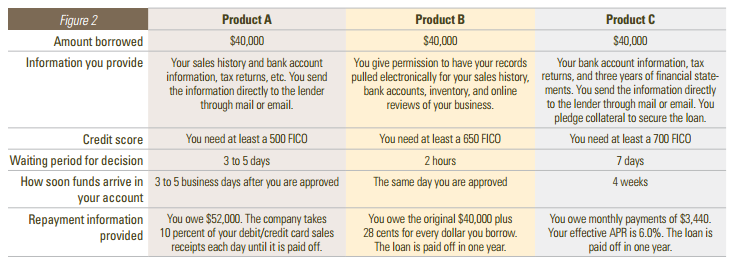
While the extent of the research is significant for any lender trying to get into the mind of a small business owner, there was a section in particular that warrants closer attention. In a mock comparison, participants were asked to compare three unnamed financial products, with one supposedly representing the characteristics of a merchant cash advance based on future credit card sales, another on a daily debit business loan, and the last a traditional bank loan.
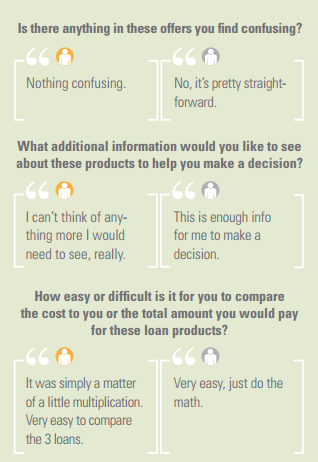
Respondents generally reported that they understood these offers and were not confused by them.
Unfortunately, the researchers assigned some gut-wrenching characteristics to the structure of the product alleged to represent merchant cash advances (Product A).
 The offer was a loan of $40,000 to pay back $52,000 in future credit card sales via a 10% processing split and participants were asked to guess the interest rate over one year. The question received all kinds of confused answers such as 5%, 9.8%, 15%, and others that made little sense.
Since the researchers presented the theoretical product as a loan, not a sale, they have potentially tainted the inferred conclusions about the transparency of future receivable transactions. Given the strong authority associated with the Federal Reserve and Nielsen, there is a troubling implication that the findings about a hypothetical loan could be used as a basis to make future regulatory decisions about unrelated products like receivable purchases.
Ironically, the diversity of wrong answers to the interest rate question could lead one to this conclusion though, that APRs wouldn’t necessarily be a transparency cure.
If business owners don’t understand what Annual Percentage Rates represent, then it might not be a very good medium to make comparisons. This argument is actually reinforced by the study’s own research since two of the three products were presented without the confusion of interest rates and “participants initially reported the three were easy to compare and that they had all the information they needed to make a borrowing decision.”
In regards to the traditional bank loan, one business owner is actually quoted as saying, “I am not sure what they mean by my ‘effective APR.'”
While value can be gleaned from the results of such a small sample size of 44 business owners, it’s obvious that the researchers influenced the participants answers on how they assessed the cost of merchant cash advances in particular.
- A transaction typically structured as a sale was presented to participants as a loan.
- A predetermined time frame of 1 year was provided to participants when they were asked about interest rates even though purchase transactions have no time frame.
The merchant cash advance product presented in the focus groups has just about no similarities to the purchase transactions that exist in real life.
What are your thoughts on this report and particularly the way merchant cash advance is framed in it? You can download the full report, including the focus group questionnaire here.
Are Your Sales Methods Wimpy?
August 24, 2015 Do you remember Wimpy? Some of you probably don’t but those who do remember Wimpy, remember him as being a silent scam artist who promised the famous phrase, “I will gladly pay you Tuesday for a Hamburger today.” He never adhered to that promise. I never ascribed cartoons to real life but we can learn a few things from Wimpy and how we understand business relationships.
Back in the day, there was something called Trust. It was a little thing that was swapped like currency with the people that you interacted with on a daily basis. Today, trust has been traded for the Internet and now we have nothing to stand on. We must work harder to build relationships in any capacity and at the end of the day, you might still question if a developing level of trust is reciprocal.
Take trust and mix it with a sales position in 2015 and you have disaster. The countless nos you must endure to get to the few yeses and the pressure to close those yeses is exacerbated by the fear that a Wimpy or the Internet will come and take them away.
While reading Personal Touch Makes Big Difference in Small-Business Loans on the WSJ this morning, I immediately got a little upset. This is such a “Duh Article.” A “Duh Article” is one of those articles that are true, but so true in the fact that you end up saying, “Duh, I know that!” and wonder why such basic teachings become important when they are finally backed up by a case study. Did anyone really not think that personal relationships help? Or that Wimpy, the borrower you didn’t know, would not really pay you on Tuesday when you relied on just his word? It goes both ways.
Below are a few ways to avoid the Wimpy traits of sales when building a relationship between you and a business owner:
#1 Rule of Sales Relationships: What are you even selling?
You are selling money so it shouldn’t be that hard right? WRONG. Even though everyone could use an influx of capital, you have two factors that impact your sales in the MCA Industry. PRICE and PROMINENCE.
- Price: We are already slandered for putting a hefty price tag on advances and even if you say, “We offer factor rates as low as a 1.08!”, How many 1.08 deals do you really close?
- Prominence: Names, Logos, and Promises. Characterization plays a big part in what you represent. With so many MCA Entities popping up, how do you set yourself apart?
You have to offset the two factors by building the relationship and creating an understanding.
Example: Imagine you are selling a line of ketchup to every hamburger shop in the U.S.
Do they already have ketchup? They will eventually need to reorder. So where do they get it now? Are they content with this outlet or have they never thought to seek out an alternative? This is the same “question scenario” you have to answer when selling. Note: Replace Ketchup with Capital.
- Do they need capital now?
- Will they need more capital soon?
- How do they get capital when they need it?
- How can I deliver all of the above and be their new preferred choice?
If the answer to the first question is no, that’s okay, move on to the next question. You are more likely to close double the sales when you answer the second and third one. Either way, one of those will have an answer.
#2 Rule of Sales Relationships: Understand the Market you are Targeting
Who is your target market and do you understand them? This is one of those situations where I feel offering a factor to a manufacturing company that is based on invoices is just plain dumb. There are many alternative financing options that are more mainstream than you think and it all boils down to the top 3 things:
- Industry: Do you understand the industry you are selling to? You will connect better with your merchant if you understand the inner workings, schedule, and the ways they obtain their receivables. Their Industry is their passion. If you don’t connect with their passion (unless there is a dire need for emergency capital) you will not be taken seriously or remembered. Ask yourself, “how can I demonstrate an understanding of the way the business makes money or works with different vendors to get paid?”
- Credit: Don’t promise a low rate to a business that you know has a credit score below 600. Research the different tier programs PROVIDED to you by most Direct Funders. Categorize your tier sales structure and request examples of similar past funded industries from the Funders you work with.
- NEED:If they do need capital now, what is it for? This is a great conversation starter. Whether it’s a seasonal need, equipment-related, or plain ol’ working capital, probe the conversation by finding out their goals so you can better represent the merchant and fit them to a better funding program.
#3 Rule of Sales Relationships: The Follow up
This may go far beyond the basic sales guidelines, but categorize your prospects!
Example: Say you have a book of restaurants that you have connected with before and you know they are going to start gearing up for the holidays. Let them know you UNDERSTAND this time of year and how you can assist! Personalize the need of capital with something they base their business on. This is where direct marketing comes into play. If you remind them of who you are and that you are to assist them to manage the most stressful money making times of the year, they will think of you as their go-to when they NEED it.