

Alternative Business Funding’s Decade Club
October 22, 2015 The working capital business is a very different animal now than it was a decade or so ago when many of today’s established players were just starting out.
“At that time, the industry was a bunch of cowboys. It was an opportunistic industry of very small players,” says Andy Reiser, chairman and chief executive of Strategic Funding Source Inc., a New York-based alternative funder that’s been in business since 2006. “The industry has gone from this cottage industry to a professionally managed industry.”
Indeed, the alternative funding industry for small businesses has grown by leaps and bounds over the past decade. To put it in perspective, more than $11 billion out of a total $150 billion in profits is at risk to leave the banking system over the next five plus years to marketplace lenders, according to a March research report by Goldman Sachs. The proliferation of non-bank funders has taken such a huge toll on traditional lenders that in his annual letter to shareholders, J.P. Morgan Chase & Co. chief executive officer Jamie Dimon warned that “Silicon Valley is coming” and that online lenders in particular “are very good at reducing the ‘pain points’ in that they can make loans in minutes, which might take banks weeks.”
The burgeoning growth of alternative providers is certainly driving banks to rethink how they do business. But increased competition is also having a profound effect on more seasoned alternative funders as well. One of the latest threats to their livelihood is from fintech companies, like Lendio and Fundera,for example, that are using technology to drive efficiency and gaining market share with small businesses in the process.
“Established lenders who want to effectively compete against the new entrants will need to automate as much decisioning as possible, diversify acquisition sources and ensure sufficient growth capital as a means to capture as much market share as possible over the next 12 to 18 months,” says Kim Anderson, chief executive of Longitude Partners, a Tampa-based strategy consulting firm for specialty finance firms.
Of course, there is truth to the adage that age breeds wisdom. Established players understand the market, have a proven track record and have years of data to back up their underwriting decisions. At the same time, however, experience isn’t the only factor that can ensure a company will continue to thrive over the long haul.
WORKING TOWARD THE FUTURE
Indeed, established players have a strong understanding of what they are up against—that they can’t afford to live in the glory of the past if they want to survive far into the future.
“With every business you have to reinvent yourself all the time. That’s what a successful business is about,” says Reiser of Strategic Funding. “You see so many businesses over the years that didn’t reinvent themselves, and that’s why they’re not around.”
Strategic Funding has gone through a number of changes since Reiser, a former investment banker, founded it with six employees. The company, which has grown to around 165 employees, now has regional offices in Virginia, Washington and Florida and has funded roughly $1 billion in loans and cash advances for small to mid-sized businesses since its inception.
One of the ways Strategic Funding has tried to distinguish itself is through its Colonial Funding Network, which was launched in early 2009. CFN is Strategic Funding’s secure servicing platform which enables other companies who provide merchant cash advances, business loans and factoring to “white label” Strategic Funding’s technology and reporting systems to operate their businesses.
“When you’re in a commodity-driven business, you have to find something to differentiate yourself,” Reiser says.
FINDING WAYS TO BE DIFFERENT
That’s exactly what Stephen Sheinbaum, founder of Bizfi (formerly Merchant Cash and Capital) in New York, has tried to do over the years. When the company was founded in 2005, it was solely a funding business. But over the years, it has grown to around 170 employees and has become multi-faceted, adding a greater amount of technology and a direct sales force. Since inception, the Bizfi family of companies has originated more than $1.2 billion in funding to about 24,000 business owners.
 Earlier this year, the company launched Bizfi, a connected online marketplace designed specifically to help small businesses compare funding options from different sources of capital and get funded within days. Current lenders on the platform include Fundation, OnDeck, Funding Circle, CAN Capital, SBA lender SmartBiz, as well as financing from Bizfi itself. Financing options on the platform include short-term funding, equipment financing, A/R financing, SBA loans and medium term loans.
Sheinbaum credits newer entrants for continually coming up with new technology that’s better and faster and keeping more established funders on their toes.
“If you don’t adapt, you die,” he says. “Change is the one constant that you face as a business owner.”
David Goldin, chief executive of Capify, a New York-based funder, has a similar outlook, noting that the moment his company comes out with a new idea, it has to come up with another one. “If you’re not constantly innovating you’re in trouble,” he says. “It’s a 24/7 global job.”
Capify, which was known as AmeriMerchant until July, was founded by Goldin in 2002 as a credit card processing ISO. In 2003, the company began focusing all of its efforts on merchant cash advances. Four years later, the company made its first international foray by opening an office in Toronto. The company continued to expand its international presence by opening up offices in the United Kingdom and Australia in 2008. The company now has more than 200 employees globally and hopes to be around 300 or more in the next 12 months, Goldin says. The company has funded about $500 million in business loans and MCAs to date, adjusted for currency rates.
THE CULTURE OF CHANGE
Five or six years ago, Capify’s main competitors were other MCA companies. Now the competition primarily comes from fintech players, and to keep pace Capify has made certain changes in the way it operates. From a human resources standpoint, for instance, Capify switched from business casual attire to casual dress in the office. The company has also been doing more employee-bonding events to make sure morale remains high as new people join the ranks. “We’ve been in hyper-growth mode,” he says.
CAN Capital in New York, another player in the alternative small business finance space with many years of experience under its belt, has also grown significantly (and changed its name several times) since its inception in 1998. The company which began with a handful of employees now has about 450 and has offices in NYC, Georgia, Salt Lake City and Costa Rica. For the first 13 years, the company focused mostly on MCA. Now its business loan product accounts for a larger chunk of its origination dollars.
This year, the company reached the significant milestone of providing small businesses with access to more than $5 billion of working capital, more than any other company in the space. To date, CAN Capital has facilitated the funding of more than 160,000 small businesses in more than 540 unique industries.
Throughout its metamorphosis to what it is today, the company has put into place more formalized processes and procedures. At the same time, the company has tried very hard to maintain its entrepreneurial spirit, says Daniel DeMeo, chief executive of CAN Capital.
One of the challenges established companies face as they grow is to not become so rule-driven that they lose their ability to be flexible. After all, you still need to take calculated risk in order to realize your full potential, he explains. “It’s about accepting failure and stretching and testing enough that there are more wins than there are losses,” says DeMeo who joined the company in March 2010.
ADVICE FOR NEWCOMERS
As the industry continues to grow and new alternative funders enter the marketplace, experience provides a comfort level for many established players.
“The benefit we have that newcomers don’t have is 10 years of data and an understanding of what works and what doesn’t work,” says Reiser of Strategic Funding. With the benefit of experience, Reiser says his company is in a better position to make smarter underwriting decisions. “There are many industries we funded years back that we wouldn’t touch today for a variety of reasons,” he says.
Experienced players like to see themselves as role models for new entrants and say newcomers can learn a lot from their collective experiences, both good and bad. Noting the power of hindsight, Reiser of Strategic Funding strongly advises newcomers to look at what made others in the business successful and internalize these best practices.
One of the dangers he sees is with new companies who think their technology is the key to long-term survival. “Technology alone won’t do it because that too will become a commodity in time,” he says.
Over the years Strategic Funding has learned that as important as technology is, the human touch is also a crucial element in the underwriting process. For example, the last but critical step of the underwriting process at Strategic Funding is a recorded funding call. All of the data may point to the idea that a particular would-be borrower should be financed. But on the call, Strategic Funding’s underwriting team may get a bad vibe and therefore decide not to go forward.
“We look at the data as a tool to help us make decisions. But it’s not the absolute answer,” Reiser says. “We are a combination of human insight and technology. I think in business you need human insight.”
Seasoned alternative funding companies also say that newbies need to implement strong underwritingcontrols that will enable them to weather both up and down markets.
The vast majority of newcomers have never experienced a downturn like the 2008 Financial Crisis, which is where seasoned alternative financing companies say they have a leg up. Until you’ve lived through down cycles, you’re not as focused as protecting against the next one, notes Sheinbaum of Bizfi. “Every 10 years or 15 years or so, there seems to be a systemic crisis. It passes. You just have to be ready for it,” he says.
Goldin of Capify believes that many of today’s start-ups don’t understand underwriting and are throwing money at every business that comes their way instead of taking a more cautious approach. As a funder that has lived through a down market cycle, he’s more circumspect about long-term risk.
 One of the biggest problems he sees is funders who write paper that goes two or three years out. His company is only willing to go out a maximum of 15 months for its loan product, which he believes is s a more prudent approach. He questions what will happen when the economy turns south—as it eventually will—and funders are stuck with long dated receivables. “You’re done. You’re dead. You can’t save those boats. They are too far out to sea,” Goldin says.
Having a solid capital base is also a key to long-term success, according to veteran funders. Many of the upstarts don’t have an established track record and need to raise equity capital just to stay afloat—an obstacle many long-time funders have already overcome.
Goldin of Capify believes that over time consolidation will swallow up many of the newbies who don’t have a good handle on their business. Hethinks these companies will eventually be shuttered by margin compression and defaults. “It can’t last like this forever,” he says.
In the meantime, competition for small business customers continues to be fierce, which in turn helps keep seasoned players focused on being at the top of their game. Getting too comfortable or complacent isn’t the answer, notes DeMeo of CAN Capital. Instead, established funders should seek to better understand the competition and hopefully surpass it. “Competition should make you stronger if you react to it properly,” he says.
Some Small Business Funders Are Pivoting or Closing Shop
October 20, 2015 One of the unique insights deBanked gets as a company that sends a lot of email and snail mail to folks in the industry is the rejection rate. One day an entrepreneur is telling us all about their new lending business and the next day the Post Office returns their magazine for a vacant address. Sometimes there’s a change in the model or a partnership didn’t work out. Other times lead generation became too hard or too many merchants defaulted very early on. The truth is, as much as the industry is growing, some companies are pivoting or closing their doors.
At Lend360, there were whispers around the trade show floor that acquisition costs have spiked and it was being felt on the bottom lines. Broker houses are opening, closing, merging with each other and being acquired. Funders have reacted by giving them lines of credit to either help them grow or stay afloat, hoping that their sources of deal flow don’t fall apart.
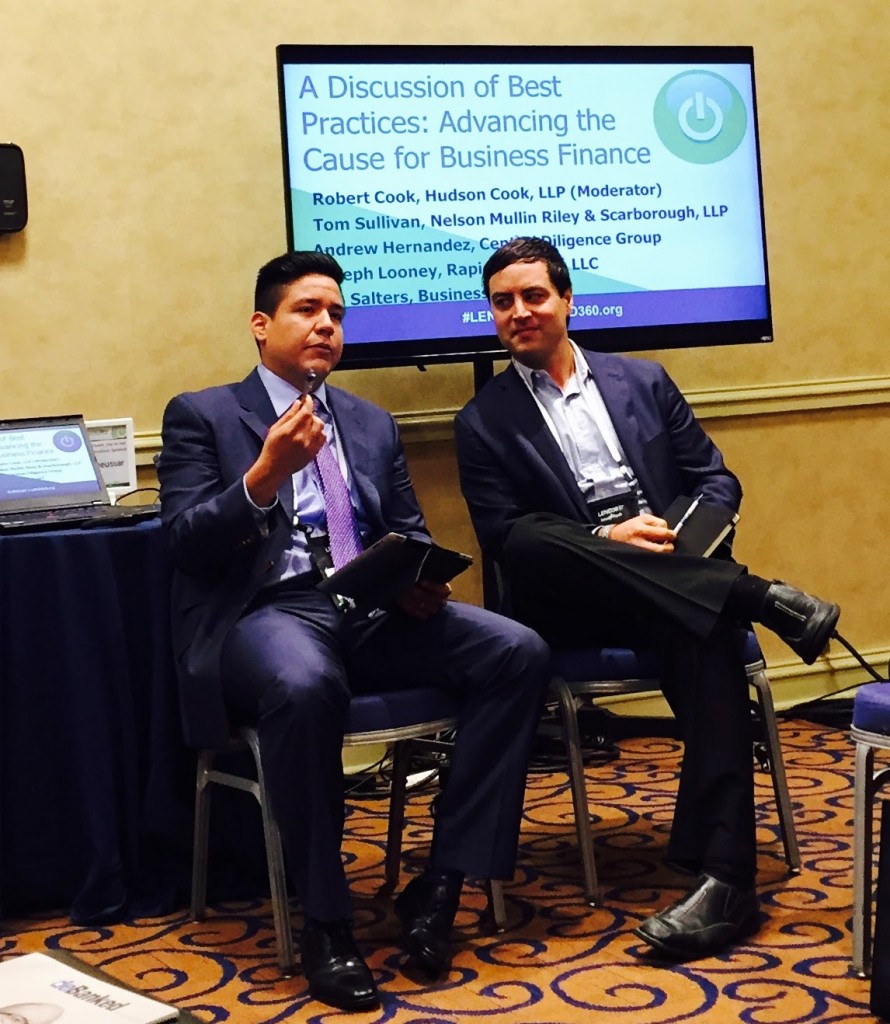
On one conference panel titled, A Discussion of Best Practices: Advancing The Cause for Business Finance, veteran underwriter and industry consultant Andrew Hernandez of Central Diligence Group, said he’s watched a lot of new entrants in this industry make mistakes. “We’ve seen guys lose their shirt,” he said. He explained that too often small business funding companies look to cut their acquisition costs in the wrong places, like simply paying less for leads or paying brokers lower commissions. That only works to a point. “Underwriters can help keep the cost of acquisition down by funding the right deals and trying to get good deals done,” he said.
The owner of one funder summed up his dilemma for me, my brokers are making more on a deal than I am and I’m the one taking all the liability on it. Maybe I should become a broker instead. Not that there would be anything wrong with that. For some companies in this industry, the best path forward is achieved through trial and error. For example, World Business Lenders’ Alex Gemici said at the conference that they started off by making unsecured loans and now only do loans secured by real estate. Gemici also said he believes the industry is heading for a major shakeout within the next three years and that irrational exuberance keeps him up at night.
If he’s right, an economic downturn could squeeze out a lot of players that are already feeling the pinch of high acquisition costs.
For those newer to the industry, they might not remember that the effects of the 2008-2009 financial crisis and ensuing recession was brutal. More than half of the providers of merchant cash advances went out of business, some within weeks when their credit lines were pulled.
A lot of the “industry leaders” of 2008 aren’t around anymore: First Funds, Fast Capital, Second Source, Merit Capital, iFunds, Summit, Infinicap, Global Swift Funding, and more.
Given the favorable economic climate and regulatory environment, this is a bad time to be struggling. 2015 may be one of the last years to pivot in a major way before it’s too late.
Stacking Questioned at Lend360
October 18, 2015 The stacking debate reemerged at Lend360 in Atlanta last week when one small business funding company promised during a breakout session to sue competitors that stacked on top of them for tortious interference. The warning wasn’t hollow either. The company, who you could probably guess the identity of, has already sued at least one funder. Many people are interested to see what the outcome of that case will be and the precedent it could set.
Meanwhile, during Thursday’s Current Trends and the Future of Small Business Lending panel moderated by Bob Coleman, industry captains generally denounced stacking as a bad thing. But bad for who, wondered Josh Karp, the Head of Operations for CFG Merchant Solutions. During the Q&A session at the end of the panel, Karp spoke from the audience and asked whether or not second position deals could appropriately serve as a bridge for merchants who have already taken a long-term product (12+ months) and were not eligible for a renewal from their current funding provider. To translate, could an outright restriction on stacking be harmful to merchants who have used a long-term product and now have a short-term need?
The panelists were mostly evasive with a handful declining to answer the question, one saying it wasn’t applicable to them because they were short-term lenders themselves, and another saying they could see how it wouldn’t be fair to expect a small business to not need additional funding with a two-year loan term.
For now, the industry debate remains unresolved.
Kabbage, Fora Financial and Square Have a Roaring Wednesday
October 15, 2015 Wednesday, October 14th was packed with exciting industry news. Right after Congressman David Scott blessed online lenders, Kabbage announced a Series E round investment led by Reverence Capital Partners for $135 million. The Wall Street Journal said the deal valued the company at over $1 billion, a figure that elevates Kabbage to unicorn status.
At the same time, Fora Financial announced that a Palladium Equity Partners affiliate had made a significant investment in the company. In the official release, Palladium principal Justin Green said, “we believe Fora Financial has developed a highly attractive credit offering and technology platform that have made it a valued provider of financing to thousands of small businesses seeking capital.”
Palladium once held a stake in Wise Foods, the potato chip snack company, and currently counts PROMÉRICA Bank, a full-service commercial bank in its active portfolio. They have more than $2 billion in assets under management.
And then there’s Square, the payment processor and merchant cash advance company who publicly filed their S-1 for an IPO. Their registration form uses the term merchant cash advance 16 times so there is no doubt it’s a significant part of their business. “Square Capital provides merchant cash advances to prequalified sellers,” the document states. “We make it easy for sellers to use our service by proactively reaching out to them with an offer of an advance based on their payment processing history. The terms are straightforward, sellers get their funds quickly (often the next business day), and in return, they agree to make payments equal to a percentage of the payment volume we process for them up to a fixed amount.”
As of June 30th, Square had already racked up a net loss for the year of nearly $78 million. In 2014, the company lost $154 million. While the losses stem mainly from their payment processing operations, they had outstanding merchant cash advance receivables of $32 million as of mid-year which illustrates how much exposure they have with that product.
The three announcements ironically coincided with comments made by SoFi CEO Mike Cagney about the industry’s lack of ambition. “The problem with fintech is that it’s not ambitious enough in terms of its objectives. It’s not really transforming anything,” he’s quoted as saying in the San Francisco Business Times. Cagney went on to categorize Lending Club as just an electronic interface bolted onto a bank to originate loans for them. While his comments hold weight given that his lending company recently just raised $1 billion in a Series E round led by Softbank, it may be fair to say however that Wednesday proved there was anything but a lack of ambition in the space right now.
Palladium Equity Partners Announces Investment in Fora Financial, a Provider of Working Capital Financing to Small- and Medium-Sized Businesses
October 14, 2015 Palladium Equity Partners, LLC (along with its affiliates, “Palladium”), a private investment firm with over $2.0 billion in assets under management, today announced that one of its affiliates has made a significant investment in partnership with the co-founders and management of Fora Financial LLC (together with its affiliates, “Fora Financial” or the “Company”), a technology-enabled provider of financing to small- and medium-sized businesses nationwide.
Founded in 2008, Fora Financial offers loans and merchant cash advances of between $5,000 and $500,000 to small businesses throughout the country. Since inception, the Company has provided total funding of nearly $400 million to more than 8,000 businesses. It has experienced rapid growth and recently was ranked among the fastest-growing companies in America in the Inc. 5000 list. Fora Financial recently expanded its New York City offices to accommodate its growing roster of over 100 employees as it bolsters key capabilities in analytics and technology and aims to continue to execute on its strategy of delivering capital in a timely and cost effective way.
Fora Financial will continue to be led by its two founders, CEO Jared Feldman and President Dan Smith.
“We believe Fora Financial has developed a highly attractive credit offering and technology platform that have made it a valued provider of financing to thousands of small businesses seeking capital,” said Justin Green, a Principal of Palladium. “My partners and I look forward to supporting Jared, Dan and the Fora Financial management team to continue the strong growth trajectory of the Company, including through new partnerships, expanded product offerings and increased lending capabilities.”
Feldman said, “We are excited to partner with Palladium, a firm with extensive financial services expertise and many years of experience supporting founder-owned businesses.”
Smith added, “With this partnership in place, we are well-capitalized to continue offering the small business community the custom, innovative funding solutions that have enabled us to build this Company into a market leader.”
Terms of the investment were not disclosed. Fora Financial was advised by Raymond James & Associates.
About Fora Financial
Fora Financial offers flexible, working capital solutions to small businesses in need of financing to sustain or grow their enterprise. The Manhattan-based company places a high value on trust and transparency and provides businesses with quick, customized financial solutions utilizing its state-of-the-art technology platforms. Founded in June 2008, Fora Financial has more than 100 employees who have provided nearly $400 million to over 8,000 customers. For additional information, please visit www.forafinancial.com, call (855) 515-2413 or follow Fora Financial on Facebook at facebook.com/Fora.Financial.
About Palladium Equity Partners, LLC
Palladium is a middle market private equity firm with over $2.0 billion in assets under management. The firm seeks to acquire and grow companies in partnership with founders and experienced management teams by providing capital, strategic guidance and operational oversight. Since its founding in 1997, Palladium has invested over $1.5 billion of capital in more than 25 platform investments and over 50 add-on acquisitions. The firm focuses primarily on buyout equity investments in the range of $50 million to $150 million. The principals of the firm have significant experience in financial services, business services, food, healthcare, industrial and media businesses, with a special focus on companies they believe will benefit from the growth in the U.S. Hispanic population. Palladium is based in New York City. For more information, visit www.palladiumequity.com.
For media inquiries, please contact:
Todd Fogarty or Peter Hill of Kekst and Company
212-521-4800
todd-fogarty@kekst.com or peter-hill@kekst.com
Leads vs. Data: Do You Know What You’re Buying?
October 11, 2015 One important aspect of being a broker is your ability to generate qualified leads. At the core of a broker’s business, he/she is really just a lead generator for their network of funders, functioning as a way to improve their funder’s profitability through the acquisition of new clientele.
While I once questioned if brokers truly knew what they were selling when it came to the merchant cash advance product, my next question is in relation to the purchase of what vendors refer to as “Leads.” I want to know, do you (as a broker) know what you’re buying?
While it’s apparent that you can produce qualified leads internally, can you truly produce the same externally? With the various companies that pop up (seemingly overnight) without domain names, without professionally designed websites or with just the use of a Gmail/Yahoo Email Address, can you truly trust the claims that most of them make in terms of their ability to sell you qualified leads? Maybe so, maybe not, but I believe if we begin with the proper connotation of a “lead” vs. a “data record”, then it might help to truly determine what you’re purchasing from these external sources.
WHAT IS DATA?
Data is business intelligence, which is either generic or specialized information on a business or a group of businesses that are within a sales professional’s generic target market. It would be up to the sales professional to take this data, turn it into a sales pipeline (leads), convert a percentage of those pipeline listings into application submissions, and a portion of those applications into funded deals. Data can come in the form of generic listings such as those from the Yellow Pages or specialized listings such as those from court houses, financing requests and UCC records.
So for example, a UCC record is a data record, not a lead. You would buy let’s say 2,000 UCC records and after running through them via a predictive dialer internally, you might filter off 130 interested prospects which creates your sales pipeline, which is what you would now call “leads.” Then through following up on those 130 interested prospects, you might convert let’s say 20 – 30 of them into application submissions and fund 6 – 9 of them.
WHAT IS A LEAD?
A lead is an actual interested prospect in the services/products that you specifically have to offer. This means they have seen your specific ad or marketing piece, and have specifically expressed interest in what you have to offer. These can only be generated in-house through:
- Running through Data Records as explained above.
- Using other forms of direct marketing such as mailers, email marketing and through directly contracted referral sources who resell your product/company.
- Using indirect marketing options such as banner ads, radio ads, TV ads, print ads, billboard ads, SEO related concepts, and Pay-Per-Click, where the prospect will see or hear the ad and respond to you directly through filling out a form, giving you a call, shooting you an email, etc.
I firmly do not believe you can purchase Leads externally, I believe they can only be generated in-house using direct or in-direct marketing procedures listed above.
 HOW TO ADDRESS LEAD GENERATION COMPANIES?
So when a company comes to you selling “leads,” you should ask them are they selling “leads” or are they selling “data” records? Because they can only be selling YOU leads if they have specifically marketed your specific company and products to said generic target market, and generated interested parties to your specific company and products.
So what about companies that generate what they deem to be “leads” for the “service” that you offer in a generic fashion? For example, people that sell insurance would see people selling insurance Leads, people that sell equipment leasing will see people selling equipment leasing leads, and of course people that sell merchant cash advance will see people selling merchant cash advance leads.
I am still of the belief that these are not leads, but data records, it’s just a different type of data record similar to that of a UCC. A UCC is a more specialized type of data record that tells you more in-depth information on the current situation of the prospect in particular, such as the fact that they took out a cash advance on XYZ date with XYZ funder. This is more specialization than let’s just say a basic Yellow Pages listing, which just has the company’s name, address and telephone number. But both the UCC record and the Yellow Pages listing are still data records.
The “product specific leads” that are sold are usually just a listing of individuals who filled out various online forms requesting some type of particular product, service or financing vehicle. In my opinion, these are not leads, but still data records that will list only the generic information on the company and the date/time they requested more information “generically” on the product or service in particular.
You (as the broker) still have to call these leads and sell them on your company, your product, your pricing, your platform, etc. This means similar to UCC records, if you get 2,000 of these records, you might only convert 130 to interested prospects, which would now be the official “leads.” Then of course from there through following up on those 130 interested prospects, you might convert let’s say 20 – 30 of them into application submissions and fund 6 – 9 of them.
 HOPEFULLY NO ONE IS OFFENDED
This article might offend some individuals who are in the “Lead Generation” business, but I explicitly want to state that my intention is not to cause distress. I firmly believe that the vast majority of the time, when one is purchasing “leads” from an external source, they are indeed only purchasing data records. As a result, such disclosure should be made and such pricing structures modified.
The purpose of this article is so that brokers can know what they are purchasing ahead of time, to make sure that the price they’re paying fits their ROI analysis.
The last thing any vendor would want (in my opinion) is to have a bunch of angry online reviews from brokers who paid $3.00 a piece for your 2,000 “leads,” that only converted to 130 truly interested parties, and then only produced 20 – 30 completed application submissions.
United Capital Source CEO Jared Weitz is deBanked’s September / October Cover
October 10, 2015Jared Weitz came from humble beginnings and nearly settled for a humble fate. But associates say an ordinary, uneventful life wouldn’t have suited him – he works too hard and figures things out too quickly.
Almost ten years ago Weitz, 33, was parking cars to earn money for community college. After finishing at St. Johns University, he almost made plumbing his career. But now he’s CEO of United Capital Source LLC, an alternative-finance brokerage with deal flow of between $9 million and $10 million a month and an annual growth rate of over 65 percent.
Business associates, former bosses and his small cadre of employees all seem to revere Weitz for his honesty and straightforwardness. They consider him a personal friend. They say he continues to grow as a businessman and as a human being while taking pleasure in helping others do the same.
Geographically, Weitz has the good fortune to know where he belongs – the city of New York is in his DNA. “Every time I fly back,” he said, “I’m so happy to land.” His love affair with the city began in Brooklyn. He was born there and raised in a Brighton Beach apartment in the shadow of Coney Island. When he was 16, the family moved to Oceanside on Long Island.
As the second of six children, Weitz had to come up with the money for college on his own…
To read the FULL 4-page exclusive, you’ll need to subscribe to deBanked!
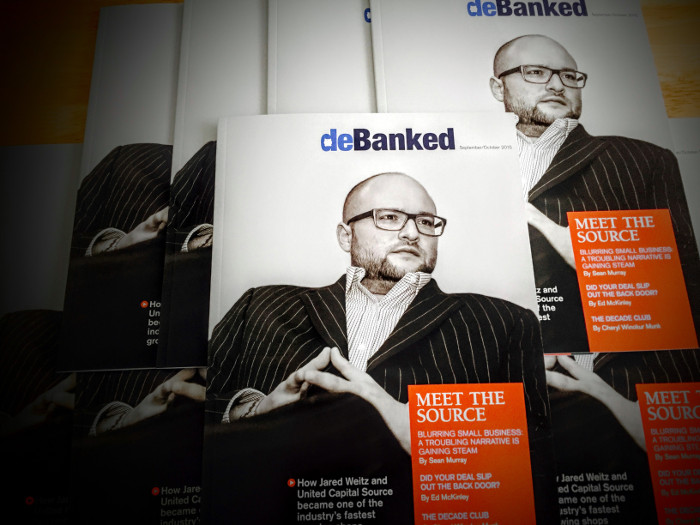
In this September/October issue, payments and finance journalist Ed McKinley explored the story behind United Capital Source, one of the industry’s fastest growing shops and what it took for its 33-year old CEO to get there.
—
For current subscribers, this edition will be dropped in the mail on Tuesday the 13th. deBanked’s Sean Murray will have a limited amount of extra copies with him at Lend360 in Atlanta and Money2020 in Las Vegas if you’re interested to get your hands on one in person.
FinSight Acquires Stake in Fundry, Yellowstone Capital’s Parent Company
October 7, 2015 Though neither company has made an announcement, deBanked has learned that FinSight Ventures, a venture capital firm that was a late stage investor in Lending Club, has acquired a stake in NY-based Fundry. As reported last week, Fundry is the newly formed parent company of Yellowstone Capital and Green Capital. Combined, they have originated more than $1 billion in small business funding since inception.
It was a small piece of equity, a single digit percentage share of ownership, said a source with knowledge of the transaction. In return, Fundry reportedly got a big boost in their valuation, though we were unable to ascertain a figure.
FinSight participated in Lending Club’s $125 million equity round back in May of 2013 that gave the company a $1.55 billion valuation and put them on track for an IPO. They were part of another equity round with Lending Club in April, 2014.
The transaction with Fundry is a nod to the industry that merchant cash advances have a lot more room to grow and perhaps a signal that Fundry is also on some kind of track.