

Pearl Beta Funding Decision a Boon to MCAs, as Long as They’re True to Their True-ups
March 26, 2018While the recent Champion Auto Sales, LLC et al. v Pearl Beta Funding, LLC decision was a win for MCA companies because it determined at the appellate level that an MCA contract issued by Pearl Beta Funding to Champion Auto Sales “was not a usurious transaction,” many lawyers are saying that, more than anything, this decision has demonstrated the importance of having strong contracts with merchants.
So what made Pearl Beta Funding’s contract so strong in the eyes the judges?
“I would say that there were a variety of factors,” said Steven Berkovitch, who represented Pearl Beta Funding in this case along with lawyers from DLA Piper. “The first thing that the judges look for is if there’s a way for the merchant to modify their payments.”
This, in essence, is what is known as the “true-up” in an MCA contract. More specifically, Berkovitch said that the true-up is a contractual obligation on the part of an MCA funder to adjust the daily payment it receives from a merchant to more accurately reflect the percentage of receivables it is owed.

Pearl Beta Funding CEO Sol Lax takes this seriously. He told deBanked: “Our front line servicing guys are well trained to respond when a merchant says ‘My deposits are down, my business is down, can I do something?’ They’re trained to know that the answer is ‘Yes. Send us some bank statements, we’ll look at it and we’ll adjust accordingly.’”
In this case, Berkovitch said that Champion Auto Sales did not use the true-up clause and did not request a payment modification when it was available to them.
“We have, literally, dozens upon dozens of cases where we’ve done the true-up,” Lax said. “So, it’s not just a contract. If [an MCA company] violates the true-up in practice and a merchant calls you and you say ‘hell no,’ that would be, not just a contractual violation, that would put a hole in your true-up clause.”
Many have remarked on how the decision of this case has already impacted the MCA industry. Berkovitch can see that himself. After the case was decided, he said that opposing attorneys have contacted him to withdraw their cases against his other MCA company clients.
Lax acknowledges, with modesty, what this decision means for the MCA industry at large: “You have a safe harbor now for the first time where, if you have a well-drafted contract, then you have active compliance [and] you’re pretty well off. Until this was settled in court, it was still up in the air.”
But Lax doesn’t take this victory for granted.
“You may still see challenges on specific [fact] patterns where a client can show that they had called, they asked for a true-up, and they were told ‘No true-up is available. You got to pay or we’re going to take all of your stuff,’” Lax said. “If they can show a pattern like that, then the MCA company is in trouble. They’ll have a hole blown right through their contract.”
SBFA Braved Snow Storm for Spring Fly-In
March 23, 2018 The Small Business Finance Association (SBFA) had their Washington DC Spring fly-in earlier this week. SBFA members met with Karen Kerrigan, the President and CEO of the Small Business & Entrepreneurship Council, on Tuesday afternoon, and Congressman Josh Gottheimer (D-NJ) in the evening.
Despite the blizzard, a handful of members continued to meet with members of Congress on the Hill on Wednesday.
Founded ten years ago, The SBFA is a non-profit advocacy organization dedicated to ensuring Main Street small businesses have access to the capital they need to grow and strengthen the economy.
2017 Small Business Financing Leaderboard
March 14, 2018Thanks to several companies filing their annual earnings statements and Funding Circle disclosing their USA origination figures for 2017, we’ve been able to put together a leaderboard in the small business financing space. This list is not comprehensive and omits key players like PayPal Working Capital and Amazon Lending.
| Company Name | 2017 Originations | 2016 | 2015 | 2014 |
| OnDeck | $2,114,663,000 | $2,400,000,000 | $1,900,000,000 | $1,200,000,000 |
| Kabbage | $1,500,000,000 | $1,220,000,000 | $900,000,000 | $350,000,000 |
| Square Capital | $1,177,000,000 | $798,000,000 | $400,000,000 | $100,000,000 |
| Yellowstone Capital | $553,000,000 | $460,000,000 | $422,000,000 | $290,000,000 |
| Funding Circle (USA only) | $500,000,000 | |||
| BlueVine | $500,000,000* | $200,000,000* | ||
| National Funding | $427,000,000 | $350,000,000 | $293,000,000 | |
| Strategic Funding | $393,000,000 | $375,000,000 | $375,000,000 | $280,000,000 |
| BFS Capital | $300,000,000 | $300,000,000 | ||
| RapidAdvance | $260,000,000 | $280,000,000 | $195,000,000 | |
| Credibly | $180,000,000 | $150,000,000 | $95,000,000 | $55,000,000 |
| Shopify | $140,000,000 | |||
| Forward Financing | $125,000,000 | |||
| IOU Financial | $91,300,000 | $107,600,000 | $146,400,000 | $100,000,000 |
*Asterisks signify that the figure is the editor’s estimate
The Underwriters – How A Small Team Is Turning Underwriting Into Big Business
March 13, 2018
A keen eye can spot a good deal. And for New York-based Central Diligence Group, an underwriting-focused company founded in 2015 by four partners, it has been a boon for business. The company has lately been providing its underwriting expertise to a wider variety of clients, including some outside the MCA space.
“We started to gear towards a more underwriting-centric model [where] a deal would come in, we underwrite it once, we assess the risk, we determine what box it would fall under and where it would qualify, and depending on what that pedigree of information [was], we would essentially [fulfill] the full underwriting [job,]” said Nick Gregory, one of the founding partners at Central Diligence.
Initially, the company provided underwriting services mostly to smaller funders, syndication brokers and ISO clients that service MCA merchants in the construction and trucking businesses, among others. But close to three years later, its roster of clients is far more diverse.
Over the past six to eight months, Central Diligence has been working with a west coast-based credit card processing company with a portfolio of over 100,000 clients, according to Andrew Hernandez, another Central Diligence partner. The credit card processing company has just built out its own MCA product, but they don’t have an underwriting team, which is where Central Diligence comes in. Hernandez said that this company, the identity of whom he could not disclose, just renewed its contract with them.
 Another unique client is an institutional investor, with offices in New York and Dallas, that just formalized a new working relationship with Central Diligence over the last week to go beyond just underwriting and into the realm of funding and servicing. According to Hernandez, this client is looking to make investments in MCA at the higher end of the market.
“In our space, $50,000 to $250,000 is pretty easy to come by, but $250,000 to $1 million, not so much,” Hernandez said. “So they see that there’s a gap with small businesses…and they’re using us to do [due] diligence [on companies.]”
Finally, Central Diligence is finishing an agreement with another unconventional client, an overseas mortgage company with interest in MCA. According to Hernandez, it is looking to execute a kind of beta test in the U.S. and then take the business model to Europe if it works.
In addition to the four founding partners, who work as underwriters, there are four additional underwriters and two junior underwriters for a total of ten on staff.
Hernandez attributes these new opportunities to the reputation they have built in the MCA space, including the 10+ years of experience that each of the founding partners have.
“Because of our experience and history in the space, a lot of our relationships have been built because of our credibility,” Hernandez said. “That’s the most important.”
Thinking Capital Acquired by Canadian Finance Firm Purpose Financial
March 12, 2018
Thinking Capital, a leader in the fintech lending industry in Canada, was acquired last week by Canadian finance company, Purpose Financial, based in Toronto.
“Under the Purpose Financial umbrella, our time to market on product innovation and funding capacity will be greatly amplified,” said Jeff Mitelman, CEO and co-founder of Thinking Capital.
Mitelman, who co-founded Thinking Capital in 2006, has long been an advocate for improving the way small business credit is evaluated and communicated in Canada.
“The challenge in Canada is that our lending institutions historically either don’t lend to small business or don’t lend to enough of our small businesses,” Mitelman told deBanked. “And that’s driven by the fact that so many of the measures of small business credit worthiness simply don’t exist. Our credit bureaus don’t report on it, there aren’t metrics or scores unique to small business, and most significantly, small business credit has never been attached to retail or institutional conduits for funding.”
 This is where Purpose Financial comes in. Mitelman believes that Purpose Financial’s investment arm and its relationship with Omers, a large Canadian pension fund, will provide small businesses with “access to conduits that historically small businesses have never been able to access.”
Thinking Capital provides an MCA product, which it calls Flexible, as well as a term product, which it calls Fixed. It also helps power loans provided by large companies like Staples.
Purpose Financial has three verticals: Investment Management (retail and institutional), Digital Technology, and Capital / Funding.
“Thinking Capital is a clear leader in the small to medium-sized business lending space…” said Som Seif, CEO of Purpose Financial. “[And] this acquisition brings together leading origination, asset management, and technology platforms as a unified entity, and enables us to bolster our product capabilities and optimize the technology, distribution, and funding model of our combined business.”
Enova’s TBB Did $15M in Merchant Cash Advance Revenue in 2017
March 12, 2018International online lending conglomerate, Enova, generated $843.7 million in revenue last year, according to their recent annual report. More than $15 million came from merchant cash advances (MCAs) made through The Business Backer (TBB), a small business financing company they acquired in 2015. That’s down from $18.6 million in MCA revenue generated in 2016.
Though MCA revenue may be down, TBB began offering an installment small business loan product in 2017. They’re available in 10 states, according to the company.
Enova refers to MCAs as RPAs in their reports, short for Receivable Purchase Agreements. “Small businesses receive funds in exchange for a portion of the business’s future receivables at an agreed upon discount,” they state.”A small business customer who enters into a RPA commits to delivering a percentage of its receivables through ACH or wire debits or by splitting credit card receipts until all purchased receivables are delivered.” That is a textbook explanation of MCAs.
Their average “RPA” customer averages $1.5 million in annual sales and has 10 years of operating history.
How One Company is Helping MCA Brokers and Clients Through Credit Repair
March 5, 2018
Venture Credit Solutions, a New Jersey-based credit repair business, was created in 2016 by founder and CEO Joe Clapman. Because of extensive licensing and other legal conditions required to run a credit repair shop, the company didn’t start operating until the beginning of this year, with a soft launch at deBanked’s Miami event in January.
Formerly an MCA broker, Clapman saw firsthand that really bad personal credit could hinder one’s ability to get cash advances for their businesses, along with home mortgages and even jobs. So he started a consumer credit repair business. He is very clear about what he can and cannot do.
“We get erroneous items that do not belong on your credit report, off,” he said.
He cannot recoup people’s money or eliminate credit card debt. He does not guarantee that he will improve your credit score, but he maintains that when negative erroneous data is removed, generally FICO scores go up and people become eligible for more credit or better credit.
This can benefit MCA brokers by allowing them to take unfundable or less fundable MCA clients and turn them into additional clients for credit repair. Clapman said that brokers for credit repair can get a commission similar to a $15,000 to $20,000 MCA deal.
“We don’t have some secret handshake with Equifax and Experian,” Clapman said. “We can’t do anything you can’t do on your own.”
Instead, Clapman told deBanked that Venture Credit Solutions is a service-based company of researchers, who he calls “information givers,” that are trained in determining the accuracy of data on personal credit reports.
“Any data on your credit report has to be accurate to the letter,” he said.
Clapman and his team make money only when they are able to successfully prove inaccurate data and remove it from a customer’s credit report. Every line of a customer’s report is itemized and the customer is told beforehand how much they will pay Venture Credit Solutions if the company is able to prove that the data is inaccurate.
And data is either accurate or it isn’t.
“If someone tells me that something is accurately described on their credit report, it’s actually illegal for me to try and get it removed,” Clapman said.
While Venture Credit Solutions provides services to individual consumers, they do not advertise to the general public. Instead, they get business from brokers, who Clapman calls “referral agents.” These are MCA and real estate brokers, among others, who are trying to improve their client’s credit – if it has been inaccurately reported.
Clapman gave the example of an MCA merchant who signed a document allowing his broker to submit an application to only one funder. But the broker sent the application out to like 93 funders, severely damaging his credit because of all the credit inquiries.
“We can help him to get all these inquiries off,” Clapman said.
One of the core mantras at Venture Credit Solutions is “The client is your client.” This is important to Clapman because he wants to communicate to his referral agents that the company is not trying to steal their clients – by, for instance, finding the client a lower mortgage. Doing something like this would adversely affect the customer’s credit, which is exactly what Venture Credit Solutions is trying to improve.
“We’re trying to create a win-win process,” Clapman said. “The broker is winning because he’s not losing a client, he’s helping a client [and getting a commision.] And the client is winning because his credit is getting better.”
Clapman said that he is in talks with the New York and New Jersey police and fire departments to potentially help their members who might have erroneous data on their credit reports.
Venture Credit Solutions also has a program for startup companies, designed to improve and build the credit of entrepreneurs. The company now has 15 people working at its office in New Jersey and it plans to be onboarding at least an additional 30 within the next two weeks. Some will work remotely, but all will be in the US, Clapman said.
Nest Planner: The Story Of A Startup MCA Broker
March 4, 2018deBanked interviewed Anthony Frisone, the founder of Nest Planner, a young ISO on Long Island, on how he got his start.

What were you doing before becoming an MCA broker?
I was doing real estate and then I got sick. I was having a hard time walking. And you can’t sell real estate when you can’t walk. I was bedridden for a long time [before I got better.] I was in a bad place, mentally and physically, and a friend of mine just said to me “you should try this out.” I knew nothing about it. So I went to his office and I actually grabbed a deBanked magazine off of one of the desks in his office.
What’s the greatest challenge of being an MCA broker?
Being sick was easier than starting out in this business. It was rough. The first three or four months was an uphill battle. It was brutal. We did zero. No business at all. But I didn’t give up. We just kept dialing the phone. I couldn’t even get funders to send deals to. I was calling quite a few of them. And they were like “Who are you sending deals to now?” And I said, “No one. I’m brand new in the business.” And they were basically like “Come back to me when you have something under your belt.”
I had a whole list of people I was calling and I called up a place called Cardinal Equity, which came from the deBanked website or magazine. The owner answered the phone and we were just talking, for a half hour, maybe an hour. I remember it was late at night and right before Thanksgiving, and he said “Call me next week and I’ll send you the application.” I was like “Oh wow, thanks.” [..] Finally he sent it to me and I sent it back to him. And he let me send him deals.
What about getting deals made?
Getting deals was a whole different story because I didn’t have anyone to tell me “Don’t take $5,000 a month accounts.” We were surrounded by no one that knew the business. So it made it even harder by not knowing what I was doing. But I had no choice. So I just came in everyday and worked. And something, little by little, started panning out.
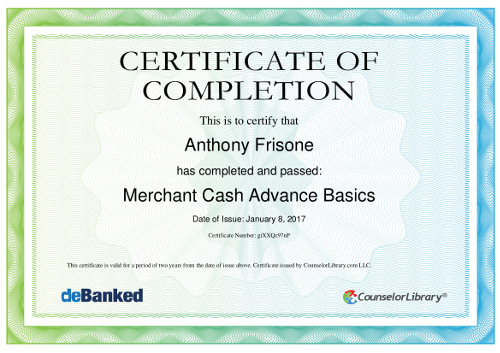 After Cardinal Equity, I didn’t get another funder until after I took the deBanked “Merchant Cash Advance Basics” [online course] in January 2017. It was eye opening for me. Everything started making sense. I was able to have a conversation with funders and actually understand them. I started sending over my MCA Basics Certificate of Completion to every funder I could think of, and within a month’s time, I had over 30 different funders waiting for me to send them deals. However, [at the time] I had no merchants to send them.
So where have you found your best leads?
We tried out so many different places and spent so much money. But we had no one to guide us in the right direction. So we would look online and probably at deBanked also. We called up a bunch of different places. None of them were fantastic, but none of them were terrible. So we knew it was a numbers game and we had to stay on the phone. So there was no set place. I bought a little bit from everywhere and a little bit worked from everywhere.
When did you start making money?
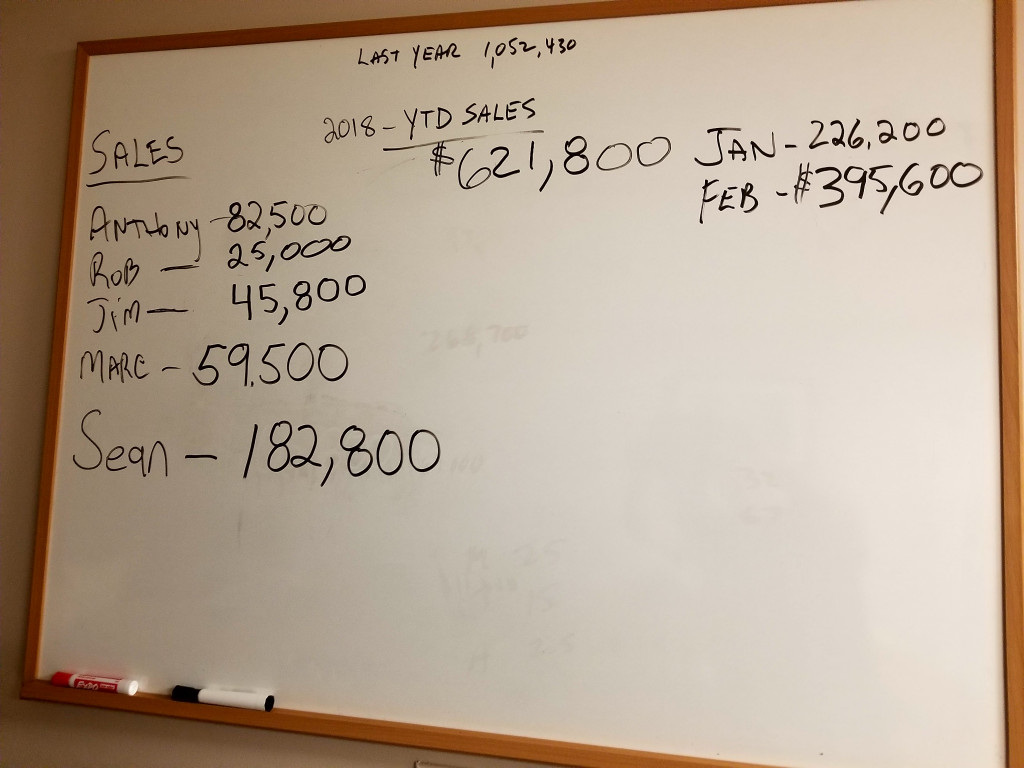
I started the business, called Nest Planner, in October 2016 all by myself. Just me and a desk and a laptop. And I didn’t start making money until March 2017. From October to March was a long 5 months. And in March I made close to $10,000 in advances. But by the end of last year, we hit the $1 million mark in advances. It’s not a lot, but it’s something that showed that we’re doing something right. And this year, it’s just February, and we have over $600,000 in [advances]. That’s huge for us and it’s just from us not giving up and pounding the phones.
How many people work for you?
Six.
How do you personally define success as a broker?
I guess the obvious part is the funds. If you make sales or close deals, it does feel good to make money. I have a wife and two kids and not taking home a paycheck is brutal. But what’s nice, also, is to see the people we hire make money. It’s nice to see them go home with a check.
How many applications do you typically send out?
So far, for January and February of this year, five of us sent in just under a 100 applications. And we funded 20 of them so far.
What resources do you wish you had that could have helped you made more deals in the beginning?
A CRM. I just had paper leads everywhere. We would just write it up on a piece of paper. No CRM and it’s rough. But it costs money. So we weren’t able to do it.
Apart from approving your applications, what do you look for in a funder?
Someone I could trust. Someone that returns calls. At the very beginning, it was hard. couldn’t get the time of day [from funders]. No one would call me back, except for Cardinal Equity. Now they’re actually calling me.
Want to become a better closer in this industry? Join your peers for training and networking at Broker Fair on May 14 in Brooklyn, NY! You can register here.