

Sean Murray is the President and Chief Editor of deBanked and the founder of the Broker Fair Conference. Connect with me on LinkedIn or follow me on twitter. You can view all future deBanked events here.
Articles by Sean Murray

World Business Lenders Wants To Take On The World of Business Lending, From Jersey City
July 21, 2016
On the thirty third floor of the third tallest building in the state of New Jersey, World Business Lenders’ (WBL) CEO Doug Naidus spoke of another third to a crowd of several hundred people. WBL, which was being honored by state and local politicians for moving their office to Jersey City, is Naidus’ third company. And as he put it, his final one.
In exchange for tax incentives, WBL will bring 225 jobs to Jersey City by the end of 2016. But the perceived benefit to the community is two-fold, because the company itself helps other companies grow through the loans it makes. Collateralized though they may be and different from their many unsecured lending peers, former Congressman Ed Towns, who spoke at the event, said that what the company does makes sense. Current Congressman Donald M. Payne Jr., who was also there, welcomed WBL “to the right side of the river.”
They were joined by Jersey City Deputy Mayor Marcos Vigil, Councilwoman Candice Osborne, Archbishop David Billings and Mitchell Rudin, the CEO of Mack-Cali.
After the speeches and ceremonial ribbon cutting, Naidus told deBanked that he wants to build a company that lasts, one that he can look back on and be proud of. With an average loan size of $200,000, Naidus believes that their system is built to endure. A disbeliever in purely algorithmic underwriting, he said that he sees a correction coming for lenders that have forsaken sound underwriting. His premise for this belief comes from his experience in the mortgage industry, a type of lending that has obviously had its own highs and lows.
WBL Chief Revenue Officer Alex Gemici echoed same, who said that one of their competitive advantages is responsible underwriting and lending. “Our product is sound,” he told deBanked. And because their business model unabashedly pursues profit, they are able to redeploy capital into marketing effectively. Compared to a company like OnDeck, Gemici explained, they can often lend more because of collateral, but only up to what they believe a small business can afford. Their ideal borrower is a business looking to increase their revenue, he added.
Jersey City Mayor Steven Fulop, reportedly said earlier that “helping small businesses thrive has been one of the guiding priorities of my administration, which makes World Business Lenders’ relocation to Jersey City even more rewarding.”
Fulop had recently just welcomed Fundry, one of WBL’s rivals, to his city a few months earlier, who also benefited from tax incentives. Fundry’s office is only a little more than three blocks away from WBL’s 101 Hudson Street address known locally as the Merrill Lynch Building.
“The Grow NJ program was designed to help New Jersey compete with other locations that are attractive for businesses looking to expand or relocate,” said Melissa Orsen, CEO of the state’s Economic Development Authority. WBL stands to receive up to $16.8 million in performance-based tax credits over ten years.
For employees of the company, the spectacular views from their new office seem to have convinced them that moving from their previous headquarters just outside of Times Square in Manhattan isn’t so bad.
“We are thrilled to contribute to the growth of Jersey City as a haven for commerce,” Naidus said. “We are delighted to call Jersey City our new home.”
Confidence Down, But Not Out On Continued Success of Small Business Finance, Survey Reveals
July 19, 2016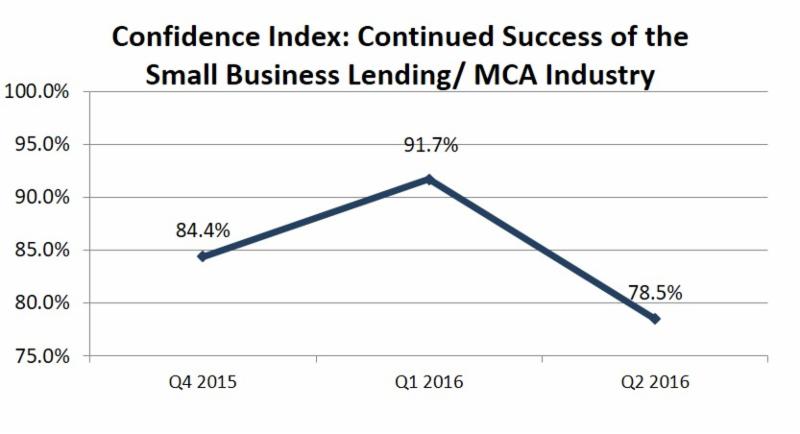 A joint Bryant Park Capital/deBanked survey of chief executives in the small business lending and merchant cash advance space showed a decline in confidence in the industry’s continued success, down from 91.7% in Q1 to 78.5% in Q2.
Respondents were not asked to explain the reasons behind their confidence levels, but increased competition is likely one contributing factor. No doubt some of the creeping pessimism is also spillover from the adjustments occurring in consumer lending, namely declining loan volumes, layoffs and the events that took place at Lending Club.
Decreased confidence may have been the reason that attendance at AltLend last week was down compared to last year. AltLend is an alternative small business lending conference hosted each year at the Princeton Club in NYC. deBanked has been a media partner of the event for the last two years.
On Forbes, Lendio CEO Brock Blake wrote that “2014 and 2015 brought an unhealthy amount of euphoria characterized by huge growth rates, hundreds of millions of dollars in venture capital, enormous valuations, high-flying IPOs, new lenders sprouting (almost) daily, and yield-hungry hedge funds chasing the newest, sexiest cash-producing asset.” But he added that “the industry is maturing and the future for online lending remains bright.”
Notably, 78.5% isn’t even bearish territory, but rather just a step down from the highs Blake described that have catapulted the industry for some time. Even as executives come to grips with the increasing regulatory scrutiny, non-bank small business financing companies have come to view themselves as in it for the long haul. That’s because growth in this sector has been less about refinancing credit cards to a lower interest rate for evermore narrow yields like on the consumer side, and more about fulfilling a role with small businesses that banks have been reluctant to take on for some time.
“Small business lending provides the fuel for small businesses across the country, and the fundamentals are still in place for this to be a formidable industry,” Blake wrote. “I am confident the supply of capital will continue to come from online lenders using technology to minimize risk and streamline processes.”
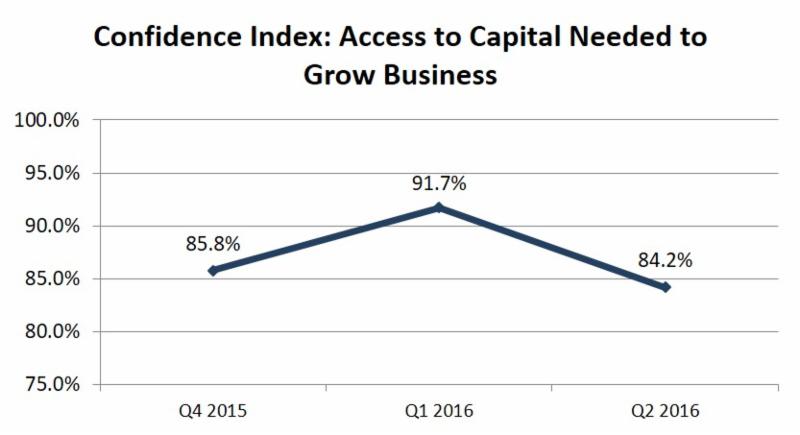
To his point, June and early July were a bright spot for companies raising capital. Fundry, Bizfi, Pearl Capital and Legend Funding all announced deals. The BPC/deBanked survey showed that industry optimism in this endeavor hasn’t shrunk by much, decreasing only from 91.7% in Q1 to 84.2% in Q2.
United Capital Source is Now Licensed in California
July 19, 2016
United Capital Source, the company featured in deBanked’s September/October magazine issue, announced that they’ve become licensed by the State of California Department of Business Oversight as a finance lender and broker. “With its new license, UCS will be writing high quality loans for California small business owners,” Weitz wrote.
California attorney Paul Rianda wrote a guide for deBanked about that process late last year and stressed, “you need to make sure the packet you submit [to the DBO] is perfect.”
In an email, Weitz said that he is “really excited about the opportunity it will create for UCS and for CA merchants to be offered our low rate financing programs.”
Are Retail Investors Really The Secret to Marketplace Lending Stability?
July 18, 2016 One anecdotal lesson that marketplace lenders seem to be circulating in 2016 is that outside institutional capital alone isn’t enough to succeed long term, at least on the consumer lending side where the yield spreads are typically narrower. Retail investors are crucial, some of them say, to achieve balance. In late March for example, a group of industry captains predicted there would be a return to the industry’s peer-to-peer roots, partially because of the assumed loyalty that retail investors offered. That was before several players stumbled, reported weak loan volumes and announced layoffs. So are we now seeing a return to the retail investor?
That assumes that they were a part of the industry’s capital structure to begin with. And that’s never really been the case. For Lending Club, about 20% of their loans were funded by self-managed individual investors in 2015. 47% came from individuals through investment vehicles or managed accounts. For Prosper, individual investors only made up about 5% of loan funding. And then that’s about it. Everyone else relied on wealthy accredited investors and institutions from the start.
“Retail investors are more loyal to a specific platform,” said Fundera’s Jared Hecht during that March panel. But he probably assumed, to his credit, that the platform wouldn’t do anything to jeopardize that trust. Lending Club, of course, is a good example of what happens when that trust is violated after the CEO resigned in a scandal that included the manipulation of loan data.
And here’s how retail investors reacted, according to a Morgan Stanley report: 24% of retail investors that were aware of the scandal and DOJ investigation said they would no longer be making new investments on the platform. Another 24% said they would stop temporarily. Only 16% of those aware said they wouldn’t be changing the amount of new investments they make. But that’s for those aware. Many retail investors haven’t any idea that something happened.
“82% of investors (not primed with information about the investigation) planned to invest more or the same amount on the platform,” they reported, which may speak more to why retail investors would be a more stable capital base than anything else, the fact that they may be more likely to be blissfully unaware or detached from what’s happening to the platform they’re investing on. That’s a frightening thought but perhaps not much different than some investors who don’t pay any attention to their equity investments so long as the dividend checks keep coming.
How many people cashed out their mutual funds after Brexit, for example? I know I didn’t. It never even entered my mind despite my portfolio losing about 4% in a few days. It of course came right back up. Contrast that with Lending Club investors who haven’t lost anything as a direct result of the investigation.
And in that sense, it probably all comes down to the relationship a retail investor has with the platform. Do they feel that it’s safe enough that they can just let it roll in the background of life to generate steady returns like a mutual fund? Or do they consider it a speculative investment where they’re in today for some yield but out tomorrow at the first sign of danger? The former would indeed be the sweet spot for a platform looking for a stable capital source, but their long-term ability to tap into this group will depend on whether or not they can prove to regulators, particularly the SEC, that they will not violate the privilege bestowed on them to do this.
After all, Lending Club and Prosper for a long time were the only platforms to have obtained special SEC approval to solicit retail investors. StreetShares is another company that has recently joined them, but their ability to tap into this investor class is made possible under a different law, the JOBS Act’s Regulation A+. Under that, they can only raise a maximum of $50 Million, an amount too small for the likes of companies like SoFi or OnDeck if they were to seriously consider making retail investors part of their capital base.
Therein lies the conundrum about retail investors being a key component of long term capital sustainability, few platforms can even access them. And with regulatory skepticism starting to creep in, the window to pursue that as a realistic channel might already be closed. Which means that any platform that was totally reliant on Wall Street to begin with, might forever be stuck with them and their volatile whims.
One doesn’t need look any further than to see the consequences of that realization than the rumors that SoFi may consider becoming a bank to guarantee its long term survival, the company whose actual slogan is “Don’t Bank.” Dependent on raising evermore outside capital, the lender seems to have recently reached the ceiling of institutional investor appetite for its products, according to the WSJ. And this at a time when their loans are performing well and the economy is still expanding. The WSJ reported that SoFi CEO Mike Cagney might be seeking regulatory approval for a state banking charter in Utah and with that the ability to offer credit cards and deposit accounts. The story states that the deposits wouldn’t be used to fund the loans themselves. If true, they would still accomplish another objective by doing that, diversifying the company out of the one-dimensional rat race of having to make evermore loans even when the market can’t tolerate them anymore.
For marketplace lending, the peers in peer-to-peer may only offer stability if you can access them. For everyone else, there’s another set of retail roots that platforms could over time head towards, deposits. Banks figured that out a zillion years ago. And to that end, marketplace lending might be known by a more fitting name in the not-to-distant future, banking. That will mean tighter controls and stricter regulations but in the end ensure long term stability. And if that’s what a platform is really trying to achieve, then maybe they’re heading to an ironic end.
The industry could return to its retail roots then after all, but a retail level far more simple and basic. Stability may just mean a teller window and an ATM machine…
Letter From the Editor May/June 2016
July 16, 2016 How can I possibly sum up the events that have occurred between this issue and the previous one? At the LendIt Conference, the excitement was still there but it had retreated from the blinding levels of sensational bliss it had exhibited in years past. That energy would only drop further in the weeks thereafter. Q1 reports showed a slowdown in originations at some of the industry’s largest players. Then, of course, Lending Club announced their chief executive had resigned in what originally appeared to be a small scandal.
The timing couldn’t have been worse because regulatory scrutiny was already starting to pick up. A controversial bill introduced into the Illinois State Senate was one of the first signs that the times are a-changin’. Several trade organizations have formed in 2016 to educate policymakers, an accomplishment that seemed almost impossible in previous years because of the competitiveness between rivals. And yet, there they were on Capitol Hill just recently, grouped together to tell their stories and explain the positive impacts they are having on the American consumer or small business.
The Internet will indisputably have a central role in how lending takes place in the future. But does that make the companies that provide loans over the Internet online lenders? Or will they just be lenders that are perhaps more tech-enabled or tech-dependent? Even banks are using technology and the Internet to interact with their customers. That makes naming the industry or sub-industries of which each company is a part of even more challenging these days. Are they online lenders? Marketplace lenders? Balance sheet lenders? Fintech companies? Crowdfunders? Peer-to-peer lenders? Non-bank funders? An identity crisis only makes advocacy more challenging, especially when distracting headlines are dominating the news. One can only imagine what a regulator must think. Hopefully all becomes clear in due time.
The Fed’s Analysis of Online Lender Satisfaction is Bogus
July 15, 2016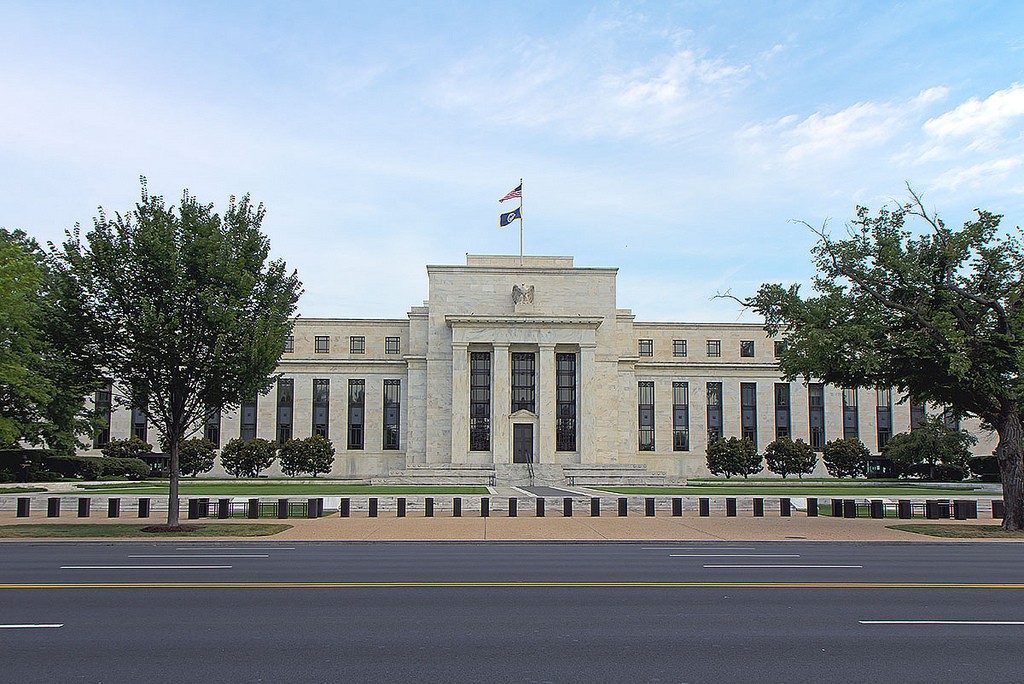
A strange statistic about borrowers and their supposed overwhelming dissatisfaction with online lenders is circulating where it shouldn’t be.
Only 15% of small business borrowers were satisfied with the loan they were approved for by an online lender, according to a Federal Reserve study published back in March. That’s actually not even what the study says but that’s the selective takeaway that some very influential people have gleaned from it. That figure in some way shape or form is being repeated at conferences, cited in academic papers, and even referenced in Congressional testimony. Apparently when it comes down to it, people are starting to believe that small businesses overwhelmingly hate their experience with online lenders because it’s something they think a very credible Fed study has confirmed.
It’s not a percent of satisfaction
The statistic in the study is actually representative of how many more people were satisfied than dissatisfied. That’s how they define it in their footnotes. 15% represents a net satisfaction score and it indicates that more borrowers were satisfied than dissatisfied. So 15% net satisfaction means that more than 50% of borrowers were satisfied.
Still though, banks scored higher than online lenders in the report so one might think that’s the important part at the end of the day. After all, this was a highly scientific study that we can still all make important decisions off of, right?
This wasn’t a scientific survey
The Fed disclaims any statistical meaning of their results in the fine print. Under methodology, it actually says:
- The data are not a statistical representation of small businesses.
- The SBCS is not a random sample of small employer firms, and therefore suffers from a greater set of biases than surveys that contact firms randomly.
- Businesses are contacted by email through organizations that serve the small business community in participating Federal Reserve Districts.
The Fed’s own authors seem to be pretty clear in stating that the data is not random, it’s biased, it’s not statistically representative, and that it was collected by third parties who coordinated distribution of the surveys on their own accord. Therefore for a policymaker, this report has no scientific value. Nonetheless, the Fed opens the report by saying “Our hope is that this report contributes to policymakers’ and service providers’ understanding of the business conditions, credit needs, and borrowing experiences of small business owners.”
Admitted falsehood becomes truth
Even though the figures are meaningless, they are being recited over and over. A major US Treasury report published in May for example, cited the Fed’s 15% satisfaction figure in its own analysis of marketplace lenders.
Testimony by Greg Baer, the President of The Clearing House Association, cited the study as well during a Senate hearing three weeks ago, but seemingly interpreted it to mean that only 15% of small businesses were satisfied with online lenders. “As reported in a recent small businesses survey, borrowers are generally dissatisfied with online lenders,” he said.
Marcus Stanley, Policy Director for Americans for Financial Reform, made the same mistake when he testified before the House Small Business Committee last month. “The evidence indicates they often provide a substandard and even exploitative product – just 15% of small business borrowers from online lenders expressed satisfaction with their experience,” he said, while arguing why they should be regulated further.
An article published by Nerdwallet also made the wrong assumption. “In fact, only 15% of small-business borrowers in the Federal Reserve survey said they were satisfied with their experience with online lenders,” they wrote in a story back in April.
Sadly, these are just a few examples.
Now what?
Does a study that’s not random, biased, not statistically representative, and not even controlled by the researchers, do more harm than good for an industry? Perhaps, because readers assume that a government study is scientifically sound on its face. Despite the authors’ move to disclaim the scientific value of it altogether, a mischaracterization of what is even presented anyway is becoming an oft quoted truism.
What is happening now is that both advocates and critics of the industry are starting to believe that only 15% of small businesses are satisfied with online lenders. No study has ever come to that conclusion though, not even the Fed study. It’s all in the fine print that openly says its not statistically representative and biased. And if that wasn’t enough, they even add “caution should be taken when interpreting the results.” Which in other words means, don’t use this stuff for anything important.
OnDeck Sets Q2 Earnings Date And…
July 14, 2016
OnDeck has one thing going for it when it releases its Q2 earnings on August 8th, the fact that the market seems to be anticipating bad news at every turn for the marketplace lending industry right now. A large drop in Q2 origination volume, if that is in fact what they report, would probably just serve as a confirmation of what everyone is already expecting.
OnDeck has already stopped referring to themselves as a technology company, a classification that likely propelled their IPO. Back in January, company CEO Noah Breslow said in a CNBC interview that OnDeck was actually a “non-bank commercial lender.” And after their first truly disappointing quarter, the company’s stock price has come down to a more sober level. It closed at $5.29 on Wednesday, down 74% from the IPO price and down 80% from the all time high.
With a good deal of doubt presumably already priced in, investors may look for reasons to be optimistic in Q2 even if the results are unfavorable overall.
A report circulated by Compass Point’s Michael Tarkan last month said that, “credit is holding up well, and the OnDeck-as-a-Service platform opportunity remains attractive.” Though it also added “overall profitability remains distant and tangible book value should continue to move lower.”
The earnings call on August 8th will take place after the market closes.
Fintech Hearing Summary (7/12/16)
July 13, 2016 A hearing about marketplace lending put on by the House Subcommittee on Financial Institutions and Consumer Credit covered a wide array of topics on Tuesday. From merchant cash advance to business loans to consumer loans, the witnesses tried to help members of Congress understand the circumstances in their respective industries.
Parris Sanz, the Chief Legal Officer of CAN Capital, explained the differences between a receivable purchase and a loan, a distinction that needed to be made in order to answer some of the questions from Missouri Congressman Lacy Clay.
The questions were generally exploratory and broad. For example, Georgia Congressman David Scott wanted to know what made consumer loans different from business loans. Sanz answered by saying that commercial loans power the economy and that their application was for creating jobs and growing businesses. More to the point, he added that these weren’t hobbyists calling themselves businesses because their average customer has been in operation for at least 13 years and does $1 million to $2 million in revenue a year. These are sophisticated users of capital, he said.
Missouri Congressman Blaine Luetkeyemer, who first read comments he obviously disagreed with that were made by CFPB Director Richard Cordray, repeated the question about the differences between the two. Rob Nichols, the CEO of the American Bankers Association, responded by saying that he didn’t believe the lines were blurred. Cordray had previously said that he believed the lines were indeed blurred, which created some fear in the commercial finance community
Where they might be blurred is in regards to data collection as mandated by Dodd Frank’s Section 1071, something that was only touched upon lightly. Ms. Gerron Levi, Director of Policy & Government Affairs, National Community Reinvestment Coalition, said that we don’t know a lot about marketplace lenders because the data isn’t being collected yet.
While there was some skepticism by the Members over how data was being used by fintech companies to make decisions, it appeared to be early days for a lot of the subjects such as the potential for creating a limited federal charter and whether or not these customers are truly underserved or are just being acquired by marketplace lenders because there is a degree of regulatory arbitrage occurring.
The tone of the hearing was overall neutral in nature.