

Sean Murray is the President and Chief Editor of deBanked and the founder of the Broker Fair Conference. Connect with me on LinkedIn or follow me on twitter. You can view all future deBanked events here.
Articles by Sean Murray

Crypto Fans Want to Buy The Constitution of the United States and They Might Actually Succeed
November 15, 2021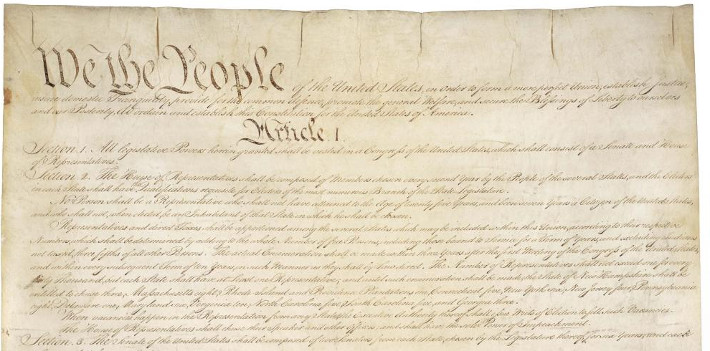
It’s the ultimate NFT, the Constitution of the United States. On November 18th, Sotheby’s will auction off one of the only thirteen surviving copies of the United States Constitution, an opportunity the public hasn’t had since 1988.
But a private collector hoping to pocket the national treasure will have some competition, the crypto mob on twitter. On November 11th, at least two individuals launched @ConstitutionDAO, a twitter account dedicated to crowdfunding crypto with the intent of raising enough money to be the winning bid.
The buyer would technically be a DAO, a Decentralized Autonomous Organization, a community-led entity with no central authority that is governed by a smart contract.
It’s predicted that if the DAO can raise significant cash before the auction that Sotheby’s will allow it to place legitimate bids. Sotheby’s put the estimated winning bid price at $15 million – $20 million.
It might not be out of reach, the DAO raised nearly $2 million in just the few hours since it began crowdfunding the money through a platform called juicebox.
If the DAO wins, theoretically “ownership” of the constitution would be fractionalized into shares based upon each member’s contribution. With a DAO, no one need even disclose who they are. Only a crypto address is required.
We have coordinated a DAO to acquire The Constitution of the United States.
I give you: @ConstitutionDAO
Ping me if interested in being a part of a monumental moment. https://t.co/VHkCTrq4fa
— Austin Cain (📜,📜) (@j_austincain) November 12, 2021
Members contributing to the pool of funds have the option of including a public message.
“To secure the blessings of liberty”
“Another first generation immigrant hoping to be the proud owner of the US constitution.”
“American Dream!!!”
“cant wait to explain this at Thanksgiving”
“in satoshi we trust”
The official website of the ConstitutionDAO is here.
For the sake of following the success or failure of this project accurately, deBanked contributed a very small amount to the DAO so that it could participate in the possible ownership and community of the Constitution. Weird, I know.
Winner of Broker NFT Made Unusual Request
November 4, 2021One winner of The Broker NFT Giveaway Raffle made an unusual request shortly after we aired his name.
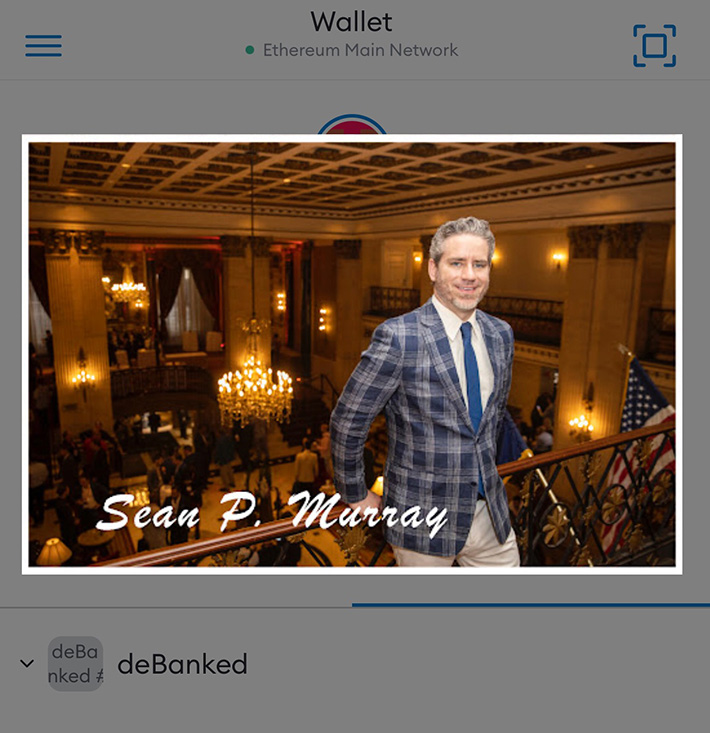 The prize was supposed to be one of the ten Broker NFTs, but Josh Feinberg, who is the CEO of Everlasting Capital, inquired about the private mints, which were not up for grabs, but had been displayed in some of our NFT livestreams.
He asked about token #3, which was, ironically, the NFT of myself that I had hand-autographed in photoshop and hand-minted via our own ethereum smart contract.
Upon discovering that his selection had not been made in jest, the decision was made to authorize the transfer of it to his ethereum wallet. Unusual (and flattering) as it was, I am honored that he wanted it.
CEO of Square Says That Hyperinflation is Happening
October 28, 2021There seems to be consensus the US is experiencing inflation in 2021, but few people of business intelligence are making a rational argument that we’re in the midst of hyperinflation. Such a scenario, if true, might mean that a cup of coffee could cost $200 by next year.
“It’s happening,” tweeted Jack Dorsey, the CEO of both Square and Twitter. “Hyperinflation is going to change everything.”
Hyperinflation is going to change everything. It’s happening.
— jack⚡️ (@jack) October 23, 2021
Perhaps Dorsey’s bearish view on cash, ironic given that his company operates Cash App, has something to do with his bullish views on cryptocurrency. Fifty eight percent of Square’s total net revenue in the 2nd quarter came from Bitcoin.
“While bitcoin revenue was $2.72 billion in the second quarter of 2021, up approximately 3x year over year, bitcoin gross profit was only $55 million, or approximately 2% of bitcoin revenue,” the company said at the end of Q2.
Square made no mention of inflation in its Q2 earnings, nor in the call with analysts that followed. The company makes more than $1 billion in small business loans per year, a business that would likely be impacted by “hyperinflation.”
A hyperinflationary economy would cause strange situations in low interest rate environments in which borrowers pay back far less than what they borrowed on a value basis. If rates are low and loan payments are fixed, the borrower might as well borrow everything they could from every source available and turn it into something that will keep up with price increases.
Dorsey’s comments weren’t a one-off. He doubled down on his prediction just seven minutes later.
It will happen in the US soon, and so the world.
— jack⚡️ (@jack) October 23, 2021
He continued by saying that hyperinflation wasn’t a wish, nor did he think it was positive. He then laughed at Steve Hanke, a well regarded economist at John Hopkins University for condemning his statements.
🤣
— jack⚡️ (@jack) October 24, 2021
If Dorsey is right, and we’re all paying $200 for a cup of coffee in 2022, he would actually be one of the first people to see it happening since so many small businesses, including coffee shops, rely on Square as their POS software.
deBanked Presents: The Broker NFT Collection
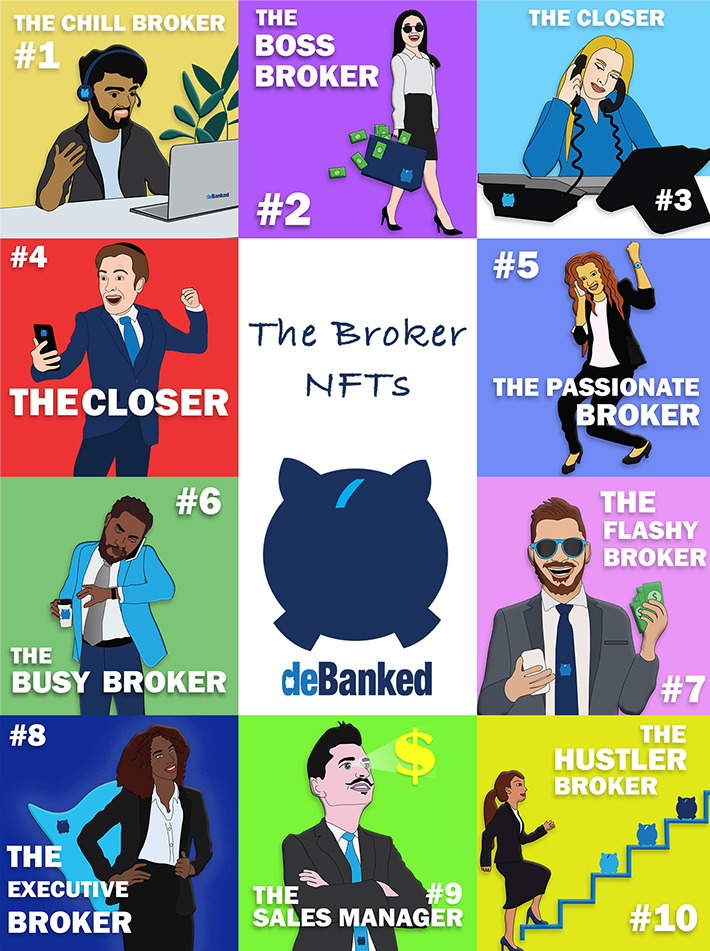
October 26, 2021Watch out CryptoPunks, deBanked has minted a limited edition set of its own Broker NFTs.
Drawing from the animated style popular in the NFT community, this collection of ten “brokers” is a diverse light-hearted tribute to the professionals in the business finance industry. Each broker in the collection has been individually minted on the ethereum blockchain.
The artwork was drawn by Cindy Recile and the NFTs minted via deBanked’s own ethereum smart contract. (See here on etherscan.)
The other news is that we’ll be giving some of these away for free. (stay tuned for those details!)
Today’s NFT market has things like pixelated punks and bored apes literally selling for millions of dollars.
A jpeg with no picture other than 4 words of text that say: “Fintech is Killing me,” is currently up for sale for more than $400, if that can be believed.
The act of minting an NFT cost Ethereum gas but if there is any particular thing you would like to see deBanked turn into an NFT, let us know and maybe we’ll make it happen! Email info@debanked.com.
Fintech Déjà Vu: Wait, Has This All Happened Before?
October 6, 2021 All one needs to do is answer a few short questions about their personal and business finances, have their answers evaluated by multiple leading lenders, and they’ll get a loan decision instantly, the advertisement said. Then, “select the loan that’s best for your business and get back to work all in less than 5 minutes.”
Touted as the “5-minute online business loan,” the ad for LoanWise ran in newspapers starting in 1999. That was 22 years ago. Back then, LoanWise was described as a marketplace that connected small businesses with lenders where borrowers could comparison shop for loans.
Provident Bank was the first to join the platform, where it would approve between $5,000 – $50,000 in as little as five minutes. At the time, the Los Angeles Times said that there were only 2,160 matches on Google for the phrase “small business finance.”
“2,160 is a big number no matter how you look at it,” the Times reported.
There’s over 6 million today by comparison.
LoanWise had set up 10 lenders on the platform by the end of 1999, with names that included American Express, Compass Bank, and PNC Bank. There was competition as well. Business Finance Mart and America’s Business Funding Directory also connected interested borrowers with lenders, according to the Times.
Today, all 3 websites no longer exist, forgotten vestiges from the land before fintech.
Or has this all happened before?
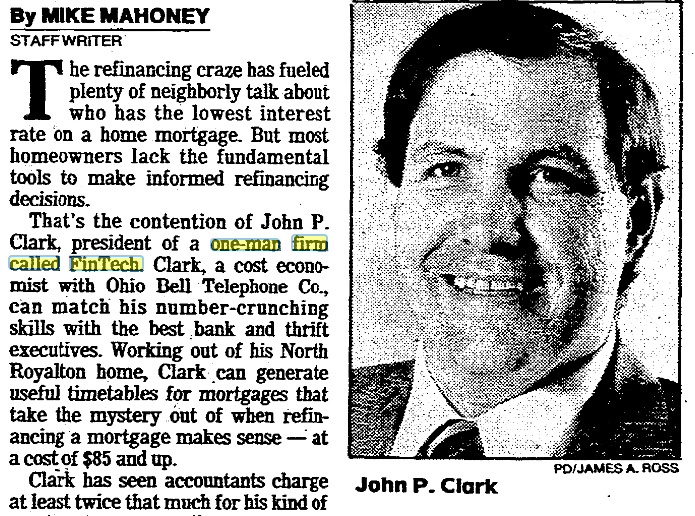 John P. Clark, a cost economist with Ohio Bell Telephone Co., ran a mortgage number crunching business in Cleveland on the side in 1986. Naming his company “FinTech,” Clark would help people calculate the best time to refinance.
“Clark can generate useful timetables for mortgages that take the mystery out of when refinancing a mortgage makes sense,” wrote The Plain Dealer. Had it been 2021, Clark sounds like it would have been a billion dollar fintech app.
It was not a one-off.
Fintech was the place to call if you wanted a working capital small business loan in San Antonio, TX starting in 1989. Ads for Small Business Financing advised people to call Fintech to get their business funded.
You could also just subscribe to the newletters. The Financial Times had four “FinTech Newsletters” in 1989 that were dedicated to covering electronic office, advanced manufacturing, telecom markets, and mobile communications. The price was £344 to £395 per year to receive them bi-weekly.
 “FinTech newsletters tend not to be excessively technical,” The Guardian wrote on Aug 10, 1989, “but provide management guides to developments in each field, with lots of bullet points.” Perhaps the striking difference between that and today is that the newsletters arrived “hole-punched for filling in a binder.”
But hey, it’s all just a coincidence that ideas were roughly the same thirty years ago. Out in say, Des Moines, Iowa in the 1960s, for example, none of these things would’ve occurred to anyone.
Or would they have?
Sidney Feintech, a supermarket owner, expanded his store in 1963 to sell appliances, car batteries, clothing, and televisions. He got the idea that selling on credit would boost sales so he formed his own in-house credit company so that customers could Buy Now, Pay Later. Innocent enough, except the newspapers mispelled his last name.
“Fintech,” the papers said, had gotten into the credit business.
 Fast forward 33 years to 1996 when a 26-year-old named Douglas Lebda thought the process of going from bank to bank to get a loan was too burdensome.
“I thought, ‘why can’t I put my information somewhere and let the banks compete for my business,” Lebda said. Launching a website, his company went on to generate $460 million worth of loans in just the fourth quarter of 1999 alone.
“There are other sites on the internet where you can apply for a loan, but those sites are operated by the lenders themselves,” Lebda said at the time. “We don’t lend money; that’s what makes us unique.”
That website was LendingTree, a company that today still has over 900 employees and a market cap of $1.8B. And Lebda is still the CEO.
In 1999, the hardest part was educating consumers to shop for loans online.
“Consumers have always done this one way, and this requires a behavioral change,” said consultant James Punishill in 1999. “In the old world, you’d pick up the newspaper and see a bunch of rates.”
“I knew from the start this would work because consumers really hate getting loans,” Lebda said at the time. “The market is huge and it’s perfect for e-commerce.”
How to Comment on New York’s Commercial Finance Disclosure Law
October 4, 2021With New York’s commercial financing disclosure law on the horizon for Jan 1, the state’s Department of Financial Services is seeking input on how the law should officially be rolled out. Their draft was published on September 21st. Directions for how to submit a comment were said to be forthcoming, but the when and how to do that, were not easily discernible.
The DFS website says that comments should be submitted via email to George Bogdan, but that the time to do that has already expired, the deadline having been October 1st.
A spokesperson for DFS on social media, however, said that comments on the law can be sent to: Comments@dfs.ny.gov.
This process of emailing comments contrasts with processes at the federal level which typically employ formal portals. While it may apparently be too late, anyone that had hoped to contribute their feedback but didn’t get to, could try the above contacts.
Fake Press Release Announced That SEC Had Dropped Case Against Ripple
October 1, 2021 XRP, the digital assets tied to Ripple, surged this morning from a price of $0.95 to $1.04 on the supposed announcement that the SEC had dropped its lawsuit against Ripple.
The news came via press release service Accesswire in the headline “SEC vs Ripple Legal Fight is Over.” Other news outlets immediately picked it up, including Yahoo, and it made its way to the top of Google’s search results.
The problem is that the entire press release was fake.
“Ripple, the leading provider of enterprise blockchain and cryptocurrency solutions for global payments, is pleased to announce that the SEC vs RIPPLE legal battle is finally over,” it began. “The lawsuit that lasted over ten months has finally been settled between the Securities and Exchange Commission (SEC) and the cryptocurrency company Ripple. The SEC has announced it would drop its charges.”
Accesswire deleted it as did Yahoo. deBanked obtained it via archive.org. Merely googling: ripple sec, however still shows the fake headline as the top result.
The public may not be fully aware that the news is false yet, if the price is any indication. It’s still trading at $1.04 as of the time this story is being written.
Two weeks ago, GlobeNewsWire fell victim to a similar scheme, when it distributed a fake announcement that Walmart would begin accepting Litecoin.
MJ Capital Funding’s Website Has Been Shut Down, Company’s Assets Being Auctioned Off
September 24, 2021 MJ Capital Funding investors holding out hope that a return to business as usual could be in the cards for the company accused of being a ponzi scheme, might find that outcome a little less likely.
The Receiver has agreed to auction off all of the assets at the company’s Pompano Beach offices on September 28, and everything must go, from the 60″ TV to the garbage cans to the houseplant.
Such powers afforded to the Receiver, a law firm partner named Corali Lopez-Castro, also gives her the ability to enter into binding legal agreements on behalf of the company, the latest ones being Consent Agreements with the SEC. In doing this, the two MJ companies (MJ Capital Funding, LLC and MJ Taxes and More Inc.), have agreed to disgorge of “ill-gotten gains,” accept a civil penalty, and be permanently restrained from continuing its former business. Such an arrangement is standard fare when companies are thrust into forced Receiverships like this one. The Receiver’s job will be to collect as much money as possible so that it can be distributed to afflicted investors.
The MJ Capital Funding Website has also been shut down. It now forwards to law firm Kozyak, Tropin, Throckmorton. Regular updates on the case are available for free at: https://kttlaw.com/mjcapital/.
The consent orders do not apply to former CEO Johanna M. Garcia individually, who lost control of the company and ability to act on the company’s behalf when it was placed into Receivership.
An astounding 3,160 people have signaled their support for Garcia in this case. That’s the number of signatures on the online petition for her located on change.org.
“Our goal with this petition is to get those funds unfrozen as soon as possible,” it says. “This is Johanna’s desire as well proving once again Johanna’s unwavering support for us and in building a strong team and community. Johanna has helped countless amounts of people and charities with the work she does local and worldwide.”