
Sean Murray is the President and Chief Editor of deBanked and the founder of the Broker Fair Conference. Connect with me on LinkedIn or follow me on twitter. You can view all future deBanked events here.
Articles by Sean Murray

Where’s the Reserve?
February 15, 2013 5 years ago it was merchant account sales. These days it’s all about the average daily ending balance in the business bank account. As the alternative business lending industry evolved, so too did the criteria to qualify, and nothing is more important now than historical cash flow. I spent a lot of time underwriting MCAs and one thing I noticed is that having a significant cash reserve is the exception, not the rule. Many small business owners I’ve encountered rely on overdraft protection just to pay their bills instead of using it as a backup cushion for the extremely rare circumstance that a check clears at the wrong time. The applicants with $1,000, $5,000 or $10,000 in daily reserves are treated very favorably in underwriting because heck, they can probably afford to take on debt. And then there’s the business owners with $20,000, $30,000 or $50,000 stashed away in the business account, a curious rarity that can actually throw up red flags.
“Why is this merchant applying for capital when they’ve got $30,000 sitting in the account right now? Something doesn’t add up here,” an underwriter might say. But the only thing that doesn’t add up is the fact that so many businesses are running on fumes. We’ve got a few small business owners writing about matters from their perspective on The Frontline, and we took great interest in something written by Chef Angela Bell. As a restaurant owner, she believes it is important to keep a cash reserve equal to a minimum of 3 months expenses. Depending on the size of the restaurant and seasonality, that reserve may need to be able to cover an entire year. This includes rent and salaries!
It seems in practice, this rule is constantly violated. Maybe holding on to extra cash hurts the competitive edge, maybe a cash reserve existed but was consumed during an emergency, or maybe the business just isn’t doing that great. There are a lot of possibilities to explain the disappearance of cash reserves, and I’m not faulting the businesses for being in this situation, but rather pointing out that in my experience, money seems to go out as fast as it comes in.
This isn’t a 2013 problem or a financial crisis problem. It’s a small business problem and one that has been around for decades. It’s why the purchase of future credit cards spawned into existence. The original Merchant Cash Advance (MCA) program wasn’t created to help people with poor credit, it was designed to help the businesses that had no cash reserves. If a business has $2,000 in deposits every day but also $2,000 in withdrawals, there’s a good chance a debt payment will bounce. Even with 750 credit, no bank would ever take the risk on a business like that, and that’s where MCA came in. Assuming the business’s plans were sound, an MCA funder would withhold a percentage of merchant account sales before they were even transferred to the business’s bank account. That eliminated the risk of bounced checks for the funder and put the burden of operating on tight cash flow on the small business. Funders then reduced the strain by withholding less in times of weak sales and more in times of strong sales. The percentage system was the bridge to ensure the relationship was not predatory.
 I’ve heard the frustrated replies from a business owner that was declined for weak or negative balances. They often sound something like this “Well, if I had cash I wouldn’t be needing a loan from you now would I?!” I feel for these people, I really do, but their approach to debt is misguided. Debt is not something you take on when you are out of money so you can continue business as usual. Debt is for growth or to be used as a temporary cash flow measure. Banks approve applicants that don’t need money because those that NEED IT are more likely to default.
MCA was the good faith option for small business owners that cried foul over the banks that wouldn’t lend to them. How could there be NOBODY willing to take a chance on them? And so MCA funding companies came along and did what the masses demanded, but at a cost to compensate them for the significant risk.
Today, there is high demand for merchant loans, loans that are evaluated based on a daily average bank balance and monthly revenue. Many people will get less than they want and others should consider traditional MCA instead. Those few that are at the breaking point and believe a loan will allow them to pay past due bills and keep them afloat are better off not applying at all. And for the rest that are contemplating using the $50,000 cash reserve they built up to expand should seriously consider financing instead to protect their cushion as best they can.
Tomorrow, the health inspector could close your doors, vandals could destroy your valuable assets, or the town could perform massively disruptive construction right outside the front steps that cripples sales for months. If you’re running on fumes, you’ll run out of gas. Always keep the cash reserve tank full and nobody will be able to stop you.
– Merchant Processing Resource
https://debanked.com
MPR.mobi on iPhone, iPad, and Android
Letters from the Frontline
February 12, 2013 I’ve worked in the alternative business lending industry for quite a while and I’ve noticed something off about many of the marketing campaigns. Some lenders have gotten so caught up in the funding that they’re losing sight of what it’s like to run a small business. Admit it, we’re all a little rusty even if we were once small business owners ourselves.
I started working as a deli clerk when I was 15 years old and continued to do it part time until my senior year of college when I began waiting tables at a restaurant instead. I could definitely tell you a few things about the daily grind and the epic drama that happens in the back of the house on a Friday night, but it’s been a while since I lived it.
But don’t you own a small business now? Yes, I do. I’ve been a part of two successful Merchant Cash Advance start-ups and I went off on my own full-time near the end of 2011. These days I have vendors, invoices, customers, contractors, accountants, and lawyers to deal with. I have monthly financials to reconcile, servers to monitor, and office rent to pay. But let’s be honest, my experience doesn’t really translate if I’m on the phone with a merchant that just had a waitress quit, a 12-top walk out on the bill, and an oven break, all while a health inspector is doing an unannounced review. Yeah, something about THAT is a little different than my day-to-day routine.
Sometimes we need to take a step back and stop trying to find the algorithm that best calculates FICO scores and monthly cash flow figures and start analyzing small businesses for what they really are. That led us to an interesting idea; Why not have actual merchants spell it out for us? What better way for us to connect with the retailers and service people of the U.S. than to have a two way dialogue right here on MPR?
Starting today, we’re announcing our experimental Small Business Corner, aka The Frontline. A small group of actual retail store owners or managers are going to contribute regularly with stories, tips, and advice about what it’s like for them. I think it will be insightful for us, as well as for the other small business owners that visit our site.
As the alternative business lending industry gets more saturated, shouting from the rooftops that you have “cash available with fast approvals!” isn’t a way to connect with the actual businesses that may benefit from a cash infusion. I’m guessing we’ll learn what does. These contributors are free to write what they want, so there’s no telling what’s in store. We hope you enjoy it.
Visit the Frontline
– Merchant Processing Resource
https://debanked.com
MPR.mobi on iPhone, iPad, and Android
Competitive Advantage: Keeping What’s Yours
February 6, 2013 The most effective competitive advantages are the ones you’re able to keep. And one of the most important of your competitive advantages can be your team. When a close partner, associate, consultant, or key employee leaves your organization there can be a really good chance of losing more than the individual qualities, skills, or experience that made that particular person such an asset. In fact, they just might take off ready, willing, and able to share with your competition what it is that makes your company, products, and/or services unique.
It’s clear that making sure the only thing an employee leaves with when they empty their desk is a few free office supplies is certainly in the best interests of your small business. This is definitely a case where an ounce of prevention is worth a pound of cure. There are three common means small business owners can put into place to help protect themselves:
- An NDA, or Non-Disclosure Agreement
- A Non-Compete Agreement
- A Non-Solicitation Agreement
Each one of these legal documents shares the goal of protecting the competitive advantages of your small business, but they are different from each other. For instance, a Non-Disclosure Agreement is commonly used when bringing in a consultant. A Non-Compete Agreement is commonly used when a major goal is to prohibit a former employee from working for a competitor within a specific geographical area for a specific period of time. A Non-Solicitation Agreement keeps a former partner or employee from leaving one business and then soliciting other employees to come and work for them.
I’m Just a Small Business – Is this REALLY Something I Need to Concern Myself With?
Certainly not all small business owners need to be concerned about NDA’s, Non-Competes, or Non-Solicitation agreements. However, although you might think of yourself as “just another small business” your business may actually require some of the protections these documents offer. It can be helpful to conduct a “confidentiality audit” to help you determine whether or not to make an appointment with an attorney. For example, here are a few things that warrant protection:
- Trade secrets such as inventions, formulas, or scientific discoveries
- Specialized methods or processes
- Specific Data
- Client and/or Customer Information
Again, you may not think of your business as needing protection. However, it is common for small businesses to fit into categories that may indeed fall prey to damage inflicted by former employees absconding with sensitive and/or valuable information.
Most small businesses are going to have employees who come into regular, consistent contact with clients and customers. What may not be obvious is that, in the course of that contact, those employees develop valuable relationships with those clients. Should such an employee leave your small business, unless you are protected, there is nothing keeping that employee from taking those customers and/or clients (and their business) with them. Your customer base should be protected as it is essentially your most valuable asset.
Advances in technology have also created situations where small business owners will want to protect themselves. Certainly if your small business conducts research and/or develops products it only makes sense to legally protect proprietary and intellectual property. For example, you will want to be sure that you retain the rights to new designs (including the right to obtain a patent) created by an employee. However, proprietary and intellectual property may not be limited to “new” products. For instance, your small business may develop an innovative application for existing technology.
If you are still on the fence regarding whether or not you should contact an expert for advice as to whether or not you might need a Non-Compete, Non-Solicitation, and/or Non-Disclosure Agreement take a moment to answer a couple simple questions:
- Do my partners, associates, consultants, or employees have on-going contact and/or access to sensitive client information and lists that would be of benefit to a competitor?
- Do my partners, associates, consultants, or employees have access to anything that is best kept “secret” from my competitors or that would place my business at risk if the information was made public? (We’re not talking about illegal activity, more along the lines of a “secret recipe” or special way of doing things.)
If you answered yes (or even “maybe”) to one or both of these questions it is better to be “safe than sorry” and make an appointment to receive expert advice from an attorney or other subject matter expert.
– Merchant Processing Resource
https://debanked.com
MPR.mobi on iPhone, iPad, and Android
MCA Industry More Fractured
February 1, 2013 Everyone agrees that the Merchant Cash Advance (MCA) industry has grown substantially over the last few years. Our best calculations estimated that $600 million in MCA deals took place in 2010. Some believed that figure was too low, especially when Capital Access Network (CAN) projected they would fund $700 million all by themselves in 2012. Could CAN really be funding more alone than what the entire industry including them funded in 2010?
The debate starts there because they have put a large focus on their NewLogic subsidiary, a company that specializes in short term loans, not MCAs. And like NewLogic, much of the growth the industry experienced in the last few years has not been centered around split-funding purchases of credit card sales, but on the alternatives. We’ve made it a point in previous articles to point out the lack of consensus on what the product is being called now, especially since everyone is offering their own version of short term financing. We even went so far as to say that by 2015, the term MCA won’t even exist anymore. We may have exaggerated a bit, but after playing around with Google’s Trends tool, we realized that prediction was much more than a hunch.
If MCA has grown so much in the last few years, why is it that 38% more people searched for MCA on Google in December 2007 than they did in December 2012? Why is it that searches for MCA information peaked in February 2009 and never recovered? According to Google’s search data, nearly 50% fewer searches are being made for MCA today than there were three years ago.
Notice that MCA as a term did not really exist on the Internet prior to June 2007. We presented our estimate of when that term was coined in Before it was Mainstream. It first appeared in print in May 2005, but didn’t pick up traction until March, 2006 in private Internet forums. The first Merchant Cash Advance Internet blog began in July 2007, weeks before people began to first start searching for information about the term. It is very likely they were also trying find the blog itself.
So is Google’s data just plain wrong? Is something fishy? The only thing wrong is the belief that the MCA industry is just about MCAs. The creation of alternatives and the recent practice of private labeling have contributed to the decline of MCA.
three new terms: merchant loans, ach loan, merchant financing
Business Cash Advance takes a dive. Seriously, who calls it that anymore? Merchant Funding is on the way back up.
There were 500% more searches for small business loans in April 2004 than there were in December 2012.
So what does this all mean? We leave you to draw your own conclusions. 2007-2009 was a period of sudden mass awareness of MCA but there has never been as much money in the industry as there is now. There are experts that say business owners feel that the recession never ended, causing them to continue hunkering down instead of seeking financing to expand. There are insiders who will attribute this to the negative stigma the product had and the need to call it something else. We believe the most likely suspect though, is the fracturing of the MCA industry. It’s possible that people aren’t typing “small business loans” or “merchant cash advance” into Google because so many companies are promoting alternative financing options that people are looking for those specific products instead.
Whatever the answer is, it appears that alternative business financing has grown tremendously but the MCA term has not. Share your thoughts about this with us. We want to hear theories.
– Merchant Processing Resource
https://debanked.com
MPR.mobi on iPhone, iPad, and Android
Wonga Retreats
January 30, 2013 For about a month, we’ve discussed the merger negotiations between On Deck Capital and UK based lender, Wonga. It seems now that our quest to evaluate Wonga’s potential success in the US was all for naught. BusinessWeek reported yesterday that the deal is off after a price disagreement. The only figure known to us is the amount originally publicized in November at $250 million. We hope our readers realize that we made a lot of fuss about this merger because it was said to be in an advanced stage months ago.
With the deal dead, it has become evident that something was gained by all of this, and that is the valuable insight from Merchant Cash Advance (MCA) veterans on a range of topics. LinkedIn lit up like a light bulb when it came to debating UK lending practices and algorithmic underwriting. Below are a few snippets from the conversation:
There are significant cultural and other differences between MCA and small business lending in the UK and the US that work against a purely algorithmic MCA underwriting model in the US. In the UK, most small businesses have been established or owned for generations – or longer. Imagine underwriting a pub that has been in existence for 200 years, or a bucolic inn in the Scottish highlands that has been owned by the same family for over 100 years. The entrepreneurial culture in the US where anyone who needs a job starts a small business – and applies for a cash advance – doesn’t exist in the UK.
The rates MCA companies charge is less of an issue in the UK, there is more alternative finance that is generally accepted and rates are not objected to, which is probably why Wonga doesn’t have an issue with the rates they charge, and when borrowers don’t have a problem with the rate they are less likely to feel entitled to default. Also borrowers don’t move as much in the UK and tend to be much more stable in their communities and banking relationships which is correlative to default in the US. Lastly we saw very little fraud in the UK, which is a significant underwriting issue in the US. It will be interesting to see if this deal gets done and what Wonga might do in the US market with their business intelligence, but it may not be as easy as they think.
Our company uses a algorithm to help with our underwriting practices, but there is something to be said about the personal touch when it comes to merchant cash advance space.
After several years of researching the U.K. marketplace and preparing for significant differences—including no UCC filings–what I found were striking similarities. These included resistance to higher (than bank) fees, switching processors, mistrust of terms or the agreement (sale and purchase of future credit card receipts), difficulty recruiting referral partners or ISO s, etc. There were, however, two very important differences between the U.S. and European business models. The first, as J. Brown points out, is cultural. The European attitude toward debt assumption and repayment is more “responsible” than it is in the U.S. Many Pubs and Inns in the U.K. have been in the family for generations. Additionally, there are over 10,000 India restaurants in the U.K. most are run by hard working families. These are considered “honorable” professions and defaulting on an obligation is not “proper.” The second is product distribution and monitoring the performance of the distribution channels. In the U.K. distribution channels were “business referral partners.”
Automation and the proper utilization of technology is certainly the backbone to having a viable and more importantly scalable lending business. I do have however disagree that algorithms and data can completely eliminate the review of a file by a human brain. The ability to ascertain the credit worthiness, borrowing ability and most importantly likelihood of repayment of a business differs vastly from the consumer finance space.
Credit goes to J. Brown, F. Capozza, M. Landau, H. Francis, and everyone else for excellent input on these subjects.
Previous Wonga Articles:
Made for Each Other? 12/12/12
Funding Down to a Science 12/21/12
Not Science 1/14/13
– Merchant Processing Resource
https://debanked.com
MPR.mobi on iPhone, iPad, and Android
Social Media for Small Business: Food for Thought
January 29, 2013Here’s an interesting trend: blog posts on the subject of the “decline” of social media. Within 90 seconds you can locate three such articles on Forbes.com:
- 3 Reasons You Should Quit Social Media In 2013
- Facebook, Twitter? Can The Decline of Social Media Come Fast Enough?
- Why I Dumped My Smartphone – 2 Months Into Building My Personal Innovation Lifestyle
OK, so three articles can’t be considered a “trend” – but they definitely provide some food for thought.
Should You Quit Social Media in 2013?
The very notion that people are suggesting there might be value in at least “taking a break” from social media should get our attention. Take the three reasons J. Maureen Henderson gives in her article for doing so:
- It harms your self-esteem
- Your blood pressure will thank you
- Online is no substitute for offline
Henderson is speaking to personal self-esteem and gives the example that there are those of us who might feel better about ourselves if we weren’t constantly exposed to technology that forced us to compare ourselves to and compete with over-achieving peers. Yes, it can be personally humbling to discover the jerk you sat next to in biology graduated from Harvard when you barely made it out of State. Small business owners overdosing on social media just might have a similar problem trying to duplicate the social media activities of large competitors whose marketing budget is a big as their small businesses’ net worth – which can be very discouraging and demotivating.
Personal social media activity definitely can get pretty ugly. Name calling, ostracizing, bullying and just generally disrespectful communications can certainly cause your blood pressure to rise. Small business owners can have a similar reaction to preserving and protecting their online brand reputation. While it’s great to be able to communicate directly with customers and clients, the flip side is small business owners don’t have total control over the conversation any longer. Even if you’re monitoring your own platforms (for example comments on your business Facebook page), there’s always the opportunity that you could be missing some “flaming” commentary about your business online somewhere out there on the Internet.
Henderson notes a study stating that one-quarter of those surveyed feel they haven’t fully experienced real-life events due to activities necessary to place those real events on virtual social media platforms. She also points out that most people looking for a job do so online even though 70% of jobs are never posted online and are instead filled via in-person networking. Here is a lesson small business owners might want to take to heart – the impact, effectiveness, and value of getting in front of your customers and clients “in-person.” Real customer experiences are as important as virtual customer experiences.
Are People Dumping Their Smartphones?
We could give you a ton of statistics, but the short answer is a definite NO. As a matter-of-fact, the trend now is major increases in consumers using mobile devices to stay connected online. Some people may be becoming less enamored with “traditional” social media – but we’re definitely going to see an increase (at least for the foreseeable future) in the use of these devices according to a wide variety of studies by reliable resources such as Mashable.
The point is small business owners need to be aware that social media is constantly evolving (and most likely always will be evolving.) And that fact is both a blessing and a curse for small business owners. Certainly having new ways to effectively engage consumers along the “pathway to purchase” is a valuable opportunity. The threat can be not only keeping up with new technologies, but also the ways those technologies impact consumer behavior.
Even “expert advice” can be both confusing and in conflict. For example, here are two predictions in an article you can find at business2community.com:
Joey Sargent, Principal, BrandSprout Advisors: In 2013, we’ll see more social maturity in both B2C and B2B applications. Business will get “social smarts” and more fully integrate social media into their day-to-day operations across the organization. This means less social for social’s sake, and more focus on social media as a legitimate business tool to facilitate communication, engagement and loyalty.
Jayme Pretzloff, Online Marketing Director for Wixon Jewelers: Going into 2013 social media will impact sales more than any other metric because of the continued integration as a marketing platform and the acceptance of users to be marketed to. In 2011, almost 70% of users said that no social media platform influenced their buying decision and in 2012, that was cut in half to 35%. In 2013, this number will be decreased significantly again because these sites have become an integral way to gain access to information on companies, promotions and products.
Bill Corbett, Jr., President of Corbett Public Relations: The hype proliferated by “marketing” people about the tremendous business generating benefits of social media for small business will wind down.
Beverly Solomon, Creative Director at musee-solomon: People are over saturated with social media. They will gradually remove themselves from all but a few networks, blogs, etc. So many ads come in everyday that they have lost their impact. Most people just delete them before reading them. Social media will function more to alert friends of rip-offs than to encourage sales. Only the most clever sales campaigns will have any impact. More and more advertisers will be leaving social media and returning to snail mail, print and other traditional ads. Social media will continue to be a dating hook up, gossip fest and avenue for “gurus” to sell seminars. But real businesses will use social media less and less.
Who’s Right?
With such conflicting advice from subject matter experts – how is a small business owner to know who to listen to? Fortunately this question is easy to answer: Listen to your customers and clients because they – and only they – know how they prefer to be contacted as well as what the content of those communications must be in order to be of value and meaningful to them. This means small business owners need to find out where their target market “hangs out.” Are they already online and using social media? If so, how and where? If not, why not and what other ways would they like to hear from you?
The one constant advantage of social media is the ability to communicate with your market. But it is certainly not the only channel. As for our position on the matter? We’re making social media a bigger priority. We’ve just gotten more involved on Google+, a social network that just passed twitter and youtube to be the 2nd most used platform in the world.

It might be time for the everyday small business owner to take a peek at the big G, especially if they feel like Facebook isn’t delivering.
Guest Authored
– Merchant Processing Resource
https://debanked.com
MPR.mobi on iPhone, iPad, and Android
Coming In From the Cold: Connecting With Prospects
January 29, 2013 A small business owner posted a great question on the LinkedIn group “Small Business Networks for Startups and Entrepreneurs” board:
Are cold calls effective? Or is it old school? For a small company, what is the best way to promote the business? Any advice will be greatly appreciated.”
The small business owner who posted this question got more than her fair share of advice and opinions regarding the practice of cold calling. And, while most every single comment had a jewel of truth and wisdom when it comes to cold calling – the comments also conflicted with each other. For example:
“Not only is it old school but its intrusive and offensive.”
“Cold calling is old school indeed but it is still one of the most effective ways to reach prospects.”
So – which is it? Offensive or Effective?
Fortunately for the small business owner uncertain whether to pick up the phone there was one comment that simply rocked. Sandra Hoedemaker owner of ChefinDemand.com an online business coaching service specializing in providing services to personal chefs, posted a completely different perspective and approach to cold calling – something she calls “Connect Calling.”
Connecting is Warm – Cold is…well, Cold
Those commenters who identified cold calling as intrusive and offensive make a good point. Today’s consumer not only isn’t interested in hearing uninvited sales pitches, they can (and quite often do) find unscheduled sales calls as a definite intrusion into an already too busy day.
Sandra notes that she does, in fact, “cold call” and also indicates that these calls are always most successful when she is able to connect with the decision maker. So far her comment sounds like your run-of-the-mill cold calling advice. However, Sandra definitely breaks rank because she goes on to say that she “doesn’t sell on the phone.”
OK, if she’s cold calling, but not selling – what exactly IS Sandra doing when she makes those calls?
Sandra knows prospects aren’t interested in “being sold” – but they are interested in learning real ways to solve their problems and get their needs met. Sandra knows that the best way to do that is to establish her credibility as an expert who knows how to solve common problems and meet the special needs of her niche. How does she do that? She offers to provide them with carefully selected free services. This allows her to:
- Build her email list and then connect with prospects freely because they have invited Sandra to contact them.
- Stay connected to her prospects via blogging, teleclasses, and other virtual events (she’s also in the process of putting video presentations in place.)
Outside of the above, connecting with prospects versus cold calling prospects has resulted in Sandra receiving referrals and she’s also garnered invitations to speak as well. Sandra has successfully used Connect Calling as a tactic to connect with prospects in meaningful ways. She’s taken an “old school, annoying” tactic and turned it into a powerful tool to build a community of prospective buyers.
What is most impressive about her approach is the opportunity to begin to establish trust with prospects via Connect Calling. Offering useful, applicable free services and information allows prospects to begin to build a relationship where Sandra becomes a Trusted Advisor who’s got their back versus someone trying to make a sale. Sounds more like networking than cold calling doesn’t it?
And when those prospects pick up a phone to make a call when they find themselves in need of services Sandra charges for, Sandra’s much more likely to be the one who hears it ring.
Sandra’s business serves a unique niche – but Connect Calling can be a valid, productive, and profitable tactic to market your small business no matter what market you serve.
Guest Authored
– Merchant Processing Resource
https://debanked.com
MPR.mobi on iPhone, iPad, and Android
The World is Going Mobile
January 28, 2013We noticed a lot of people sharing and retweeting a link today to a web campaign by Google to create mobile friendly sites. Coincidentally, we’ve been working on “mobile-izing” Merchant Processing Resource for the past couple weeks. We used Google’s GoMo tool to see how we’re doing so far:
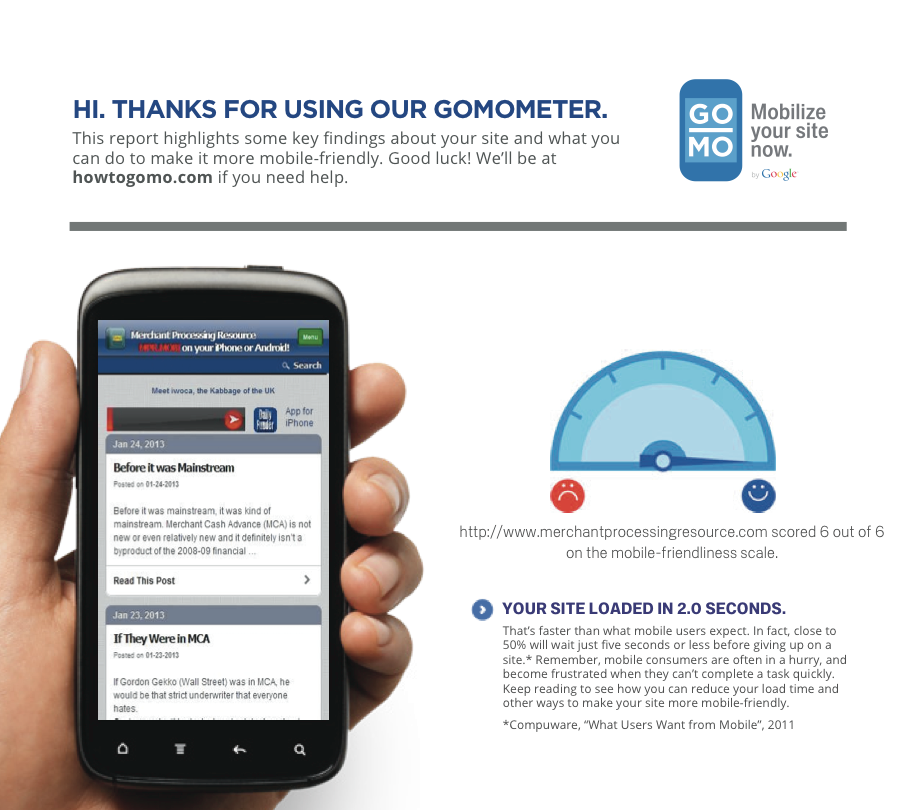
2 Seconds and easy to use! Now it’s your turn to GoMo.
Get to our site easily on your phone by typing in MPR.mobi.