Small Business Lending is King to Institutional Investors
June 2, 2015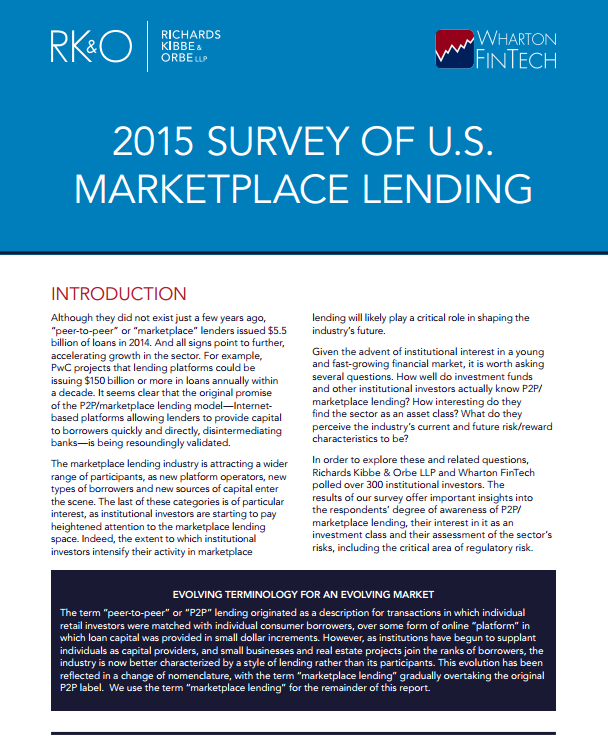
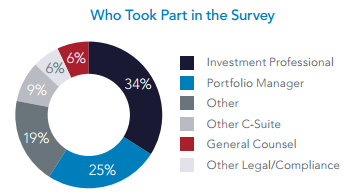
Richards Kibbe & Orbe LLP and Wharton FinTech polled more than 300 institutional investors to gauge their thoughts on marketplace lending. They published their findings in a recently released report.
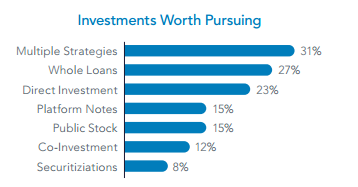
The surveyors seemed surprised that institutional investors indicated their interest in small business loans was greater than that of consumer, real estate, education, and everything else.
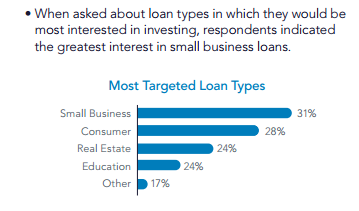
Securitizations ranked lowest on the list of investments worth pursuing and buying whole loans was second only to “multiple strategies.”
Regulatory risk and uncertainty was low on the list of concerns while borrower quality was the most concerning factor. Curiously, competition was the least concerning of all.
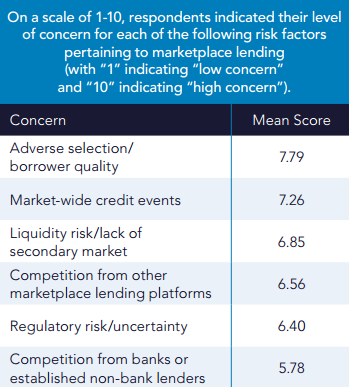
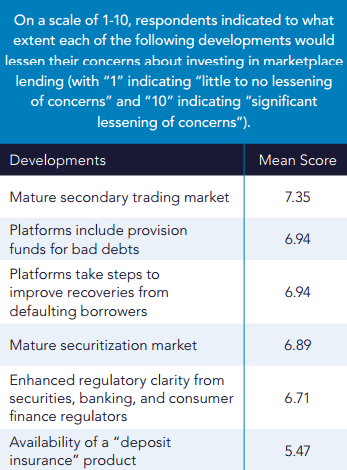
Speaking to the liquidity issues of the assets, institutional investors indicated that the development of a mature secondary trading market was more likely than anything else to lessen their concerns about marketplace lending.
Do any of these results surprise you?
Download the Key Findings report
The Broker’s Future: Are The Good Times Over?
June 1, 2015 As we continue the Year Of The Broker discussion, we must take an honest look at The Future. Due to the low barrier to entry into our space, there isn’t a week that goes by that I don’t see another recruiting ad informing the reader that all they need is a heartbeat, a UCC list, and an industry list of SIC Codes to make big money in our space. But is everything really as rosey as promoted, or if you are a new broker, should you consider investing your capital (time, energy, money and mental health) in another industry?
The Past
To understand The Future, sometimes we have to look at The Past. Instead of a year of the broker, there was instead an actual era of the Broker, and that was from 2000 to about 2013:
(( 2000 – 2007 ))
Few firms offered a “Merchant Cash Advance” as either a direct sell or value add, and very few merchants were receiving telephone solicitations in regards to the having “working capital” other than those involved in the Equipment Leasing or A/R Factoring sectors. While the market was wide open, most merchants wouldn’t entertain an advance for 6 months with a 1.25 – 1.30 factor rate when banks were lending pretty well at much lower borrowing costs.
(( 2008 to 2013 ))
When the economy and markets took a downturn in 2008 creating The Great Recession, and banks halted most of their lending to small business applicants, the Merchant Cash Advance product was more aggressively sold by the pioneers of the industry through their Merchant Processing ISO relationships, direct selling, online advertisements, and more. The pioneers also introduced risk based pricing and premium priced products, allowing them to appeal to the higher credit graded merchants who were finally entertaining the product due to banks not lending as efficiently as previously. The pioneers also introduced multiple formats of repayment including through ACH, which allowed them to service merchants that they couldn’t tie the repayment to their merchant processing volume due to the merchant’s inability to switch or the merchant’s low monthly processing volume.
Awareness of the Merchant Cash Advance skyrocketed, hundreds of millions in equity capital began pouring in, major media outlets such as CNBC gave the product coverage, and annually the industry was funding over $1 Billion to small business applicants.
This boom period also started the trend of new lenders and brokers popping into the industry overnight using mainly the same marketing strategies such as UCC Lists, SEO, PPC, Bankcard Portfolio Marketing, and Cold Calling Various SIC Codes. These strategies worked in a decent fashion until the flood of new direct lenders and brokers coming into the industry continued, with these new entrants using mainly the same strategies. Profits were being driven down, new client acquisitions were being driven down, and because a funder’s UCC filings were being called so much, they decided to begin filing them under fake names or only filing them on riskier merchants, or never filing a UCC at all. Also most of the Online Marketing methods became too expensive, pricing the little guy out of the market.
The Future
Now we are in 2015 and new broker entrants are mainly using the exact same strategies from 2008 – 2013, discovering that UCC lists and Cold Calling SIC Codes just will not work efficiently going forward. The Future of profitability and new client acquisition in our space is going to be through Strategic Partnerships. There are three sections of your Strategic Partnerships and they are your Professional Network, Mom and Pop Network, and Online Network.
• Professional Network – The creation of a professional network from referrals such as Banks, Credit Unions, Accountants, Business Brokers, Merchant Processing ISOs, etc., to bring in a high amount of consistent leads of small business applicants who are currently seeking capital.
• Mom and Pop Network – The creation of an external independent broker channel that includes hundreds of random brokers that you sign up to resell your services. You would use the same tongue and cheek, everything is rosey, recruiting ads that I see every week just to get a rush of people on the telephone making cold calls to SIC codes, trying to compete in online marketing, or calling the remains of UCC lists, all with the dream of making a lucrative payday. The volume produced on an individualized basis will be so small it’s irrelevant, but as a collective, they will make up a major chunk of volume. This why I call these sources Mom and Pop.
• Online Network – This is your SEO, PPC, High Traffic Website Ads, and other online advertising methods. These methods will become more expensive going forward and only those with large marketing budgets will be able to truly capitalize in this area with positioning, listings, etc.
Summary
Our space is changing and new broker entrants might want to reconsider investing their capital (time, energy, money and mental health) into this venture. Only direct lenders with team members that were pioneers of this space as well as with the right networks and equity sources, are capable of truly seizing The Future. Those just now trying to come in and ride the wave will soon discover that just like with the Stock Market, the real money has already been made and most of the future returns are already capitalized. As a new broker, you more than likely will fall into that dreaded Mom and Pop category, which isn’t a good position to be in for The Future.
Mapping the Business Financing Industry (Sneak Peek)
May 27, 2015People often ask what the real presence of the merchant cash advance & business lending industry is like in New York City. Below is a map of Midtown Manhattan.

We apologize if we didn’t plot your company on here. Let us know you exist by signing up for our magazine.
In the May/June issue that’s being sent off to the printers at this very moment, we explore the industry scene in lower Manhattan. Midtown may have been a birthing place and permanent home for industry titans, but Wall Street, long believed to be a haven for stock brokers has been overrun by a new kind of broker.
You’ll just have to stay tuned to read more. If you’re not signed up to get our free print magazine, register now.
Also in the May/June issue:
- An examination of a new trend, consolidating loans and advances.
- Watching everyone else get rich off alternative lending? Whether you’re in underwriting, administration, operations, or sales and whether you have a lot of money to invest or just a little, there are opportunities available to “get in”. You might be in this industry but are you in this industry? We’ll run through the basics of what’s available out there. Become a player or just educate yourself.
- And more!
The Co-brokering Phenomenon: In Business Loans & Merchant Cash Advance
May 25, 2015 Meet the broker’s broker, the middleman serving the middleman. Some call this co-brokering since both parties will typically share in the commission.
Wait, what?
The broker’s broker might have relationships that the little broker does not. They could have leverage over their funding partners because of the amount of volume they can produce or the amount of professionalism they bring to the table. And they likely have a canny ability to close deals that otherwise would get tossed by the wayside.
Disintermediation is the war cry of today’s famous tech-based lenders but in the Year of the Broker, reintermediation has been the unforeseen byproduct. Big lenders such as OnDeck are shedding third party funding advisors but those advisors aren’t magically going away.
A number of them are still getting their deals funded at OnDeck, just indirectly. They have to go through a broker whom OnDeck has not cut off, a handful of salespeople have told me. Many brokers acknowledge that OnDeck’s rates and terms are not easily attainable elsewhere so they’d rather share a commission with an OnDeck approved broker than risk a dead deal with no commission.
And CAN Capital is known to offer comparable pricing to OnDeck but it’s been reported that new brokers must go through a rigorous audit before CAN will accept their business. It’s not something everybody wants to go through.
With the two largest funders in the industry imposing real barriers to doing business with them, sanctioned brokers play toll booth operator for the swarm of shops that can’t get their deals submitted without them.
Perhaps as a direct result of that, there is now an entire niche of brokers whose only business is brokering deals for other brokers. They have little to no interaction with merchants. They have no marketing budget. They might not even have a website. And they play an almost mystical role of gatekeeper and power broker.
Onesy-twosy woes
A strong focus within the industry has been growth. There’s a lot of time, resources, and salesmanship that goes into courting the lucrative partnerships. Large funders, especially those with VC backing, are typically not interested in mom and pop broker shops. “If they’re only going to send one or two deals per month, we don’t want them,” I’ve heard time and time again.
Even five to ten deals a month can draw yawns. It’s nothing particularly against the mom and pop brokers, but experience has apparently shown them that the same amount of resources are spent on the onesy-twosy brokers as the ones doing a hundred deals a month. The cost benefit analysis has to make sense, they say.
That’s left hundreds or perhaps even thousands of mom and pop brokers to fend for themselves. What outsiders might not seem to realize is that the commission on a $50,000 loan or advance can be $5,000. That’s potentially enough for a stay-at-home parent to pay for the rent, groceries, and all the other bills. A onesy-twosy broker might be completely insignificant to a funder doing a billion dollars worth of deals a year, but to a mom and pop broker, it only takes one deal to pay their bills and only a handful to make them rich, especially if they live in middle America where the cost of living is cheaper.
In From Lowes to Loans, superstar broker William Ramos said he made $66,000 on just one deal alone. While his shop produces more than a million dollars in deal flow a month, it’s easy to see what’s drawing the hoards of newbies in. A $66,000 commission might be the only commission someone needs for an entire year.
There is no licensing required so becoming a broker is as easy as imagining that you are one. And as the space invites the less knowledgeable, a more sinister element has found opportunity as well.
Shady
 “There is no president/ruler of the MCA world that can help you with your commission debacles,” wrote PSC’s Amanda Kingsley on an industry forum. That was part of her reply to a thread titled, co-brokering scumbags. The thread might be new, but the circumstances aren’t. A broker sent their deal to another broker who got the deal closed with a funder. The original broker supposedly got screwed out of the commission.
It’s a case of stolen deals. “You just have to find the right people to work with. There are a lot of shady characters in this industry,” wrote another user.
1st Capital Loans Managing Member John Tucker, who recently authored, Broker Business Planning, wrote in reply to the thread, “Get everything in writing and research your lender/partner heavily before contracting with them. Talk to other brokers and ask them about their experience with said lender/partner in terms of paying on new deals, renewals and residuals. Get a ‘feel’ for them.”
Several faulted the aggrieved party for not taking the time to hammer out a contract that would allow them to rectify the situation easily through a lawsuit. But even with a contract, pursuing the offender legally could cost more than the commission lost. A stolen deal might cost a broker a few hundred or a few thousand dollars, figures worthy of small claims court.
“Under no circumstances would I ever co-broker a deal,” wrote Tucker. “There’s just no reason to unless you are a newbie and getting trained by said broker.”
But another user wrote, “Sometimes you don’t even know you are co-brokering until after the fact.”
Unscrupulous brokers will be purposely deceitful but for others walking the thin line between broker and funder, it’s difficult to judge what constitutes direct. There are brokers that wholeheartedly believe that if any portion of their own funds are invested in a deal, then they too are a direct funder. That means a broker that syndicates with a variety of funders could be so inclined to identify themselves as a direct funder by extension.
Kingsley wrote, “You have to understand what a ‘broker’ is in this space and understand that it is A LOT different than brokering in another industry.”
She also pointed out that it’s not always the little guy that’s susceptible to becoming a victim, as could be the case if an early deal default leads to a commission chargeback. When that happens, the funder will take back the full commission on the deal from the broker of record. It’s the responsibility of that broker to claw back whatever split of the commission they shared with the sub-broker.
“The broker you sub-brokered for, can vanish,” Kingsley wrote.
Ban the bad guys?
Several industry veterans have suggested creating an ISO/funder blacklist for those that steal commissions or deals. The challenge is that a stolen deal is not always a black and white situation. Often times there are expiration dates built into contracts that allow funders to claim deals if they have not been closed by the submitting broker within a specified period of time. Other times it’s a case of miscommunication, or the victim conveniently left out key details that would certainly add a degree of color to the situation.
Calling out an offender online can quickly devolve into a he said/she said schoolyard brawl. Unfortunately, this might be the only remedy a victim has, especially if they have limited financial resources to pursue legally, or the only evidence of their deal is a handshake or an email.
The bad guys, if they’re engaged in trickery on a large scale, tend to get identified rather quickly. There’s always a few that come in, burn a lot of bridges, and then find themselves completely ostracized from the industry. When the damage is done, they might never be heard from again or they might try to repeat the process by using a different name. Blacklisting a broker or funder wouldn’t be foolproof, especially if the company owner legally changes their name, which has actually happened before.
Trust
Through it all, Tucker offered this advice, “In a nutshell, the only true thing protecting your compensation is a very good relationship with an honest, credible and ethical lender.”
And if you have to go through a broker, make sure you choose the right one. Don’t blindly send your deal to somebody you met on a message board. An unscrupulous player will tell you exactly what you want to hear. Ask around for references. If nobody’s ever heard of them, chances are you’re talking to the wrong shop.
Even the author of that thread conceded that co-brokering offers benefits. “I’m all for co-brokering deals, especially if someone has a solution that may suit the client better than a traditional MCA or when an MCA wont work,” he wrote.
So there just may be a place for the broker’s broker, whether as a gatekeeper, power broker, or toll booth operator. And like it or not, reintermediation has ironically become a byproduct of disintermediation. There are sadly no algorithms that exist to vet how a broker might treat another broker. Co-brokering is a trade that relies on the most basic of basics, trust.
Nothing’s more valuable.
OnDeck Gets Taste of its Own Medicine
May 24, 2015 You know those subtle and not so subtle knocks OnDeck has made about merchant cash advances over the years regarding costs and transparency? Well, the tables have turned.
A supposed unnamed merchant shared their capital raising adventure stories with Fundastic and apparently confused the OnDeck cost factor of 1.24 with an APR of 24%. “The interest rate was 24%, which we thought was excessive, as well as the daily $984 payments we got as part of the deal, but in the end we moved forward with the line,” the business owner reported. A Fundastic editor’s note explained the merchant’s APR was actually around 52% because of the closing fees.
The business owner continued to gripe about not receiving an amortization schedule, as well as the fact that they couldn’t pay off the loan early without incurring a penalty.
Apparently the simplified dollar for dollar cost that OnDeck outlined wasn’t forthcoming enough for them, and they were much more satisfied when they switched to Lending Club.
The merchant then went on to explain that their Lending Club business loan rate was only 9.9%, down from OnDeck’s 24%.
Transparency and full understanding at last?
Ironically, Fundastic had to add yet another note to show that the APR was actually 12.96%. 9.9% was not an APR. “LendingClub had a transparent loan — reasonable interest rate (we have 9.9% + 3% origination for a 2-year loan),” the business owner wrote, yet it seems he was unaware of the APR here either.
Fundastic ultimately concluded, “If you qualify for both LendingClub and OnDeck business loans, I can’t see any reason why you would go with OnDeck. LendingClub’s loans are cheaper in cost [and] more transparent.”
Lending Club might’ve been cheaper in this scenario but the merchant appears to have gotten similar information from both lenders. I’m not sure how much more transparent a lender can be when they spell out exactly how much you have to pay back, though an APR would be useful for certain comparative purposes.
Them’s fightin’ words
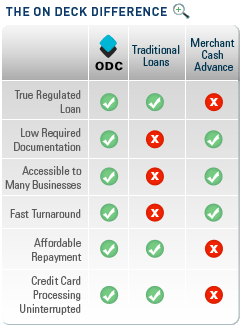 The jab at OnDeck though is reminiscent of the way OnDeck historically attacked merchant cash advances. In a 2008 press release, they wrote, “On Deck Capital fills the void between bank loans and alternative business financing products such as merchant cash advances which, similar to payday loans, charge excessive percentage rates for short term capital.”
They even used to display this little chart to explain just how much merchant cash advance sucked compared to them.
Affordable repayment? NOPE!
Meanwhile, OnDeck is still not profitable after 8 years. That either just goes to show how hard it will be for them to compete with Lending Club’s pricing or it indicates that Lending Club is severely underpricing its business loans. It might be the latter.
Lending Club’s business loan program is still highly experimental and dozens of business lenders have entered the space with the belief that undercutting higher priced products right out of the gate will magically yield positive results.
Does this look familiar? OnDeck is being attacked by Lending Club with its own playbook:
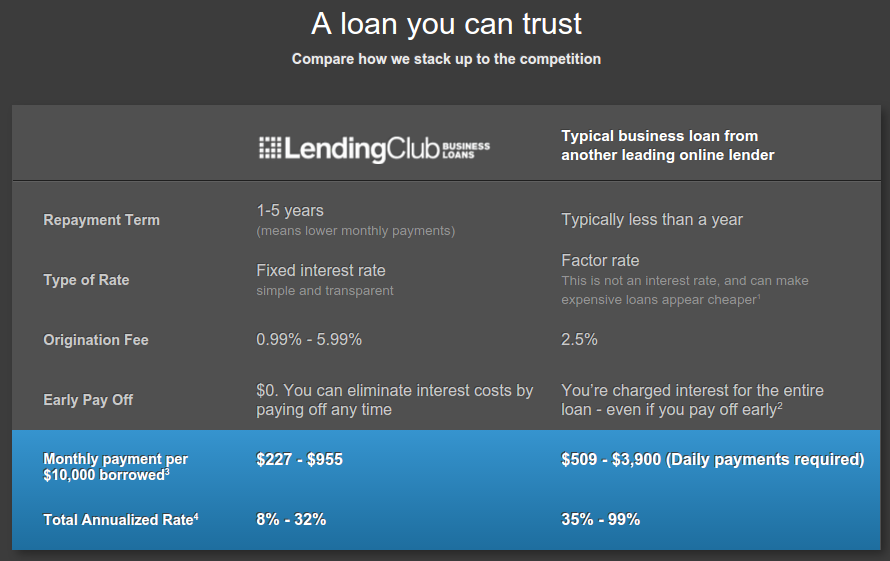
And in case you weren’t sure if they were comparing themselves to OnDeck specifically, the 2.5% origination fee is the number that appears right on OnDeck’s website. “We charge an origination fee of 2.5% of the loan amount for your first loan,” it states.
And here’s a snippet of a chart that used to appear on OnDeck’s website:
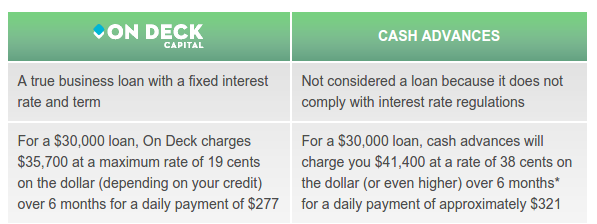
OnDeck has repeatedly stated that competitive pressure has not been the reason that their interest rates are dropping. It may actually be in anticipation of a brewing public relations war. Lending Club’s supporters are beginning to attack OnDeck in the same way that OnDeck attacked merchant cash advance companies.
Most merchant cash advance companies held firm on their terms over the years and it has paid off. Costs have come down where warranted, but few have been interested to actually underprice their product and risk bankruptcy just to appease criticism.
The circumstances are slightly different for OnDeck who has more to lose as a public company. If their model is dependent entirely on growth and Lending Club begins to snatch some of the lucrative partnerships away from them, their shareholders might suffer in a big way. They can’t have that, so they’re dropping their rates.
Perhaps they should take a page from the merchant cash advance playbook and hold firm, or given their current financials, even raise their rates. Let Lending Club do their thing. Whether the rate is 9.9% or 12.96% is great for a small business, but it’s unlikely to be sustainable or profitable for the lender.
How safe is small business lending really?
Did you know that 29.4% of all Cold Stone Creamerys that received an SBA 7(a) loan defaulted? 29.4% of all Quiznos have defaulted. 26.4% of all Aamco Transmissions have defaulted.

Scarier yet, the SBA’s special ARC loans that were put together in the wake of the recession had an anticipated 60% default rate across the board.
These figures should serve as a warning to any startup business lender, especially if they’re taking jabs at their higher priced competitors.
It’s a great time to get a loan as a merchant, but a politically tough environment for a lender to price that loan profitably. One day you’re the hot new low cost alternative serving up a public relations beating to the standard bearers of alternative finance, the next day someone’s using the exact same strategy on you.
Can OnDeck take the heat?
Write for deBanked
May 20, 2015
Missed your calling? deBanked is looking to hire a journalist to keep up with the industry’s explosive growth.
This is a paid work-from-home opportunity. Freelancers are welcome, but we’re open to an exclusive arrangement as well. You cannot be employed or contracted with a funder/lender or similar business however. You must have excellent writing skills, communication skills, and at least a fundamental understanding of the industry.
The role involves phone and email interviews with industry executives and writing for our blog, magazine, and newsletters. There may occasionally be face-to-face interviews.
Contact sean@debanked.com if interested.
—-
Established in 2010, deBanked covers the alternative finance ecosystem, with topics ranging from peer-to-peer lending to bitcoin to merchant cash advance financing.

PSC and Hudson Cook, LLP Align to Promote Best Practices in Merchant Cash Advance Industry
May 18, 2015 Earlier today, New York-based PSC announced an alliance with nationally renowned law firm Hudson Cook, LLP to educate members of the merchant cash advance industry. PSC provides full backend systems and support staff for more than a dozen merchant cash advance companies.
The move is significant because it focuses on the adoption of best practices. The only other similar initiative has come from from the Small Business Finance Association (SBFA), but no organization has ever actually made guidelines public, at least not since the Electronic Transactions Association published a white paper in March 2008.
Both Hudson Cook and the SBFA are said to be separately working on their own public best practice frameworks in collaboration with industry participants.
Three attorneys for Hudson Cook recently took on the industry’s most polarizing topic, stacking, when they authored, Stacking: Is it Tortious Interference?. “The analysis of what is ‘improper’ interference versus vigorous, but acceptable, competition will be based on the specific facts of each case,” they wrote.
The law firm may draw from another well established best practice playbook, like the one that exists for the Online Lenders Alliance in the consumer lending space.
 PSC recently hired Amanda Kingsley, the woman behind the headline, “Year of the Broker” in our last issue. Kingsley spoke often of best practices in her interview with deBanked Magazine.
A month ago at the LendIt conference, Karen Mills, the former head of the Small Business Administration, said she asked several regulatory bodies who would stand up to oversee small business lending. “No one stood up,” she said.
For now, that seems to mean that the industry is on its own. “PSC also intends to maintain its commitment to its members by providing standards to help them better adhere to all new legal requirements and regulatory practices,” the release said.
It’s a step in the right direction.
The Myth of the Exclusive Lead
May 14, 2015 The Small Business financing space is getting crowded. There’s no disputing that. With new ISOs and Direct Funders appearing each day, this space is getting tighter and tighter. With a finite number of small businesses that are receptive to a certain type of loan instrument, competition can be fierce. Both existing and new funders are looking for ways to gain new business to ensure a stream of income. Many turn to lead providers like myself, but many ask the same question “Do you do exclusive leads?”
When theLendster was first starting out and getting its sea legs, a meeting was held with the management team and the idea of selling exclusivity to our clients was raised. This idea was warmly received all around the table. After all, the price would be higher. However, this became more troublesome than it was worth as we soon found out exclusivity was a myth and made us look not forthcoming with our clients.
The number of small businesses is finite but measurable. There are 319 million people in the United States today. Broadly speaking, small businesses are about 10% of this number. Therefore, we are looking at more or less 32 million businesses across the nation. Now, how many are looking for what we’re offering? 10%? 25%? 50%? Using these percentages, the “goldilocks” businesses (not able to get a bank loan but at the same time able to pay back an MCA or small business loan) number anywhere from 3 million to 16 million.
While this is a wide margin, it demonstrates something regardless: the number isn’t that large. So when adding in lead generators and funders/ISOs who do their own direct marketing, the competition to get a lead’s attention is fierce. The problem is everyone is reaching out to the same businesses. These prospective customers are being bombarded from all angles: telemarketing, email and direct mail. Each of these all sound like there could be some exclusivity and while a salesperson may have a small window of opportunity to grab the attention of the decision maker, it doesn’t last forever.
So when a business is identified, the whole industry zeroes in on them. Let’s give a hypothetical example: A salesperson is connected directly to the business’s decision maker via a live transfer telemarketing campaign and is able to talk to them about the product. This can lead to an application sent out. However the second the business owner hangs up the phone, they’ll go to their mailbox and get a letter from another funder or ISO. Now their attention is shifted to the letter. Then while reading the letter, in between serving customers, the phone rings again. It’s another funder. They listen and perhaps send an application. And then, When going to read their email, they are part of drip marketing campaigns from still other funders or lead generators. So right then and there, the attention that the original salesperson was fortunate enough to grasp has quickly faded away.
 So how can a lead generator guarantee exclusivity? The answer is this: beyond promising not to sell the lead multiple times, there’s not much they can do. Going back to when theLendster was in the middle the exclusivity experiment, our clients would come back day after day saying that we were misleading them. Business owners would answer their phone and say, “I’ve been contacted by you dozens of times.” While this was true, it wasn’t an entirely accurate statement though. The leads that were sent were only delivered to one client. However, anything that was occurring outside the confines of theLendster was beyond our control. So clients believed that multiple competitors were contacting the leads from theLendster’s list, which was not the case.
In the end, theLendster decided to move to a shared lead model to ensure that clients who signed on were aware that not only would they be competing against others for the lead that was delivered, but also against others who reached that lead through other lead generators or marketing initiatives. Since then, clients have been satisfied and were able to adjust their sales tactics to make sure that they have a fighting chance on closing the business. In fact, many of the clients we have expressed that they are more successful using this approach.
But why are funders drawn to the exclusive lead? It’s simple. They believe that they are the only ones that will touch this potential customer. This gives their sales team a competitive edge. However, with the funding space as crowded as ever, it would be a success if the day the lead comes in that it was only touched by 3 or 4 other companies. This is why the exclusive lead is a myth. With hundreds of marketers dipping their hand in this well, nothing like exclusivity can be guaranteed.
All is not lost though, as leads themselves provide an invaluable service to ISOs and Direct Funders. Without this necessary marketing tool in the hands of sales teams, there would be no selling. Simply put: leads are the lifeblood of this industry. It’s what powers the sales engine and connects funder and funded.
From a funder and ISO viewpoint, exclusive leads should not, and from now on cannot be viewed as a siloed item. Business owners are not sitting by the phone, the mailbox, or the computer waiting for a funding opportunity to arise. They are out there running their businesses and trying to make their living. However, in between the day-to-day running of their business, they are being exposed to multiple solicitations from a wide range of funders. These prospective customers live in a world where they are constantly being exposed to your competition. Exclusivity is not the “golden gun” that can change a funder’s narrative. Because it was never existed in the first place.