
Loans
Prime and Non-prime Lenders Exchange Notes
October 25, 2018 Ken Rees, CEO, Elevate
At Money 20/20 Ken Rees, CEO of Elevate, a non-prime consumer lender, sat down with David Kimball, CEO of Prosper, a prime consumer lender. As they discussed a number of topics, listeners got insight into how these lenders think, and how they think differently based on the customers they serve.
On Partnering with Banks
Rees said that he is eager to partner with banks and that banks have spoken to him about a gap they have – namely, the fact that they have thousands, if not millions, of checking account customers with low Fico scores for whom they have no other products to offer. Elevate has products for these banks’ non-prime customers.
“Banks have customers and we want to work with them,” Rees said.
Rees said that the very large banks may have the resources to develop new products on their own, but that there are thousands of mid-sized banks to partner with.
Kimball, who was CFO of USAA Federal Savings Bank, had some advice for fintechs on how to approach a potential partnership with a bank.
“Don’t go in thinking they’re stupid,” he said. “Assume that you have a really good partner.”
Furthermore, Kimball said that having worked at a bank during the recession, “when you break things, regulators aren’t so happy to work with you again.” By this, he meant that bankers may have very legitimate concerns about taking on risk by working with a fintech company.
Kimball continued, “You need a good champion at the right level [at a bank] to move you forward.”
 David Kimball, CEO, Prosper
On a Looming Recession
Kimball said that Prosper is being more conservative with its underwriting now. On the other hand, Rees said that a recession doesn’t concern him as much.
“Our customers are always living in a recession,” Rees said.
On Speed vs. Rate
“For prime customers, it’s all about rate. For non-prime, it’s all about speed, how fast they can get the money,” Rees said.
On Marketing
Kimball said that direct marketing still works best to get new customers, while Rees mentioned a new geo-marketing tool that alerts Elevate when a potential customer approaches a payday lending shop. Someone visiting a payday lending shop would likely be a good customer for Elevate. Rees conceded that “this could be kind of creepy.” But it’s a new approach.
Square Expands into Consumer Lending, Keeps Banking Hopes Alive
October 16, 2018 Square is no stranger to payments and is looking more and more like a bank every day. Square Capital already facilitates loans to small businesses, and now they’re expanding into consumer loans. Meanwhile, it’s been several months since Jack Dorsey’s fintech startup withdrew its application to become an Industrial Loan Company (ILC), but Square’s banking pursuits appear far from over.
“With regard to charters, Square Capital is uniquely positioned to build a bridge between the financial system and the underserved, and we continue to work closely with the FDIC and Utah DFI on our ILC applications,” a Square spokesperson told deBanked.
In the interim, Square is making a push into consumer lending, giving small businesses the opportunity to capture big-ticket sales that might otherwise slip away. After testing the feature for about a year, Square Installments has now been rolled out across 22 states with plans for a nationwide expansion.
“Historically, offering financing options for customers has only been available to larger businesses. For many Square sellers, providing a payment option like this to customers has either not been possible, or has been too complicated or time/labor intensive to set up. We are focused on expanding access to financial services for both businesses and individuals, and Square Installments sits at the intersection of both,” the spokesperson said.
Square Installments will further diversify the company’s revenue stream and build on the momentum that they have been experiencing with business loans. The new product offers customers more flexibility for purchases between $250 and $10,000, giving them the option to pay over three, six or 12-month installments at an APR of up to 24%.
“We noticed there were a lot of very high-ticket purchases on Square and sellers were saying that they might lose a sale because a national chain might offer financing,” according to the spokesperson. Over the past year, Square facilitated tens of millions of transactions for purchases of more than $250.
And it isn’t just merchant demand. Small business customers similarly are hunting greater flexibility and more financing options for budgeting purposes, according to a survey of American consumers done by Square over the summer.
Square Installments works at both the point-of-sale for brick-and-mortar businesses as well as with Square Invoices for e-commerce companies. Other fintechs that offer similar consumer lending solutions include Affirm, GreenSky and Klarna, as Reuters pointed out.
For sellers, Square Installments can be integrated into their existing Square offerings. The seller is not engaged in the credit decision process and is paid for the sale up front.
By giving customers the ability to pay in installments, small businesses can increase their sales, bolstering growth in the process. Square gives the example of Fly1 Motorsports, whose sales increased between 20%-30% while order values increased by more than 50% as a result of Square Installments.
Square has a history with the sellers on its platform, which delivers greater transparency to the credit decision process. The loans, however, will be added to Square’s balance sheet, a risk that was reflected in declines in Square’s stock price on the heels of the announcement. Square (SQ) shares are down 22% so far in October. The declines also coincided with the departure of Square’s CFO, Sarah Friar.
“From a risk perspective, we look at two types of risk — fraud and credit. At Square, we start with an advantage since we know the sellers we are bringing on to the Square Installments program given they are already processing with Square. We have visibility into what they sell, their average ticket size, and any chargebacks,” the Square spokesperson explained.
On the consumer credit risk side, Square uses machine learning and other tools to provide what it describes as a “holistic view of our borrowers.”
Digital Mortgage Lender “Better” Goes Where No Fintechs Have Gone
October 8, 2018
One product noticeably absent from fintechs expanding into lending or banking is mortgage loans, but now a fintech startup is looking to disrupt the $13 trillion mortgage industry.
Eric Wilson is co-founder and head of operations at Better Mortgage, a New York-based digital mortgage lender. Wilson explained to deBanked:
“Our industry more than consumer lending is stuck in the pre-internet era and hasn’t been able to leverage the tools to make getting a mortgage feel as simple and as empowering as other products we’re used to consuming online. The industry was waiting for a company like ours to come along with the right skills and engineering staff.”
Better Mortgage is an end-to-end mortgage lender that matches investors interested in giving loans to a subset of consumers. “We take applications and compare with investors for the best price. Underwriting and communication with the borrower happen on the internet,” Wilson said.
The investors are large financial institutions that are in the business of buying mortgage loans.
“We are a direct lender. We originate mortgages. We don’t charge origination fees to customers. We make money when we sell those loans to the secondary market, whether it’s Fannie Mae or any one of our 28 partners,” said Paula Tuffin, Better Mortgage chief compliance officer and general counsel.
In addition to zero origination fees, Better has eliminated commissions. “For us, we believe you should be able to put your storefront online and have consumers find you. We don’t think it’s appropriate or necessary pay one individual to take $6,000 out of a $300,000 loan,” said Wilson.
Instead, Better relies on a team of loan consultants who are “full-time employees or better” who are incentivized to deliver a delightful customer experience,” said Wilson. This differs from the traditional broker model used by much of the industry. “We don’t deal with third-party mortgage brokers. This eliminates a lot of the potential for fraud and harm to investors,” he noted.
Pain Points
The “pain points,” he noted, tied to mortgage lending surpass that of personal or unsecured lending. For instance, greater amounts of data are needed for loans of this size, and there’s the complex and intensive process of risk underwriting, all of which is exacerbated by heavy regulation.
Unlike some of its fintech peers, Better Mortgage has no interest in pursuing an OCC special- purpose national bank charter, or fintech charter.
Wilson is a millennial who had a front-row seat to the mortgage crisis and all of the hardship that fell on consumers. “It was a result of irresponsible lending practices,” said Wilson, “and a failure by regulators to keep lenders in check. So to that end, we are champions of post-crisis Dodd Frank-era consumer protection regulation.”
While operating under a single regulator across all 50 states would streamline the process for Better, it would come at the high price of innovation. “It comes with some pretty hefty strings attached. That regulatory environment is often so challenging to navigate or requirements so onerous … that I would be hesitant to go head-first into a program like this,” said Wilson.
As a result, Better incurs the cost of taking a state-by-state approach, a burden that Wilson says the company is happy to bear: “If we were to pivot and get a bank charter issued by the OCC, we could transact in 50 states overnight. But our ability to innovate evaporates in the process.”
Better is licensed in 19 states and is making an expansion push in which it plans to operate in all 50 states in the first half of 2019. The minimum FICO score for a Better conforming mortgage product is 620.
“By and large, the market is shallow in the application of technology. We’re a tech company first and we acquired a mortgage company as opposed to being a mortgage company learning about tech. This gives us a fundamental advantage in the way we think about problems,” said Wilson.
PeerIQ Report Shows Mixed Signs for Non-Bank Lending
June 7, 2018PeerIQ released its 2Q2018 Lending Earnings Insight Report today, presenting forward-looking insights into the FinTech & non-bank space.
The report said that CEOs and CFOs see tax reform as increasing consumers’ disposable income. However, “an increasing supply for credit and demand for credit, as well as re-normalization trends and increased competition are leading to higher charge-offs.”
Credit performance this quarter is mixed, the report says. The analysts observe improvements, yet also record low delinquencies from OnDeck, OneMain Holdings and FinTechs in particular. At the same time, LendingClub expects 31 bps lower charge-offs moving forward due to tighter credit standards. At Discover – which is typically a bellwether for personal loan performance – the net charge-off rate jumped 92 basis points year over year to 3.62 percent. This is the largest increase in several years.
According to the report, card issuers are increasing loan loss reserves at a higher rate than loan growth, indicating expectations of higher losses moving forward. The report also notes that banks are either partnering with FinTechs or investing in ramping up their technology capabilities in payments, lending, digital banking and wealth management.
Lenders are taking actions to pass rising rates on to borrowers to protect margins and investor returns, the report says. Lenders are also trying to reduce all-in funding costs by reducing the credit spreads on their securitizations.
On the brighter side, the report said that “FinTech and Non-Banks overall posted good revenue growth [in Q1 2018] in the range of 7% to 25% and most expressed optimism about the exceedingly good credit environment we find ourselves in.” Enova, OneMain Holdings and OnDeck saw some of the lowest charge-offs, with Lending Club indicating that expected charge-offs across grades would be up to 31 bps lower, according to the report.
Lending Disruptor, Rocket Mortgage, Announces First eSports Sponsorship
January 22, 2018Rocket Mortgage has thrown its hat into the burgeoning eSports ring, Quicken Loans, its parent company, announced on Friday. The brand has entered into a sponsorship agreement with the 100 Thieves’ League of Legends division.
Citing a synergy between the end-to-end online and on-demand mortgage product and the “disruptive” world of eSports gaming, Quicken Loans CEO, Jay Farner said via release that Rocket Mortgage is “aligning (its) brand with a subculture that embodies what we stand for as a company – industry disrupting and groundbreaking innovation.”
The deal includes the naming rights to The Rocket Mortgage Team House in Venice, California, logo placement on the 100 Thieves team jerseys and integration into the team’s social media presence.
“The Rocket Mortgage Team House gives us the chance to practice constantly, call team meetings in minutes and build synergy both in and outside of gaming as a team,” said Neil “Pr0lly” Hammad, head coach of 100 Thieves, veteran LoL player and most recently the head coach at H2k-Gaming where he was awarded the title for the EU LCS’s Coach of the Split on three separate occasions. “This is crucial for maintaining a competitive environment, and by handing us the keys to this team house, Rocket Mortgage is helping us prepare to destroy the NA LCS.”
The 100 Thieves eSports team as founded in 2016. In addition to League of Legends, the club has also fielded a team for the popular video game title, Call of Duty.
As for Rocket’s parent, Quicken Loans, the Detroit-based lender is the second largest retail home mortgage lender on U.S. soil. The company closed upwards of $400 billion of mortgage volume across the country between 2013 and 2017.
Was This Bitcoin Lender Paying Returns Too Good to Be True?
January 17, 2018 As the rivers flowed red with the blood of crashing cryptocurrencies Tuesday, one company did not survive. BitConnect, a company infamous in the crypto community for paying out obscenely high returns for lending your bitcoins, may have been too good to be true.
BitConnect offered investors the opportunity to make loans on their platform and earn up to 40% interest per month PLUS an additional .25% daily. The seemingly irresistible returns were enough to allow the market cap of their own company cryptocoin (BCC) to soar to more than $2.6 billion by early January.
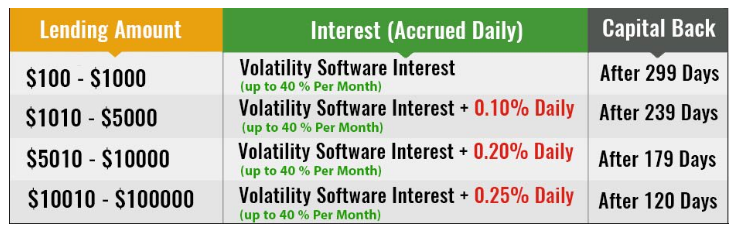
On Tuesday, they announced that their lending service and other segments of their business would be discontinued. Cease and desist orders issued by two states, North Carolina and Texas, are said to have played a role. Texas authorities relied more on the company’s obvious flagrant violations of securities laws while North Carolina alleged that the company’s advertised returns were a red flag for a ponzi scheme.
The BitConnect Coin lost nearly 90% of its value immediately after announcing their closure. Meanwhile, the cryptocurrency markets shed more than $200 billion in market cap the same day, according to Coinmarketcap.com. The value of Ripple (XRP), a coin speculators believe will play a role in the future of banking, was not spared. Its price has dropped by 68% since January 5th.
New Mexico Bill Would Allow State Employees to Repay Loans Via Paychecks
January 15, 2018 Proposed legislation would enable New Mexico to offer small loans to state employees that are paid back via deductions from their paychecks.
Put forth by Democratic state Senator Bill Tallman, the bill would put a 30 percent ceiling on interest rates for loans obtained via the program and limit repayment to 12 percent of gross salary or wages.
According to the Associated Press, Tallman says the bill is aimed at lowering debt burdens on state workers.
Should it pass, Tallman’s initiative would serve as another step for the state in its current battle against predatory lending tactics. As of this month, small lenders in New Mexico are held to a maximum of 175 percent interest on all loans finalized from January 1, onward.
Doug Farry, executive vice president of Employee Loan Solutions Inc., which deploys the employee lending service, True Connect, believes such a strategy can prove successful at the state level.
“It’s a benefit program,” said Farry while discussing the bill. “There’s no reason why it can’t work for a state government as well as a county or city.”
Aimed at empowering workers that face obstacles when applying for credit via traditional avenues, True Connect mainly serves private employers but has seen increased interest in the public sector. This includes government organizations such as Santa Fe Public Schools and others within the state of New Mexico.
At no cost to their participating employer and without submitting a credit score, workers can sign up for small loans via the company’s website.
Typically the funds are deposited with in one business day, and the loan is repaid over the course of 26 paychecks at a flat rate of 24.9% interest.
New Mexico’s decision regarding the practice is yet to be determined, but should the bill pass, the state may soon have followers.
Farry says that True Connect is currently in talks with multiple state governments about including a similar system in their benefits package.
Payday Loan Convict Scott Tucker to be Featured in Netflix Docuseries
January 14, 2018Payday loan mastermind Scott Tucker, who was recently sentenced to 16 years in prison, will be featured in Dirty Money, a Netflix docuseries focused on tales of greed.
 Tucker was among the most prolific payday lenders in the United States, using Native American tribes to shield himself from state laws while generating billions of dollars in revenue. Prior to his conviction on charges of participating in a racketeering enterprise through the collection of unlawful debt, wire fraud, money laundering, and violations of the Truth In Lending Act, he garnered the largest FTC judgment in history, a staggering $1.3 billion.
Tucker’s penchant for racing fancy cars that includes a professional career with some notable victories likely secured his place in the annals of financial villains.
The docuseries begins on January 26th.