
Sean Murray is the President and Chief Editor of deBanked and the founder of the Broker Fair Conference. Connect with me on LinkedIn or follow me on twitter. You can view all future deBanked events here.
Articles by Sean Murray

Not Just For Salespeople: Becoming a Certified Small Business Finance Professional
November 23, 2021 Its aim is to become an industry standard. The newly launched Certified Small Business Finance Professional (CSBFP) program will first become available at Broker Fair in New York City on December 6th.
But what’s the difference between this one and others? Steve Denis, Executive Director of the Small Business Finance Association (SBFA), says that his organization’s backing of the CSBFP makes all the difference.
“We’re the largest trade group in the space without question,” Denis said, adding that the group has about 30 members, several of which are among the largest in the country.
“It’s going to be a signal that you’re doing things the right way and want to go out of your way to show that you are doing things the right way,” Denis said.
The certification will require applicants to complete a course centered on understanding products, laws governing the industry, and compliance. The certification exam will focus on testing applicants’ ability to understand key concepts and best practices.
This course is designed to be taken in person. While it will be available at Broker Fair, Denis said that they plan to partner with other events as well.
 “We’re going to focus on as many in-person training sessions as possible,” he said.
And it’s not just salespeople they’re targeting. Underwriters, collectors, support staff, and more are not only all welcome to obtain their certification, but are also encouraged.
“It’s open to anyone in the industry,” Denis said. “The more the better. […] It will send a very strong message that there is a diverse group of people that want to take a certification and take it very seriously.”
In the official announcement, it was stated that it would be more than just a stamp and that certified professionals would also be provided with “a way to connect, learn and grow beyond the initial education process.”
Denis compared the CSBFP standard to CFPs (Certified Financial Planners) in the financial advisor space.
Attendees of Broker Fair 2021 can take the course at the event at no extra charge.
Congress Introduces New Restrictive Small Business Financing Bill
November 19, 2021 A new bill introduced by Rep. Nydia M. Velázquez, the Chairwoman of the House Small Business Committee, and Senator Robert Menendez (D-NJ), hopes to “stop predatory small business loans” by applying broad consumer protections to small business borrowers nationwide.
This would be done by including small businesses as a covered party under the already existing Truth in Lending Act (TILA).
The proposal, if successful, would arguably become more restrictive than New York’s recently passed commercial financing disclosure law.
Among the supporters of the bill are LendingClub and Funding Circle. No republican members of congress are listed among the sponsors in the official announcement.
The bill is similar to one introduced last year that failed to advance, the Small Business Lending Disclosure and Broker Regulation Act of 2020. That bill never made it out of the House Financial Services Committee. The makeup of Congress now, however, is different than it was last year.
So We Didn’t Buy The Constitution
November 18, 2021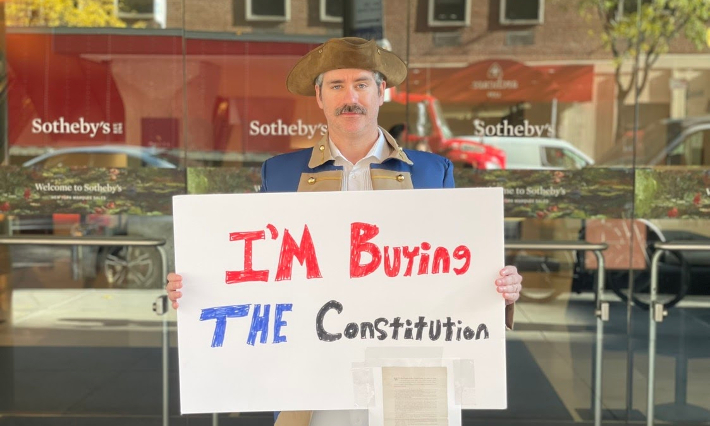 An internet movement started last week to buy one of the only remaining original copies of the United States Constitution reached a roaring climax on Thursday night and then descended into chaos and confusion as almost no one seemed to know what the outcome was, how auctions work, who was bidding on the movement’s behalf, or anything at all.
Several news outlets reported that the Decentralized Autonomous Organization, aka DAO (pronounced “Dow”), representing the internet movement, had won, including the crypto-focused outlet Coindesk. The DAO raised approximately $47 million via ethereum contributions in a matter of just days from a total of more than 17,437 people who joined in (yours truly included). Knowing that, most people were lured into believing that the winning bid of $43.2 million had to have been the DAO. Unfortunately, the contributors seemed largely unaware of the hefty fees charged on top by Sotheby’s, the 8.875% sales tax, and more. I wrote about this two days prior.
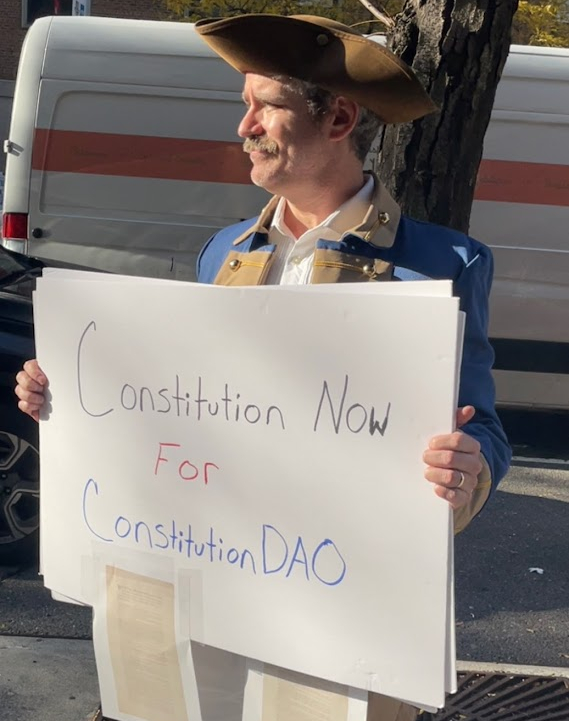
This snafu seems to have been expected by those skeptical of an internet movement. Having actually stood outside of Sotheby’s earlier in the day in full George Washington-esque garb, I was asked by someone seemingly connected to a bidder if the DAO was aware of the added fees. I told them what I knew, but I couldn’t speak in the affirmative for the other 17,436 people.
Having also crossed paths with Julian Weisser, however, a Core team member and nice fellow, it was clear that he was extremely knowledgeable about all the details involved. Weisser was also the first team member to officially announce the loss on the discord.
“@everyone – We did not win the bid for the copy of the U.S. constitution.
While this wasn’t the outcome we hoped for, we still made history tonight with ConstitutionDAO. This is the largest crowdfund for a physical object that we are aware of—crypto or fiat. We are so incredibly grateful to have done this together with you all and are still in shock that we even got this far.
Sotheby’s has never worked with a DAO community before. We broke records for the most money crowdfunded in less than 72 hours. We have educated an entire cohort of people around the world – from museum curators and art directors to our grandmothers asking us what eth is when they read about us in the news – about the possibilities of web3. And, on the flip side, many of you have learned about what it means to steward an asset like the U.S. constitution across museums and collections, or watched an art auction for the first time.
We had 17,437 donors, with a median donation size of $206.26. A significant percentage of these donations came from wallets that were initialized for the first time.
You will be able to get a refund of your pro rata amount (effectively minus gas fees) through Juicebox. Please expect more details from us about this tomorrow – our team has not slept in the past week, and we are giving people the night to get some rest before we’re back at it tomorrow AM.
Every one of you were a part of this. We want to also thank our partners in this work: Alameda Research, Endoament, FTX US, Juicebox, Morning Brew, and SyndicateDAO”
 Once the results finally started to kick in, feelings were mixed. Discord members were torn between feeling completely bamboozled or excited to use a DAO to make some other kind of meaningful purchase. The leadership behind the organization’s official twitter account signed off for the night early after working around the clock for about a week to even put the entire thing together.
gn everyone we’ll be back tomorrow
thanks for all your love and support. can’t wait to shape the next leg of this journey with you all 🙂 🌙 📜 https://t.co/Vhtiglpntg
— ConstitutionDAO (📜, 📜) (@ConstitutionDAO) November 19, 2021
By any measure, the dollars involved were astounding. This particular copy of the Constitution last sold in 1988 for the price of $165,000. Sotheby’s pegged the current value at $15 – $20 million. With $47 million in hand, winning seemed a strong possibility. The one major problem, however, is that with the blockchain being a public ledger, the rival bidder already knew the DAO’s best bid.
Overall, it was a rather strange experience, no doubt made more unusual by my throwing down eth and then donning a costume on the Upper East Side of Manhattan to the bewilderment of many locals.
Was this ultimately a loss for crypto or still a win? Only time will tell…
They’re Actually Going to Buy the Constitution
November 17, 2021 It was Tuesday night in the ConstitutionDAO discord. Users posted the same questions that the mods had answered hundreds of times already.
“Wen constitution fren?” wrote apelord37.
Another begged the number to hit $6 million already just so they could go to sleep. It was a weak milestone. The earlier thresholds had been more exciting.
“A million, no two million, no THREE MILLION!” the crowd cheered on social media.
But the deadline to reach $20 million, the figure that the auction house had estimated on the high end of what a rare copy of the Constitution of the United States could sell for, was rapidly approaching.
$20 million would be a respectable bid, but it wouldn’t even guarantee a win, and besides that wouldn’t even account for the separate $5 million needed just for auction fees and sales tax. What the DAO really needed was $25 million just to be in the game.
Ouch.
With less than 48 hours to go, hope began to dissipate. A betting site pegged the odds of the DAO actually succeeding at 19%, a discouraging sign.
Just as the people began to pray that Elon Musk might ride in like a white knight, contributors to the DAO awoke Wednesday morning to find that someone had anonymously contributed 1,000 eth to the cause, the equivalent of more than $4 million.
“Holy sh**, this could actually happen,” $people said.
With renewed energy, the DAO reached $20 million by noon and was at $35 million at the time this story is being posted. All of the data is public. A review of it shows that there are more than 11,700 contributors. The top 20 contributors, however, account for more than half of all the funds raised.
On the ConstitutionDAO discord, confidence has surged.
“WAGMI,” one user wrote.
The questions have shifted to what happens if too much is raised and who is going to be hosting parties irl to watch the auction live.
Still others have begun to make other suggestions, like using excess funds for starving children. The crowd isn’t pleased by this, however.
“people, people, focus here, we have only set out to do one thing and that is We’re All Gonna Buy the Constitution,” a user writes.
Crypto Fans Want to Buy The Constitution of the United States and They Might Actually Succeed
November 15, 2021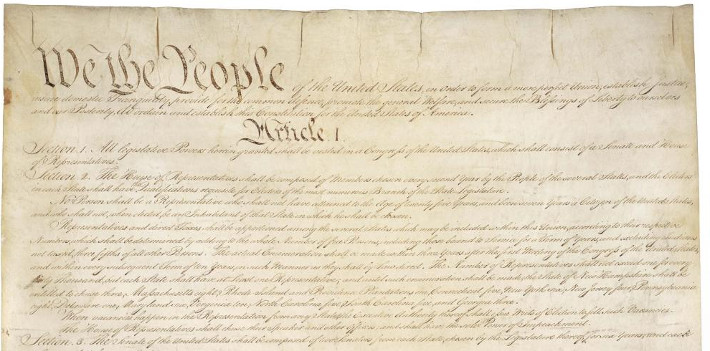
It’s the ultimate NFT, the Constitution of the United States. On November 18th, Sotheby’s will auction off one of the only thirteen surviving copies of the United States Constitution, an opportunity the public hasn’t had since 1988.
But a private collector hoping to pocket the national treasure will have some competition, the crypto mob on twitter. On November 11th, at least two individuals launched @ConstitutionDAO, a twitter account dedicated to crowdfunding crypto with the intent of raising enough money to be the winning bid.
The buyer would technically be a DAO, a Decentralized Autonomous Organization, a community-led entity with no central authority that is governed by a smart contract.
It’s predicted that if the DAO can raise significant cash before the auction that Sotheby’s will allow it to place legitimate bids. Sotheby’s put the estimated winning bid price at $15 million – $20 million.
It might not be out of reach, the DAO raised nearly $2 million in just the few hours since it began crowdfunding the money through a platform called juicebox.
If the DAO wins, theoretically “ownership” of the constitution would be fractionalized into shares based upon each member’s contribution. With a DAO, no one need even disclose who they are. Only a crypto address is required.
We have coordinated a DAO to acquire The Constitution of the United States.
I give you: @ConstitutionDAO
Ping me if interested in being a part of a monumental moment. https://t.co/VHkCTrq4fa
— Austin Cain (📜,📜) (@j_austincain) November 12, 2021
Members contributing to the pool of funds have the option of including a public message.
“To secure the blessings of liberty”
“Another first generation immigrant hoping to be the proud owner of the US constitution.”
“American Dream!!!”
“cant wait to explain this at Thanksgiving”
“in satoshi we trust”
The official website of the ConstitutionDAO is here.
For the sake of following the success or failure of this project accurately, deBanked contributed a very small amount to the DAO so that it could participate in the possible ownership and community of the Constitution. Weird, I know.
Winner of Broker NFT Made Unusual Request
November 4, 2021One winner of The Broker NFT Giveaway Raffle made an unusual request shortly after we aired his name.
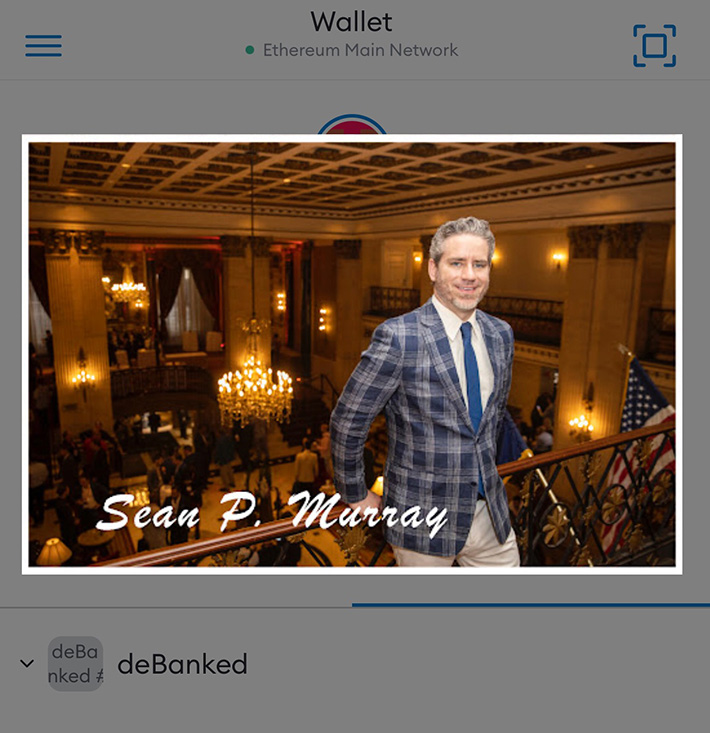 The prize was supposed to be one of the ten Broker NFTs, but Josh Feinberg, who is the CEO of Everlasting Capital, inquired about the private mints, which were not up for grabs, but had been displayed in some of our NFT livestreams.
He asked about token #3, which was, ironically, the NFT of myself that I had hand-autographed in photoshop and hand-minted via our own ethereum smart contract.
Upon discovering that his selection had not been made in jest, the decision was made to authorize the transfer of it to his ethereum wallet. Unusual (and flattering) as it was, I am honored that he wanted it.
CEO of Square Says That Hyperinflation is Happening
October 28, 2021There seems to be consensus the US is experiencing inflation in 2021, but few people of business intelligence are making a rational argument that we’re in the midst of hyperinflation. Such a scenario, if true, might mean that a cup of coffee could cost $200 by next year.
“It’s happening,” tweeted Jack Dorsey, the CEO of both Square and Twitter. “Hyperinflation is going to change everything.”
Hyperinflation is going to change everything. It’s happening.
— jack⚡️ (@jack) October 23, 2021
Perhaps Dorsey’s bearish view on cash, ironic given that his company operates Cash App, has something to do with his bullish views on cryptocurrency. Fifty eight percent of Square’s total net revenue in the 2nd quarter came from Bitcoin.
“While bitcoin revenue was $2.72 billion in the second quarter of 2021, up approximately 3x year over year, bitcoin gross profit was only $55 million, or approximately 2% of bitcoin revenue,” the company said at the end of Q2.
Square made no mention of inflation in its Q2 earnings, nor in the call with analysts that followed. The company makes more than $1 billion in small business loans per year, a business that would likely be impacted by “hyperinflation.”
A hyperinflationary economy would cause strange situations in low interest rate environments in which borrowers pay back far less than what they borrowed on a value basis. If rates are low and loan payments are fixed, the borrower might as well borrow everything they could from every source available and turn it into something that will keep up with price increases.
Dorsey’s comments weren’t a one-off. He doubled down on his prediction just seven minutes later.
It will happen in the US soon, and so the world.
— jack⚡️ (@jack) October 23, 2021
He continued by saying that hyperinflation wasn’t a wish, nor did he think it was positive. He then laughed at Steve Hanke, a well regarded economist at John Hopkins University for condemning his statements.
🤣
— jack⚡️ (@jack) October 24, 2021
If Dorsey is right, and we’re all paying $200 for a cup of coffee in 2022, he would actually be one of the first people to see it happening since so many small businesses, including coffee shops, rely on Square as their POS software.
deBanked Presents: The Broker NFT Collection
October 26, 2021Watch out CryptoPunks, deBanked has minted a limited edition set of its own Broker NFTs.
Drawing from the animated style popular in the NFT community, this collection of ten “brokers” is a diverse light-hearted tribute to the professionals in the business finance industry. Each broker in the collection has been individually minted on the ethereum blockchain.
The artwork was drawn by Cindy Recile and the NFTs minted via deBanked’s own ethereum smart contract. (See here on etherscan.)
The other news is that we’ll be giving some of these away for free. (stay tuned for those details!)
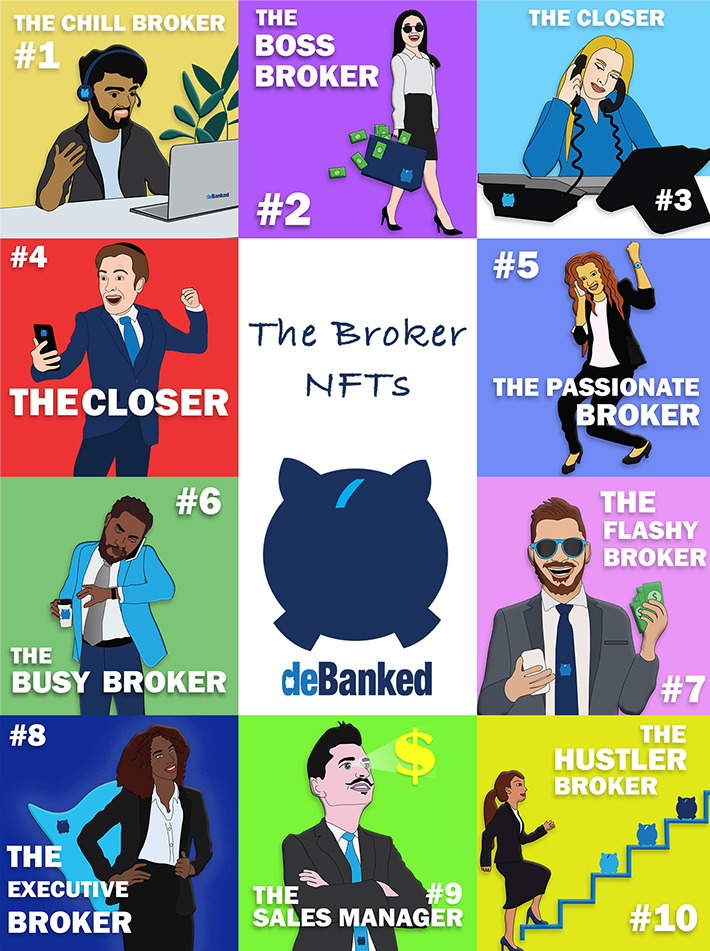
Today’s NFT market has things like pixelated punks and bored apes literally selling for millions of dollars.
A jpeg with no picture other than 4 words of text that say: “Fintech is Killing me,” is currently up for sale for more than $400, if that can be believed.
The act of minting an NFT cost Ethereum gas but if there is any particular thing you would like to see deBanked turn into an NFT, let us know and maybe we’ll make it happen! Email info@debanked.com.