

Sean Murray is the President and Chief Editor of deBanked and the founder of the Broker Fair Conference. Connect with me on LinkedIn or follow me on twitter. You can view all future deBanked events here.
Articles by Sean Murray

Is Lending Club Not Disruptive After All?
September 21, 2015Timothy Puls, an equity analyst for Morningstar is not sold on the Lending Club model. One of his chief critiques is that the platform does not provide a network effect, meaning that the value of the company doesn’t grow just because more users are on the platform.
Puls also feels that the underwriting and distribution model is easily replicable. And that’s not all, you can listen to his analysis in the video below:
Do you agree or disagree?
BFS Capital Joins the Ranks of Consolidated Powerhouses in Alternative Lending
September 21, 2015 Coral Springs, FL-based Business Financial Services has joined the ranks of consolidated powerhouses with the announcement of their rebrand to BFS Capital. As part of the move, the company has unified its North American business affiliates.
Entrust Merchant Solutions, GBR Funding and Premium Capital Group will now also use the BFS Capital name. Entrust, who was acquired by BFS Capital on August 26th, has become the firm’s direct sales division. Ilya Fridman, Entrust’s former CEO, is now a Senior Vice President of BFS Capital and will oversee sales.
Boost Capital, their UK arm, is not changing its name.
BFS Capital is the latest small business funding provider to consolidate their affiliates and change their name.
Already this year, Merchant and Cash and Capital became Bizfi, AmeriMerchant became Capify, and RetailCapital became Credibly. Industry insiders have noticed one thing in common about all these changes, that they’re memorable.
“I think people are thinking about going public and want names that are easily identifiable more than wanting to sound techy,” said John Celifarco, Sales Manager at NY-based Sure Payment Solutions. “Maybe a little of both.”
When deBanked previously asked Rory Marks, a Managing Partner of NY-based Central Diligence Group, about the name recognition-value of certain funders in the industry including Business Financial Services, he said “when choosing to use words that are ubiquitous in the industry, it could be difficult to distinguish yourself. Ultimately this could potentially impact the customer’s ability to fully understand the nature of your business.”
Business financial services could be confused as a genre or a category, a few insiders commented, instead of a company name.
The BFS Capital brand should remedy any confusion, although Justin Benton, Executive Loan Producer of Lenders Marketing shared, “a simple name that conveys what you do has value, not only in the eyes of your potential clients, but in the eyes of search engines like Google. At the end of the day, if you do your job well and the client is pleased with the loan product and service you provide, your name will be positively associated as a trusted resource.”
Business Financial Services has long been referred to as BFS by industry insiders so unlike other funders that completely transformed during their rebrand, BFS Capital may retain more of their previous name’s goodwill.
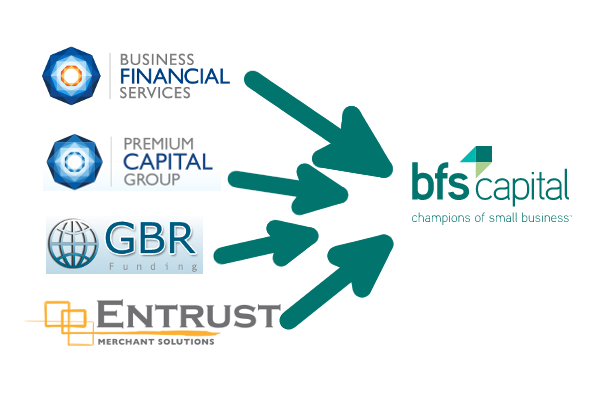
“Bringing all your companies under one umbrella can bring each company’s unique strengths together in one collective effort, rowing towards one common destination,” said Benton.
BFS Capital has been a hot news item this summer. In July, they surpassed $1 billion in lifetime funding.
Dodd-Frank and More Paperwork Make Lending Harder
September 19, 2015 It’s not just alternative lenders that have concerns about Dodd-Frank, Section 1071 and the CFPB. Several community bankers recently testified in front of The House Committee on Small Business Subcommittee on Economic Growth, Tax and Capital Access to explain just how detrimental regulations have been to their lending operations.
While the discussion encompassed all types of lending including consumer mortgages, B. Doyle Mitchell Jr, the CEO of Industrial Bank said that, “Dodd-Frank was intended for maybe 50 to 100 institutions. It was not intended for mainstream institutions, minority banks around the country.” Mitchell was speaking on behalf of the Independent Community Bankers of America (ICBA).
While repeatedly making the case about how important community banks were to local communities, he explained that Dodd-Frank had not helped them achieve their goals. “It has only increased our costs,” he testified.
Mitchell also expressed a feeling of perpetual anxiety over the loans they make, worrying that a regulator will not like them.
Dixies FCU CEO Scott Eagerton, who was there speaking on behalf of the National Association of Federal Credit Unions (NAFCU) said, “I really feel like we’re getting away from helping people and making sure that we make the loans that Washington agrees with and I think that needs to change.”
While alternative lenders were not on the agenda, the subject of government mandated transparency and its intent to help make things easier for borrowers is both timely and relevant. Referencing some of the new disclosures required in loan documents by Dodd-Frank and/or the CFPB, Congressman Trent Kelly asked if all the added pages to loan agreements make it easier for their customers to understand.
“Do they understand what they’re signing?” he asked.
Mitchell responded that they do not. “It is not any more clear,” he answered. “In fact it is even more cumbersome for them now.”
Regulators should pay special attention to this especially in light of a Federal Reserve study that came to the same conclusion. In Alternative lending: through the eyes of “Mom & Pop” Small-Business Owners, small business owners were asked if they understood financing terms offered by typical online lenders. The feedback was overwhelmingly positive that they did. But when asked a trick question about annual percentage rates, most got confused. While some advocacy groups interpreted this to mean that small business owners are confused by online lenders, it actually offers pretty compelling evidence to the contrary. A future standard of government mandated transparency as it relates to annual percentage rates would only serve to make it harder for small businesses to understand contracts, not easier.
 Both Eagerton and Mitchell made the case that increased compliance costs undermined the ability of community banks to grow the economy. “You cannot expect a trillion dollar institution to focus on hundred thousand dollar loans,” Mitchell said. And Subcommittee Chairman Tom Rice said, “the burdens created by Dodd-Frank are causing many small financial institutions to merge with larger entities or shut their doors completely, resulting in far fewer options where there were already not many options to choose from.”
Eagerton argued that,”lawmakers and regulators readily agree that credit unions did not participate in the reckless activities that led to the financial crisis, so they shouldn’t be caught in the crosshairs of regulations aimed at those entities that did. Unfortunately, that has not been the case thus far. Accordingly, finding ways to cut-down on burdensome and unnecessary regulatory compliance costs is a chief priority of NAFCU members.”
But Congressman Donald Payne, Jr wondered why the ICBA was objecting to Section 1071 of Dodd-Frank, the part that grants the CFPB authority to collect certain pieces of data from financial institutions. Regulation B of Section 1071, for those that aren’t aware, was intended to study gender, racial and ethnic discrimination in small business lending.
Payne likened the law to The Home Mortgage Disclosure Act (HMDA), pronounced HUM-DUH, in which raw data is disclosed to the public but no penalties are specifically imposed if the data leans one way or another.
Mitchell responded to that by saying HMDA was a good example of something that was already very burdensome and another reason why Section 1071 was a bad idea. “While there is a clear need to outlaw discrimination at any level, I don’t think [this law is] necessary for community institutions,” he said. He pointed out that his bank could suffer reputational damage in the community by disclosing the gender and racial statistics of their business loans to the public at large.
While he did not expand on what he meant by reputational risk, one could fill in the blank that he meant the context that such data would lack. For example, if 75% of Hispanic-owned businesses were declined for business loans while only 25% of African-American-owned businesses were declined for business loans, one might infer from that raw data that there is potential discrimination taking place. Since small business loans are less FICO driven than consumer lending and focused more on the story of the business and the projected financial future, it is impossible to infer anything from raw data as it relates to discrimination.
“Simply put, Dodd-Frank needs to be streamlined,” said Marshall Lux, Cambridge, MA, John F. Kennedy School of Government, Harvard University.
And “the problem with Dodd-Frank,” Mitchell voiced, “is you cannot outlaw and you cannot regulate a corporation’s motivation to drive profit at all costs so while it had a lot of great intentions in over a thousand pages it has not helped us serve our customers any better.”
You can watch the full hearing below:
IOU Financial is Playing Offense in 11th Hour
September 19, 2015 Perhaps jolted awake by corporate raiders attempting a hostile takeover, IOU Financial is making some bold moves and issuing some optimistic news. Yesterday on September 18th, IOU announced that they took home a profit for the months of July and August and in addition signed a letter of intent for a credit facility of up to $50 million. They also said that the board has received an offer to proceed with a private placement of up to $10 million in principal amount of convertible debentures, with committed subscriptions in excess of $7 million.
It should be noted that neither is guaranteed and a letter of intent is not a closed deal. The lender’s loan originations for the months of July and August, totaled US$31.3 million, representing a year over year increase of 150% in comparison to the same period in 2014.
IOU is fighting to stave off Qwave Capital, a VC firm that recently made a formal bid to buy a controlling stake for $17 Million CAD. IOU’s board has adamantly rejected the offer and has been urging share holders to turn it down.
The offer expires at 5pm EST on Tuesday, September 22nd.
“We continue to believe Qwave’s Offer provides IOU shareholders with excellent value, liquidity and opportunity,” said Serguei Kouzmine, a manager of Qwave Capital in a release dated September 17th. “The IOU board has failed to deliver an alternative offer, has repeatedly refused to act in the best interests of all shareholders, and has approved related-party transactions that put insiders first. We think IOU shareholders deserve better, and we’re asking them to tender their shares and partner with us to help IOU realize its full potential.”
Is The Small Business Administration An Ally to Alternative Lenders?
September 16, 2015 Add the Small Business Administration (SBA) to the list of organizations likely to understand the rise of tech-based business lending. Miriam Segal, a research economist for the SBA, recently published a report titled, Peer-to-Peer Lending: A Financing Alternative for Small Businesses. In it, she opens with a line that is all too familiar in the merchant cash advance and non-bank lending industry. “Imagine that you own a small bakery and you need $15,000 to buy a new oven,” she writes. She later adds, “Data suggest that peer-to-peer lending may be a viable financing alternative for small businesses, particularly given the post-recession credit market.”
After having read the recent Federal Reserve study that essentially concluded that small business owners are just too confused to make sound financial decisions, the SBA report is a welcome sign that there is little to fear from “alternative lending.”
While the SBA is sometimes cast as a villain to the private sector, what with their ability to assuage banks into making small business loans at very low interest rates with the assurance of default guarantees, a practice viewed by some economic ideologues as anti-free market, there hasn’t actually been much competition with alternative lenders. The average SBA loan is about $371,000, much higher than the average merchant cash advance transaction of about $30,000. And although they are a government agency, the SBA is scrutinized far more than today’s alternative lenders are. Politicians have sought to shut the agency down for decades but it has managed to survive. If any small business lending group knows what it’s like to be a political football, it’s the SBA. They’ve even been accused of similar antics, like being a participant to predatory lending.
Chris Hurn, Fountainhead Commercial Capital’s CEO, offered his opinion on such in the Huffington Post when he wrote, “I realize that calling some behaviors ‘predatory’ will raise some hackles, but what else would you call a virtually systemic practice of convincing small business owners to accept an inferior loan program on commercial real estate transactions, which almost certainly puts these borrowers in future harm’s way, only so a bank can maximize its income?”
Where have we heard this viewpoint before?
In the SBA report, Segal acknowledges a wide array of working capital options including merchant cash advance products. “P2P lending may fill a gap in small business lending for entrepreneurs seeking small amounts of capital when existing options are not suitable or available (e.g., bank loans, credit cards, and merchant cash advances),” she states.
She also gets to the heart of the issue that those touting the superiority of long term loans seem to be missing and that is that, “the majority of small business borrowers appear to be interested in relatively short-term loans in relatively small amounts.” Using data made available by Lending Club, 56% of small business owners applied for loans of $15,000 or less. Although the SBA will guarantee really small loans, it’s uncommon for banks to spend time and effort underwriting these, not to mention that many small businesses lack collateral and other minimum requirements for eligibility.
The reality is that alternative lending is for the most part the world outside of the SBA’s scope. “For some small businesses, an expensive loan may be better than no loan,” Segal concludes.
Given the variations in application process, interest rate, loan amount, and term length across loan products, it is apparent that each option presents a unique set of pros and cons. Peer-to-peer loans offer the benefits of expedited application processing, smaller loan amounts, and shorter terms, but borrowers pay for these conveniences in the form of higher interest rates.
– Miriam Segal
Research Economist, SBA
From the perspective of small business advocacy, the report gets it right. “Peer-to-peer lending to small businesses is rising while the origination of small business bank loans is decreasing. Micro businesses are interested in borrowing small amounts of money, although their credit applications are the most likely to be rejected. Therefore, the financial regulatory environment in which P2P lending exists is particularly important to small businesses.”
And it concludes, “Peer-to-peer lending has the potential to change the landscape of small business financing for the better. In order for this to happen, financial regulations must reflect the need for investor protection and simultaneously allow small businesses to access the capital that many individuals are willing to provide—no small task.”
As the wider industry is being researched by regulators, it is an especially important time to discover who shares the same understanding of the facts. Although not an immediately obvious choice of ally, the SBA is undoubtedly qualified to communicate the needs of small business. That makes them an especially good candidate to help explain the story about the what, why, and how of the changing landscape.
Major Business Lending Fraud Has Consequences
September 15, 2015 It appears that commercial financing fraud is not limited to just the average $40,000 transactions typical in the merchant cash advance and non-bank business lending sector. Four executives for a small business named Projuban, LLC, DBA G3K Displays, Inc., were sentenced last week to serve time in prison for their role in an $18 million loan fraud.
G3K was a New Jersey-based company that provided in-store displays for retailers. According to a report published by the FBI, the execs “engaged in a scheme to falsely inflate G3K’s revenue and accounts receivable, and as part of the scheme, made and caused to be made materially false and misleading statements about G3K’s financial condition. To create the false impression of sales, the defendants created phony documents, including fake and falsely inflated purchase orders purporting to reflect sales to G3K’s customers.”
One of the lenders that fell victim to the fraud is Veritas Financial Partners LLC. Veritas is no stranger to the merchant cash advance industry, having financed at least one merchant cash advance funder themselves just a few years ago. They are regularly involved in multi-million business financing transactions, deals that are typically considered too large for merchant cash advance companies and other non-bank lenders.
In addition to the prison sentences which ranged from 4 months to 40 months, The FBI report says that, “STEVEN KAITZ, 56, of Jersey City, New Jersey, was ordered to forfeit $1,382,427 and pay $18,687,518 in restitution; LATCHMEE MAHATO, a/k/a “Robbie,” 50, of Jamaica, Queens, was ordered to forfeit $2,215,417 and pay $18,687,518 in restitution; JONATHAN WHEELER, 46, of Southport, Connecticut, was ordered to forfeit $957,435 and pay $18,687,518 in restitution; and ZACHARY KAITZ, 32, of Brooklyn, New York, was ordered to forfeit $100,000 and pay $18,687,518 in restitution.”
Perhaps the lenders working on really large transactions should heed the advice of those working on small transactions, and that’s to stop relying on paper statements. In this case, the perpetrators heavily relied on the use of fake documents.
“ZACHARY KAITZ, who was skilled in graphic design, helped carry out the fraud by creating fraudulent documentation, such as fake invoices, purchase orders, and bills of lading, to support the false representations to the lenders about G3K’s business,” the FBI report states.
Who’s On Your Fantasy Funding Team?
September 14, 2015 A few years ago, a friend of mine was dropped by the funding brokerage he worked for and put on the waiver wire. He was promptly picked up by a competitor and today ranks among one of the top closers in the industry. It was one of the strangest moves of the season because his numbers had been really good month after month. It turned out that he was turned loose for earning too much money, something the firm wasn’t content with.
Even though he was compensated on a commission-only basis, he was apparently putting the company over their salary cap. That of course begged the question, why was there a compensation cap for a top performer, somebody who was directly leading to the firm’s growth? For what it’s worth, he was entitled to approximately 20% of the company’s gross commission revenue. So on every deal funded the company took home the other 80% of the commission. This worked for both parties until the closer started earning well into the six figures, at which point they told him he wasn’t allowed to earn more than a certain amount.
Although discouraged by the sudden limitation, he continued to work hard to prove why the cap should be removed. It wasn’t. Soon afterward he found himself on the waiver wire.
He was replaced by two rookies fresh out of college who were willing to do the same job for a lot less, but neither had any experience in the field.
As someone who has been active in this industry for nearly a decade, I’ve watched this scenario play out dozens of times.
- Firm needs top talent to grow
- Firm hires Talent
- Talent produces
- Firm grows
- Firm doesn’t like that Talent is making so much
- Firm fires Talent or Talent quits
As the firms gallop off to the next scouting combine to find somebody younger and more malleable, the pool of experienced talent is dispersed across a sea of competitors. A consequence of this is that each of those companies become more evenly matched and it becomes increasingly difficult to stand apart from the crowd.
At trade shows and happy hours, it’s not uncommon for top players to openly question what would happen if they all joined forces to create a funding dream team of sorts. And while such cohesion rarely actually happens, I can’t help but imagine if given the opportunity to build the best team to win, who I would pick.
Top talent is expensive. I know this because I recently spent 89% of my budget in a fantasy football auction draft to acquire just three players. And last year I spent a similar percentage on only four players and won the entire league. My thought process was to build a team that was centered around the best of the best. Previous years of conservative play led to mediocre results and I wanted to change that.
Today, there are hundreds of alternative business financing companies and thousands that can be considered brokers. There’s a lot of decent teams out there but few that are built around a group of all stars. And oddly, some companies seem to be dumping their best and brightest on purpose, just like I described previously. That might lead to improved margins for the firm, but probably won’t help them win in the long run.

Here’s something to think about while you’re watching Monday Night Football. If you had to build your company around a core group of talented people, who would you pick? Don’t worry about whether or not they’re available or if they fit into your budget. Those are obstacles that can be overcome.
Here’s a list of positions to help you imagine your fantasy funder:
- 1 Senior Manager
- 2 Underwriters
- 2 Closers
- 1 Flex Spot
- 1 Admin
- 1 Collector
- 1 Tech Person
Good luck!
Financing Not Really an Issue for Small Business According to the NFIB
September 11, 2015 Small businesses need money right? Well according to an August 2015 survey conducted by the National Federal of Independent Business, 21% of respondents said that taxes were the single most important problem facing their business today. That ranked highest on a list of ten issues. Only a minuscule 1% said that financing and interest rates were the most important problem. Even inflation was ranked as more important than financing.
Thirty-three percent of all owners reported borrowing on a regular basis and similarly, thirty-three percent reported all credit needs met. 49 percent however, explicitly said they did not want a loan. This data is based on a sample of 3,938 small-business owners/members that translated into 656 usable responses received for a response rate of 17%.
20% of respondents said that government requirements and red tape were the single most important problem they face, second to taxes.
One could infer from the data that access to capital is not a challenge for small business right now, which would make sense given how many non-bank alternatives are currently available. It also raises the question as to why regulations for non-bank alternatives would be considered a priority when small businesses seem to be pretty content with the way things are. If anything, the message here is that the best solution to grow small business is to lower their taxes. With that remedy being unlikely, a potential takeaway from this study then is that non-bank financing companies should consider ways to address their prospects’ two biggest pain points, taxes and government requirements. And if not those two, then the third issue that respondents said was the single most important problem, poor sales.
How can non-bank financing companies help small businesses address poor sales? This may be the key to long-term mutual success.