Sean Murray is the President and Chief Editor of deBanked and the founder of the Broker Fair Conference. Connect with me on LinkedIn or follow me on twitter. You can view all future deBanked events here.
Articles by Sean Murray

Some Small Business Funders Are Pivoting or Closing Shop
October 20, 2015 One of the unique insights deBanked gets as a company that sends a lot of email and snail mail to folks in the industry is the rejection rate. One day an entrepreneur is telling us all about their new lending business and the next day the Post Office returns their magazine for a vacant address. Sometimes there’s a change in the model or a partnership didn’t work out. Other times lead generation became too hard or too many merchants defaulted very early on. The truth is, as much as the industry is growing, some companies are pivoting or closing their doors.
At Lend360, there were whispers around the trade show floor that acquisition costs have spiked and it was being felt on the bottom lines. Broker houses are opening, closing, merging with each other and being acquired. Funders have reacted by giving them lines of credit to either help them grow or stay afloat, hoping that their sources of deal flow don’t fall apart.

On one conference panel titled, A Discussion of Best Practices: Advancing The Cause for Business Finance, veteran underwriter and industry consultant Andrew Hernandez of Central Diligence Group, said he’s watched a lot of new entrants in this industry make mistakes. “We’ve seen guys lose their shirt,” he said. He explained that too often small business funding companies look to cut their acquisition costs in the wrong places, like simply paying less for leads or paying brokers lower commissions. That only works to a point. “Underwriters can help keep the cost of acquisition down by funding the right deals and trying to get good deals done,” he said.
The owner of one funder summed up his dilemma for me, my brokers are making more on a deal than I am and I’m the one taking all the liability on it. Maybe I should become a broker instead. Not that there would be anything wrong with that. For some companies in this industry, the best path forward is achieved through trial and error. For example, World Business Lenders’ Alex Gemici said at the conference that they started off by making unsecured loans and now only do loans secured by real estate. Gemici also said he believes the industry is heading for a major shakeout within the next three years and that irrational exuberance keeps him up at night.
If he’s right, an economic downturn could squeeze out a lot of players that are already feeling the pinch of high acquisition costs.
For those newer to the industry, they might not remember that the effects of the 2008-2009 financial crisis and ensuing recession was brutal. More than half of the providers of merchant cash advances went out of business, some within weeks when their credit lines were pulled.
A lot of the “industry leaders” of 2008 aren’t around anymore: First Funds, Fast Capital, Second Source, Merit Capital, iFunds, Summit, Infinicap, Global Swift Funding, and more.
Given the favorable economic climate and regulatory environment, this is a bad time to be struggling. 2015 may be one of the last years to pivot in a major way before it’s too late.
Is Online Lending Really Just Offline Lending?
October 19, 2015 Two weeks ago the Wall Street Journal postulated that online lending’s biggest beneficiary was the U.S. Postal Service. “In July alone, Lending Club mailed 33.9 million personal-loan offers,” it said. “The average monthly volume of personal-loan offers sent through the mail has more than doubled in two years to 156 million in the year through July from 73 million in the same period in 2013,” it added.
These figures have some people concerned that there is no network effect for these lending platforms. Last month, Timothy Puls, an equity analyst for Morningstar, said that the value of a company like Lending Club doesn’t grow just because more users are on the platform. That means a continuous stream of marketing is essential since they’ll always need to find new borrowers to sustain the business.
To illustrate how sensitive lenders are to this, OnDeck CEO Noah Breslow spoke to the increasing competitiveness of direct mail in their 2nd quarter earnings call and argued their strategy was to “break through the clutter” and “better communicate our value proposition.” Analysts on the call were concerned by that, which prompted a question by Christopher Brendler of Stifel, Nicolaus & Company during the Q&A session.
Question by: Christopher Brendler of Stifel, Nicolaus & Company
You mentioned in the direct channel about a response rate, talking about a response rate to direct mail. Can you talk about the response rate that you are seeing in that channel? It seems like from an outsider’s perspective we’ve gotten more competitive and it sounds like you’ve had a little bit of a struggle there. We just want to see if there is any color you could add on what the competitive environment is having on the direct channel.Answer by: Noah Breslow of OnDeck
I think what we are seeing really is just an intensified set of activities and you can’t really isolate it down to any single or couple of competitors but it’s sort of both in the offline direct mail channel, we are seeing increased mail volumes over where they were six months ago. And then in the online channel we are seeing increased bidding and so forth for Google Adwords and the like.
Nothing to worry about when it comes to that mail stuff though right? Google Adwords, facebook, instagram, and snapchat are where the real action comes from for online lenders, you might think.
According to Marlette Funding CEO Jeffrey Meiler, that’s not the case. In the WSJ, he admits that 90% of the billion dollars in online loans they’ve originated have come from offline channels.
And maybe that’s because the term online lender might be a red herring. Online lenders don’t only exist in cyberspace, they have offices in the real world just like banks do. And sure, they have websites, but then again so do banks. When you start to boil it down, online lenders look a lot like every other business in existence today. And while it may not be typical for a small business owner to walk into the office of an online lender to get funding, several lenders have said this happens. And for the brokers that arrange business loans, it’s pretty common for them to visit the actual businesses and meet with the owner(s). Not a very online experience…
It may be fashionable to say what separates banks from online lenders is that you have to walk into a bank to apply for a loan, but that’s often just not the case. Most banks offer loans through the form of credit cards both online and through direct mail and they’ve been doing this for decades. The only difference is now they’re competing with other lenders that don’t have local branches for the customer to walk into it, the online lenders. And maybe that’s what the difference is, being branchless could be what defines an online lender.
For now though, a heck of a lot of online lending seems to be originated offline.
World Business Lenders Makes Credit Prediction, Employs Different Model
October 19, 2015World Business Lenders (WBL) Managing Director Alex Gemici thinks the next credit correction will take place within three years, he told a crowd at Lend360 last week in Atlanta. When he and his fellow panelists were asked what keeps them up at night, Gemici said, “irrational exuberance.” He clarified that by saying that there was an incredible amount of capital pouring in right now and insinuated that it’s not all being deployed intelligently. He also pointed to the country’s economic history and said we’re naturally due for a shift in the credit cycle.

From Left to Right: Bob Coleman of the Coleman Report, Jason Rockman of CAN Capital, Craig Coleman of ForwardLine, Alex Gemici of World Business Lenders, David Gilbert of National Funding and Jeremiah Neal of Biz2credit
Part of WBL’s hedge (if you could call it that) against a future industry shakeout, is that their loans are actually collateralized, though they didn’t start out that way. When they launched in 2011, they initially offered unsecured loans and eventually evolved towards collateralizing them with all different types of assets. They have shifted even further in that direction and today the only collateral they accept is real estate. That makes WBL’s model quite traditional by comparison to competing products like merchant cash advances and OnDeck loans. Gemici says however, that they believe in technology and data mining to make better underwriting decisions, just like today’s unsecured fintech lenders.
But while they use technology, their process isn’t fully automated and that’s because Gemici believes algorithms aren’t advanced enough yet to make decisions on their own. You can’t ask Siri whether she’d approve a business loan yet, Gemici joked.
Will business loans backed by real-estate give them a long-term edge over unsecured lenders? Only time will tell. One thing many people agree on however is that there will most certainly be a shakeout when the next economic downturn hits.
Stacking Questioned at Lend360
October 18, 2015 The stacking debate reemerged at Lend360 in Atlanta last week when one small business funding company promised during a breakout session to sue competitors that stacked on top of them for tortious interference. The warning wasn’t hollow either. The company, who you could probably guess the identity of, has already sued at least one funder. Many people are interested to see what the outcome of that case will be and the precedent it could set.
Meanwhile, during Thursday’s Current Trends and the Future of Small Business Lending panel moderated by Bob Coleman, industry captains generally denounced stacking as a bad thing. But bad for who, wondered Josh Karp, the Head of Operations for CFG Merchant Solutions. During the Q&A session at the end of the panel, Karp spoke from the audience and asked whether or not second position deals could appropriately serve as a bridge for merchants who have already taken a long-term product (12+ months) and were not eligible for a renewal from their current funding provider. To translate, could an outright restriction on stacking be harmful to merchants who have used a long-term product and now have a short-term need?
The panelists were mostly evasive with a handful declining to answer the question, one saying it wasn’t applicable to them because they were short-term lenders themselves, and another saying they could see how it wouldn’t be fair to expect a small business to not need additional funding with a two-year loan term.
For now, the industry debate remains unresolved.
Kabbage, Fora Financial and Square Have a Roaring Wednesday
October 15, 2015 Wednesday, October 14th was packed with exciting industry news. Right after Congressman David Scott blessed online lenders, Kabbage announced a Series E round investment led by Reverence Capital Partners for $135 million. The Wall Street Journal said the deal valued the company at over $1 billion, a figure that elevates Kabbage to unicorn status.
At the same time, Fora Financial announced that a Palladium Equity Partners affiliate had made a significant investment in the company. In the official release, Palladium principal Justin Green said, “we believe Fora Financial has developed a highly attractive credit offering and technology platform that have made it a valued provider of financing to thousands of small businesses seeking capital.”
Palladium once held a stake in Wise Foods, the potato chip snack company, and currently counts PROMÉRICA Bank, a full-service commercial bank in its active portfolio. They have more than $2 billion in assets under management.
And then there’s Square, the payment processor and merchant cash advance company who publicly filed their S-1 for an IPO. Their registration form uses the term merchant cash advance 16 times so there is no doubt it’s a significant part of their business. “Square Capital provides merchant cash advances to prequalified sellers,” the document states. “We make it easy for sellers to use our service by proactively reaching out to them with an offer of an advance based on their payment processing history. The terms are straightforward, sellers get their funds quickly (often the next business day), and in return, they agree to make payments equal to a percentage of the payment volume we process for them up to a fixed amount.”
As of June 30th, Square had already racked up a net loss for the year of nearly $78 million. In 2014, the company lost $154 million. While the losses stem mainly from their payment processing operations, they had outstanding merchant cash advance receivables of $32 million as of mid-year which illustrates how much exposure they have with that product.
The three announcements ironically coincided with comments made by SoFi CEO Mike Cagney about the industry’s lack of ambition. “The problem with fintech is that it’s not ambitious enough in terms of its objectives. It’s not really transforming anything,” he’s quoted as saying in the San Francisco Business Times. Cagney went on to categorize Lending Club as just an electronic interface bolted onto a bank to originate loans for them. While his comments hold weight given that his lending company recently just raised $1 billion in a Series E round led by Softbank, it may be fair to say however that Wednesday proved there was anything but a lack of ambition in the space right now.
God Bless The Online Lenders
October 14, 2015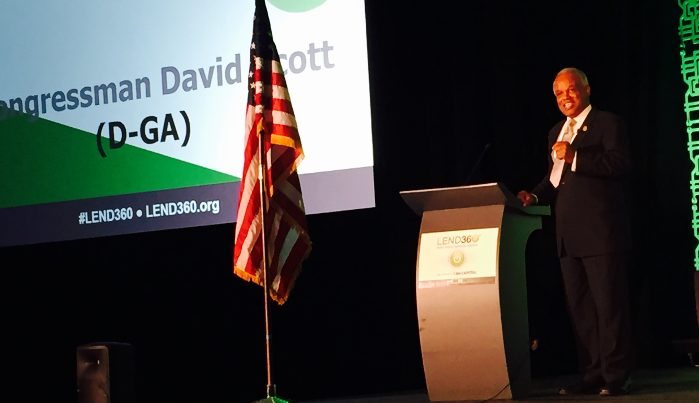 “God bless the online lenders,” said Democratic congressman David Scott while addressing an enormous crowd at Lend360 in Atlanta on Wednesday. Scott kicked off the morning’s events by offering a plan of action for online lenders. “Your industry is faced with some enormous challenges,” he said.
Among those challenges is the aftermath of Operation Choke Point and the Consumer Financial Protection Bureau. On Choke Point, Scott said that the government saw themselves as coming to the rescue after the Four Oaks Bank fraud case. A theme of his speech was that the onus is on the online lenders to make sure the Department of Justice and other regulators don’t overreact to problems.
“You’ve got to raise the issue because when you do nothing, something bad happens to you,” Scott rallied the crowd. He pointed out that a large percentage of the population is unbanked or underbanked and that we’ve got to make sure that people and small businesses have access to loans.
Attorney Tom Sullivan immediately followed Scott and introduced the Coalition for Responsible Business Finance (CRBF), an advocacy and education platform for those that provide alternative capital for small businesses. CRBF was created to educate state and federal policymakers, media, and communities on how technology and innovation are providing small businesses access to capital that is necessary for growth.
“Federal regulators and congress are interested in what you’re doing,” said Sullivan. “That could be a good thing or a bad thing.”
On a panel later in the day, Sullivan told attendees that a best practices framework can be used as a template for a law or guidance for regulators and that such a framework should be specific and not overgeneralize. Take the theoretical and apply it to an actual lending transaction, he said.
The general consensus at the conference was that an intelligent proactive approach with policymakers was the best course of action for the industry going forward. Congressman Scott communicated that while the federal government might have good intentions, it definitely helps if there’s a strong voice available to tell their side of an issue.
God bless America and God bless the online lenders.
United Capital Source CEO Jared Weitz is deBanked’s September / October Cover
October 10, 2015Jared Weitz came from humble beginnings and nearly settled for a humble fate. But associates say an ordinary, uneventful life wouldn’t have suited him – he works too hard and figures things out too quickly.
Almost ten years ago Weitz, 33, was parking cars to earn money for community college. After finishing at St. Johns University, he almost made plumbing his career. But now he’s CEO of United Capital Source LLC, an alternative-finance brokerage with deal flow of between $9 million and $10 million a month and an annual growth rate of over 65 percent.
Business associates, former bosses and his small cadre of employees all seem to revere Weitz for his honesty and straightforwardness. They consider him a personal friend. They say he continues to grow as a businessman and as a human being while taking pleasure in helping others do the same.
Geographically, Weitz has the good fortune to know where he belongs – the city of New York is in his DNA. “Every time I fly back,” he said, “I’m so happy to land.” His love affair with the city began in Brooklyn. He was born there and raised in a Brighton Beach apartment in the shadow of Coney Island. When he was 16, the family moved to Oceanside on Long Island.
As the second of six children, Weitz had to come up with the money for college on his own…
To read the FULL 4-page exclusive, you’ll need to subscribe to deBanked!
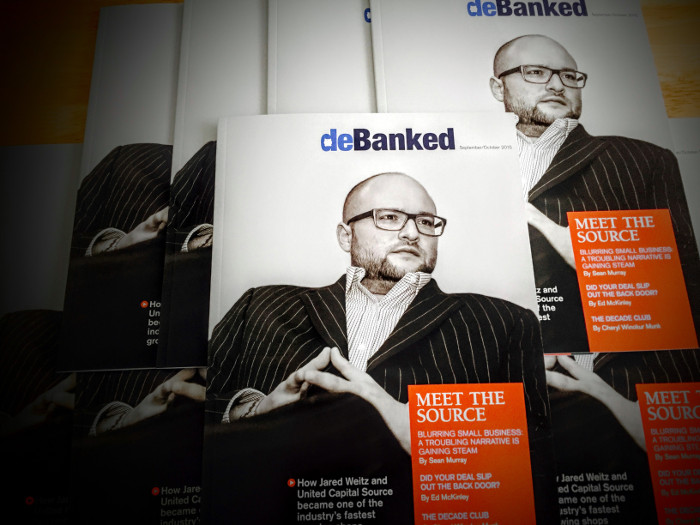
In this September/October issue, payments and finance journalist Ed McKinley explored the story behind United Capital Source, one of the industry’s fastest growing shops and what it took for its 33-year old CEO to get there.
—
For current subscribers, this edition will be dropped in the mail on Tuesday the 13th. deBanked’s Sean Murray will have a limited amount of extra copies with him at Lend360 in Atlanta and Money2020 in Las Vegas if you’re interested to get your hands on one in person.
LoanDepot to be Lending’s Next IPO?
October 9, 2015 loanDepot, which describes itself as a leading technology-enabled U.S. consumer lending platform, has publicly filed their S-1 registration form. Originating more than $50 billion worth of loans since 2010, that makes them the nation’s second largest direct-to-consumer non-bank originator. Their products range from home loans to unsecured personal loans.
The filing states they seek to raise $100 million, however that number might be revised upward. For loanDepot’s CEO Anthony Hsieh, this is business as usual. According to Crunchbase, he founded LoansDirect.com in 1994 and merged with ETRADE Financial in 2001 to create ETRADE Mortgage. His next company, Home Loan Center, Inc., merged with Lending Tree.
loanDepot is a natural succession to similar businesses he’s built over the past 20 years.