
Archive for 2018
Princeton Alternative Funding Files Chapter 11
March 9, 2018Princeton Alternative Funding LLC filed for chapter 11 on Friday, court records reveal. A related entity, Princeton Alternative Income Fund, LP, also filed for Chapter 11.
Princeton Alternative Funding provides capital for businesses that make consumer loans in the non-prime market.
The Princeton Alternative Income Fund was previously reported to be a woe affecting Ranger Direct Lending after the blowup of online consumer lender Argon Credit.
AltFi reported in November that Ranger had written to Princeton to urgently seek information about Argon-related financial reporting prior to the commencement of arbitration proceedings.
9 Real Industry Stories To Get You Fired Up
March 7, 2018 Whether you’re working from home as an independent agent or you’re the owner of a young alternative funding startup, here are nine deBanked stories that are guaranteed to inspire. For those of you that haven’t been in the industry very long, you’ll definitely want to read some of the older ones!
Nest Planner: The Story Of A Startup MCA Broker | 3/4/18
Hard Work, Big Success – The True Story of an MCA Broker | 12/15/17
A True Rapid Advance For Mark Cerminaro | 12/16/16
Can an ISO “Excel” in 2016? | 8/26/16
Stairway to Heaven: Can Alternative Finance Keep Making Dreams Come True? | 4/28/16
The Dual Aura of Fora – How Two College Friends Built Fora Financial and Became the “Marketplace” of Marketplace Lending | 2/16/16
The Closer – Meet the Yellowstone Capital Rep That Originated $47 Million in Deals Last Year | 2/10/16
Meet the Source: How Jared Weitz and United Capital Source became one of the industry’s fastest growing shops | 10/23/15
From Lowes to Loans: Meet William Ramos | 4/12/15
Ready to network with your industry peers in person? Register For Broker Fair! coming on May 14 in Brooklyn, NY.
LendingPoint Debuts Point of Sale Lending Platform for Merchants
March 6, 2018LendingPoint announced today the launch of LendingPoint Merchant Solutions, a platform that allows merchants to offer loans to their customers for purchases ranging from furniture to medical procedures.
“When merchants offer consumer financing at the point of sale, they can remove friction and increase conversion,” said Mark Lorimer, Chief Marketing Officer of LendingPoint. “Our ability to offer shared risk plans, payment servicing plans as well as the full suite of promotional loan products, allows us to service all of a merchant’s customers from 850 all the way down to 500 FICO scores.”
Banks have long provided customers with loans for large priced items, but Lorimer told deBanked that it is very uncommon for non-banks to provide this service, particularly those that carry loans on their own balance sheet.
“The thing that’s different about our program is that in almost every single instance, when you apply for a loan at the point of sale, the first thing that happens is your credit is pulled,” Lorimer said. “This knocks down your credit for a while [and] if you’re in the near prime [FICO score range], 600, 680, you’re usually not going to be approved by a bank.”
Instead of pulling a customer’s credit score, LendingPoint Merchant Solutions does a soft credit pull, which has no impact on a customer’s credit, according to Lorimer.
“Depending on [what] the merchant is interested in, we can get close to 100 percent approval because we can take the loans between 600 and 850 ourselves,” Lorimer said.
LendingPoint offers point of sale loans that range from $500 to $15,000 with terms from 12 to 60 months. And the company responds to customers in a matter of seconds with an approval decision. Merchants get paid in full by LendingPoint Merchant Solutions at the point of sale and the customer does not always pay interest on the loan, as long as they pay within a promotional period set out by the merchant.
In December of last year, LendingPoint acquired LoanHero, which specialized in merchant onboarding, program management and reporting technology. LendingPoint Merchant Solutions combines LoanHero’s know-how with LendingPoint’s credit underwriting, risk management, and customer service expertise. The LoanHero brand has been retired and will now operate as LendingPoint Merchant Solutions.
LendingPoint was founded in 2014 and has issued nearly $500 million in consumer loans to more than 70,000 borrowers.
How One Company is Helping MCA Brokers and Clients Through Credit Repair
March 5, 2018
Venture Credit Solutions, a New Jersey-based credit repair business, was created in 2016 by founder and CEO Joe Clapman. Because of extensive licensing and other legal conditions required to run a credit repair shop, the company didn’t start operating until the beginning of this year, with a soft launch at deBanked’s Miami event in January.
Formerly an MCA broker, Clapman saw firsthand that really bad personal credit could hinder one’s ability to get cash advances for their businesses, along with home mortgages and even jobs. So he started a consumer credit repair business. He is very clear about what he can and cannot do.
“We get erroneous items that do not belong on your credit report, off,” he said.
He cannot recoup people’s money or eliminate credit card debt. He does not guarantee that he will improve your credit score, but he maintains that when negative erroneous data is removed, generally FICO scores go up and people become eligible for more credit or better credit.
This can benefit MCA brokers by allowing them to take unfundable or less fundable MCA clients and turn them into additional clients for credit repair. Clapman said that brokers for credit repair can get a commission similar to a $15,000 to $20,000 MCA deal.
“We don’t have some secret handshake with Equifax and Experian,” Clapman said. “We can’t do anything you can’t do on your own.”
Instead, Clapman told deBanked that Venture Credit Solutions is a service-based company of researchers, who he calls “information givers,” that are trained in determining the accuracy of data on personal credit reports.
“Any data on your credit report has to be accurate to the letter,” he said.
Clapman and his team make money only when they are able to successfully prove inaccurate data and remove it from a customer’s credit report. Every line of a customer’s report is itemized and the customer is told beforehand how much they will pay Venture Credit Solutions if the company is able to prove that the data is inaccurate.
And data is either accurate or it isn’t.
“If someone tells me that something is accurately described on their credit report, it’s actually illegal for me to try and get it removed,” Clapman said.
While Venture Credit Solutions provides services to individual consumers, they do not advertise to the general public. Instead, they get business from brokers, who Clapman calls “referral agents.” These are MCA and real estate brokers, among others, who are trying to improve their client’s credit – if it has been inaccurately reported.
Clapman gave the example of an MCA merchant who signed a document allowing his broker to submit an application to only one funder. But the broker sent the application out to like 93 funders, severely damaging his credit because of all the credit inquiries.
“We can help him to get all these inquiries off,” Clapman said.
One of the core mantras at Venture Credit Solutions is “The client is your client.” This is important to Clapman because he wants to communicate to his referral agents that the company is not trying to steal their clients – by, for instance, finding the client a lower mortgage. Doing something like this would adversely affect the customer’s credit, which is exactly what Venture Credit Solutions is trying to improve.
“We’re trying to create a win-win process,” Clapman said. “The broker is winning because he’s not losing a client, he’s helping a client [and getting a commision.] And the client is winning because his credit is getting better.”
Clapman said that he is in talks with the New York and New Jersey police and fire departments to potentially help their members who might have erroneous data on their credit reports.
Venture Credit Solutions also has a program for startup companies, designed to improve and build the credit of entrepreneurs. The company now has 15 people working at its office in New Jersey and it plans to be onboarding at least an additional 30 within the next two weeks. Some will work remotely, but all will be in the US, Clapman said.
Quicksilver Capital Secures $15 Million Credit Facility
March 4, 2018 Quicksilver Capital LLC, a leading FinTech provider of financing to small and mid-sized businesses, has announced the closing of a $15 million facility provided by a New York based private investment firm.
“We are pleased to announce this $15 million credit investment, which increases our funding capabilities and is indicative of Quicksilver’s excellent operational and financial execution,” stated Michael Puderbeutel, CEO of Quicksilver Capital. “The new facility, from a leading institutional investment firm, is a validation of the strength of our team, our track record of success and the market reputation that Quicksilver Capital has built.”
Since its founding, Quicksilver Capital has provided more than 18,000 businesses with over $350 million in working capital solutions to grow and succeed. Proceeds from the transaction will be used by the Company to execute its strategic growth plan and accelerate their ability to provide more small and medium sized businesses with access to attractive non-bank financing.
Visit: http://quicksilvercap.com/
Nest Planner: The Story Of A Startup MCA Broker
March 4, 2018deBanked interviewed Anthony Frisone, the founder of Nest Planner, a young ISO on Long Island, on how he got his start.

What were you doing before becoming an MCA broker?
I was doing real estate and then I got sick. I was having a hard time walking. And you can’t sell real estate when you can’t walk. I was bedridden for a long time [before I got better.] I was in a bad place, mentally and physically, and a friend of mine just said to me “you should try this out.” I knew nothing about it. So I went to his office and I actually grabbed a deBanked magazine off of one of the desks in his office.
What’s the greatest challenge of being an MCA broker?
Being sick was easier than starting out in this business. It was rough. The first three or four months was an uphill battle. It was brutal. We did zero. No business at all. But I didn’t give up. We just kept dialing the phone. I couldn’t even get funders to send deals to. I was calling quite a few of them. And they were like “Who are you sending deals to now?” And I said, “No one. I’m brand new in the business.” And they were basically like “Come back to me when you have something under your belt.”
I had a whole list of people I was calling and I called up a place called Cardinal Equity, which came from the deBanked website or magazine. The owner answered the phone and we were just talking, for a half hour, maybe an hour. I remember it was late at night and right before Thanksgiving, and he said “Call me next week and I’ll send you the application.” I was like “Oh wow, thanks.” [..] Finally he sent it to me and I sent it back to him. And he let me send him deals.
What about getting deals made?
Getting deals was a whole different story because I didn’t have anyone to tell me “Don’t take $5,000 a month accounts.” We were surrounded by no one that knew the business. So it made it even harder by not knowing what I was doing. But I had no choice. So I just came in everyday and worked. And something, little by little, started panning out.
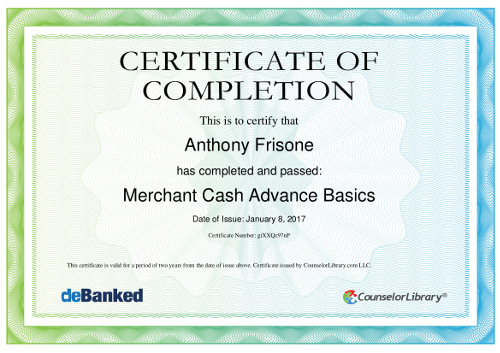 After Cardinal Equity, I didn’t get another funder until after I took the deBanked “Merchant Cash Advance Basics” [online course] in January 2017. It was eye opening for me. Everything started making sense. I was able to have a conversation with funders and actually understand them. I started sending over my MCA Basics Certificate of Completion to every funder I could think of, and within a month’s time, I had over 30 different funders waiting for me to send them deals. However, [at the time] I had no merchants to send them.
So where have you found your best leads?
We tried out so many different places and spent so much money. But we had no one to guide us in the right direction. So we would look online and probably at deBanked also. We called up a bunch of different places. None of them were fantastic, but none of them were terrible. So we knew it was a numbers game and we had to stay on the phone. So there was no set place. I bought a little bit from everywhere and a little bit worked from everywhere.
When did you start making money?
I started the business, called Nest Planner, in October 2016 all by myself. Just me and a desk and a laptop. And I didn’t start making money until March 2017. From October to March was a long 5 months. And in March I made close to $10,000 in advances. But by the end of last year, we hit the $1 million mark in advances. It’s not a lot, but it’s something that showed that we’re doing something right. And this year, it’s just February, and we have over $600,000 in [advances]. That’s huge for us and it’s just from us not giving up and pounding the phones.
How many people work for you?
Six.

How do you personally define success as a broker?
I guess the obvious part is the funds. If you make sales or close deals, it does feel good to make money. I have a wife and two kids and not taking home a paycheck is brutal. But what’s nice, also, is to see the people we hire make money. It’s nice to see them go home with a check.
How many applications do you typically send out?
So far, for January and February of this year, five of us sent in just under a 100 applications. And we funded 20 of them so far.
What resources do you wish you had that could have helped you made more deals in the beginning?
A CRM. I just had paper leads everywhere. We would just write it up on a piece of paper. No CRM and it’s rough. But it costs money. So we weren’t able to do it.
Apart from approving your applications, what do you look for in a funder?
Someone I could trust. Someone that returns calls. At the very beginning, it was hard. couldn’t get the time of day [from funders]. No one would call me back, except for Cardinal Equity. Now they’re actually calling me.
Want to become a better closer in this industry? Join your peers for training and networking at Broker Fair on May 14 in Brooklyn, NY! You can register here.
CIT Group Appoints Factoring Veteran for Southeastern Region
March 2, 2018CIT Group Inc. announced today the appointment of Jerry Younts, a factoring veteran, to its Commercial Services team.
According to Textile World, Younts will serve as Senior Business Development Officer. He will be responsible for offering factoring and asset-based financing services to furniture, textile, and floor covering manufacturers, among others, mostly in the Southeastern United States.
“CIT is continuing to build a best-in-class team to provide factoring and other financing options to Southeastern manufacturers and importers,” said Mike Hudgens, Southeast regional manager for CIT’s Commercial Services group. “We are pleased to welcome Jerry to our lineup of experts.”
The New York City-based public company also has a corporate office in Livingston, NJ and provides an array of financing alternatives including SBA loans and Syndicated loans.
Prior to CIT, Younts worked most recently as Senior Vice president at BB&T Commercial Finance in its factoring group. Before that, he was Senior Vice President at AdvanedAR, a Charlotte, NC-based AR company.
A Dialogue with Peter Renton: Cryptocurrency and Beyond
March 2, 2018
deBanked Magazine recently caught up with Peter Renton, founder of Lend Academy, a leading educational resource for the marketplace industry. Through his writing, podcasts and video courses, he’s been helping multitudes of people better understand the industry since 2010. Renton is also the co-founder of LendIt, one of the world’s largest fintech conventions, which recently branched out beyond its marketplace lending focus to include other types of fintech. The flagship U.S. conference will take place April 9 through April 11 in San Francisco. The following is an edited transcript of our discussions.
deBanked: Why did you decide to rebrand LendIt as LendItFintech?
Renton: The main reason is that we have moved beyond the online lending space. While it’s still the core of what we do, it’s not all of what we do anymore. Many of the large online lenders have also moved beyond online lending. Lending is part of financial services, but our attendees want to know what else is important. Our attendees also want to look at other opportunities for expansion. They want to know how other areas of fintech are going to affect their business—topics such as blockchain and digital banking. LendItFintech tells people that lending is what we focus on, but it also makes clear that we’re about more than lending.
deBanked: In addition to your marketplace lending investments, you entered into the cryptocurrency space back in early 2015. Tell us what you’re doing now with respect to cryptocurrency?
Renton: This was not something that I spent much time thinking about back then. At the time, I expected bitcoin to never amount to anything. But I’m interested in financial innovation and I decided to give it a go. I never thought in my wildest dreams that it would get to $10,000. (Editor’s note: In 2017, bitcoin climbed to nearly $20,000; in early February it fell below $8,000 for the first time since Nov. 2017)
I opened up a Coinbase account with $2,000, which got me 10 bitcoins. I have since sold a portion of it gradually as the price of bitcoin went up, and I diversified into a handful of other coins as well. I have recently moved a significant portion of my investment into a privately managed cryptocurrency fund, and I still maintain my Coinbase account too.
deBanked: How are things different now than when you first entered the digital currency market?
Renton: In January 2015, I created my bitcoin account and I don’t think I ever logged in over the next 18 months, or if I did, it was maybe just once or twice. No one was talking about bitcoin back then. It was still on the fringe of fintech. Sure, there were some people focused on it, but it wasn’t part of mainstream media coverage. Then, all of a sudden, it became hot because people love get-rich-quick schemes and hearing about people who hit the big time from nothing. These stories really fuel people’s imagination. Then suddenly bitcoin became one of the biggest phenomena of 2017; no one would have predicted a few years ago that would happen.
deBanked: What are the biggest risks you see with cryptocurrency today and how can investors best overcome these challenges?
Renton: Many people are buying purely on speculation with no thought that bitcoin could go down in price. You hear of people buying bitcoin on their credit card and paying 20 percent interest on that purchase. It’s insane. I feel that cryptocurrencies are here to stay, but I don’t like that they have these massive 20 percent to 30 percent swings in a day. The speculators have helped drive the price up, but they’ve also driven the volatility up and that’s been a bad thing.
deBanked: Do you think cryptocurrency will ever dethrone cash? If so, what will it take to get to that point?
Renton: I feel that some kind of digital currency is inevitable—but whether it’s a Federal Reserve-backed currency or something else remains to be seen. I have an 11-year-old and a 9-year-old and I am confident that at some point in their lifetime there will be no such thing as cash. In China, for example, there are some places where you can’t even use cash. You can go to a street vendor and buy a piece of fruit with your phone. Certainly in the U.S. we’re not there yet, but I think China shows where we are going to be.
Cryptocurrency is only one type of digital cash, and it’s hard to say how it will ultimately fit into the larger picture. To dethrone cash as we know it today, cryptocurrency needs to be a quick and efficient way of transacting, and right now it’s not quick and it’s not cheap.
That said, I believe there will be some kind of digital currency in the future. It will take a long time for the Federal Reserve to say cash is no longer legal tender, but I expect we’ll see some kind of digital currency in the next 10 years for sure.
deBanked: How do you think regulation will change the cryptocurrency landscape? Is it inevitable and, more importantly, do you think regulation of cryptocurrency is necessary to take it beyond the level it is today?
Renton: Right now bitcoin is not systemically important. At a market cap of around $156 billion in early February, if something happens and it completely crashes, it won’t make a dent on the U.S. or world economy. But if bitcoin continues to rise and reaches a market cap of say $16 trillion, and then it falls to zero, that would reverberate around the world. The largest economies that have the most bitcoin would be the most impacted.
At some point governments will step in with regulation. It’s already happening in places like China and South Korea and there are rumors of other governments taking action. I don’t think the largest governments will allow their economy to be at the whim of speculators.
deBanked:deBanked: How do you feel about the SEC stepping into regulate ICOs? Is this necessary to protect investors?
Renton: There are certainly some ICOs that are complete scams while others are obviously violating securities laws. But many ICOs have strong legal teams supporting them and are doing it right now. The SEC should absolutely clamp down on those doing the wrong thing, but my hope is that they don’t overreact and throw the baby out with the bathwater.

deBanked: What about online lending? The industry has gone through a lot of changes in its relatively short history. How do you expect to see the competitive landscape change in the next year or so? What about farther out?
Renton: The online lending space has gone through a lot of changes in its short history. I feel like the biggest trend we’re seeing right now is banks launching their own platforms. Take Goldman Sachs with the Marcus online lending platform, for example. More than anything else that has happened in the history of online lending that is among the most telling for the future, I think. Goldman has gone all in with this effort, and that move woke up all the large banks. Top banks like PNC and Barclays are also launching their own initiatives instead of partnering with others, which was surprising to me. I would have thought there would be more partnerships. There are still some, but several banks have decided to do it themselves rather than partnering. Smaller banks, however, that want to get into the space, will likely partner because they can’t afford to do it themselves. While we have seen a few partnerships develop, I expect we will see many more over the next couple of years.
deBanked: What do you see as the biggest risks for online lenders today? How can they best overcome these challenges?
Renton: As an industry, we have to focus on profitability. Profitability comes down primarily to two things. First, you have to get your cost of acquisition down. Some of the companies that failed recently were never able to get their costs of acquisition down to a manageable level. Underwriting is the second piece. Particularly if you’re a balance sheet lender and you’re not underwriting well, you can’t make money. The pullback in the industry in 2016 occurred because many of the major platforms got a little too aggressive in their underwriting. Investors are still paying for some of those mistakes.
Successful companies are ones that have figured out how to profitably acquire customers and how to underwrite effectively. Most of them have learned their lesson, but in business companies sometimes have short memories. We need to keep a close eye on it.
deBanked: What advice do you have for alternative lenders and funders?
Renton: In addition to paying careful attention to profitability and underwriting, another important piece is having diversified funding sources. You want to make sure that you don’t have one big bank or some other source providing 90 percent of your funding. You should really have different kinds of lending sources. Some loans you can fund through a marketplace, some loans you can fund through your balance sheet. It’s good when you’re not reliant on one particular way of funding your loans.
deBanked: How is regulation likely to impact the online lending industry?
Renton: Having support in Congress for the online lending space is important. Congress hasn’t devoted a lot of attention to it in the past few years, but it’s starting to. The Madden decision—which has the potential to lead to significant nationwide changes in consumer and commercial lending by non-bank entities—has created uncertainty in the industry. In states affected by the decision (Connecticut, New York and Vermont) already there has been less access to credit. I’m hopeful that Congress moves ahead with legislation to override the Madden decision that’s having such an impact in the Second Circuit states. People are worried that it could expand nationwide and Congress needs to act so there’s clarification. There’s too much uncertainty right now.
deBanked: Several platforms have closed their doors in the past year or so. Do you expect to see this trend continue?
Renton: There are companies out there still trying to raise money and struggling to do so. That’s a healthy thing for an industry. You want the strong players to survive and thrive and for the weaker ones to go away.
deBanked: How big do you think an online lender has to be to thrive?
Renton: There’s no doubt that scale is important. If you’re a small player, you have to have some kind of niche in order to acquire customers. If you have that, you have the ability to compete. Even with that sometimes, it’s going to be difficult. It’s a pretty complex business. You need to have a lot of staff for compliance and operations and that can be expensive. When you have high fixed costs, you have to have scale to be able to make a profit. That said, I think there’s room for more than just the ultra-large players in the online lending space. I think there will be plenty of opportunity for strong, well-positioned medium-sized players to compete.
deBanked: What about M&A in the industry?
Renton: Valuations at many of the large platforms are way down from where they were several years ago. As long as valuations stay depressed, I think we could see a big acquisition of a major platform this year. Some of these platforms have millions of customers. Having the ability to pick up such a large number of customers instantly through an acquisition could be compelling for the right buyer, such as a large bank.
deBanked: Is this a good time or a bad time to be an online lender in your opinion?
Renton: It is still a good time to be an online lender. We are expanding access to credit and making the world a better place. I have never been more excited about the industry than I am today.