Remember When? Funders Talk About Their First Deals
October 14, 2016
It’s hard to forget the firsts, especially first deals — they set precedents, lay down the groundwork for policies and establish a starting point for legacy.
For funders and lenders, their first deal can be significant in establishing client relations, setting priorities for credit policies and as we found out, teaching them valuable lessons.
 First Steps..Baby Steps
John D’Amico’s first bet was a small cafe in Carmel, Indiana that his company GRP Funding advanced $25,000 to, eight years ago. Reviewed on credit card sales, GRP looked at the business’ cash flow and deemed it a good risk to take, D’Amico recollected.
“That business model seems so far and long ago,” he said. “OnDeck was not a company at that point and loan products were not talked about. It was only advances.”
Would he still feel confident doing the same deal today? “Yes, that deal is still there to be had today. But you want to make sure that you’re not stacked.”
#LifeLessons: Don’t get comfortable, stay updated with the times and evolve and keep the credit risk policies fresh.
 Small Can Be Significant
The first check, Jersey City-based World Business Leaders cut was for $7,000, back in 2011.
Chief revenue officer, Alex Gemici recalled that it was an African arts store run by a woman in Virginia Beach who paid back the loan in full and came back three months later for an additional loan of $12,000.
“We believed her story and went by our lending policy and the deal fit the bill.”
#LifeLessons: We could make a big difference even with a small loan.
 Not All Firsts Are Good
But not everyone has a smooth start. For New York City-based company, Cardinal Equity, the first deal was a bump on the road.
The auto dealership in New Jersey that it advanced $250,000 to in 2011 defaulted on the second renewal. Although Arty Bujan, managing member at Cardinal Equity still thinks auto dealerships are a “nightmare,” his company still funds them but with very strict scrutiny, looking for ones with a steady revenue stream and a good amount of time in the business.
#LifeLessons: There’s always risk
Merchant Cash Advance Misinformation Abounds – What’s A Broker To Think?
October 10, 2016
Last week, at least two panelists at the major commercial loan broker conference critiqued merchant cash advances, even going so far as to assign an arbitrary cost to them. Craig McGrain, President of factoring company Durham Funding, said they cost about 75%. Bob Coleman, owner of The Coleman Report, an SBA loan journal, said that merchant cash advance contracts should stipulate that prices are basically equivalent to 100% APR. Neither accurately describes a merchant cash advance if for no other reason than because a merchant cash advance is merely a methodology or a mechanism, not a price. The term itself is derived from the process of making a merchant an advance on their future projected sales. With hundreds of companies employing that concept, some are able to do it at a low cost and others at a high cost.
And it’s obviously the high cost ones to which their disdain was directed. But even then, when MCAs are properly structured as a purchase of future sales, there is no calculable APR because there is no assigned time frame, predetermined payments, or interest rate. This doesn’t mean an MCA product can’t be expensive, because surely they can be, but assigning randomly high percentages to scare people only compounds the misinformation that has persisted for years.
On a panel I participated in with Bob Coleman, Coleman said that these purchases were really just loans. The New York Supreme Court, however, repeatedly disagrees with him. In Platinum Rapid Funding Group Ltd v. VIP Limousine Services, Inc. and Charles Cotton, the court affirmed a purchase of future receivables for an upfront payment, adding that the request for the Court to convert the Agreement to a loan and assign an interest rate to it would require unwarranted speculation, and would contradict the explicit terms of the sale of future receivables in accordance with the Merchant Agreement.
In Merchant Cash & Capital, LLC v G&E Asian Am. Enter., Inc., the court reached the same conclusion.
With regard to McGrain of Durham Funding, he said that 70%-80% of companies that apply for his company’s factoring services have already used an MCA. This kind of competitive pressure is probably a leading reason why a factor would mischaracterize MCAs. In fact, the factoring industry has felt so threatened by MCAs, that two years ago the International Factoring Association voted to ban all MCA companies from their organization.
This isn’t to suggest that factoring is an inferior product and that MCA is the newer better thing. On the contrary, factoring is an excellent loan alternative and to McGrain’s credit he said that he believed the free market would work everything out. To facilitate that, more MCA brokers need to be educated on factoring and SBA lending. And in return commercial finance brokers need to understand the true nuts and bolts of MCA. That process gets sullied when misinformation abounds. Merchants will get the best help when the brokers fully understand all of the market’s options.
My panel with SBA lending expert Bob Coleman and equipment leasing veteran Kit Menkin at the NACLB conference last week highlighted some differences of opinions across these closely related industries but also demonstrated areas in which we all agree. Small businesses have different needs and it’s up to the brokers to prescribe the most appropriate solution. Whether it’s short-term or long-term, cheap or expensive, proactive or reactive, there’s capital out there. Hopefully the kind of cooperative engagement the NACLB conference provided this year will continue to be fostered for years to come.

Dear Funders: Don’t Dial ‘M’ for Marketing
October 7, 2016
Imagine you own a small donut shop in Arizona and receive an email saying, “Hello, I have heard your chocolate donuts are amazing and the most popular item. I work for XX, and we provide small business loans, do reach out to us if you’re looking to take it a step further.”
Versus
Getting yet another envelope in a deluge of mails with a bank-check-like promotional ad for a preposterous amount that startles you for a hot second before it ends up in the paper shredder.
One of these methods is free, personalized and subtle. And no points for guessing which one.
Gone should be the days where funders indiscriminately send out email blasts or cold call merchants offering working capital. But are they?
A year ago, a Wall Street Journal article said,
“A big reason online lenders make heavy use of mail, they said, is that it is still more effective than other types of direct marketing. Across all industries, the overall response rate for direct-mail overtures is 3.7%, compared with 0.1% for both email and social-media marketing campaigns, according to a recent report from the Direct Marketing Association, an industry group.”
Mintel Comperemedia, a database which tracks advertising data highlighted the use of technology as being the paramount shift in marketing for the financial services industry. But is the transition from analog to digital underway?
For some companies, it is. New York-based SOS Capital does not have a sales team and does all of its marketing on social media. The company sends no direct mailers, limits email blasts and instead scouts for small businesses on Facebook, LinkedIn and Yelp.
With more small businesses ramping up their social media presence, discovering leads has not only become easier but also cheaper. “Small business presence on Facebook is growing every day and finding them there can save you a lot of money,” said David Obstfeld, CEO and co-founder of SOS Capital. “Facebook is not explored by most funders but we have had great success.” The company spent $6,500 marketing to SMBs on Facebook and had 120 conversions over a period of two months.
How does that compare with the conventional methods of direct mail campaigns, email blasts and phone calls?
According to Justin Benton, sales director at leads generation firm, Lenders Marketing, it could cost about $100,000 to send out a million emails to active, verified accounts and as much as a dollar for a nice direct mail, including printing and postage.
“Even though it’s cost prohibitive for some folks and some others think that it’s past its prime, direct mail still wins,” said Benton who urges his clients to consider social media marketing which he says can be “virtually free.”
Discovering companies on sites like LinkedIn and Yelp can offer insights into the business and target customers better. “Calling a lead once and saying the words, ‘business loans’ or ‘working capital loans’ does not work, you need to understand the business,” Benton added.
Digital marketing can also help one keep better track of leads and reinvest in the ones that work. “It’s important to have a leads scoring system,” Benton said. The opposite of that, to him, looks like “Making a gumbo from scratch but you have no idea how you did it and cannot recreate it.”
Competition among financial companies will eventually force them to get more creative with their marketing tactics. Like Partners Funding for example, an MCA funder that markets to ISOs, uses incentives as baits. “If the ISOs fund three deals over $50,000, we reward them with extra points or give them marketing dollars,” said Michael Jenssen, ISO sales manager at Partners Funding, which sticks to marketing through email blasts, calls and exhibiting at trade shows.
Ultimately, the road to a lasting relationship with clients is paved with effective marketing. And the line between pushing call to action and being pesky is quite fine. “Funders have been using the same marketing campaigns and it’s making the clients sick,” said Obstfeld. “There are only so many mailers one can receive. They have to be creative about marketing to people without annoying them.”
For Obstfeld, the value in pursuing businesses through channels like Facebook is having more control over deals and interacting with the merchants directly, without any interference from ISOs. “It’s not just about saving money but the control over the deal. When there is no ISO involved, there is no stacking involved.”
The transition to moving all marketing online might be slow but inevitable. Until then, using bank check imagery to promote big pre-approvals will be more than just gags.
Brief: SMB Credit Rating Agency PayNet Releases Data Scoring for Alternative Lenders
October 7, 2016PayNet, an Illinois-based company that provides credit ratings to small businesses released a pooled-data score for alternative lenders to assess risk.
This new score builds on the existing PayNet MasterScore v2, which contains a total of over 587 variables. PayNet maintains a proprietary database of small business loans, leases and lines of credit worth over $1.4 trillion.
“Alternative loans are higher risk than traditional bank loans, but the nature of their risks is also different, as are a number of the warning signs of risk,” said Thomas Ware, PayNet’s senior vice president of analytics & product development, in a statement.
Merchant Cash Advance’s Impact on Factoring
October 6, 2016 A little more than two years ago, the International Factoring Association voted to ban merchant cash advance companies from membership, citing loose underwriting standards and competitive pressure.
On Wednesday, at the NACLB conference in Las Vegas, Craig McGrain, President of factoring company Durham Funding, hinted on a panel at just how strong that competitive pressure has become. According to him, about 70-80% of their applicants today already have a merchant cash advance. Five years ago, it was only 5% of businesses, he said. He thinks a lot of that has to do with small businesses not knowing what all of their available options are.
The numbers may not be all that shocking considering that Funding Circle VP Michael Rabil also said at the conference that 30-40% of their applicants already have an MCA. Funding Circle provides small business term loans.
That’s a lot of merchants turning to MCA before finding their way to another product.
Mind The TCPA And Get deBanked All Over Again
October 4, 2016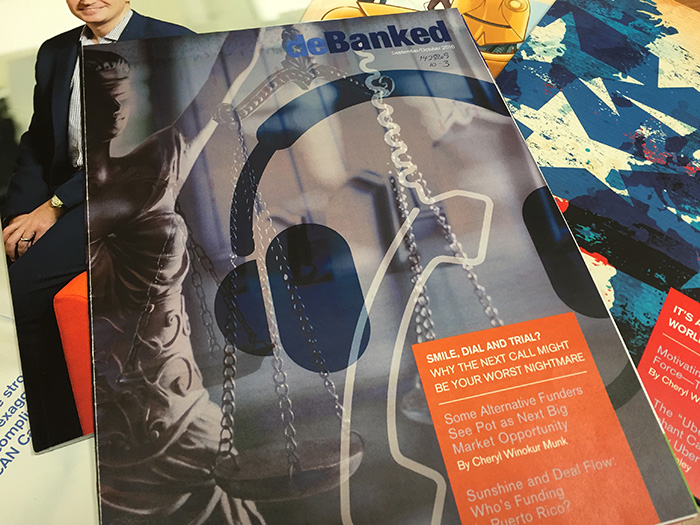
deBanked’s September/October 2016 issue is set to go in the mail very soon. And in this issue, we wade chest-deep into a trend that has many brokers and funders worrying behind closed doors. In the last year there has been a surge of TCPA lawsuits, whether for robo-dialing, Do-Not-Call-List violations or something else. Are industry players being irresponsible or is there something else amiss? deBanked went looking for the answers and you might be surprised by some of the things we found.
If you’re wondering what TCPA lawsuits even are or how they might affect you, this story will hopefully teach you about the risks of marketing over the phone. Smile Dial… and Trial? You’ll want to read this.
If you’re already subscribed to receive the magazine, you’ll be getting your copy soon. If not, you should SUBSCRIBE NOW FREE
Commercial Finance Coalition Tells MCA Industry Story on Capitol Hill
September 23, 2016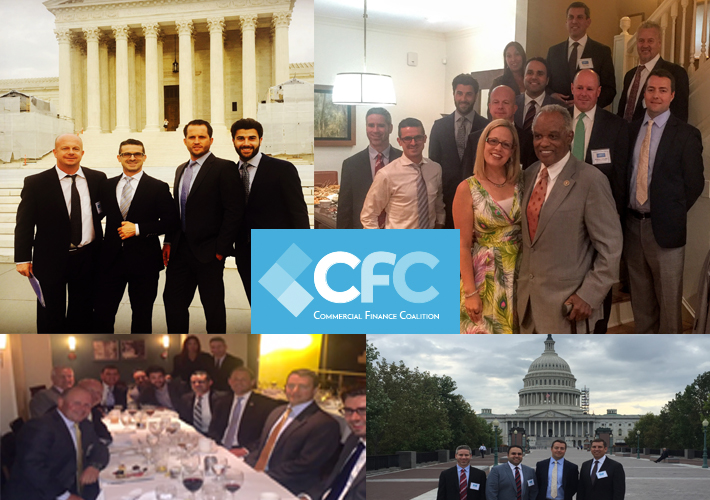
Earlier this week, executives and representatives from the merchant cash advance industry met with dozens of policymakers on Capitol Hill. The Fly-In was hosted by the Commercial Finance Coalition, whose members make up a sizable chunk of the industry’s overall transaction volume. It was their second such event this year.

The opportunity allowed industry representatives to get face time with Republicans and Democrats from both the House and the Senate. One message of great importance was in communicating the challenges that small businesses face in trying to access less than $250,000 in working capital. Another was in distinguishing purchase transactions from loans.
“Our members are engaged and committed to educating and advocating the interests of the merchant cash advance industry in Washington DC and state capitals around the country,” said Isaac Stern, President of the CFC and Fundry. “I would strongly encourage my industry colleagues and competitors to get involved in the organization and help us grow the CFC.”
While banks have been accused of being too big to fail, the CFC noted that many businesses have become too small to survive as a consequence of banks moving upstream. Regulations have made it too burdensome and expensive for a bank to underwrite a $25,000 loan, plus they may not be able to stomach the risk or be properly incentivized to approve or decline a loan in the first place. The CFC’s members do not securitize their transactions or sell them off, lending credence to the position that their livelihood depends on small businesses succeeding and performing.
“In less than 9 months the CFC has become the gold standard of alternative small business finance trade groups in Washington,” said Dan Gans, Executive Director of the CFC. “In a short time we have been able to conduct over 50 meetings with key policymakers and assemble a world class regulatory and lobbying team. I would encourage anyone involved in the merchant cash advance or alternative small business finance space to join the CFC and help us advocate for the thousands of small businesses across the country who benefit from the access to needed capital provided by the industry.”
The CFC has not been the only coalition from the broad genre of fintech to host a Fly-In, making it all the more imperative for the MCA industry to educate policymakers on the specifics of what they do and how they do it. For instance, a lot of the regulatory discussion as of late has focused on the partnerships between online lenders and chartered banks, the legitimacy of those partnerships and the sustainability of the algorithms being employed to make quick decisions. While there are several MCA-like products that rely on that model, there is also an entirely different methodology that relies on helping small businesses by purchasing their future receivables. The CFC is one major coalition communicating that distinction.
The CFC is also currently accepting new members to join their cause and participate in future events.

IT’S A BROKER’S WORLD
August 31, 2016
From east to west, small businesses are getting funded. But how they’re found and who they work with depends on where they are. In the US, where brokers tend to have a love/hate relationship with the funding companies they work with, they are no doubt a driving force in the market. In other countries, they might not even exist, are just starting to bloom or they add balance to a mature market. Is the world built for brokers? deBanked traveled far and wide to find the answers.
Down under in Australia where American-based merchant cash advance and lending companies have expanded, the ISO (which stands for Independent Sales Office and is synonymous with broker) model has not really followed. David Goldin, CEO of Capify, an international company headquartered in New York, told deBanked that there’s very few ISOs in Australia.
 He believes that’s because there’s next to no payment processing ISO market there, a foundation that was a major precursor in the US towards the development of ISOs reselling merchant cash advances and business loans.
Luke Schmille, President of CapRock Services, echoed same. The Dallas-based company founded Sprout Funding in Australia earlier this summer as part of a joint venture with Sydney-based family office Huntwick Holdings. “Direct marketing is the primary method [of acquiring deal flow],” he said. “The credit card processing space is controlled by several large banks, so you don’t see ISO efforts in the acquiring space either.”
Big bank dominance was only one reason why another country’s emerging alternative small business funding market developed slowly. In Hong Kong, non-bank alternatives like merchant cash advances faced legal uncertainty for a long time. For example, Global Merchant Funding (GMF), once the only merchant cash advance company in the Chinese special administrative region, had been relentlessly pursued for years by the Secretary for Justice for conducting business as a money lender without a license. GMF fought it. And won.
In May of this year, the legality of merchant cash advances ultimately prevailed after the highest court ruled the agreements were not loans. Emboldened, several companies have stepped up their marketing of the product. But whether they’re doing daily debit loans or split-processing merchant cash advances (both of which exist there), marketing tends to be directed at merchants, not a middle market of brokers.
 Gabriel Chung of Hong Kong-based Advanced Express Capital said that there are a handful of large brokers typically comprised of former bankers, but the rest of the broker market is highly fragmented, mostly made up of individual freelancers.
Adrian Cook, the Founder and CEO of Hong Kong-based Asia Capital Advance, agreed that marketing is usually aimed at merchants directly but that it’s changing. “Since the market is still very new and MCA is only beginning to gain popularity, brokers on the market are only starting to recognize MCA,” he said. “There is a lot of room for the brokerage market to grow.”
In the UK, where Capify also operates, CEO David Goldin explained that the UK doesn’t have a lot of credit card processing ISOs so there wasn’t a major migration from that business to MCA like there was in the US. But that doesn’t mean there is no middleman market at all.
 Paul Mildenstein, executive director of London-based Liberis, said that brokers are an important channel, but not as dominant as they are in the US. “Our brokers are usually members of the NACFB, an organisation in the UK that actively supports and provides operating principles to the furtherance of the commercial finance broker community,” he wrote. The National Association of Commercial Finance Brokers claims to have 1600 members, one among them is Liberis.
“Many clients want the support of an experienced professional who can discuss the financial options available to them in their specific circumstances,” said Liberis’ CEO, Rob Straathof. “Given relatively low awareness of the Business Cash Advance product in the UK, this means that brokers have a key role to play in educating potential customers on when this is the right option for them,” he added.
Straathof stressed a robust criteria for the brokers they work with and explained that brokers are their eyes and ears in the market. “The relationships we have with them are not transactional, but transformational for our business,” he said.
The NACFB was also praised by Alexander Littner, Managing Director of Chelmsford, Essex-based Boost Capital. The company, which is actually a subsidiary of Coral Springs, FL-based BFS Capital in the US, sees a balance between their use of brokers and their efforts to acquire customers directly.
“As the alternative finance market is still relatively new here in the UK these brokers are important for this independent advice, and to help educate the market and establish trust,” Littner said. “At Boost Capital we work very closely with brokers across the UK, they are a critical part of our growth and fundamental to our ongoing success.”
In the US, brokers play such a dominant role in customer acquisition that some MCA funding companies rely on them to source the entirety of their business. Back in February, Jordan Feinstein of NY-based Nulook Capital told deBanked, “We decided that the best way to grow is to build relationships to avoid the overhead, compliance, training and manpower that a sales team would require.” Nulook markets its broker-only approach as a strength.
Others take a more blended approach, like Justin Bakes, CEO of Forward Financing, for example. “While our priority is to self originate, it is essential to create and maintain partnerships in this business,” he said earlier this year.
Notably, no such guiding authority like the UK’s NACFB exists for brokers in the US so it’s not easy to track exactly how many there are or how they operate, but their role in the industry cannot be understated. deBanked actually labeled 2015 The Year Of The Broker, when it published an article in its March/April 2015 issue that tried to capture the essence of the industry at the time. Tom McGovern, who was then a VP at Cypress Associates LLC, said of brokers, “They’re like the missionaries of the industry going out to untapped areas of the market.”
But preaching the gospel of alternative funding exists at different stages across the world. And Goldin, whose company Capify operates in four countries including the US, thinks that many middlemen here at home may not ultimately survive. In an interview, he predicted that the stronger ones over time will be acquired by funding companies and that direct marketing will only increase. “I think more and more companies are going to start building their own internal sales forces,” he said.
Other brokers are not convinced that acquisition costs will lead to the death of their businesses, especially if they’ve already found ways to reduce overhead costs. Several brokers have discreetly mentioned running operations from Costa Rica, Nicaragua or elsewhere as a way to keep things profitable. Still more, like Excel Capital Management based in Manhattan, have found that offering a suite of products allows them to monetize more customers. Chad Otar, a managing partner for Excel, said that they recently brokered a $4.9 million SBA loan. MCA is just one of their options these days. “As long as there’s small businesses, there’s always going to be opportunity,” he said.
 In the US, the brokers have certainly seized it, but that’s because most funding companies offer big bucks and quick payment to those that are capable of sourcing customers. In other countries, compensation for services rendered might be the responsibility of the broker to arrange with the merchant since it may not be customary for funding providers to pay commissions. That would mean more work and more risk for the broker.
Ironically, some brokers in the US will tap into both sides, earning a commission from the funder and charging a fee to the merchant for services rendered. And if the broker has payment processing roots, they can go a step further and earn merchant account residuals as well.
Brokers can’t exist without funding companies willing to support their endeavors, of course. While their prevalence around the world varies, most of the funding companies deBanked spoke to, appear eager to nurture the middleman’s role, so long as they act responsibly.
“Brokers in the UK are incredibly important as independent advisors to small businesses on the various sources of finance to suit their needs,” said Littner.
And as long as those customers, wherever they may be, are getting the value they want from a broker, that role, so long as it can continue to be done profitably, will likely have a place in the world for the foreseeable future.