

Letter From The Editor
December 23, 2017 It was a year to remember, our sources declare
‘Twas the Jan/Feb issue I wrote about my loan from Square
 Through March into April salespeople closed deals via text
As banks looked to fintech as their plan for what’s next
 We went to Texas a nexus for finance and lending
It was May, maybe June when Bizfi’s final days were pending
 Merchants talked, banks adjusted, it was a summer of learnings
For the pressure was on to produce solid quarterly earnings
 September, October, liens and judgements were removed
But the world hardly noticed and deals still got approved
 Winter coats and furry hats meant the year would end soon
But by golly 10k, no 19k! Bitcoin went straight to the moon!
 And so boys and girls the story of ‘17 has been told
What a time for finance, for money, and a world to behold
See you in ‘18, in ‘19, and the roaring twenties my friend
We’ll be right there, whether you deal in receivables or lend

– Sean Murray
MCA’s Top Social Media Voice
December 18, 2017 LinkedIn has unveiled its top 10 voices for marketing and social media. Fintech did not make the list, but perhaps the social networking site didn’t look hard enough. If they had been following Jennie Villano, who on Dec. 1 joined Kalamata Advisors as vice president of business relationships, that list might have included a nod to the MCA industry.
By most standards she’s a newbie to fintech, having joined her previous employer Pearl Capital only two years ago. But that hasn’t prevented her from making her social media presence known. And while she reserves Facebook for her personal life, if you know Villano then you wouldn’t be surprised at her success on LinkedIn, as she seems to have a knack for social media.
“I felt like I needed a very strong presence in this industry to get anywhere,” Villano told deBanked. “It’s funny, I think a lot of people associate sales with a type A personality and being pushy. I’m not an aggressive, pit-bull woman. You don’t have to be that type of woman to get ahead. I thought about how am I going to show this to the industry? Social media was my answer. My Facebook and LinkedIn attract a lot of views.”
Indeed, it was because of her Facebook profile that Villano was featured by a famous painting by David Uhl. The painting, dubbed Steampunk Seduction, is the first in Uhl’s Steampunk series. “I got that through Facebook,” Villano explained. “Someone saw my profile on Facebook, reached out and said, ‘you should contact the artist.’ I told them they were crazy. They insisted, and he chose me. It’s been a blessing.”
Meanwhile, her LinkedIn posts designed for MCA ISOs have similarly caught on like wildfire, and she only “amped up” her activity on the site in July. Villano has been posting on LinkedIn once per week, and the proof is in the pudding. “Since then, in September, October, and November, we broke funding records every month. It works,” said Villano of her previous employer Pearl Capital.
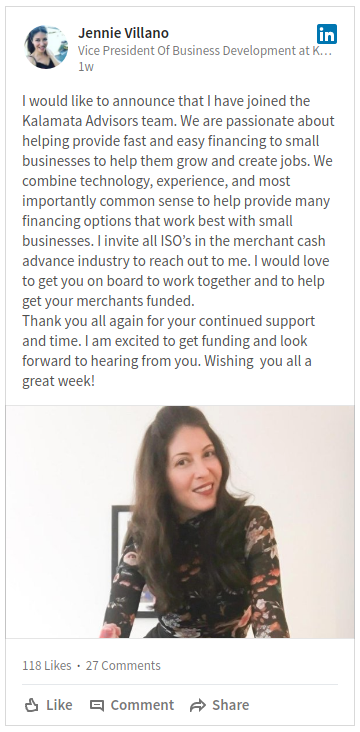
Underpinning that deal flow has been a flow of new relationships she’s forming, evidenced by more than 500 ISOs having contacted Villano on LinkedIn via her previous employer’s Salesforce network.
“That was from posting one time per month and just educating; not posting pictures of me on a beach sipping a Pina Colada,” said Villano. Instead, she was educating them about Pearl’s funding options, the types of deals they wanted, their bonus structure, etc. “So, it’s very basic information. I was just letting them know what they can expect from Pearl, what kind of fundings we were doing, just being a constant reminder,” she added.
While Villano is no longer employed by Pearl Capital, her posts from her tenure there have had a lasting impact. “[Last month] I put up a post announcing that I was leaving Pearl Capital,” Villano said. “The post generated more than 35,000 views.” Meanwhile, since she’s been posting, she’s seen the number of LinkedIn connections skyrocket.
Villano is continuing her social media push at her new employer, Kalamata Advisors.
“Kalamata has a partnership-culture mentality. It’s an amazing opportunity to be elected a partner, like a partner at Goldman Sachs or McKinsey, here after a couple of years. Then you have a real stake in the company and work at a firm where everyone wants to pitch in,” she explained. “Second is their great reputation. The partners put their mission and values first. They’ve grown so fast; but they’ve grown with the purpose to genuinely help people. And lastly, they’re very respected in the industry. Everyone here is very responsive, honest and professional.”
And while she’s no longer employed by Pearl Capital, she has nothing but respect for her former employer as well. The feeling is mutual, evidenced by a going away party that they threw for her on her way to Kalamata.
Gender Gap
 So why isn’t social media more pervasive among MCA market participants? According to Villano, the reasons are two pronged, the first of which is compliance. “It’s very important to make sure we convey ourselves properly,” she said.
The other has to do with the fact that MCA is a male-dominated industry. “Women are more conversationalists through texting or social media. I find women are more intimate with it on a professional level. I have to say that I have the most active social media in our industry,” said Villano, who again only joined fintech two years ago. She’s inspired by the many women who are behind the scenes at ISO shops, many of whom she explained work as processors.
We asked Villano about whether sharing her trade secrets with competitors in the industry made her uncomfortable. “Not at all. I’m not made like that,” she said. “And Kalamata believes trust is the importance of every brand. With transparency, there is trust. Everyone is authentic and unique. Everyone should have the opportunity to share his/her own self in any industry.”
deBanked Connect: Miami — SOLD OUT
December 12, 2017deBanked’s cocktail networking event on January 25th in South Beach is now SOLD OUT!
 If you missed out on your chance to RSVP, you can still register for our much bigger, better, and more comprehensive event on May 14, 2018 in Brooklyn; Broker Fair 2018.
With 20 sponsors already signed on, Broker Fair is sizing up to be the biggest event in the MCA and small business lending industry of the entire year! During this exclusive full-day conference, brokers, lenders, funders and service providers alike can expect education, inspiration and opportunities to connect and grow their business. You can view our preliminary agenda here.
DON’T GET LEFT OUT. REGISTER FOR BROKER FAIR 2018 TODAY!. Got questions? E-mail: info@brokerfair.org
Closing Loans and MCAs — From the Bedroom to the Office
December 8, 2017 The merchant cash advance industry has gone mainstream so quickly that it has become more difficult to identify potential customers.
Market saturation and industry consolidation have caused the cost of sales leads to increase sharply. Yet a New York business loan broker is finding success by applying lead generation and online marketing strategies to merchant cash advance, or MCA, while expanding the number of services he offers prospects. Funding is just the foot in the door.
Philip Smith, founder and CEO of PJP Marketing Inc., told deBanked the MCA industry’s acceptance has made it more difficult for sales lead generators to produce profits. But expanding the number of services that independent sales organizations (ISOs) offer can offset the contraction. Smith’s life as a stay-at-home-dad, was recently featured in Innovate Long Island, a regional newspaper.
An ISO can’t just be a broker anymore. It needs to change, identify new revenue streams to excel. In doing so, a lead generator transforms itself into a business consultant that prospective customers turn to for additional services they often didn’t even know existed, Smith said.
For example, business loans and MCA is Smith’s largest business generator. But his most popular add-on services with such sales leads are credit repair and credit monitoring.
“The market is relatively easy,” Smith said. “The hard part is monetizing. The ISOs are going out of business because they refuse to monetize the other, non-cash advance leads.”
Smith, armed with a degree in business/e-business from the University of Phoenix, is also an advocate for entrepreneurs who want to work from home. It’s a viable model for lead generators because low overhead costs provide entrepreneurs an opportunity to capitalize on aggressive business strategies.
As such, Smith markets his pajama-centric business model with IWorkInMyJams.com. But he acknowledges that working from home presents its own challenges. Entrepreneurs need to be extra focused and tough to distract. No watching Dr. Phil during work hours.
Since they don’t work with more experienced managers, work-from-home entrepreneurs also need to seek their own sources of business advice and strategies. They deal with the reality that some lenders may deem them too small to do business. “Not everyone will work with you,” he said.
Working from home also requires a entrepreneur to set office hour limits and parameters to prevent burnout, Smith said.
“Do you know when to turn it off?” he asked. “That’s my problem. I’m up until 1 o’clock in the morning because I can.”
Smith now brokers sales leads in several verticals such as credit repair, tax relief, mortgage and solar energy. He claims revenue of $1.6 million last year and plans to reach $2 million this year.
When he was just 23, Smith launched his first company, We Link You Internet Services, a business that evolved into a web hosting concern.
He later worked for New York-based Canrock Ventures to launch a search-engine optimization platform called SEOPledge that was acquired in 2013. The following year, he founded what is now called PJP Marketing to broker leads amid the rapidly rising MCA space using the digital marketing skills he’d learned from the previous positions.
In October, deBanked reported that several factors have contributed to several changes in the MCA industry, including consolidation, making it more difficult for alternative-funding business lead generators.
ISOs and brokers have gotten pickier about the types of leads they’ll accept as MCA evolves from a niche business to one that’s more commonplace. Also, a stricter application of the Telephone Consumer Protection Act (TCPA) has chilled soliciting and hamstrung the ability to connect with business owners who are prospective clients.
Last year’s LendingClub Corp. scandal ousted several senior managers, including the company’s then-CEO. Last summer, Bizfi laid off workers and sold the servicing rights to its $250 million loan portfolio to rival Credibly.
The result has been a consolidation of the alternative funding business.
“There are still roughly 75,000 business owners every week who meet the criteria for an [MCA],” California-based Lenders Marketing partner Justin Benton told deBanked. “Now instead of there being 5,000 options in the space, there are 2,000, so those 2,000 are gobbling it all up.”
 David Ross, a 12-year veteran of the MCA industry and owner of Pro Leads NYC, said MCAs higher profile has been a game changer for lead generators.
“MCA is beyond saturation,” he said. “All of the merchants know about it and understand it. Now, [funders] want exclusive leads.”
Working from home is a possible option for ISOs that are wizards at online marketing. But it’s less attractive for the conventional lead generator who relies on backing from a marketing team, Ross said.
“Realistically, if you’re a broker and want to make money you have to be on someone’s floor,” he said. “You need marketing.”
Last year, a Bryant Park Capital report estimated the MCA market to be worth about $12.8 billion. It’s projected to top $15 billion this year. Smith expects the continued strong demand for MCAs regardless of all the industry consolidation and costlier lead generation.
“I think they will always be fine because they can live through the storm,” he said. “It’s now a mainstream service so more people know about it.”
Smith told Donna Drake during an appearance on the Live It Up television program that going it alone as entrepreneur takes a “do-not-quit attitude” that has served him well so far.
“Any business is pretty much a numbers game,” he said. “I live and breathe it every single day.”
Originations Since Inception
December 8, 2017After several company announcements recently, we’ve compiled a milestone chart to plot where they rank. Originations may indicate business loans or MCAs funded on balance sheet, brokered, or placed through a marketplace. These rankings are a work in progress. This chart may not include companies for which public data is not available. If you’d like your figures to be listed here, e-mail sean@debanked.com.
| Company | Origination Volume Since Inception | Year Founded |
| OnDeck | $8 Billion | 2007 |
| Kabbage | $4 Billion | 2009 |
| Yellowstone Capital | $2 Billion | 2009 |
| BFS Capital | $1.7 Billion | 2002 |
| Funding Circle | $1 Billion (US only) | 2010 |
| IOU Financial | $500 Million | |
| Lending Club | $500 Million (SMB loans only) | 2006 |
| SmartBiz Loans | > $500 Million (SBA loans) | 2009 |
| Lendio | > $500 Milllion | |
| Forward Financing | $275 Million | 2012 |
| Blue Bridge Financial | $200 Million | 2009 |
Are Lawsuits the New UCCs?
December 5, 2017 Back when merchant cash advance funders first began to file UCCs, competitors immediately began to look them up and turn them into leads. The practice became so widespread that MCA funders began filing under pseudonyms to throw people off the scent. But soon, competitors began to figure out who the pseudonyms belonged to and the game continued. Funders tried other methods like having the UCC service providers themselves be named as the secured parties. Eventually, competitors realized that although they couldn’t figure out who the true secured party was on these, they could at least reasonably identify the named debtor as having obtained funding. Eventually some funders gave up and stopped filing UCCs altogether.
These days, a new breed of public records detectives are harvesting the NY state court records for lawsuits against merchants in default. Though they don’t always wait until a merchant has already been sued, the public dockets make it easy for them to obtain all the details they need to pitch services such as debt settlement and legal aid.
An unfortunate consequence of that is that these so called advocates may not have the merchants’ interests at heart and they can greatly complicate communication between the parties.
See previous coverage:
- 4th Alleged Co-conspirator in Fake Debt Settlement Company Arrested
- ISOs Alleged to Be Partners in Debt Settlement “Scam” in Explosive Lawsuit
- Is The End Near For This Debt Settlement Firm?
- A Tale of “Debt Restructuring”?
The practice of trolling the dockets is becoming so popular that a similar trend may be cropping up, funders filing lawsuits under obscure entity names. While it’s too early to tell if debt settlement lead hunters could get so aggressive as to actually make it untenable to file a lawsuit or a confession of judgment, it is something to keep an eye on. Unlike a UCC, which may only reveal a description of the secured interest and the merchant’s name, the dockets may reveal the actual contract itself, all of the terms, what platform it was funded on, how much remains outstanding, etc. There’s vastly more than could ever be gleaned from a UCC. The downside, of course, is that it suggests a merchant breached a contract and may not be an ideal candidate for additional funding. But to a debt settlement firm (unsavory or not), that might just be the prospect they’re looking for.

Are lawsuits the new UCCs? Time will tell.
Yellowstone Capital Funds $100 Million Over Last 60 Days
December 1, 2017An email circulated by Jersey City-based Yellowstone Capital yesterday, confirmed that the company had originated $50 million in deals for the month of November. The figured tied the record set in the previous month, bringing the 60-day total to $100 million.
Two sales representatives ended up in a tie for top performer of the month, each originating $4.65 million. Juan Monegro, whom deBanked interviewed almost two years ago, was right behind them at $4.55 million.
ISO Roadmap For 2018
November 26, 2017ISOs, as you finish out a wild year of funding, we’ve put together a roadmap to prepare you for a very successful 2018!

1. Educate yourself. Litigation in the MCA industry skyrocketed in 2017. That means as a salesperson you’re  more accountable than ever to communicate the products and services you sell in a succinct and truthful manner. Case in point, MCAs are offered by funders, not lenders. Using lending-related terminology at any point during the sales process for non-lending products can open yourself up to both legal or regulatory consequences, even if you’re just an employee. As these fundamentals apply to industry veterans as well as newcomers, your top priority in the new year should be to get a certificate in Merchant Cash Advance Basics.

2. Source your own leads. Sneaking deals out the backdoor or being on the receiving end of ill-gotten leads may yield a couple bucks but it may ultimately come at the expense of your reputation and career. It could also be against the law. The surefire way to become a legitimate top performer in the industry is to generate your own deals. How else do you expect to build a book of business that’s truly yours and relationships with clients that are built on trust and integrity? Need help getting started? Check out this list of lead sources!

3. Participate in industry events. In 2018, it will pay to truly know who you’re working with. Sending your deal off to some random person you’ve never met claiming to be a funder or lender is a great way to increase the odds that your deal and potential commission will disappear. Fortunately in the coming year, there are great opportunities to network with industry colleagues. Here’s a link to one deBanked hosted this past August at Marine Park Golf Course in Brooklyn. If you’re a sales rep in the South Florida area, you should attend deBanked’s FREE cocktail networking event in South Beach on January 25, 2018. And if you want to better your skills, discuss the issues, and connect with the industry, you should register for Broker Fair 2018 right now! Check out the list of companies that have signed on to sponsor it already. Broker Fair 2018 is the number one don’t-miss event of the coming year.
4. Keep up on the news. Keep up on  developments taking place across the entire alternative finance spectrum. The best part about deBanked magazine is that it’s free to subscribe. We publish six issues a year. Copies can be mailed to your home or office in print free of charge. Magazine content is typically distributed in print before it ever comes online so don’t miss out. Make sure the next deBanked magazine will be coming your way in 2018!
5. Choose your partners wisely. In the same way that it’s probably not a good idea to send your deal off to a random funder that cold called you, using old-fashioned methods like Google to discover who’s who can be onerous. That’s why we’ve segmented our sponsor directory by business type so that you can narrow down the right partner to fit your needs fast. While it’s true that these companies pay to advertise here, it’s an excellent starting point. So check out our list of sponsors!