cryptocurrency
Blockchain Expert says Crypto Tools will Revolutionize Lending
November 11, 2021 Blockchain technology can seem complex, but many individuals operating companies that utilize the technology are planning for their world to collide with mainstream finance very soon. Mark Shekleton, CEO of Smart Seal, a company that provides digital identifications for physical goods, believes that those in fintech and small business lending will utilize the technology that blockchains offer on a daily basis in the near future. The technology that will be most useful according to Shekleton, is a type of token he refers to as an (non-transferable token) NTT.
“When I’m talking about NTTs, I’m talking about a token that is like an NFT, but it can’t be transferred. It’s issued against a wallet and it can be revoked from that wallet by the issuer,” said Shekleton.
“By issuing NTTs, you allow [merchants] operating in the crypto space to gain reputation and credit for the activity they do under that wallet. So if I am operating a business, and I’m using a crypto wallet to operate, and I borrow some money, and I pay it back, the lender can issue me a positive credit report; a positive token. A token that symbolizes a positive [payment history].”
This token, issued as a one-way NFT, would be a permanent record on an objective platform that could be referenced by anyone who is looking to view the credit history of a specific merchant.
“If I go to another lender [as a merchant], they can look at all of these NTTs that are issued against my wallet and they can say ‘hey look, we saw this other lender issue one of these tokens’, [thus] you paid back your loan, and have this positive piece of reputation associated with your wallet.”
“As you go, the level of trust around a certain wallet increases. If you operate your business, and you can demonstrate that you are trustworthy, and you have people who are issuing these tokens in your wallet, you can prove to anyone else that you are a trustworthy business.”
Shekleton expanded his ideas of potential uses for blockchain technology into identity verification as well. He explained how the same process used for credit history for merchants can be used for individuals or businesses when trying to prove who they are virtually.
“Companies or banks that have services where they’re verifying the identifying of online customers, there’s a really good opportunity here for (Know Your Customer) KYC companies to issue identity tokens,” said Shekleton.
“Say I have a wallet. And right now I created a new wallet, it’s completely anonymous, I’ve never associated my identity with it. But I want to use that wallet to borrow money. I want to make sure there’s no money laundering, the lender needs to know my identity. I go to a KYC issuer, I upload my ID, meet all my requirements to verify my ID, and I sign with the wallet to prove that I’m the holder of this wallet. Then, they issue an identity token, and I can’t transfer that token to anyone else’s wallet, it can only stay in my wallet.”
According to Shekleton, an NTT’s ability to be revoked by the issuer makes it a great way to counteract fraud or identity theft, as the authenticity of the token can be revoked at any time, making the token visibly unusable to all who attempt to use it fraudulently. When asked why this idea hasn’t caught on, and why he referred to NTTs as “not talked about, and complex” at NFT.NYC last week, he blamed the infancy of NFTs and how NTTs are just too new to be widespread.
“The technology itself is just in its infancy. I think there’s a huge opportunity here, virtually untapped, but it’s still very young so it’s going to be a couple of years before anyone realizes the gains of this tech if you start building it now. I think when you start talking about NFTs as utilities to fintech and lending companies, I just don’t think they are awake to that yet. They haven’t started building.”
NYC Rapper’s Experience With Fat Joe is Becoming an NFT
November 5, 2021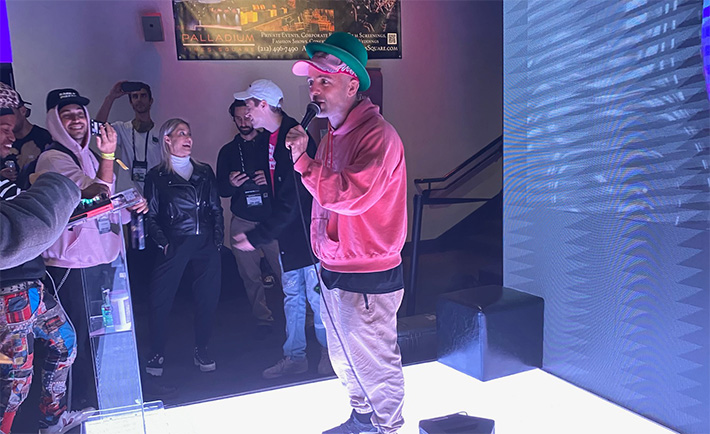
Rami Even-Esh, better known by his rap name Kosha Dillz, went viral last week after hip-hop artist Fat Joe joined him in his ritual of rapping for Knicks fans outside of Madison Square Garden before and after home games. When Fat Joe approached him while he was rapping, Even-Esh’s life changing moment spiraled into a world of opportunities. Now, he’s trying to turn a once in a lifetime experience, along with other highlights from his life, into NFTs.
Even-Esh spoke with deBanked at NFT.NYC on Wednesday about his performance at the event, after he just showed up and was given a stage—subsequently stealing the crowd away from the speaker’s showcase in the next room, and towards his crypto-inspired rhymes.
“Fat Joe heard me rapping on the beat, got on the mic, and tipped me twenty bucks,” said Even-Esh, when describing the incident he wishes to mint. “He got on the mic and spit a verse that I knew word for word, from Big L’s ‘Enemy’, it’s a very classic song. That went to one page, then it went to another page, and then that was it. Game over. You know, we probably hit about nine million views and now more people are posting it.”
After the iconic moment outside of Madison Square Garden, Even-Esh immediately hopped on a flight to Colorado to try and make another connection with Fat Joe during one of his shows there.
“I showed up on my own flight, and went there unannounced. Then he saw me, embraced me, there were bunch of cameras around us. Fat Joe sent his people to bring me backstage, they interviewed me, and then they said man, we’re going to put you on stage.”
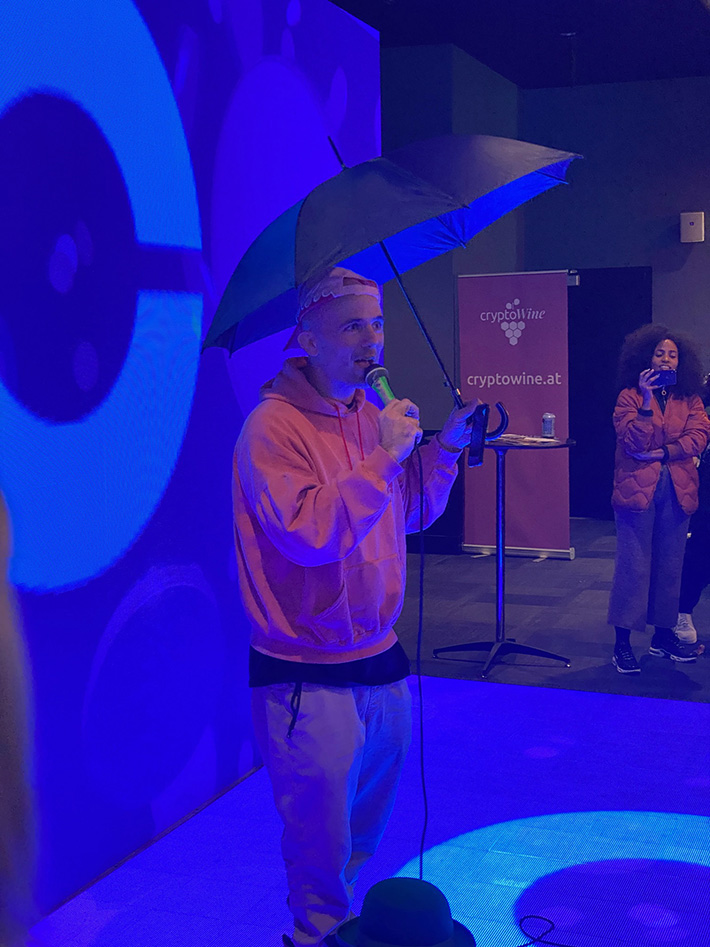 “That’s when I told Fat Joe, I said, my whole life is changing man, we should make this into an NFT.”
Even-Esh has had impressive bouts in the music industry prior to this event, which are what he hopes to build upon when he mints NFTs out of his experiences. His website mentions collaborations with rappers like Matisyahu and Rza, and even a tour with Wu Tang Clan. According to Spotify, Kosha Dillz has almost 16,000 monthly listeners on their platform.
Even-Esh has long taken interest in the crypto space, and talked extensively about what NFTs and blockchain technology mean to communities like his who are trying to make a name for themselves while also trying to pay their bills.
“With NFTs, you can mint a moment. There’s so much stuff that happens. That could be a whole series of NFTs, moments that weren’t documented that offend people, or moments of people [that are] in trouble, that could be a thing,” said Even-Esh.
“Moments where great rap music happened but no one ever saw— these could be NFTs.”
Even-Esh appears to be hoping to turn these his minted life experiences into a revenue stream. He claims that all of the places he has been to along with the people he has met create value for potential buyers. “I’m looking to mint more of my experiences because I think my experiences are gold. I have golden life experience.”
Whether it is the NFTs or his music that takes off, the exposure that the moment with Fat Joe gave Even-Esh has set his life on a new path.
He shared his advice to others after appearing to be inspired by the publicity he has received. “Someone told me there’s a million dollars out there for everybody. You have to seek it, go out, and find it.”
The timetable on the minting of his experiences is still undetermined, but that is only because of the amount of attention he has gotten, and the more opportunities that have come his way.
“I’ve been approached by a lot of record deals. Lawyers, agents, major companies, you know that’s what I’m trying to do, investors to take my thing to the next level and sell my story. My job is to tell my story.”
Winner of Broker NFT Made Unusual Request
November 4, 2021One winner of The Broker NFT Giveaway Raffle made an unusual request shortly after we aired his name.
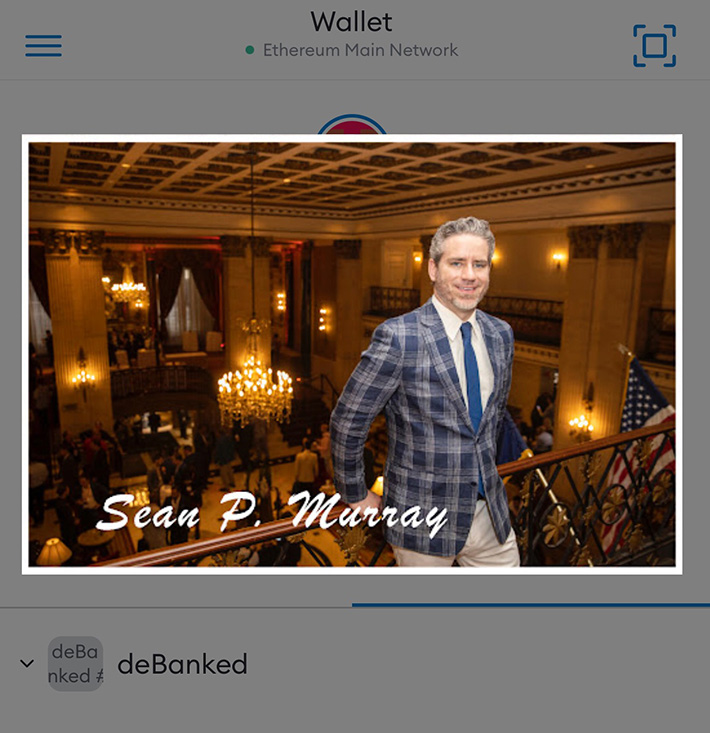 The prize was supposed to be one of the ten Broker NFTs, but Josh Feinberg, who is the CEO of Everlasting Capital, inquired about the private mints, which were not up for grabs, but had been displayed in some of our NFT livestreams.
He asked about token #3, which was, ironically, the NFT of myself that I had hand-autographed in photoshop and hand-minted via our own ethereum smart contract.
Upon discovering that his selection had not been made in jest, the decision was made to authorize the transfer of it to his ethereum wallet. Unusual (and flattering) as it was, I am honored that he wanted it.
Robinhood Posts Rough Q3
October 26, 2021 Robinhood revealed a steep $1.3B loss on Tuesday. Thought it was highly attributable to share-based compensation, several areas of their growth went into reverse. Transaction-based revenues, for example, were only $267M in Q3, a sharp drop from the $451M in Q2.
That’s not all. Assets Under Custody, Average Revenue Per User, and Monthly Active Users all shrank as well.
“This quarter was about developing more products and services for our customers, including crypto wallets,” said Vlad Tenev, CEO and Co-Founder of Robinhood Markets, in the company’s official statement. “More than one million people have joined our crypto wallets waitlist to date. With 24/7 live phone support, we believe that Robinhood is becoming the most trusted and intuitive platform for retail and crypto investors. And looking ahead, we’re committed to delivering tax-advantaged retirement accounts to help everyone invest for the long term.”
deBanked Presents: The Broker NFT Collection
October 26, 2021Watch out CryptoPunks, deBanked has minted a limited edition set of its own Broker NFTs.
Drawing from the animated style popular in the NFT community, this collection of ten “brokers” is a diverse light-hearted tribute to the professionals in the business finance industry. Each broker in the collection has been individually minted on the ethereum blockchain.
The artwork was drawn by Cindy Recile and the NFTs minted via deBanked’s own ethereum smart contract. (See here on etherscan.)
The other news is that we’ll be giving some of these away for free. (stay tuned for those details!)
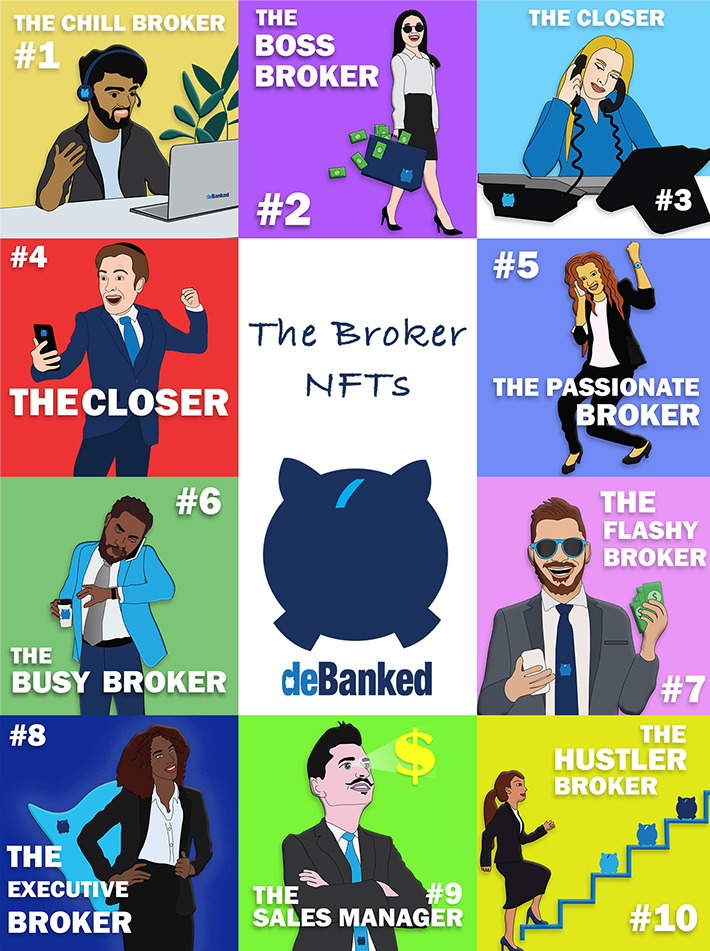
Today’s NFT market has things like pixelated punks and bored apes literally selling for millions of dollars.
A jpeg with no picture other than 4 words of text that say: “Fintech is Killing me,” is currently up for sale for more than $400, if that can be believed.
The act of minting an NFT cost Ethereum gas but if there is any particular thing you would like to see deBanked turn into an NFT, let us know and maybe we’ll make it happen! Email info@debanked.com.
Miami is Now Making Money Off of Its Own Crypto Coin
October 7, 2021 Francis Suarez, the crypto-crazed mayor of Miami that has attempted to make his city the next center of innovation in the industry, has recently generated more than $7.1M in funding for Miami’s government via MiamiCoin. Arriving in the form of a crypto “donation” to the city, it was all made possible by CityCoins, a nonprofit that allows users to mine coins that the company claims can help the wallets of both coin holders and the cities with whom they look to invest in.
According to CityCoins’ website, each time a city launches a new coin, users can mine coins themselves. They are an open-source network that allows developers to create smart contracts on top of the same layer used by Bitcoin, a feature normally reserved for blockchains like Ethereum or Cardano.
“Each time a new CityCoin such as MiamiCoin launches, 20+ unique wallets are needed to activate the token’s mining process,” the site reads. “Once this happens, a 150 block (~24 hour) countdown begins, signaling the start of the CityCoins’ mining process at the end of the countdown period. From there, anyone is eligible to participate in the CityCoins mining process within a given Stacks block and be rewarded for their contributions.”
The system creates a bidding process, sending Stack tokens to the chosen city’s smart contract for a specific block. The more Stack tokens that are sent to the contract, the more likely a user is to win rewards for that block. This creates a system where anyone can compete for the coins, as the process of mining a CityCoins product is completely free of any type of hardware.
Thirty percent of miners’ forwarded Stacks is directed into a crypto wallet for the respective city, and the remaining 70% can be used to earn Stacks or Bitcoin. Winners of the coins through CityCoins’ mining process, are chosen by a Verifiable Random Function (VRF) that takes into account the number of Stacks sent to specific contracts.
Anyone would be forgiven if the process and potential utility sounds convoluted. It becomes even more so after examining what exactly a “Stack token” is.
Stacks, a type of blockchain token originated into existence in 2019, were previously registered as securities with the SEC, a rarity in the crypto space. The company that issued them, however, has since changed course and has chosen to no longer register them. This was based upon the company’s own legal opinion, not the SEC’s.
Bottom line: However this CityCoins systems works and whatever the reasons why anyone would participate in it, it has somehow managed to yield more than $7 million for the city of Miami.
While everyone today likes to focus on the negative and want to create conflict and division…We made 1 million dollars on Miami Coin…TODAY…think about that! https://t.co/Ycbwre6Wss
— Mayor Francis Suarez (@FrancisSuarez) October 1, 2021
When speaking about the city’s involvement in becoming a fintech hub with The Floridian, Suarez credited timing to why his city is becoming the go-to spot for fintech businesses to flock. “We had an opportunity,” Suarez said. “You had cities across America, urban cities, pushing out innovators through taxation policies, sometimes elected officials saying “F” Elon Musk, or Amazon picks New York and they push them out.”
Suarez, a member of the Florida BlockChain Task Force, also credited his December 2020 viral tweet as a reason for tech’s attraction to Miami. Suarez answered a tweet with “how can I help?” after a user took to Twitter asking people if they believed Silicon Valley should move to Miami. “It was so counter-narrative to the way elected officials were dealing with technology and technologists,” he said, in reference to the Tweet.
According to Suarez, the city’s focus on crypto and fintech has made Miami a tech-trendsetter for other cities. Thanks to tech’s arrival, Miami is the first city to pursue paying workers in Bitcoin, the first to allow citizens to pay taxes in Bitcoin, and hitting huge numbers in the city’s job market. According to Suarez, the city added 8,000 jobs with an average annual salary of $120,000 in the past nine months.
“For the first time in [Miami’s] history, we are now creating high paying jobs,” Suarez said.
Fake Press Release Announced That SEC Had Dropped Case Against Ripple
October 1, 2021 XRP, the digital assets tied to Ripple, surged this morning from a price of $0.95 to $1.04 on the supposed announcement that the SEC had dropped its lawsuit against Ripple.
The news came via press release service Accesswire in the headline “SEC vs Ripple Legal Fight is Over.” Other news outlets immediately picked it up, including Yahoo, and it made its way to the top of Google’s search results.
The problem is that the entire press release was fake.
“Ripple, the leading provider of enterprise blockchain and cryptocurrency solutions for global payments, is pleased to announce that the SEC vs RIPPLE legal battle is finally over,” it began. “The lawsuit that lasted over ten months has finally been settled between the Securities and Exchange Commission (SEC) and the cryptocurrency company Ripple. The SEC has announced it would drop its charges.”
Accesswire deleted it as did Yahoo. deBanked obtained it via archive.org. Merely googling: ripple sec, however still shows the fake headline as the top result.
The public may not be fully aware that the news is false yet, if the price is any indication. It’s still trading at $1.04 as of the time this story is being written.
Two weeks ago, GlobeNewsWire fell victim to a similar scheme, when it distributed a fake announcement that Walmart would begin accepting Litecoin.
Small Business Finance Industry Mulls Crypto, NFTs
September 16, 2021 As the crypto craze roars on, NFTs are starting to stake a claim in the finance world as a legitimate option for those looking to invest or stash money in a virtual space. The sports world recently took their swing at NFTs, and here at deBanked we minted NFTs of our own early this week. It seems that NFTs have sparked the interest of the media, athletes, and art enthusiasts— but in small business finance, the conversation is only in the early stages.
“I think of it more not so much as a currency, but from what I’ve been reading, more of an investment vehicle,” said Noah Grayson, President of South End Capital, when asked what he thinks an NFT represents. “It’s a way for people to put tangible items in a digital format to get ownership from.”
Grayson says those in his industry have brought up the topic around the office, but it hasn’t made its way into any type of business practices yet. “It’s tough to see how [NFTs] would affect the lending industry at this time, cryptocurrency is something a little more probable in the long term.”
Grayson stressed how difficult small business lending can already be with dollars, and it seems as though the industry just isn’t ready to start conducting business in other types of currencies. “When you consider that many small business owners have no credit score and a large portion of those still pay for things in cash, I think it’s going to be a long time before the industry as a whole considers [crypto] an option to make loans with or compensate partners [with] as a whole,” he said.
“I’d describe it as a digital asset that can be purchased, owned, and used by an individual, giving that individual exclusive rights to the asset,” said James Webster, CEO and founder of ROK Financial when asked how he would define an NFT. “Like any other asset, the price can go up or down over time.”
Although his company has never created an NFT themselves, Webster won’t eliminate the possibility for one in the future. With the interest of the industry and his employees being focused around crypto as of late, Webster can’t keep the crypto and NFT talk out of the office.
 “We have a [clever] and nimble-minded staff at ROK. NFTs and crypto like other tradable assets are always being discussed and invested in here,” said Webster. “The team has been buying crypto for years now and I don’t see that slowing down any time soon.”
Webster believes it’ll inevitably make its way into the business with positive effects. “I see it streamlining, as well as making lending and banking for that matter more efficient over time,” he said.
At Velocity Capital Group, crypto has already seeped into the business. The company began offering commission payments to brokers this past August with an immediate positive reception. Velocity Capital Group CEO Jay Avigdor attributes “speed” as the primary use-case of crypto in his business.
“The feedback has been fantastic!” Avigdor said.
With crypto on the minds of fintech gurus everywhere, it’s evident its interest comes from the ability to put the technology in practice. Until these types of things can be borrowed, used to buy goods, or seen as a means of collateral at a mainstream level, the small business finance community will continue to eye their development and evolve if necessary.