
Business Lending
Greenbox Capital on Official Panel to Aid Section 1071’s Rollout
October 21, 2020 This week, Greenbox Capital, the Miami-based alternative finance company known for its MCA and SMB financing, announced they are serving as a Small Entity Representative (SER) to the Consumer Financial Protection Bureau (CFPB) as the organization proceeds with the rollout of Section 1071 of the Dodd-Frank Act.
“I am representing, and Greenbox Capital is essentially representing, the industry,” CEO Jordan Fein said. “There are some banks, there’s Funding Circle, but other than that, it’s Greenbox Capital serving in the industry.”
Fein, who founded Greenbox in 2012 and has since facilitated MCAs and business loans across America, Puerto Rico, and Canada, wrote in a press release that it was an honor to be selected to provide feedback on Section 1071.
“Over 2 million businesses across the U.S. are either women or minority-owned,” Fein wrote. “It is vital they can secure funding as easily as non-minority-owned businesses.”

Congress passed the Dodd-Frank Act in 2010 in response to the Great Recession. To further protect consumers, the CFPB was born. Section 1071, an amendment to the 1974 Equal Credit Opportunity Act, mandates financial institutions report demographic information to the CFPB. But much was left undefined about how to go about doing that and who would technically be subject to it.
Ultimately, the intent behind the law was to measure potential disparities among factors like the race and gender of applicants. Ten years later, the rollout is finally moving along.
As part of this, the CFPB created a board of firms representing the affected industry, on which Greenbox sits, to ensure the law works with the industry, not against it. The first panel was on October 15, in compliance with the 1996 Small Business Regulatory Enforcement Fairness Act (SBREFA.)
“They’re going through the SBREFA process, which is a structured process where they have a panel of industry representatives, and they share what they’re planning to do,” Fein said. “They run it by companies like us and we give our opinion and talk about how we think companies will be impacted.”
According to an invitation letter the firms received, they will have until November 9 to respond.
Fein said Greenbox would ensure any suggestions it made would positively impact the industry. Especially during a pandemic, Fein said it is essential to create regulation with firms in mind.
Steve Denis Talks About SBFA Study: APR is a Bad Metric For SMB Loan Transparency
October 19, 2020 In response to regulatory bills in California and New York that will enforce APR disclosures on small business capital providers, the Small Business Finance Association (SBFA) funded a study by Kingsley-Kleimann to find out if APR is a good metric to use for business loans.
Steve Denis, the Executive director of the SBFA, said his group supported the study because the states should test concepts with actual small business owners before passing regulation. In the NY disclosure bill awaiting signature, Denis said there was no concept testing. Some of the companies that support the bill might not have even read what it stipulates.
“You have a group of companies that are pushing these types of disclosures, for no reason other than their own self-interest,” Denis said. “We’re fine with disclosure, we are all for transparency, but it needs to be done in a way that we believe is meaningful to small business owners.”
In qualitative testing of 24 small business owners and executives who have experience taking commercial loans, the study concluded participants did not understand what APR was. The study found that the total cost of financing model was a better way to understand and compare options for their use.
“As one participant, when asked to define APR, answered: ‘I feel like you are asking a kid, why is the sky blue?’ (Participant 3, NY).” The study concluded, “In other words, [APR] is ever-present yet also inscrutable.”
Kingsley-Kleimann is a research-based organization that studies communication and disclosure for government agencies like the FTC and private or public business. Participants were selected from Califonia and NY.
Denis said that the findings show what SMB lending companies have already known- Anual Percentage Rate is not a useful metric for short term loans. Many do not know that APR represents the annualized cost of funds for the loan term, with the fees and additional costs included.
“People don’t know what APR is; it confuses them,” Denis said. “They know it’s a metric they should use, but they don’t know why. The APR is such a marketing tool now, it’s not a valuable tool.”
The study showed most respondents thought APR was the same as an interest rate. It’s not.
 Denis said using an annualized rate for shorter-term loans or SMB loans that have no ending date worsens the problems. In those cases, firms estimate an APR, and it is inaccurate.
“When you have a merchant cash advance, there’s no term,” Denis said. “So you have to estimate a term, and I mean that is just a recipe for fraud.”
Denis said that the firms supporting California SB1235 and the New York S 5470/A 10118-A disclosure bill and taking credit for writing the laws are the same companies that will suffer under the strict tolerance of an APR rule.
“The companies pushing this, the trade associations pushing it, they like to take credit for writing the bill in California and writing the bill in New York: I don’t even think they’ve read it,” Denis said. “It’s going to subject their own members to potentially millions if not hundreds of millions of dollars in potential liability [fines.]”
The SBFA is not against disclosure by any means, Denis said, but supported other avenues. The trade group believes knowing the total cost of a loan and the cost and timeline of payments will help protect and inform borrowers better than APR. Firms that support the disclosure bill are banking off the positive press, hoping to be seen as pro-consumer protections but forcing APR will make it harder to compare the actual value of loans, Denis said.
Denis is still optimistic that regulators will work with businesses affected by the incoming legislation. He said the NY legislature and governor’s office, as well as the California Department of Business Oversight, understand the problems of using APR.
“They’re receptive to these arguments, and they know what they’re doing,” Denis said. “The last thing they want to do is pass a bill that’s going to further confuse businesses, especially during a pandemic when businesses are relying on this capital to stay afloat.”
deBanked Meets The Kosher Guru
October 19, 2020In a crossover episode, deBanked president and chief editor Sean Murray had lunch with Kosher Guru at Reserve Cut in lower Manhattan. In it, they talked Kosher food, business funding, and more!
Keeping Up With Kabbage
October 17, 2020 On Friday, American Express announced that it had completed its acquisition of Kabbage.
“Kabbage, An American Express Company will continue to provide quick and easy cash flow management solutions for small businesses, now backed by the trust, service, and security of a American Express,” American Express wrote on social media. “We’re excited to welcome Kabbage’s talented colleagues to American Express. Together we will combine our over 60 years of experience backing small businesses with Kabbage’s innovative technology to support our customers through this challenging time, and help them get back on their feet and thrive.”
Meanwhile, below is a copy of a Q&A deBanked had with Kabbage co-founder Kathryn Petralia that appeared in our magazine’s July/August issue.
Q: How specifically do you think the pandemic will change the way SMEs bank?
 A: The pandemic will first change with whom they bank, and that choice will change the way they bank. For perspective, one hundred percent of Kabbage customers have a bank account, but very few of them can get a loan from their bank. We launched Kabbage Checking earlier this year to serve the smallest of businesses without sacrificing the features they expect and offering other products banks don’t. We’re focused on making cash flow tools accessible to the businesses traditionally underserved and overlooked, and the pandemic has been a catalyst for businesses to find new solutions.
Q: How might the dynamic of banking change after the crisis?
A: It was well-reported that businesses without an existing credit relationship with their bank were turned away from applying for PPP loans. We’ve heard directly from many of our PPP customers that this will compel them to change banks, and the demand for Kabbage Checking has reflected that sentiment since its launch. In the short term, businesses of all sizes and ages will seek out and sign up for new, tech-forward banking partners. In the long term, that shift will change customers’ expectations of what banks should offer. For example, prior to the PPP, Kabbage had issued well over a billion dollars to customers during non-banking hours. On-demand, 24/7 access to funding and cash flow insights, or faster settlements and money transfers will soon become commonplace, and large retail banks will need to adapt if they want to capture or reclaim these customers.
Q: How are these changes likely to impact alternative lenders and funders?
A: For starters, single-product lending companies will realize they must diversify their offerings in order to compete in the new financial-services marketplace. I would expect to see lenders launch new products to more resemble a bank. Conversely, traditional banks will need to begin adopting automated ways to serve customers with a tech-forward experience. Especially in the new normal where customers may be apprehensive about in-person banking meetings, they must adapt online to acquire and serve customers.
Q: What’s still needed to help Main Street recover?
A: The PPP was only the first phase; we’re not out of the woods yet. Businesses now need to restart and eventually grow. The crisis made business owners realize they need tighter controls over their cash flow, as many found themselves on the back foot and ill-equipped to withstand a long-term crisis such as the one through which we are all muddling.
They’ll need cash-flow tools to be more prudent and appropriately plan for similar events. Having said that, it’s not only on the shoulders of small businesses or tech solutions. They need customer demand, and local economies need to begin to reopen safely so consumers feel comfortable returning to normal commerce. That will take the support of cities and states encouraging consumers to shop local so small businesses have greater incentive to recall their employees and get back to work.
Q: How can alternative lenders and funders best play a role in this recovery?
A: Much of what we’re already doing is exactly what our economy needs. For the most part, fintech companies serve the customers banks won’t or can’t. That reality is unfortunately unchanged today. That’s why during the pandemic Kabbage made every effort possible to provide products that helped SMBs through this crisis. With respect to PPP, we helped nearly 300,000 small businesses access over $7 billion, helping preserve an estimated 945,000 jobs. Our payments product saw a near 4X spike in adoption as businesses sought contactless payment options. We built www.helpsmallbsuiness.com in three days to allow any small business to generate needed revenue by selling online gift certificates. We also launched Kabbage Checking, giving small businesses a new banking option, and Kabbage Insights remains available and free to access for any small business.
Q: What changes do you expect to see in the alternative lending and funding industry as a result of the pandemic?
A: Everyone will expand their services. Whether it’s larger companies expanding their solutions through acquisitions, or start-ups investing beyond their primary product, everyone will aim to enhance their offerings to give customers more data-driven products that help them rebuild.
Q: Kabbage just agreed to be purchased by American Express. Should we expect to see more consolidation in the alternative lending/funding space? If so, over what time frame and why do you expect this to happen?
A: I would not be surprised if we saw more deals announced before the end of the year.
Q: Tell us a little about why Kabbage decided to sell and why the timing was right?
A: For us, it has always been about finding the right company with the right mission and intentions. We just happened to be in the middle of a crisis when the conversations started, despite having the financial capacity to support operations for multiple years. American Express shares our vision to be an essential partner to small businesses, and we couldn’t be more excited at the opportunity to continue the important work of providing solutions and innovative capabilities that address a range of small business cash flow needs alongside AmEx.
DailyFunder Still #1 Small Business Finance Community
October 14, 2020 DailyFunder, the small business finance forum founded by Sean Murray in 2012, continues to be the leading online community for the industry, according to a recent announcement. The forum recently surpassed 10,000 registered members, in addition to logging more than 2 million page views just in 2020 so far.
“The forum has attracted well over a million visitors since inception and users have historically spent longer than 10 minutes on the site in any given session on average,” Murray said.
deBanked’s parent company fully acquired DailyFunder earlier this year. The announcement was featured prominently in deBanked’s January/February 2020 magazine issue. In it, Murray renewed the website’s objective:
“The mission will be to create a great forum for those involved in day-to-day dealmaking,” he said in a Q&A. “How can we provide a platform that enables those in the industry to make more money? That’s the way I look at it. I think if we can provide that type of value, success will follow.”
Square, Stripe, Intuit, Shopify, Talked SMB Lending at LendIt Fintech 2020
October 8, 2020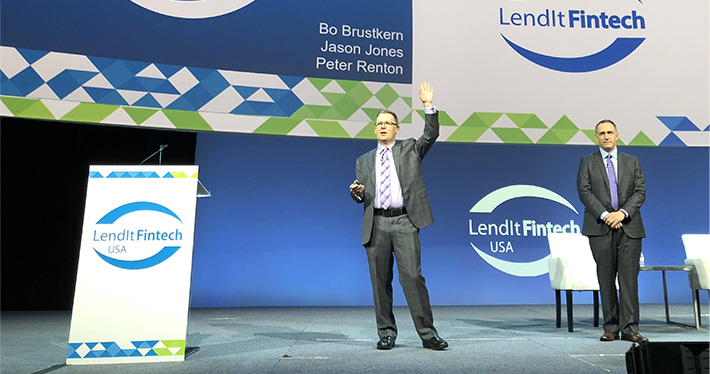 The LendIt Fintech digital conference last week was a sign of the times. This year, millions of average businesses and consumers have had to go virtual: they had no choice. 2020 has been a year of struggle and survival, and a time of great fintech adoption.
Some firms have been more successful than others. Going full digital, LendIt introduced virtual networking at the conference- the first day alone saw 2,171 meetings. Zoom meetings and virtual greetings took the place of handshakes and elevator pitches that would regularly accompany the convention.
On day three, LendIt hosted a panel of SMB lending leaders from Stripe, Shopify, Square, and Quickbooks Capital. Bryan Lee, Senior Director of Financial Services for Salesforce, served as moderator and he focused the discussion on “How the leading fintech brands are adapting.”
THE PIVOT
Lee began the talk by asking Eddie Serrill, Business Lead from Stripe Capital, about how the industry has pivoted.
Serrill talked about how Stripe was powering online interactions and saw an influx of traditionally offline businesses switching over to their platforms. Stripe also saw an increased demand for online purchases and payment.
“We’ve been trying to find that right balance between supporting users that have been doing incredibly well,” Serrill said. “While trying to support our users who are seeing a bit of a setback.”
Stripe introduced a lending product in September of last year and now SMBs can borrow from Stripe and pay back by diverting a percentage of their sales, much like the other panelists’ companies offer.
Jessica Jiang, Head of Capital Markets at Square Capital, talked about how her firm adjusted. Square reacted to fill the niche of their underserved customers by introducing a main street lending fund, serving industries hard hit by the pandemic, Jiang said. Small buinesess that relied on in-person action like coffee shops and retail community businesses were given preferential lending options.
Product Lead at Shopify, Richard Shaw, said that this year his firm learned to be prepared for anything. Everything that Shopify was potentially going to do or planning on implementing in the coming years suddenly became a here-and-now necessity.
“We tore up our existing plans,” Shaw said. “It was like the commerce world of 2030 turned up in 2020. You need to do ten years of work, but you need to do it today.”
Shopify, the Canadian e-commerce giant has doubled in value this year. The firm launched Shopify Capital in the US and Canada in 2016 and has originated $1.2 billion in funding to small businesses since that time.
Luke Voiles, the VP of Intuits QuickBooks Capital, talked about how his team handled pandemic conservatively.
“Five years of digital shift has happened instantaneously due to COVID,” Voiles said. “Intuit is pretty recession-resistant in the sense that you have to do taxes, you have to do your accounting, and the shift to digital helps a lot.”
Business lending was different, Voiles said, as soon as his team saw COVID coming, they battened down the hatches, slowed lending, and pivoted to facilitating PPP.
PPP
Voiles said the craziest thing he has seen in his career was what Quickbooks did to deploy PPP aid.
Within about two weeks, almost 500 people from across Intuit came together to shift all the data they carried on customers to aid applications.
“We were uniquely positioned to help solve and deploy that capital,” Voiles said. “We have a payroll business where 1.4 billion business use us, we have a tax business where we have Schedule C tax filings, and we have a lending business. We were able to pivot and put the pieces together quickly.”
QuickBooks Capital deployed $1.2 billion to 31,000 business in a process that Voiles said was 90% automated. Now customers are awaiting other rounds of government aid.
Square’s Jiang said the initial shutdown weeks in March and April saw hundreds of Square team members working on PPP facilitation through the night and weekends. As the funds dried up those first two weeks, it was clear to Jiang the program was favoring larger firms and higher loan amounts, leaving out small businesses.
“That’s typical of investment bankers, but not very typical of tech,” Jiang said. “PPP is a perfect example of how small businesses are continuing to be underserved by banks.”
THE SHAKEOUT AND THE FUTURE
2020 has been a major shock to the lending marketplace. Voiles from Quickbooks said the amount of work it took to make it through the first wave was a significant shakeout.
“You’ve seen what’s happening with Kabbage and OnDeck and other transactions with people getting sold; there is a shakeout happening in the space,” Voiles said. “The bigger players will make it through and will continue to help small businesses get access to capital that they need.”
When asked about the future roadmap of QuickBooks Capital, Voiles said it wasn’t just about automating banking. Using Intuit’s resources to build an automated system is only half of the picture- the firm believes in an expert-driven platform. After the automated process, customers will be able to talk to an expert to review the data, and “check their work.” Voiles said Quickbooks wants to offer a service that is equivalent to the replacement of a CFO.
“These small businesses that have less than ten employees, they can’t afford to hire a pro,” Voiles said. “They need automated support to show them the dashboard and picture of what their business is.”
Pointing to Stripe’s online infrastructure, Serrill exemplified what successful lenders will offer next year: a platform that combines many needs of SMBs in one place.
“I think it’s really about linking all of this data, making it super intuitive and anticipating the need for their users, so they don’t need a team of business school grads to manage their finances,” Serrill said. “So they can get back to building the core of their business, not figuring out whether they have enough cash flow tomorrow.”
Jiang said the future of small business would be written in data, contactless payments, and digital banking. She sees consolidation in the Fintech space and has a positive outlook on bank-fintech partnerships.
The FDIC granted Square a conditional approval for the issuance of an Industrial Loan Company ILC in March this year. Jiang outlined plans on launching an online SMB lending and banking service next year called Square Financial Services if the conditional charter remains in place.
For Shopify’s future, Shaw was excited to look forward to the launching of Shopify balance- a cash flow management system, and Shopify installment payments. He reiterated that the success of Shopify’s lending division was due in part because making loans was not the entire business.
“Shopify Capital is one piece of a wider ecosystem,” Shaw said. “All these things together are more powerful than individual parts.”
Kapitus CEO Speaks on Success of Rating Reaffirmation
October 6, 2020 When lending companies faced the tightest squeeze on capital since the great recession, many ran into trouble. Kapitus, having survived 08′, met 20′ with the same discipline that helped them navigate the pandemic.
“Our whole industry was put on a credit watch downgrade, and it’s very exciting that we were upgraded, reaffirmed to the original rating,” Kapitus CEO and founder Andy Reiser said. “Most of the companies, our peers defaulted and went into what’s called rapid amortization and did not make it through to keep their securitization.”
Reiser was happy to report that Kapitus received a rating affirmation from Kroll Bond Rating Agency (KBRA) on Friday. KBRA has removed the Kapitus securities from a Watch Downgrade.
Back in March, the businesses that Kapitus and their competitors funded across the country, faced state mandated shutdowns. Many customers were suddenly unable to make the loan, MCA, or equipment payments that they had been able to make for years.
For lenders that bundled and securitized the loans they made, the value of those loans was called into question.
On March 30, KBRA placed the ratings of 29 securitizations representing $2.1 billion from 10 SMB lending firms on a “Watch Downgrade” due to the economic downturn.
To overcome the warning, Kapitus reigned in and focused on helping their customers. Reiser cited the addition of Jeff Newman from Citigroup to manage the risk team as an example of how the firm has been focused on funding responsibly for years.
“We focused on strong business practices and keeping the portfolio strong, and it paid off,” Reiser said. “We never stopped, we were not lending at the same velocity that we did pre COVID, but we never had a day that we didn’t fund a new deal.”
Reiser said that during the pandemic’s height, the team took a lot of long nights working on new products. One was a “step renewal” that allowed clients to pay installments and build up to the full payment, to make sure they were not overwhelmed. Kapitus also offered extended periods for their healthcare loans, up to 36 months, Reiser said.
For companies like Kapitus, a questionable rating could lead to a rapid amortization event: a sudden call to liquefy the bonds and give back investor money. For some, an event like this will spell the end: most firms don’t keep hundreds of millions or even billions on hand to give back principals in a moment’s notice.
Reiser said out of the ten securities on credit watch, only one other was reaffirmed, due to a renegotiation of terms that bond investors had to agree on. Kapitus made no negation but was reaffirmed due to the success of their business practice, Reiser said.
The securitization was initially issued for $105 million in June 2018, and expanded to $160 million last December, in three classes with a senior class rating of “A.”
Reiser believes that the pandemic, like the ’08 recessions, will see some consolidation and strong companies prospering in a displaced environment.
“I think COVID will teach a lot of other players that were very aggressive in coming down to this market that it’s not so easy,” Reiser said. “I think some of the banks and the alternative lenders that were more eager to come into this market may not be so aggressive at least for a while.”
Capify CEO David Goldin on New $10 Million Equity Round
September 30, 2020 Capify, a leading international small business lending platform, announced a $10 million equity round this week from a new investment group with vast experience in the alternative lending industry.
“[investors were] diligent seeing Capify, the management team, and the opportunity,” Goldin said. “They thought it was a very good investment, particularly how Capify’s portfolio performed during the pandemic.”
Goldin said the capital is a great “restart of the engine” after the cautious approach the company took to lending at the height of the pandemic. The money is not an equity round from current investors, but rather new capital joining the team.
The funding will be directed toward ramping lending back up and extending business partnerships with firms that serve small businesses, as well as direct and indirect lenders.
“So, hindsight is actually better than 2020 vision; no one in our lifetime has experienced the pandemic,” Goldin said. “No one knew what to expect from a risk profile, so we took the conservative approach.”
That approach was to shut down new loans and focus on servicing its current customers. It was a difficult time for the alternative lending industry veteran, but now Goldin said he sees a great demand for capital.
“This was one of the toughest challenges that I’ve experienced ever as an entrepreneur,” Goldin said. “The result really speaks to Capify as a company. People are willing to make that investment, believing in opportunity ahead and not the current times or the past during the pandemic.”
Goldin said that Capify has always been known for its well-performing portfolio, one of the reasons that in 2019 the firm received a $95 million credit facility from Goldman Sachs’ Merchant Banking Division.
Goldin began working in the fintech industry before the word fintech was even coined; in the early 2000s, he started one of the first MCA companies. Amerimerchant started selling loans and MCAs internationally in the UK and Australia in 2008, then rebranded to Capify in 2015. After leaving the US market in 2017 gained Goldman’s attention last year.
“So now that we have the firepower, we believe there’ll be opportunities in these markets as demand picks up for small business lending,” Goldin said.