Business Lending
Failing Main Street NY
December 21, 2020 During the election, we heard candidates on both sides to toss around the phrase “small businesses are the backbone of the American economy.” A staple of exhausted political rhetoric, made trite despite its truth because for many politicians it’s a talking point, not a platform. We must move from rhetoric to action. To do so, America’s political leaders need a real understanding of what small businesses need—and what they don’t.
The struggle between understanding and posturing is on display right now in Albany. While small business owners struggle to open their doors, the legislature passed a so-called “truth in lending for small business” bill that claims to provide more disclosure to business owners seeking financing. Led by Senator Kevin Thomas and Assemblyman Ken Zebrowski the bill is currently pending before Governor Cuomo. The legislators recently authored an op-ed that further demonstrates their failure to recognize that the innocuously named bill is rife with faults and lacks a competent grasp of small business issues. The critical blind spots in the bill’s design threatens billions of dollars in capital leaving New York—a failing small businesses owners can scarcely afford at such a difficult time.
Yet, rather than incentivizing finance providers to stay in New York, the legislature is focused on complex disclosures that lack real meaning or understanding to small business owners. Senator Thomas opined on the Senate floor “… the reason I introduced this bill is because people don’t use standard terminology.” Interestingly, this bill creates several new terms and metrics that would be required to be disclosed that have never been used before in finance. Terms like “double-dipping” and new confusing metrics that even the CFPB under President Obama labeled as “confusing and misleading” to consumers. This bill’s fatal flaw is that it has confused information volume with transparency, somethings a recent study proved would harm small business owners.
Even Senator Thomas acknowledged the legislation’s myriad of problems while still encouraging its passage. In his colloquy with Senator George Borrello on the Senate floor, right before he called New York small business owners “unsophisticated,” he mentioned how his bill had “many issues” that he “hoped” would be worked out before implementation. Hope is not a strategy and it won’t help small business owners obtain the financing they need to stay in businesses. Advancing legislation that would limit options for entrepreneurs working to stay in businesses during a pandemic that has crippled the New York economy represents a reprehensible failure of leadership.
Minority-owned businesses have faced a disproportionate economic impact from the pandemic. According to the Fed, Black-owned businesses have declined by 41% since February, compared to only 17% of white owned businesses. Further, the Paycheck Protection Program (PPP), the federal government’s signature relief program for small businesses, has left significant coverage gaps: these loans reached only 20% of eligible firms in states with the highest densities of minority-owned firms, and in counties with the densest minority-owned business activity, coverage rates were typically lower than 20%. Specific to New York, only 7% of firms in the Bronx and 11% in Queens received PPP loans. Moreover, less than 10% of minority-owned businesses have a traditional banking relationship—something that was initially required to have access to the PPP.
The lack of cogency and lazy approach to this legislation is a disservice to the hard-working entrepreneurs who continue to open their businesses while facing daily economic uncertainty. Governor Cuomo has worked tirelessly to continue to provide economic relief to both businesses and consumers—removing billions in financing for small businesses will only hinder this effort. New York can do better.
Steve Denis
Executive Director
Small Business Finance Association
Aspiria Co-Founder On Successful Funding in Mexican SME Space: Still Lots of Room to Grow
December 5, 2020 After 38 years, Guillermo Hernandez has seen the boom and busts of the Mexican financial markets, weathering seven recessions in all, he said. But until 2020, he had never led a company through a pandemic.
Aspria, Hernandez’s online lending firm, had planned on completing a Series A from international investor Oikocredit, but the deal went into the icebox as the cases came.
“In the beginning of the year, things were doing very well in Mexico, the whole economy was booming,” Hernandez said. “Out of nowhere, we got hit by the pandemic. And the transaction that we were supposed to be closing in March 2020, our investor said, ‘you guys are fantastic, but there are too many unknowns.'”
But due to Aspiria’s resilience and the fact that they went into 2020 with a rock-solid business, Hernandez said Oikocredit decided to complete the investment deal. Aspiria was growing and profitable, and though it was unclear if the markets were going to fall apart, Hernandez said he and his team put the nose to the grindstone and worked through it.
Oikocredit is a worldwide cooperative that provides loans and investments to promote financial inclusion while empowering people by improving livelihoods. That vision is what Aspiria aims to accomplish as an SME lender, Hernandez said, helping businesses access funds to grow.
The Mexican financial space has ample room for growth, and Hernandez said Aspiria is one of the first alternative business lending firms to capture the market.
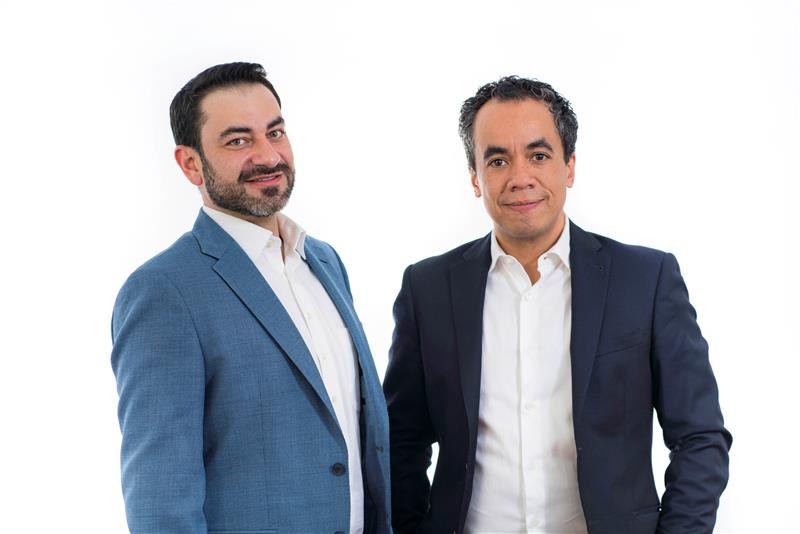 Hernandez said the banking world in Mexico is twenty years or more behind the US, and he founded Aspiria to bring some change to the financing space.
“The whole financial services industry, I mean it’s light-years behind the US,” Hernandez said. “I saw that the way that people would do the underwriting, the way that people provided financing for small businesses was just so outdated; it was more of an old school market here. I decided there was this huge opportunity for the market.”
For example, Mexico has a third of the US population, but only 30 banks to the 7,000-10,000 the US has. That population is also a younger demographic than up north. In Mexico, the average age is 27 (It’s 38 in the US); Hernandez said: the Average Mexican is trying to establish themselves and reach the middle class, young, educated, and ready to start a business.
 Hernandez has been working in finance all his life, starting in Mexico as a banker and consultant for new financial companies before leaving to get his MBA on an HSBC scholarship in Manchester, England. He worked for a time in financial services there before joining a payment startup in the US, where he found his love of startup tech culture.
“It was my first exposure to technology, and I was completely amazed. I fell in love with it,” Hernandez said. “At that moment, I was actually thinking about changing careers. I was completely fed up with financial services because it’s boring sometimes. I thought it was not sexy anymore.”
Co-founding Aspiria, Hernandez went on to become the major funder in the space. He said there is so much demand for capital in a standard year that his firm can see 100% year-over-year growth. Even in a pandemic, his firm received a confident investment that will go directly toward building the shop, scaling up funding, hiring, and aiming toward a firm that will one day put it on par with the rest of North America’s leading alternative finance firms.
Why The PPP and EIDL Data Got Dumped
December 3, 2020 The SBA’s time has run out: on Tuesday night, the organization released the loan data for all Paycheck Protection Program (PPP) recipients. The name, address, and how much each recipient received was posted in a series of excel spreadsheets in compliance with a D.C. District Court order, decided November 24.
The results do not inspire confidence. Despite knowing this data would be scrutinized by the public, records show that nearly $10 million went to businesses for which the business name field was not entered correctly. Some of these were blank while others contained phone numbers or random dates.
Is it fraud? Maybe, maybe not. It certainly suggests, however, that the official books on $525 billion in individual PPP loans aren’t exactly up to snuff.
The legal struggle to release the data began with filing a Freedom of Information Act (FOIA) in May by a coalition of news companies, including the New York Times, representatives for the Wall Street Journal, ProPublica, and 11 other newsrooms. They hoped to uncover where billions of CARES Act loans went but received privacy concern pushback from the SBA.
In June, the SBA released limited info on the top bracket of loans, from $150,000 upward. United States District Court Judge James Boasberg ruled that there was no reason not to release the information after the SBA refused to open the files up on the bottom 4 million loans at the beginning of November. The SBA pushed for a stay of the order, which was shot down by Boasberg, and finally, the SBA released the data.
As of early November, the agency had processed and approved more than 5.2 million individual PPP loans, along with an additional $192 billion in EIDL loans. PPP funds had the unique distinction of being forgivable so long as they were used for expenses like payroll.
A PPP & EIDL search tool is available on the Small Business Forum where anyone can query the released data.
EIDL Loans Searchable
December 3, 2020The Small Business Forum has added additional functionality to its PPP loan querying tool. The tool now enables users to query every single EIDL borrower as well.
SBA Dumps Detailed Data on Every Single PPP Borrower
December 2, 2020 The SBA has dumped all of it.
A court order recently forced the SBA to reveal precise details of every single PPP and EIDL borrower regardless of loan size and regardless of privacy concerns.
The SBA dumped all the data late on Tuesday night through a series of downloadable .csv files.
However, small-business-forum.net has made a web-friendly search tool for the PPP loans (not the EIDL), which contains 5 million records. The loan amounts are precise. This latest cache of data is different from the previous reveal in that the loan amounts are exact. There is no approximating here.
The mass disclosure was viewed as controversial because PPP loan amounts were directly correlated with monthly payroll figures so one could potentially deduce the salary of a self-employed business owner with no employees by knowing just their PPP loan amount.
In any case, all of the data has been made public. The easiest way to search the database is at https://www.small-business-forum.net/pppchecker.php
Fed Lowers Minimum Main Street Lending Program Loan to $100,000: Too Little, Too Late?
November 8, 2020 “$100,000, we can make that work,” said Ryan Metcalf, head of Public Policy Affairs at Funding Circle. “But we can help a lot more small business if it was $50,000.”
Metcalf was referring to a recent change in the minimum loan amount in the Main Street Lending Program (MSLP.) Just recently, the Federal Reserve lowered the minimum loan amount for the MSLP for a third time, to $100,000. The change was intended to broaden the underused Cares Act aid facility but it might not be enough.
Though changing the program days before, at a press briefing Thursday Fed chair Jerome Powell said SMB aid projects like PPP and the MSLP were up to the gridlocked House and Senate.
“The Fed cannot grant money to particular beneficiaries; we can only create programs or facilities to make loans that will be repaid,” Powell said. “Elected officials have the power to tax and spend, and to make decisions about where we as the society should direct our collective resources.”
Despite Powell’s talk of inaction in the face of an undecided congress, Metcalf said the Fed’s actions have proved that changes can be made to existing programs. Metcalf has been fighting for changes to MSLP for months on behalf of the small business lending community, he says.
In July, Metcalf, in partnership with the Innovative Lending Platform Association and Marketplace Lending Association, wrote a letter to the fed to argue for changes to the MSLP.
The letter argued that the Cares Act made non-depository finech lenders eligible to participate in PPP lending. Though these lenders saved millions of jobs, they were not allowed to lend through the MSLP facility.
Even if they could, the minimum loan size was still too large for “main street” American businesses that needed capital. The letter advocated for a lower minimum of $50,000, allow lenders that were approved for PPP to lend in the MSLP, and create a Special Purpose Vehicle for fintechs.
Metcalf said the Fed has only responded, “that is not under consideration.”
So far, 400 borrowers have taken out $3.7 billion in loans, of the $600 billion allocated. The program offers Fed backed five-year loans with differed principal and interest payments and minimal rates. With the facility’s deadline approaching Dec 31 and no changes in sight, Metcalf said the program’s vultures are circling.
If new aid, revisions, or at least an extension is not passed by when the government is funded Dec 11, Metcalf said the program might be finished.
Back in September, Powell testified before Congress that lowering the minimum any further wouldn’t change the adoption rate.
“We have very little demand below a million, as I told the chair a while back,” Powell said. “We’re not seeing demand for very small loans. And that’s really because the nature of the facility and the things you’ve got to do to qualify, it tends to be larger sized businesses.”
Mnuchin has consistently argued that grant programs like PPP would most benefit smaller firms. Metcalf said this was only the case because the MSLP facility has left out smaller firms and alternative lenders that need the capital.
“My response to that was no, there’s been no uptick in your program because the requirements of the program are not attractive enough to make it workable,” Metcalf said. “Don’t scrap the entire program altogether; look at the proposal that we sent you back in July and work with us on amending the facility.”
Square Capital Lends $155M to Small Businesses in Q3
November 6, 2020Square Capital loaned $155M in Q3, according to the company’s latest earnings report.
“We paused new flex loan offers until the end of July and, upon resuming offers, we were measured in ramping origination volumes in August and September,” the company said. The $155M originated was spread out across 35,000 loans.
The figure puts them slightly ahead of OnDeck ($148M) for the quarter but well below Shopify Capital ($252M)
2020 YEAR TO DATE:
| Company | Q1 2020 | Q2 | Q3 | YTD TOTAL |
| PayPal | $1.3B | |||
| OnDeck | $592M | $66M | $144M | $806M |
| Square Capital | $548M | $0 | $155M | $703M |
| Shopify Capital | $162.4M | $153M | $252.1M | $567.5M |
Pearl Capital is BACK
November 5, 2020 Pearl Capital was among the many small business finance companies that hit the pause button in 2020.
Now it’s BACK.
The company announced today that it was resuming funding MCAs after a long stretch of facilitating PPP loans, of which it processed more than $1.75B through a partnership it had with Cross River Bank.
“Pearl did not default on its senior credit line due to its superior underwriting and has added $250 Million in committed financing to expand its activities,” said company CEO Sol Lax. “If you are a small business and you have survived COVID, you shouldn’t have to shut your doors because you have limited access to capital. We are going to be there for small business both in further iterations of PPP as well as MCA.”
Pearl expects to resume at full speed rather than with limited capacity and highly restricted guidelines. According to the announcement, “Pearl’s ISO Partners can expect lighter stipulation requirements with fewer requested documentation than before and updated pricing. Virtually all business types are eligible for funding from Pearl including high risk industries like auto sales, real estate, home-based businesses, and insurance.
[…]
“We’re thrilled to have the ability again to continue to provide financing for companies during an especially difficult time for businesses across the country and give much needed financial support to businesses,” Lax said.