
Sean Murray is the President and Chief Editor of deBanked and the founder of the Broker Fair Conference. Connect with me on LinkedIn or follow me on twitter. You can view all future deBanked events here.
Articles by Sean Murray

Google Culls Online Lenders – Pay or Else?
March 15, 2016Can you become one of the biggest or most successful online lenders without Google? A search layout update may be inadvertently culling the herd.
In late February, Google eliminated ads from the right side of the page while adding another layer to the top and bottom. When factoring in features like site links, the effects on organic search has been devastating. Non-paid links are now entirely below the fold for many commercial keywords, which means users may limit their selections entirely to ads. Here’s an example of a full screen browser window on a Macbook Air when searching for Business Loans:

Brad Geddes, a Google Adwords marketing author, expert and consultant, has said the Click-through rate (CTR) on this new 4th ad placement is skyrocketing. “Depending on the keyword, position 4 is going to have a 400%-1000% CTR increase,” he said on Webmaster world. And while side links and bottom links were never a huge factor anyway (less than 15% of click-throughs), Geddes believes a consequence of this change is that fewer ad slots means higher cost bids to rank on the 1st page. “Companies with thin margins are going to have a lot of words fall to page 2,” he wrote.
In summary: Fewer ad placements, higher costs per click, decreased likelihood of organic click-throughs.
And the online lending industry is already feeling the burn. Several funders and ISOs on the commercial side have told deBanked in confidence that the online lead gen battle has been lost or that they have been temporarily sidelined by the increase in costs. At least one funder is refocusing their efforts entirely on the ISO channel after a horrible experience with Pay-Per-Click.
 And it’s not just the costs, it’s the quality of leads, they say. The searchers clicking their expensive ads and running up their bills sometimes literally meet none of the qualifications their ads stipulate. Yet many searchers click anyway, rendering the ads’ carefully scripted messages moot. One study might explain why that is. In it, users spent around .764 seconds considering the first paid search result and a total of only 4.5 seconds scanning the first five results. That’s not a whole lot of time to read each ad, digest them and consider whether or not there’s an appropriate fit.
On one industry forum, ISOs have reported that the cost of acquiring a merchant cash advance or business loan deal from Pay-Per-Click is ranging from $700 to $1,200. “PPC for premium keywords as high as $40 at times. Ugly. Real ugly,” one user wrote. Another user wrote, “It’s not just Adwords that is saturated. The whole market is saturated. Lenders and the onslaught of new brokers are making it tough. Lenders with programs like Funding Circle and Kabbage, and with all the advertising money in the world to burn and get direct traffic.” And still another believes that online ads are simply inviting the lowest hanging fruit. “Internet leads have the highest level of fraud,” said one sales manager.
Notably, many of the top 8 funders are only competing for a limited number of competitive keywords or may not even be running Adwords at all. PayPal and Square for example, focus only on their existing payment processing customers despite being “online lenders.”
It’s too early to tell what effects Google’s ad changes will have on the online lending industry, though a couple of companies who were paying just enough to extract clicks from side ads have indicated the change is for the worse and they have suspended their campaigns.
The natural alternative to paid search, organic search, is seldom discussed anymore as a realistic strategy these days, in part because the rankings might be rigged anyway.
One irony that’s pervasive in the online lending industry is that borrowers are being targeted offline where it’s potentially more affordable. In a discussion thread that garnered 76 posts last fall, ISOs and funders suggested that direct mail, referrals, UCCs, cold calling, radio and even going out and shaking hands, were pegged as “what’s next” for marketing. Pay-Per-Click was only mentioned once and only in the context of it being something that had long ago been made too expensive for small and mid-size companies.
The cost of making these things work might be why so many funders are hoping that brokers can figure it out. “We decided that the best way to grow is to build relationships to avoid the overhead, compliance, training and manpower that a sales team would require,” said Nulook Capital’s Jordan Feinstein in an interview with deBanked last month.
With Google becoming even more competitive now though, perhaps United Capital Source’s Jared Weitz summed it up best. “Marketing is getting more expensive and only the ones who can afford to pay can play,” Weitz said.
The Top 8 Small Business Funders
March 13, 2016Whether they do loans or merchant cash advances, here are the top 8 alternative small business funders:
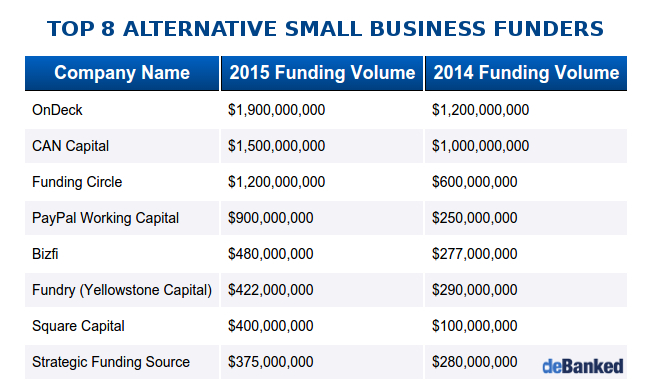
This list originally appeared in a story about Square’s Q4 Earnings and has been republished individually here in case anyone missed it. The figures were either disclosed to deBanked directly or are a best estimate based on publicly available materials. This list is not comprehensive and in instances where no reliable data could be obtained, the company was just omitted. A larger list will appear in deBanked’s March/April Magazine issue so make sure you subscribe if you haven’t already.
Bank Strikes Back Against Online Lenders – Offers 5 Minute Business Loans
March 12, 2016Online lenders have new competition, a 198-year-old bank based in Boston, Eastern Bank. Worried that technology would leave them in the dust, Eastern has invested millions in an application and underwriting system that can fund merchants up to $100,000 in 5 minutes. “The 55 requests for information on the old form have been replaced by eight,” according to the WSJ.
Rates range from 6.99% to 9.99% and it’s only available to existing customers. However a new customer only need open a checking account to become immediately eligible for it. One out of the 36 original borrowers on this program has already become delinquent on their loan, a statistic mostly within their expectations, the WSJ reports.
Eastern makes no mention of their speedy capabilities on their website, which still has the old paper application available for download.
Notably, former NFL player Doug Flutie, Eastern Bank’s spokesman for over 10 years, is scheduled to appear on the upcoming season of Dancing With the Stars.
“Me, Too” Lenders Something to Worry About, Says Former OnDeck Investor
March 11, 2016 Lending Club, SoFi and OnDeck will endure, wrote Matt Harris, a former OnDeck board member and investor, and current Managing Director for Bain Capital Ventures. In a blog post that approached 4,000 words, Harris admits that he has not invested in a single lender since OnDeck.
“It is still possible, though I believe increasingly unlikely, that marketplace lending will be a durable innovation,” he wrote. He bases that on the assumption that origination platforms with no skin in the game are not sustainable over the long term and that what really made companies like Lending Club special is that it has “scale, a brand in the capital markets for producing high quality assets, and an unbelievable management team.”
All of the other perceived advantages don’t make sense, he argues. The average cost of funds for a bank “is 0.06%, assuming they fund their loans using deposits. OnDeck’s funding costs for its assets averages 5.3%. Lending Club has paid a median return to its asset purchasers of 7.4%.” Banks have lower operating costs as well. “I’ll point out that most of the bank expenses they highlight are fixed expenses like branches and compliance, which makes that expense burden irrelevant to the profitability of the marginal loan,” he wrote.
Even on technology, Harris says banks spend less, and on big data credit scoring, he says a lot of the factors marketplace lenders might find useful in predicting performance cannot be used legally because they end up correlating with a protected class such as race, whether it’s directly or indirectly.
“Things are going to get harder before they get easier,” Harris wrote, though he thinks companies like OnDeck and Lending Club are positioned to last. Everyone else who copied their model is in shaky territory. And yet through it all, he is optimistic. “For the first time in a decade, I’m feeling like it’s a great time to be starting a lending company,” he said.
Square’s Merchant Cash Advance Program Now Among Biggest in the World
March 10, 2016Square originated more than $400 million worth of merchant cash advances advances in 2015, according to their Q4 earnings report. Their average deal size was just shy of $6,000. The result is a 300% increase year-over-year and makes them one of the largest players in that industry worldwide.
RANKINGS
| Company Name | 2015 Funding Volume | 2014 Funding Volume |
| OnDeck | $1,900,000,000 | $1,200,000,000 |
| CAN Capital | $1,500,000,000 | $1,000,000,000 |
| Funding Circle | $1,200,000,000 | $600,000,000 |
| PayPal Working Capital | $900,000,000 | $250,000,000 |
| Bizfi | $480,000,000 | $277,000,000 |
| Fundry (Yellowstone Capital) | $422,000,000 | $290,000,000 |
| Square Capital | $400,000,000 | $100,000,000 |
| Strategic Funding Source | $375,000,000 | $280,000,000 |
A much longer list will be available in deBanked’s March/April 2016 Magazine Issue. SUBSCRIBE FREE to make sure you obtain a copy.
Marketplace Lending Investors: Enjoy Redlining While it Lasts
March 9, 2016 For investors, geographic discrimination in marketplace lending is not only a possibility, it’s a privilege and a joy
Two years ago, LendingMemo’s Simon Cunningham openly boasted about his exclusion of Florida borrowers from his marketplace lending strategy. In, The Joy of Redlining: Why I Never Lend Money to Florida, Cunningham wrote “folks from Florida are less likely, in a statistically significant way, to pay back their p2p loans. So I have never loaned a dollar to people in Florida, and have gone on to earn a higher net return on my peer to peer investment than 90% of p2p lenders.”
And he could openly say that because so long as the lenders are the ones making the loans, it’s within his right to buy pieces of the ones he wants in a secondary market. If Lending Club themselves were to underwrite that way however, well then they could potentially be accused of discriminatory redlining.
Lending Club used to offer rather precise geographic data to investors such as the actual city of the borrower, but that has since changed to only include the first 3 digits of the zip code. Racial and gender identity are obviously not disclosed.
NSR Invest, a marketplace lending investment-advisory firm, told the WSJ that about about 16% of people who buy loans from online marketplaces use a borrower’s state to make lending decisions. Some investors however are simply ignoring states like Vermont, New York and Connecticut because of a peculiar court ruling with jurisdiction over those three states.
Investors might not be able to redline forever, its foretold. According to the WSJ, the CFPB is reviewing this practice. “The agency said it aims to ensure that companies aren’t incorporating potentially discriminatory factors into marketing or underwriting.” Jo Ann Barefoot, a former advisor to the CFPB, said that “it may be unclear whether the investors in marketplace loans would have liability,” adding that the practice is in the regulatory gray space.
—
Full disclosure: I currently exclude borrowers from 11 states in my marketplace lending strategy, including Florida.
SoFi Starts Hedge Fund – And It’s Weird
March 8, 2016 With investor interest waning, SoFi’s solution to sell more loans is to launch their own hedge fund to buy them. Are they hypocrites?
Why stop at a dating app when you could also launch a hedge fund?
According to the WSJ, SoFi needs to be able to sell more loans so that they can continue to grow, but investors just aren’t buying them fast enough. A new hedge fund launched last month solely for the purpose of solving this problem has already raised $15 million. It has “a real chance to solve the balance-sheet problems facing the industry,” said SoFi CEO Mike Cagney to the WSJ. Called the SoFi Credit Opportunities Fund, Cagney believes it could grow to manage $1 billion and be used to buy loans from other lenders, not just SoFi.
News of the hedge fund arrives on the heels of a leaked rumor that the company was exploring the formation of a REIT to keep up with its burgeoning mortgage business, which it also does alongside student lending. Just a few months ago, SoFi was reportedly originating more than $50 million a month in mortgages.
Cagney’s choice of words in the WSJ interview seem to depart with his previously held beliefs on the capital markets. “In normal environments, we wouldn’t have brought a deal into the market, but we have to lend. This is the problem with our space,” he said. Emphasis mine.
In Cagney’s August 2015 Op-ed for American Banker, he said “The beauty of marketplaces is real-time information feedback. If there are too many buyers, the loan rates are too high. If there aren’t enough, they are too low.”
In practice, SoFi’s reaction to there not being enough buyers has been to start their own hedge fund to continue originating loans at a fever pitch. Absent a buyer, they’ll simply become their own buyer.
“If there is no buyer, MPLs simply stop lending — they won’t start originating underwater loans,” Cagney wrote back then.
Broadmoor Consulting’s Managing Principal Todd Baker warned of this exact scenario, ironically in an Op-ed battle with Mike Cagney. “An MPL has to keep issuing loans to survive. It can’t slow down lending and slash operating costs to stay afloat while collecting cash from existing loans, like a traditional finance company, because it doesn’t own any loans,” he wrote.
And although SoFi’s survival is not currently at stake, SoFi is indeed not slowing down.
 Cagney and Baker actually faced off in person last November at the Marketplace Lending and Investing Conference in NYC. There, Cagney told the crowd that “the beauty of marketplace lending is we’re balance sheet light.” But just a few months later, he’s claiming the industry has “balance-sheet problems,” as in there’s not enough money floating around to buy the loans they want to generate regardless of demand.
Slowing down growth is apparently not a path that SoFi is looking to take. More loans originated means more fee income, and that’s ultimately the conflict of interest that Baker had pointed out.
Brendan Ross, who heads up a similar hedge fund that buys only business loans, expressed concern over the existence of an institutional buyer in the market that is connected to the seller. “You wouldn’t want to have SoFi advisers cherry-picking the best loans,” Ross said to the WSJ.
One thing is certain. SoFi’s “We’re Not a Bank” slogan says what they’re not, but these days it’s becoming harder to tell what exactly they ARE.
Yellowstone Capital Welcomed to New Office Location By City Mayor
March 8, 2016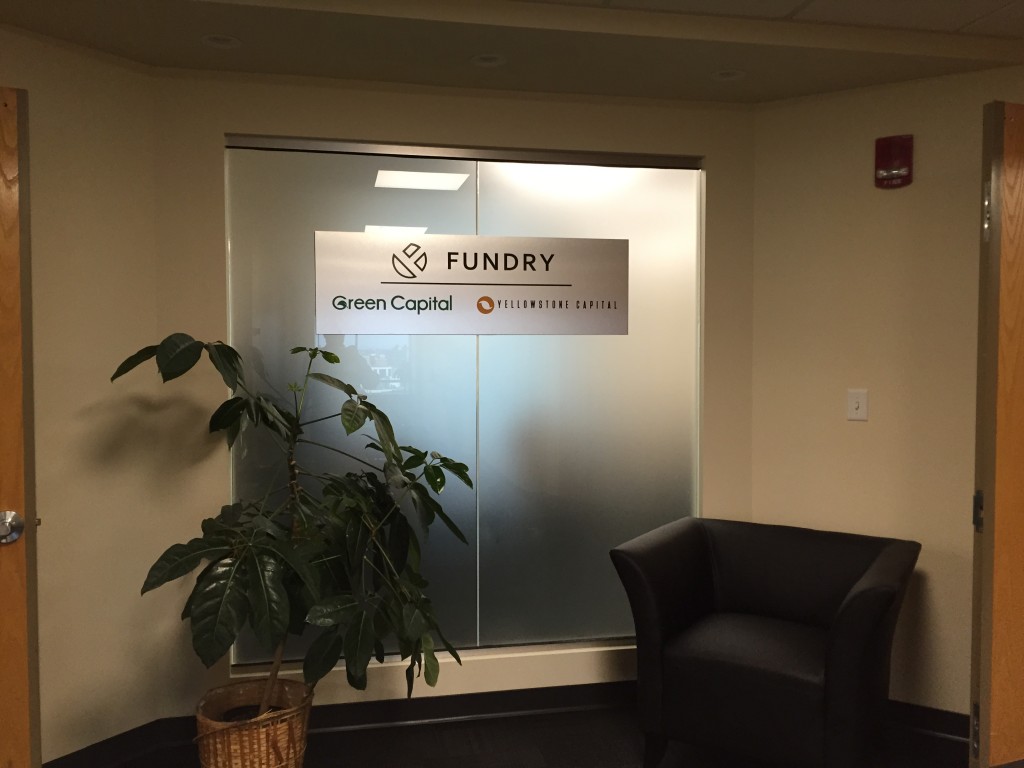 It’s a change of scenery, insiders at Fundry subsidiary Yellowstone Capital say about their new office.
The company has officially relocated from 160 Pearl Street in Manhattan to 1 Evertrust Plaza in Jersey City. On their first day in the new location, Jersey City Mayor Steven Fulop made an appearance and posed for a photo with company executives Isaac Stern and Jeff Reece to celebrate their arrival. Aside from outgrowing the NYC office that they operated from for years, Yellowstone was wooed to the State by the New Jersey Economic Development Authority to create jobs in the area in exchange for a tax incentive. The hundreds of employees they bring with them to the neighborhood now will also serve to stimulate Jersey City’s burgeoning economy.
The company originated close to half a billion dollars in funding for small businesses in 2015.
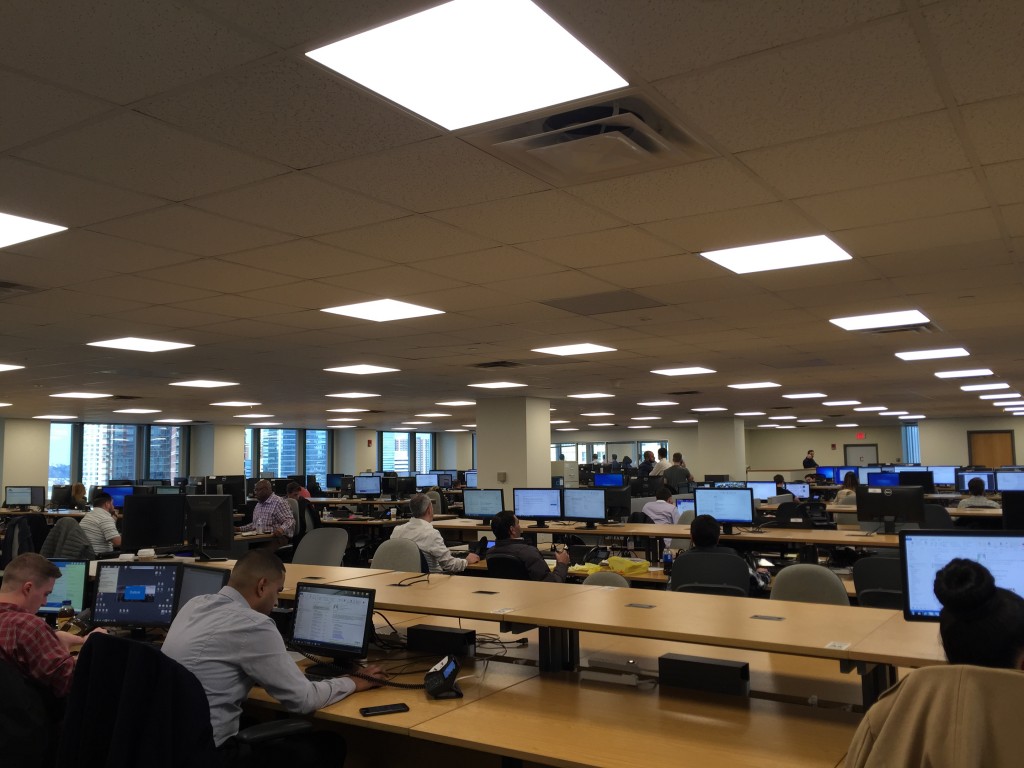
 Just one stop from the Path Train’s World Trade Center station, Yellowstone’s new office environment makes it feel as if the company has been transported a million miles away. deBanked was given a tour of the new space, which at 25,000 square feet, was easy to get lost in. One employee said the upgrade from their previous location felt so immense, that it felt like they had moved to Japan.
A clear view of NYC’s Freedom Tower from many of the floor’s windows assures them that they are not that far.