Sean Murray is the President and Chief Editor of deBanked and the founder of the Broker Fair Conference. Connect with me on LinkedIn or follow me on twitter. You can view all future deBanked events here.
Articles by Sean Murray

Broker Running Around Calling Himself a ‘Direct Lender’ Shut Down by CA Regulators
December 21, 2016A loan broker representing themselves to be a “direct lender,” was not a direct lender at all, according to witness testimony entered against Financial Services Enterprises DBA Pioneer Capital. The California Department of Business Oversight (DBO) noted in its case against Pioneer that “the evidence did not show that respondent actually funds loans itself, and did not include documentation of any loans actually consummated.”
The regulatory action, which was centered around whether or not the business loan broker was unlicensed in California ended unfavorably for Pioneer, with the DBO ordering the company to Desist and Refrain. You can read a good summary on LeasingNews by attorney Tom McCurnin: http://leasingnews.org/archives/Dec2016/12_21.htm#dbo
The Twelve Days of Funding
December 20, 2016On the Twelfth day of funding, my true love gave to me











Merry Christmas, Happy Hanukkah and may all your deals fund!
CAN Capital Woes Continue – Layoffs Commence
December 16, 2016More information is slowly starting to come out about the recent C-level removals at CAN Capital. In the meantime, the company announced major layoffs just before the holidays. American Banker says the number is 136 employees laid off just at CAN’s Kennesaw, GA office.
Multiple brokers that have done business with CAN in the past have told deBanked that CAN is not actually servicing renewals for existing customers or that they’re only doing them on a highly selective basis, despite what the company said two weeks ago.
The company’s chief executive officer, chief financial officer and chief risk officer were all put “on a leave of absence” in late November after discovering that “some assets were not performing as expected and that there was a need for process improvements in collections.” All of their names have been removed from the leadership page on the company’s website.
While the collective expectation has been that CAN would resume funding new business again in January, the wave of layoffs do not inspire confidence. No executive replacements have been named and CAN’s chief legal officer still remains in place as the company’s “acting chief executive.” It’s a bizarre sequence of events that seems to indicate there will not be a return to normalcy any time soon.
Fifth Third Bank/ApplePie Capital Deal Great, But Bank Deals For Many Other Business Lenders Still a Pie in the Sky
December 13, 2016 Fifth Third Bank is buying a stake in franchise marketplace lender ApplePie Capital as part of a $16.5 million venture round, the WSJ reported. The prediction that non-banks are evolving into banks is slowly coming true, but will the trend in the commercial space continue?
Consider that ApplePie has only made 120 loans over the last two years, a small piece of pie compared to a company like CAN Capital which has made nearly 200,000 loans and advances since inception. But ApplePie and CAN are not competitors, nor is ApplePie really like the rest of the industry that has long proclaimed that banks can’t profitably make small business loans under $250,000 or lend to borrowers with poor credit history. Instead, ApplePie’s model, terms and customers have always had a common synergy with banks, $420k loans (on average) for up to 7 years to franchise owners at 8.62% APR (on average) and 750 FICO (on average). It’s a borrower profile that has literally resulted in zero defaults for ApplePie so far, though it’s still early days. Business owners can get term-sheets in 5 days and funding in approximately 30 days. Sounds mighty bankish to me.
ApplePie’s loans are even issued by a New Jersey State chartered commercial bank, Cross River Bank. But ApplePie is the platform, using technology to draw attention to franchise owners in need of financing, streamlining the process and providing a way for investors to participate in the deals. Denise Thomas, the company’s CEO and co-founder told the WSJ that banks’ costs are now too high to make $420,000 loans. That might be true but one wonders if such loans should be done over such a long period of time and at such low rates, especially considering that their borrowers are not asked to put up any personal collateral.
Another lender that tried their hand at prime small business borrowers closed their doors last month. In an op-ed penned by Candace Klein of the now defunct Dealstruck, she said of moving away from the mid-prime borrower to prime, “yields began to tighten. Lenders stopped making a profit and backend capital began to question whether there was a ‘there’ there after all.”
But whereas Dealstruck was constrained by their cost of capital, a bank could potentially make it work. One pitfall that ApplePie has however is limited time in business. It’s easy to claim no defaults on loans with 70 month terms (on average) when you have only been business for two years. Even still, it’s not hard to see why a bank would be interested in their particular model. The vast majority of non-bank small business funding companies operate in a totally different universe, with smaller loans, poorer credit, shorter terms and faster service. These are the ones typically associated with fintech, seeing as they have been able to make tens of thousands or hundreds of thousands of loans in a short amount of time. If that market was as easy as pie though, banks probably would’ve forged more partnerships by now.
SBA ‘SmackDown’ In Linda McMahon, As Pick for Administrator Brings More WWE to Small Business Funding
December 8, 2016
President-Elect Trump’s pick to head the Small Business Administration is Linda McMahon, the former CEO of World Wrestling Entertainment (WWE). The publicly-traded company has produced many household names over the years, from The Undertaker to Bret “The Hitman” Hart to The Rock.
In a public announcement, Trump said “Linda has a tremendous background and is widely recognized as one of the country’s top female executives advising businesses around the globe. She helped grow WWE from a modest 13-person operation to a publicly traded global enterprise with more than 800 employees in offices worldwide.”
If confirmed by the Senate, McMahon will succeed Maria Contreras-Sweet, who has held the position since 2014 and has had a pretty open attitude about online lenders. The former WWE exec taking her place might find even more common ground with the non-bank finance community given that Bret the Hitman Hart is the official spokesperson for a merchant cash advance company.
Sharpshooter Funding in Canada, which heavily features Hart in their marketing campaigns, is affiliated with First Down Funding, a US-company that also does small business funding. A joint-company press release from earlier this year quotes Hart as saying, “When you sit down and listen to the whole format and how it provides money to much needed businesses and small business owners that need financial support and extra funding. It’s a worthwhile endeavor, and I’m actually very grateful that Paul Pitcher involved me with it so far.”
Meanwhile, McMahon says she is up to the task. “Our small businesses are the largest source of job creation in our country,” she said in an announcement. “I am honored to join the incredibly impressive economic team that President-elect Trump has assembled to ensure that we promote our country’s small businesses and help them grow and thrive.”
LendingMania might be just around the corner in 2017.
New deBanked Magazine Issue is On The Way
December 7, 2016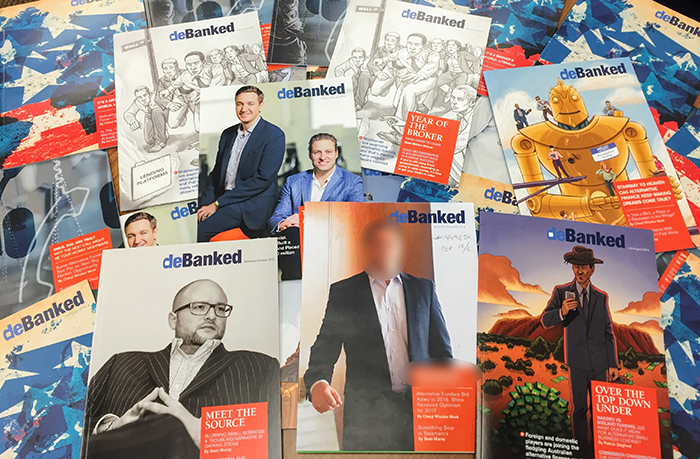
The Nov/Dec issue of deBanked magazine is on the way! Can you guess who is on the cover? Hint: his face is blurred out in this image so you can’t cheat!
This edition closes the end of 2016, celebrates the journey of an industry veteran, recaps late fall conferences, and reveals new clues and details into a former industry player’s devilish fall from grace.
Stay on top of the industry and finish out the year with our latest major stories that are released in print well before they’re online. If you’re not already subscribed to deBanked Magazine, register now for FREE!
Is Marketplace Lending Really Just Westworld?
December 5, 2016
If you haven’t watched HBO’s new flagship TV show Westworld, my analogy may have some broad spoilers so you might want to look away. Also, you should start watching the show.
In a world controlled by banks, people can visit a world where the hosts looks like banks but aren’t. They’re non-banks with bank-like attributes run off of advanced programming. You can borrow from them, pay them back, invest in them and securitize their loans. They seem real indeed, but the real banks are the chartered ones that pull their strings and script their stories.
In this real life version of Westworld, might the proposed OCC charter be the maze?
A rose is a rose is a rose.
The CAN Capital Shakeup Is A Sign of the Times
November 30, 2016Update 11/30 7:30 pm: CAN says they are still open for business and still providing access to capital for current customers and renewal business. They are not actively seeking new business at this time, but will evaluate it as it comes in.
 Part II of the industry’s season finale has begun. On Tuesday afternoon, CAN Capital confirmed that CEO Dan DeMeo had been put on a leave of absence. The chief risk officer and chief financial officer have also reportedly stepped down. Parris Sanz, the company’s chief legal officer, is now running the company, a CAN spokesperson said. His new title, acting head (which is how their statement referred to him), is perhaps a subtle clue that the company did not plan these moves far in advance. And it’s the phrasing that’s used to describe the departure of these executives that’s worth raising an eyebrow. A leave of absence? A curious fate indeed.
In an exclusive interview deBanked conducted with DeMeo last year, he said of CAN at the time, “it’s a self-sustaining business. We’re not forced to approach the capital market to cover our burn rate. We’re cash-flow positive.”
But more recently, there’s a different tone. A spokesperson for CAN said that the company had “self-identified that some assets were not performing as expected and that there was a need for process improvements in collections.” The sudden decapitation of the company’s top officers seems a harsh consequence for this apparent underperformance, especially given that CAN has long been on the short-list as a potential IPO candidate. DeMeo himself had been with the company since 2010, having started originally as the CFO and rising to the CEO position in 2013.
While CAN Capital is a private company, they are notable in that they have originated more than $6 billion in funding to small businesses since 1998 and secured a $650 million credit facility led by Wells Fargo just last year.
Some of CAN’s ISOs report being told that originations have been put on hold until January. A source with close knowledge of the company however, said that’s not correct. The Financial Times reported though that CAN had paused new business until the end of the year and would only be servicing current customers. And they might indeed need time to upgrade their systems since American Banker cited an unnamed source that said “problems arose when CAN Capital used old systems, which were not designed to require daily repayments, to collect money owed by term loan borrowers.”
Some outsiders are not surprised by what’s going. Alex Gemici, the chief revenue officer of World Business Lenders (WBL), said that it’s an indicator that uncollateralized lending is not the panacea everyone thought it was. “What we’ve been saying all along is right there on deBanked,” Gemici said, while directing me to the prediction they made a year ago that appears right on this website. At a December 2015 event at the Waldorf Astoria, WBL CEO Doug Naidus told a crowd comprised mostly of his company’s employees that he believed the bubble was about to burst. He doubled down on that prophecy in an interview four months ago in which he chided companies for having forsaken sound underwriting.
Is he right? In the last six months, the CEOs of Lending Club, Prosper and CAN Capital have all stepped down. Avant shed a lot of its staff. Dealstruck, Circleback Lending and Windset Capital have stopped funding. Confidence in the business side of alternative finance has also started to slip on a measurable basis before the election even happened.
“I believe companies are experiencing higher than normal losses due to a serious lack of proper underwriting practices, policies, and procedures,” said Andrew Hernandez, a managing partner at Central Diligence Group, a company that specializes in risk analysis who wasn’t commenting about any lender specifically. “As I say to people not familiar with the space, ‘putting the money out is the easy side of the business; getting it back is what proves to be the most difficult.'”
But CAN has not specifically fingered underwriting practices as the reason for their management shakeup, instead leaning towards it being a lapse in their process as the company grew. “It became clear that our business has grown and evolved faster than some of our internal processes,” they said in their statement.
The only alternative business lender funding more annually is OnDeck, a company that has garnered its fair share of criticism over its lackluster financial performance. Their stock is currently down a whopping 77% from the IPO price, but they have put on a good face for the industry they lead. The familiarity of their famous CEO and the decade in business under their belt arguably even has a calming effect on the tumultuous world of financial technology startups.
OnDeck too though, has been referenced in the context of bursting bubbles. Less than two years ago, RapidAdvance chairman Jeremy Brown voiced concern that the industry was heading into unsustainable territory, even going so far as to call out OnDeck by name. “When I see some of the business practices, offers, terms and other aspects of our business today, I am worried,” he wrote. “I am worried because I believe that 2008 has been too quickly forgotten, and very few, other than those of us that were on the front lines on the funding side at that time, appreciate what happened to outstanding portfolios at that time when average duration was 6 months and no deals were written over 8 months.”
For risk experts like Hernandez of Central Diligence Group, he thinks the newness of everything has been part of the problem. “I believe [funding companies] have faced a big hurdle in acquiring talent,” he said while adding that funding companies can be forced to hire underwriters with no prior knowledge of the product just to keep up with the growth.
While still very little is known about what exactly happened at CAN Capital, most people that deBanked spoke with were shocked that anything could happen there at all. “It’s insane,” said the chief executive of another competitor who wished to remain anonymous. “This is CAN we’re talking about.”
A sign of the times?