
Sean Murray is the President and Chief Editor of deBanked and the founder of the Broker Fair Conference. Connect with me on LinkedIn or follow me on twitter. You can view all future deBanked events here.
Articles by Sean Murray

Federal Court Agrees, Merchant Cash Advances Not Loans or Usurious
May 13, 2017 By now, numerous judges in the New York Supreme Court have concurred that purchases of future receivables are not loans nor usurious, yet challenges to these contracts continue. In the latest landmark ruling, defendants/counterclaim plaintiffs Epazz, Inc., Cynergy Corporation, and Shaun Passley a/k/a Shaun A. Passley, moved to have the original action involving their merchant cash advance dispute transferred from state court to federal court, perhaps hoping for a different opinion on whether such agreements are usurious.
The law was not on their side. In the Southern District of New York, a federal court, the Honorable Louis L. Stanton echoed on May 9th, 2017, what state judges have been saying all along, that a purchase is not a loan because the purchased receipts are not payable absolutely.
In this case, the “receipts purchased amounts” are not payable absolutely. Payment depends upon a crucial contingency: the continued collection of receipts by Epazz from its customers. TVT [TVT Capital] is only entitled to recover 15% of Epazz’s daily receipts, and if Epazz’s sales decline or cease the receipts purchased amounts might never be paid in full. See counterclaims, Exhs. A-C at 1. The agreements specifically provide that “Payments made to FUNDER in respect to the full amount of the Receipts shall be conditioned upon Merchant’s sale of products and services and the payment therefore by Merchant’s customers in the manner provided in Section 1.1.” Id. at 3 § 1.9.
Defendants’ argument that the actual daily payments ensure that TVT will be paid the full receipts purchased amounts within approximately 61 to 180 business days, id. ¶¶ 33-47, is contradicted by the reconciliation provisions which provide if the daily payments are greater than 15% of Epazz’s daily receipts, TVT must credit the difference to Epazz, thus limiting Epazz’s obligation to 15% of daily receipts. No allegation is made that TVT ever denied Epazz’s request to reconcile the daily payments. TVT’s right to collect the receipts purchased amounts from Epazz is in fact contingent on Epazz’s continued collection of receipts. See Kardovich v. Pfizer, Inc., 97 F. Supp. 3d 131, 140 (E.D.N.Y. 2015), quoting Amidax Trading Grp. v. S.W.I.F.T. SCRL, 671 F.3d 140, 147 (2d Cir. 2011) (“Where a conclusory allegation in the complaint is contradicted by a document attached to the complaint, the document controls and the allegation is not accepted as true”).
None of the defendants’ arguments, Counterclaims ¶¶ 51-109, change the fact that whether the receipts purchased amounts will be paid in full, or when they will be paid, cannot be known because payment is contingent on Epazz generating sufficient receipts from its customers; and Epazz, rather than TVT, controls whether daily payments will be reconciled.
The decision relies heavily on the reconciliation clause common to merchant cash advance agreements, whereby merchants can adjust their daily ACH amounts to correlate with their actual sales activity. This concept is explained at length in the Merchant Cash Advance Basics training course.
Furthermore, the court was incredulous over the defendants’ claim that they actually wanted loans but were instead fraudulently induced into purchase agreements.
Defendants do not claim that they were misled with regard to the amount of their payment obligation, only that they were misled into believing that their repayment obligation would be absolute when it actually is contingent. Their injury from that is unclear.
In short, the judge suggests that entering into a loan would’ve been worse because it was absolutely repayable, whereas the purchase agreement was not. So how could they have been damaged?
The entire decision surrounding all the claims can be downloaded here.
The case is Colonial Funding Network, Inc. as servicing provider for TVT Capital, LLC v. Epazz, Inc. Cynergy Corporation, and Shaun Passley a/k/a Shaun A. Passley in the United States District Court’s Southern District of New York. Case: 1:16-cv-05948-LLS.
Defendants Shaun Passley and Epazz also lost challenges in another merchant cash advance case in the New York Supreme Court.
‘Debt Collection Terrorist’ Sues Protection Legal Group and Corporate Bailout
May 13, 2017 A new crop of supposed debt relief companies are beginning to take fire from all sides. In this latest case, Mark D. Giubaldi & Associates, LLC DBA Protection Legal Group and Corporate Bailout LLC, have once again found themselves on the receiving end of a complaint. On Wednesday, May 10th, Craig Cunningham, a once self-proclaimed debt collection terrorist and famous TCPA litigant, filed a lawsuit in the Northern District of Texas to seek out more than $1 million in damages for alleged unsolicited robocalls to his cell phone.
Cunningham, who goes by the screen name Codename47 on the fatwallet.com forum, previously authored a post titled, “TCPA enforcement for fun and for profit up to 3k per call” and is well known in the TCPA plaintiff community. In the complaint against Protection Legal Group and Corporate Bailout, he claims that they called him more than 50 times to ask about supposed “merchant cash advance loans” he had outstanding. The deeply troubling problem with that, according to the complaint, is that Cunningham doesn’t have any such thing.
When the calls connected to an agent, the Plaintiff was told that he was called by the defendants and told that according to UCC filings, they had noticed the Plaintiff had several merchant cash advance loans out. In reality, there are no UCC filings, and the Plaintiff has no merchant cash advance loans outstanding. In every call, the Plaintiff noticed a delay between answering the phone and the call connecting with a live person, which is characteristic of an automated telephone dialing system.
These are just some of many harassing calls the Plaintiff has received and as Defendants are just content to knowingly call what could be wrong numbers, or uninterested individuals and are blanketing the nation with these unsolicited calls.
[…]
Additionally, in the above referenced telephone calls, Defendants and their agents falsely claimed to have information regarding alleged UCC filings of Plaintiff, which don’t exist and were never made.
These calls were knowingly and willfully placed and the Defendants had or should have ascertained they were calling the wrong person.
Additional lawsuits currently pending against Protection Legal Group allege that the company is practicing law without a license in New York and interfering with merchant cash advance contracts.
Craig Cunningham v. Mark D. Guidubaldi & Associates LLC DBA Protection Legal Group, and Corporate Bailout LLC was filed in the United States District Court for the Northern District of Texas under case # 3:17-cv-01238-L.
Are You a Loan Broker? You Need to Be Licensed in Vermont
May 12, 2017 Loan broker licensing may have gotten stalled in New York, but in Vermont, it’s the law. Governor Phil Scott made H. 182 official on May 4th, regulating everyone engaged in loan solicitation with prospective Vermont borrowers. Specifically this applies to anyone that:
- offers, solicits, brokers, directly or indirectly arranges, places, or finds a loan for a prospective Vermont borrower;
- engages in any activity intended to assist a prospective Vermont borrower in obtaining a loan, including lead generation;
- arranges, in whole or in part, a loan through a third party, regardless of whether approval, acceptance, or ratification by the third party is necessary to create a legal obligation for the third party, through any method, including mail, telephone, Internet, or any electronic means;
- or advertises or causes to be advertised in Vermont a loan or any of the services described in (i) –(iii). This license does not include the authority to engage in the business of making loans.
The loan solicitation law is separate from a Commercial Lender License, which already requires licensing to solicit business loans under $1 million, as it covers:
- Any company or person who engages solely in the business of making commercial loans of money, credit, goods, or things in action and charges, contracts for or receives on any such loan interest, a finance charge, discount, or consideration therefore. Commercial loans do not include a loan or extension of credit secured in whole or in part by an owner occupied one-to-four unit dwelling. [Note: The company’s main office must be licensed as a commercial lender prior to, or simultaneously with, the filing of a branch commercial lender license.]
- Each location, whether located in Vermont or not, desiring to engage in the business of making commercial loans in Vermont must obtain a separate license by filing a Form MU3 through the NMLS.
- A commercial loan solicited or made by mail, telephone or electronic means to a Vermont business is subject to licensing notwithstanding where the loan is legally made. No person may engage in the business of soliciting or making commercial loans by mail, telephone or electronic means in Vermont unless duly licensed.
Brokers and lead generators should take a good hard look at their marketing since it may not matter if the customer ultimately is referred to a non-lender such as an equipment lessor or a merchant cash advance company if loans are even an option among many.
According to the law, each loan solicitation licensee shall include clearly and conspicuously in all advertisements of loans and solicitations of leads, the following statement:
“THIS IS A LOAN SOLICITATION ONLY. [INSERT LICENSEE NAME] IS NOT THE LENDER. INFORMATION RECEIVED WILL BE SHARED WITH ONE OR MORE THIRD PARTIES IN CONNECTION WITH YOUR LOAN INQUIRY. THE LENDER MAY NOT BE SUBJECT TO ALL VERMONT LENDING LAWS. THE LENDER MAY BE SUBJECT TO FEDERAL LENDING LAWS.”
A loan solicitation license cost $1,100.00 (includes a $500.00 Licensing Fee, a $500.00 Investigation Fee; and the $100 NMLS processing fee), according to the government website.
If you’re sending mailers to Vermont businesses, calling them or even marketing to them on the Internet, you should speak with an attorney about both the loan solicitation license and commercial lenders license first.
What You Need to Know About The CFPB and Small Business Lending
May 10, 2017
On Wednesday, the Consumer Financial Protection Bureau (CFPB) held a hearing on small business lending. Here’s why it mattered and what you need to know:
Why: The 2010 Wall Street Reform and Consumer Protection Act, aka Dodd-Frank, empowered the CFPB to collect data on small business lending. The CFPB is just now getting around to rolling this out. The purpose is to facilitate enforcement of fair lending laws and enable communities, governmental entities, and creditors to identify business and community development needs and opportunities of women-owned, minority-owned, and small businesses. In short, to determine if women and minority-owned businesses are operating on a level-playing field when it comes to accessing credit.
Who: “I’m an MCA funder, factor, equipment lessor or other, and this only applies to lenders right”?
Maybe, maybe not. Although Section 1071 makes several references to loans and credit, it doesn’t refer to the companies subject to data collection as small business lenders. Instead it says financial institutions which it defines as “any partnership, company, corporation, association (incorporated or unincorporated), trust, estate, cooperative organization, or other entity that engages in any financial activity.” That sounds incredibly broad.
What: What are they trying to collect?
- the number of the application and the date on which the application was received;
- the type and purpose of the loan or other credit being applied for;
- the amount of the credit or credit limit applied for, and the amount of the credit transaction or the credit limit approved for such applicant;
- the type of action taken with respect to such application, and the date of such action;
- the census tract in which is located the principal place of business of the women-owned, minority-owned, or small business loan applicant;
- the gross annual revenue of the business in the last fiscal year of the women-owned, minority-owned, or small business loan applicant preceding the date of the application;
- the race, sex, and ethnicity of the principal owners of the business; and
- any additional data that the Bureau determines would aid in fulfilling the purposes of this section.
How: Great question. The law says that where feasible the underwriter or analyst isn’t allowed to know if the business is woman-owned or minority-owned and that this information must be captured separately and kept secret from the underwriter. The section is actually called the “NO ACCESS BY UNDERWRITERS” section. Oddly, as this applies to all small business lending, not just faceless transactions, one wonders how an underwriter is supposed to avoid discovering the gender or ethnicity of the applicant. It is possible that in 2009 when this section was drafted, the architects could not imagine a business lending universe that looked beyond FICO scores and balance sheets.
When: It’s still early days. Right now the CFPB just wants to know everything about what these “financial institutions” do and how they do it before they start requiring the data be collected. To that end, they’ve published a Request For Information, seeking voluntary responses so that they can start formulating the data collection framework in a way they believe best.
Where: Where can you read and watch more about this? We’ve got some information on this page here, including a video of the hearing.
What should I do? Should I do anything?
Join an industry trade association. When it came to the proposed regulation in New York, they did most of the heavy lifting. There are many to choose from depending on your business model. In New York though, the regulations were purely proposed. Under Dodd-Frank, the CFPB already has the power to collect data. They’re just finally getting around to using it.
Exercise of Ordinary Intelligence Would’ve Revealed Merchant Cash Advance Contract Was Not a Loan, Court Says
May 9, 2017 In the New York Supreme Court, the Honorable Linda S. Jamieson was tasked with ruling on twelve causes of action in a merchant cash advance contract case. While the 18-page decision covers a lot of ground, one notable section was the plaintiffs’ request for rescission based on “misrepresentations or unilateral mistake” and “damages for fraudulent inducement.” According to the order, the plaintiffs, K9 Bytes, Inc., Epazz, Inc., Strantin, Inc., MS Health Inc., and Shaun Passley, “claim that the defendants misled them by representing that they were entering into “loans governed by usury laws,” but instead caused them “to enter into ‘merchant agreements.'” Exhibits on the docket attached by the plaintiffs purport to demonstrate the word loan being used in communications, though the judge noted that the plaintiffs failed to identify how the individuals in those communications specifically attributed to the defendants. Nevertheless, the judge was unmoved by plaintiffs given the overt language spelled out in the contract itself.
[The plaintiffs] state that they would not have knowingly entered into merchant agreements, because what they really wanted were loans. Indeed, plaintiffs allege that “the word ‘purchase’ or ‘sale’ would have caused Passley to decline a transaction with [defendants] because a loan – the product Passley wanted to obtain – is not a purchase or sale.”
A review of the contracts in this action shows that not only do they all clearly state that they involve purchases or sales, but they all expressly state they are not loans. Even if someone were confused by the contracts, or did not understand the obligation or the process, by reading the documents, one would grasp immediately that they certainly were not straightforward loans. The very first heading on the page was “Merchant Agreement,” and the second heading says “Purchase and Sale of Future Receivables.”
[…] For plaintiffs to state that they would not have entered into a purchase or sale if they had known that that is what they were doing is utterly undermined by the documents themselves. As the Second Department has held, in Karsanow v. Kuehlewein, 232 A.D.2d 458, 459, 648 NY.S.2d 465, 466 (2d Dept. 1996), “the subject provision was clearly set out in the … agreements, and where a party has the means available to him of knowing by the exercise of ordinary intelligence the truth or real quality of the subject of the representation, he must make use of those means or he will not be heard to complain that he was induced to enter into the transaction by misrepresentations.” So too here, plaintiffs had the means to understand that the agreements set forth that they were not loans. As it has long been settled that a party is bound by that which it signs, the Court finds that the ninth cause of action, for recission based on misrepresentation or mistake, and the tenth cause of action, for fraudulent inducement based on misrepresentation, must be dismissed as a matter of law. Pimpinello v. Swift & Co., 253 N.Y. 159, 162-63 (1930) (“the signer of a deed or other instrument, expressive of a jural act, is conclusively bound thereby. That his mind never gave asset to the terms expressed is not material. If the signer could read the instrument, not to have read it was gross negligence; if he could not have read it, not to procure it to be read was equally negligent; in either case the writing binds him.”).
The plaintiffs are likely to be disappointed with the rest of the ruling as well. The decision can be found in the New York Supreme Court in the County of Westchester under Index Number 54755/2016 or can be downloaded in full here.
MCA Company Wins Case After Judge Actually Reads the Contract
May 5, 2017 An explosive New York Supreme Court decision in December against a merchant cash advance company just lost some of its bite, thanks to a decision handed down by the Honorable Catherine M. Bartlett in Orange County.
By all accounts, plaintiff Merchant Funding Services, LLC (“MFS”) had reason to be worried when Long Island attorney Amos Weinberg appeared on behalf of defendants Micromanos Corporation and Atsumassa Tochisako. MFS and Weinberg squared off last year in an almost identical case when Weinberg represented a company named Volunteer Pharmacy, Inc. There, a Westchester County judge decided the agreement in question to be criminally usurious on its face, leaving no question of fact for a trier of fact to resolve. According to court records, Weinberg has been relying on that decision to bolster his legal arguments against other MCA agreements ever since.
But up in Orange County, less than an hour northwest of Westchester, the court there sided in favor of MFS on Thursday, even after being briefed on the Volunteer Pharmacy decision.
Defendants, citing Merchant Funding Services, LLC v. Volunteer Pharmacy Inc., 44 NYS3d 876 (Sup. Ct. Westchester. 2016), assert that a plenary action is not required in the circumstances of this case because the Secured Merchant Agreement is, on its face and as a matter of law, a criminally usurious loan. However, Defendants’ position is grounded on a dubious misreading of the Agreement.
Micromanos, like Volunteer Pharmacy, was seeking to vacate the confession of judgment entered against them by way of a motion rather than by filing an entirely new lawsuit.
Here, the judge not only rejected that the confession of judgment be vacated but she also admonished Micromanos for misleading the court over the actual wording of the contract in order to serve their argument.
The agreement on its face provided for MFS’s purchase of 15% of Micromanos’ future receipts until such time as the sum of $224,250 has been paid. Paragraph 1.8 of the Agreement recited the parties’ understanding – directly contrary to Defendants’ claims herein – that (1) MFS’ purchase price was being tendered in exchange for the specified amount of Micromanos’ future receipts, (2) that such purchase price “is not intended to be, nor shall it be construed as a loan from MFS to Merchant”, and (3) that payment by Micromanos to MFS “shall be conditioned upon Merchant’s sale of products and services and the payment therefore by Merchant’s customers…”
These provisions not withstanding, Defendants contend that the Addendum altered the essential nature of the Agreement by requiring a Daily Payment of $2,995.00 on pain of default, thereby eliminating any element of risk or contingency in the amount or timing of payment to MFS, and converting the Agreement into a criminally usurious loan bearing interest at the rate of 167% per annum. Not so. The Addendum expressly provided that the $2,995.00 Daily Payment was only “a good-faith approximation of the Specified Percentage” of 15% of Micromanos’ receipts, and that Micromanos was entitled to request a month-end reconciliation to ensure that the cumulative monthly payment did not exceed 15% of Micromanos’ receipts. Defendants’ contention that MFS was entitled under the Addendum to the $2,995.00 Daily Payment without being obliged to offer Micromanos a month-end reconciliation is founded on an incomplete and palpably misleading quotation of paragraph “d” of the Addendum.
According to Defendants, paragraph “d” states:
“The Merchant specifically acknowledges that ***the potential reconciliation*** [is] being provided to the Merchant as a courtesy, and MFS is under no obligation to provide same”.
As noted above, paragraph “d” actually states:
“The Merchant specifically acknowledges that: (I) the Daily Payment and the potential reconciliation discussed above are being provided to the Merchant as a courtesy, and that MFS is under no obligation to provide same, and (ii) if the Merchant fails to furnish the requested documentation within five (5) business days following the end of a calendar month, then MFS shall not effectuate the reconciliation discussed above.”
The Defendants’ omission fundamentally alters the meaning of paragraph “d”. Contrary to Defendants’ assertion, the gist of paragraph “d” is that the institution of the fixed Daily Payment plus month-end reconciliation mechanism as a substitute for Micromanos’ daily payment of 15% of its actual receipts was a non-obligatory courtesy. Paragraph “d” plainly does not enable MFS to require a $2,995.00 Daily Payment while concomitantly refusing Micromanos’ request for a reconciliation.
Defendants further contention that the Agreement as a matter of law eliminated all risk of hazard of nonpayment by placing Micromanos in default upon any material adverse change in its financial condition is not borne out by the language of the Agreement. Under Paragraphs 2.1 and 3.1 of the Agreement, Micromanos’ failure to report a material adverse change in its financial condition, not the adverse change itself, was defined as an event of default.
Therefore, the Secured Merchant Agreement is not on its face and as a matter of law a criminally usurious loan. Consequently, Defendants have failed to establish an exception to the general requirement that relief from a judgment entered against them upon the filing of an affidavit of confession of judgment must be sought by way of a separate plenary action.
It is therefore ORDERED, that Defendants’ motion is denied.
Alarmingly, court documents show that Micromanos attorney Amos Weinberg is relying on the same “incomplete and palpably misleading quotation” in other cases involving other merchant cash advance contracts to serve his arguments. Fortunately, in this case, the Honorable Catherine M. Bartlett compared his quotation of the contract to the actual language of the contract and saw they didn’t match up. While a decision from the Supreme Court in Orange County doesn’t mean that the matter is settled for good in New York State, it does potentially put the decision that arose from Volunteer Pharmacy on very shaky ground.
Merchant Funding Services, LLC v. Micromanos Corporation d/b/a Micromanos and Astsumassa Tochisako can be found in the New York Supreme Court under index number: EF000598-2017
System Error: Prosper Showed Incorrect Returns to Investors
May 3, 2017Investor returns weren’t what they claimed for at least seven quarters, according to a notice Prosper issued on Wednesday.
It recently came to our attention that the annualized net return numbers displayed on your account overview page were inaccurate due to a system error. This error affected the Annualized Net Return and Seasoned Net Annualized Return numbers and has now been fixed.
This error did not impact any other part of your account, including payments, deposits, monthly statements, tax documents and note and loan level information – including estimated returns.
We sincerely apologize for this error. If you have any questions, please email us at investorquestions@prosper.com.

And this was no small adjustment. On LendAcademy, Ryan Lichtenwald said his returns were adjusted from 13.55% down to 9.27%. One user on the LendAcademy forum said his returns were adjusted down from 10% to 8% and another from 14% to 7%. Yet another individual who interacted with me on twitter claims his return dropped from 10% to 1.2%. While we can’t confirm some of these accounts, Prosper’s admission and Lichtenwald’s post on LendAcademy are pretty alarming.
An old LendAcademy forum post shows users mulling over Prosper’s return calculation more than a year ago, but were unsure what to make of it.
In December 2016, the subject came up again.
That same month, Prosper hired a new CFO, Usama Ashraf.
Update: According to Bloomberg, “some of the investors that were affected saw their annual returns fall in half, but in most cases returns fell less than 2 percentage points.” A Prosper spokesperson said that the issue has been going on for several quarters.
Update 2: According to Financial Times, “The miscalculations affected a majority of Prosper’s customers and date back as far as seven quarters.”
Links to additional websites that show investors were growing suspicious of Prosper’s calculations:
Oct 2016: Prosper showing return of 8% – “What I don’t understand, is that when I look at my statements and compare account balances, I’m seeing a return of closer to 4%.”
Reactions from Prosper investors on the Internet:
“My displayed returns are now 1/2 of what they used to be.”
“I was at 16.81%. Today my account shows 9.42% – so not exactly half, but a lot.”
“Prior to the update I was somewhere close to 11%. After the correction…6.65% HAHA”
Words Matter in Contracts (And everywhere else)
April 25, 2017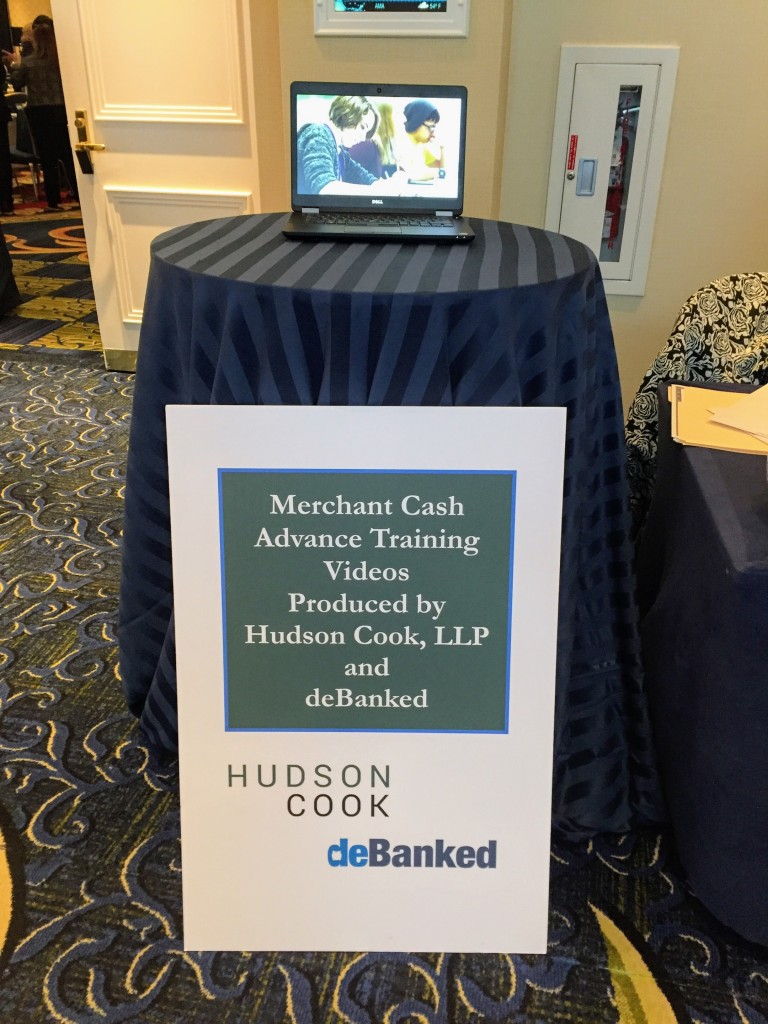 The Counselor Library conference powered by law firm Hudson Cook LLP was a big hit in Baltimore this week. While focused on consumer lending, they held a special one-day program on merchant cash advance and small business lending. The topics and discussions were off-limits to press reporting but what was largely visible on the exhibition floor was the Merchant Cash Advance Basics training course.
Recent merchant cash advance case law suggests that it is of critical importance for sales reps and underwriters to be knowledgeable of their own products. To be specific, the words you use to communicate with merchants over emails, on the phone and in your contracts should always be consistent and in compliance with applicable laws. What you write on forums and the promises you make in your ads should also pass legal muster.
Even if you consider yourself to be an industry veteran, the Merchant Cash Advance Basics course should refresh your memory on fundamental industry practices. If you are a newcomer, consider Merchant Cash Advance Basics an absolute necessity.
Hudson Cook, LLP has established itself as a leader in the MCA legal arena and we were proud to participate in their event.