
Archive for 2018
Fed Study Debunks “Lax Screening” Hypothesis Of Fintech Lenders
February 23, 2018 The New York Federal Reserve published the results of their study on the role of technology in mortgage lending. And they bear good news for fintech, that technological innovation has improved the efficiency of financial intermediation.
Fintech lenders, it turns out, are faster, experience lower default rates, and are more responsive to changes in demand. Faster processing times did not translate into issuing riskier loans, the report concludes.
Fintech lenders were defined as lenders that offer an application process that can be completed entirely online.
The Fed researchers also found little evidence that fintech lenders disproportionately target marginal borrowers with low access to finance. On the Contrary, the data actually shows that fintech borrowing is actually higher among those both older and more educated.
“We find that default rates on fintech mortgages are about 25% lower than those for traditional lenders, even when controlling for detailed loan characteristics,” the report says. “There is no significant difference in interest rates. These results speak against a lax screening hypothesis, and instead indicate that fintech lending technologies may help attract and screen for less risky borrowers.”
The two largest fintech mortgage originators in 2016 were Quicken Loans and loanDepot.
LendingPoint Co-founder Weighs in on Lending Club’s Earnings Report
February 21, 2018Lending Club announced its fourth quarter and full year 2017 earnings earlier this week. The report included a $92.1 million quarterly loss (which the company attributed primarily to a class action litigation settlement) and a fourth quarter net revenue increase of 20 percent year-over-year.

“This report had lights and shadows,” said Juan Tavares, Co-founder of LendingPoint. “On the regulatory front, [Lending Club] seems to be making a lot of headway,” Tavares told deBanked. “It speaks to the adoption of fintech by regulatory bodies, and really flattens the playing field for the rest of us.”
He also noted that, of course, it’s a positive thing for the alternative lending industry that Lending Club keeps growing. However, Tavares, whose company competes in the same space as Lending Club, sees fundamental flaws in his competitor’s business model.
“In my view, [Lending Club’s] underlying problem is that they don’t have alignment of interest between their stakeholders,” Tavares said. “At LendingPoint, we have a different approach. We look at it really as a balance sheet model, which means that we put everything on our books. We use our own equity. We leverage other investors’ capital, but we’re not an origination platform…Lending Club’s model primarily is that they have to continue feeding the beast, so to speak, in order to continue making their revenues. They don’t have inventory to continue generating assets or to monetize going forward. That’s a significant shortcoming in their model,” he said.
In Lending Club’s press release on Tuesday, CEO Scott Sanborn said, “2017 was a year of rebuilding and transforming our core business. We returned to growth and materially expanded and diversified our investor base. We’re continuing to invest in our people, technology and products to position us for the years ahead.”
Last year, Lending Club started taking on credit responsibility for some of its loans, which may signal a change in direction for the company.
But Tavares said that this still only accounts for less than ten percent of the company’s originations. He’s proud that LendingPoint, founded in 2014, has 100 percent of its loans on its balance sheet.
Keith Nason Steps in as New CEO of In Advance Capital
February 21, 2018 In Advance Capital, who has seen steady growth, has announced that Keith Nason stepped in to the role of Chief Executive Officer as of February 3, 2018. This growth includes 163% year over year growth in 2017.
“We are going to be disciplined, develop even stronger relationships with all channels, internal and external, and strive to execute to perfection to produce the absolute best product for all of our clients while assisting small business owners accomplish their dreams,” Nason said.
Nason has spent the last 10 years in risk, credit modeling, and operational leverage, specifically, through various financial institutions and alternative lenders. While previous CEO, Shalom Auerbach, transitions into a Board of Directors role while assisting with strategic initiatives for In Advance, Nason says that he is “excited about the opportunity and appreciative of the trust that the executives of this company has instilled in me”.
Through the efforts of Tom Corliss, Co-Founder and Head of Sales, and the well developed In Advance sales channels, In Advance has been able to maximize valuable relationships through direct consumer and brokerage channels to drive sales opportunities while cultivating strong, profitable relationships.
About In Advance Capital
Founded in 2015, the company provides working capital to small business owners. To learn more, visit http://www.inadvancecap.com or call 646-412-3303.
PeerIQ Announces Partnership with Cross River Bank
February 20, 2018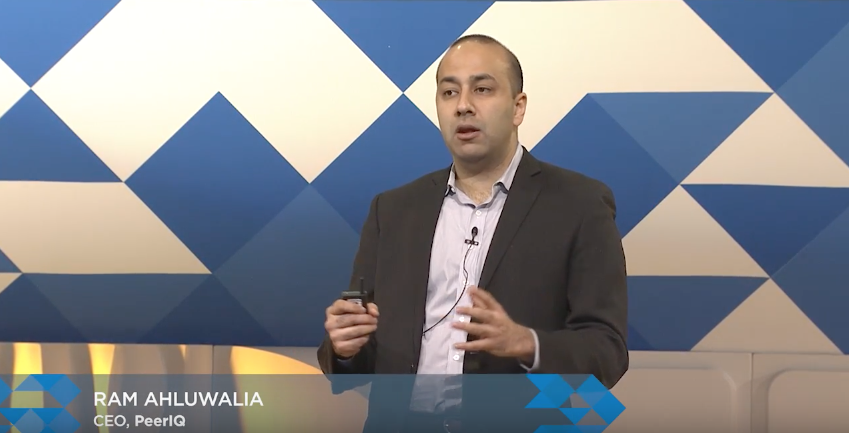
PeerIQ, the New York-based software company that provides analytics and risk management services to lenders, announced today a partnership with Cross River, a New Jersey State Chartered FDIC-insured bank.
“Cross River is one of the most innovative banks I’ve seen,” PeerIQ CEO and co-founder Ram Ahluwalia told deBanked. “They have technology that enables same-day settlement of payments transactions, which is really novel.”
Ram is also excited that Cross River’s customers are technology companies, like Coinbase, and fintech lenders. This new partnership means that Cross River will now start to use some of PeerIQ’s software products.
“[Cross River] is incorporating technology innovation to rethink the banking experience,” Ahluwalia said.
Ahluwalia explained that Cross River is the lender of record for about 15 platforms, including Marlette and loanDepot, so it is therefore “in a very unique position in the lending ecosystem.”
Founded in 2015, PeerIQ employs 36 people at its Manhattan office and completed a $12 million Series A at the end of August. Founded in 2008, Cross River is backed by investors including Battery Ventures, Ribbit Capital and Andreesen Horowitz.
BFS Capital Secures $175M Revolving Line
February 20, 2018
BFS Capital has secured a new $175 million revolving credit facility from funds managed by Ares Management, L.P. (NYSE:ARES), according to a company announcement. Stephens Inc. acted as financial advisor to the transaction.
ARES is one of the largest global alternative asset managers with $106.4 billion under management. They previously announced a $100 million line for LendingPoint, an online consumer lender.
BFS Capital also recently announced that 2017 was their biggest year yet. They generated more than $300 million in originations for the year.
BFS Capital plans to use the new facility to accelerate the growth of its lending business.
“The market continues to appreciate our small business customer focus,” said BFS Capital CEO Michael Marrache in a prepared statement. “Our strategic partners, such as ISOs, also commend us for our data and underwriting expertise—based on 15 years of financings across multiple economic cycles—which enables us to better anticipate the future performance of our financings.”
The Madden Decision, Three Years Later
February 18, 2018
At first, reversing the 2015 Madden v. Midland Funding court decision, which continues to vex the country’s financial system and which is having a negative impact on the financial technology industry, seemed like a fairly reasonable expectation.
The controversial ruling by the Second Circuit Court of Appeals in New York, which also covers the states of Connecticut and Vermont, had humble roots. Saliha Madden, a New Yorker, had contracted for a credit card offered by Bank of America that charged a 27% interest rate, which was both allowable under Delaware law and in force in her home state.
But when Madden defaulted on her payments and the debt was eventually transferred to Midland Funding, one of the country’s largest purchasers of unpaid debts, she sued on behalf of herself and others. Madden’s claim under the Fair Debt Collection Practices Act was that the debt was illegal for two reasons: the 27% interest rate was in violation of New York State’s 16% civil usury rate and 25% criminal usury rate; and Midland, a debt-collection agency, did not have the same rights as a bank to override New York’s state usury laws.
In 2013, Madden lost at the district court level but, two years later, she won on appeal. Extension of the National Bank Act’s usury-rate preemption to third party debt-buyers like Midland, the Second Circuit Court ruled, would be an “overly broad” interpretation of the statute.
For the banking industry, the Madden decision – which after all involved the Bank of America — meant that they would be constrained from selling off their debt to non-bank second parties in just three states. But for the financial technology industry, says Todd Baker, a senior fellow Harvard’s Kennedy School of Government and a principal at Broadmoor Consulting, it was especially troubling.
“The ability to ‘export’ interest rates is critical to the current securitization market and to the practice that some banks have embraced as lenders of record for fintechs that want to operate in all 50 states,” Baker told deBanked in an e-mail interview.

A 2016 study by a trio of law professors at Columbia, Stanford and Fordham found other consequences of Madden. They determined that “hundreds of loans (were) issued to borrowers with FICO scores below 640 in Connecticut and New York in the first half of 2015, but no such loans after July 2015.” In another finding, they reported: “Not only did lenders make smaller loans in these states post-Madden, but they also declined to issue loans to the higher-risk borrowers most likely to borrow above usury rates.”
With only three states observing the “Madden Rule,” the general assumption in business, financial and legal circles was that the Supreme Court would likely overturn Madden and harmonize the law. Brightening prospects for a Madden reversal by the Supremes: not only were all segments of the powerful financial industry behind that effort but the Obama Administration’s Solicitor General supported the anti-Madden petitioners (but complicating matters, the SG recommended against the High Court’s hearing the case until it was fully resolved in lower courts).
Despite all the heavyweight backing, however, the High Court announced in June, 2016, that it would decline to hear Madden.
That decision was especially disheartening for members of the financial technology community. “The Supreme Court has upheld the doctrine of ‘valid when made’ for a long time,” a glum Scott Stewart, chief executive of the Innovative Lending Platform Association – a Washington, D.C.-based trade group representing small-business lenders including Kabbbage, OnDeck, and CAN Capital — told deBanked.
Even so, the setback was not regarded as fatal. Congress appeared poised to ride to the lending industry’s rescue. Indeed, there was rare bipartisan support on Capitol Hill for the Protecting Consumers’ Access to Credit Act of 2017 — better known as the “Madden fix.”

Introduced in the House by Patrick McHenry, a North Carolina Republican, and in the Senate by Mark Warner, Democrat of Virginia, the proposed legislation would add the following language to the National Bank Act. “A loan that is valid when made as to its maximum rate of interest…shall remain valid with respect to such rate regardless of whether the loan is subsequently sold, assigned, or otherwise transferred to a third party, and may be enforced by such third party notwithstanding any State law to the contrary.”
Just before Thanksgiving, the House Financial Services Committee approved the Madden fix by 42-17, with nine Democrats joining the Republican majority, including some members of the Congressional Black Caucus. Notes ILPA’s Stewart: “We were seeing broad-based support.”
But the optimism has been short-lived. The Madden fix was not included in a package of financial legislation recently approved by the Senate Banking Committee, headed by Sen. Mike Crapo, Republican of Idaho. Moreover, observes Stewart: “Senator Warner appears to have gotten cold feet.”
What happened? Last fall, a coast-to-coast alliance of 202 consumer groups and community organizations came out squarely against the McHenry-Warner bill. Denouncing the bill in a strongly worded public letter, the groups — ranging from grassroots councils like the West Virginia Citizen Action Group and the Indiana Institute for Working Families to Washington fixtures like Consumer Action and Consumer Federation of America – declared: “Reversing the Second Circuit’s decision, as this bill seeks to do, would make it easier for payday lenders, debt buyers, online lenders, fintech companies, and other companies to use ‘rent-a-bank’ arrangements to charge high rates on loans.”
The letter also charged that, if enacted, the McHenry-Warner bill “could open the floodgates to a wide range of predatory actors to make loans at 300% annual interest or higher.” And the group’s letter asserted that “the bill is a massive attack on state consumer protection laws.”
Lauren Saunders, an attorney with the National Consumer Law Center in Washington, a signatory to the letter and spokesperson for the alliance, told deBanked that “our main concern is that interest-rate caps are the No. 1 protection against predatory lending and, for the most part, they only exist at the state level.”
But in their study on Madden, the Stanford-Columbia-Fordham legal scholars report that the strength of state usury laws has largely been sapped since the 1970s. “Despite their pervasiveness,” write law professors Colleen Honigsberg, Robert J. Jackson, Jr., and Richard Squire, “usury laws have very little effect on modern American lending markets. The reason is that federal law preempts state usury limits, rendering these caps inoperable for most loans.”
While the battle over the Madden fix has all the earmarks of a classic consumers-versus-industry kerfuffle, the fintechs and their allies are making the argument that they are being unfairly lumped in with payday lenders. “Online lending, generally at interest rates below 36%, is a far cry from predatory lending at rates in the hundreds of percent that use observable rent-a-charter techniques and that result in debt-traps for borrowers,” insists Cornelius Hurley, a Boston University law professor and executive director of the Online Lending Policy Institute. Because of fintechs, he adds: “A lot of people who wouldn’t otherwise qualify in the existing system are getting credit.”
A 2016 Philadelphia Federal Reserve Bank study reports that traditional sources of funding for small businesses are gradually exiting that market. In 1997, small banks under $1 billion in assets –which are “the traditional go-to source of small business credit,” Fed researchers note — had 14 percent of their assets in small business loans. By 2016, that figure had dipped to about 11 percent.
The Joint Small Business Credit Survey Report conducted by the Federal Reserve in 2015 determined that the inability to gain access to credit “has been an important obstacle for smaller, younger, less profitable, and minority-owned businesses.” It looked at credit applications from very small businesses that depend on contractors — not employees – and discovered that only 29 percent of applicants received the full amount of their requested loan while 30 percent received only partial funding. The borrowers who “were not fully funded through the traditional channel have increasingly turned to online alternative lenders,” the Fed study reported.
The ILPA’s Stewart gives this example: A woman who owns a two-person hair-braiding shop in St. Louis and wants to borrow $20,000 to expand but has “a terrible credit score of 640 because she’s had cancer in the family,” will find the odds stacked against when seeking a loan from a traditional financial institution.
But a fintech lender like Kabbage or CAN Capital will not only make the loan, but often deliver the money in just a few days, compared with the weeks or even months of delivery time taken by a typical bank. “She’ll pay 40% APR or $2,100 (in interest) over six months,” Steward explains. “She’s saying, ‘I’ll make that bet on myself’ and add two additional chairs, which will give her $40,000-$50,000 or more in new revenues.”
In yet another analysis by the Philadelphia Fed published in 2017, researchers concluded that one prominent financial technology platform “played a role in filling the credit gap” for consumer loans. In examining data supplied by Lending Club, the researchers reported that, save for the first few years of its existence, the fintech’s “activities have been mainly in the areas in which there has been a decline in bank branches….More than 75 percent of newly originated loans in 2014 and 2015 were in the areas where bank branches declined in the local market.”
Meanwhile, there is palpable fear in the fintech world that, without a Madden fix, their business model is vulnerable. Those worries were exacerbated last year when the attorney general of Colorado cited Madden in alleging violations of Colorado’s Uniform Consumer Credit Code in separate complaints against Marlette Funding LLC and Avant of Colorado LLC. According to an analysis by Pepper Hamilton, a Philadelphia-headquartered law firm, “the respective complaints filed against Marlette and Avant allege facts that are clearly distinguishable from the facts considered by the Second Circuit in Madden.
“Yet those differences did not prevent the Colorado attorney general from citing Madden for the broad-based proposition that a non-bank that receives the assignment of a loan from a bank can never rely on federal preemption of state usury laws ‘because banks cannot validly assign such rights to non-banks.’”
Should the Federal court accept the reasoning of Madden, Pepper Hamilton’s analysis declares, such a ruling “could have severe adverse consequences for the marketplace and the online lending industry and for the banking industry generally….”
Another ICO Leads to Losses
February 16, 2018
DropDeck, a company that launched an ICO, suffered a catastrophic event, according to the company’s company’s blog.
The digital wallet software where token purchasers were being held was hacked. But rather than the funds being stolen, the Ethereum (ETH), the cryptocurrency that purchasers sent to DropDeck to make their investment, was irretrievably locked in the wallet. In effect, the user money is there but no one can withdraw it or use it, not even the company. All users of that particular wallet software were cruelly affected, not just DropDeck.
The DropDeck loss totals 2,766 ETH or about $2.6 million at today’s prices.
George Popescu was one of multiple advisors to DropDeck according to a company post. Popescu is also the founder and CEO of Lampix, an augmented reality platform company whose own ICO has so far resulted in participant losses of nearly $5 million to-date, due to a decline in the Lampix token price.
Lampix had announced ties to reputable organizations such as the Aspen Institute while soliciting token purchasers. However, Douglas Farrar, senior manager for communications and public affairs at the Aspen Institute, previously told deBanked that he could find no business relationship between Aspen and Lampix, when deBanked attempted to confirm one. Popescu informed us, however, that a Fellow from Aspen had invited Lampix out to Colorado to power up a meeting using Lampix, and that Lampix was paid for its services provided during that meeting.
Popescu also advised the launches of ICOs by the companies AirFox, FirstBlood, and Restart Energy. The latter, Restart Energy, a Romanian company that claims to be the fastest growing private energy and gas provider in the European Union with $20 million in annual revenue, raised approximately $30 million from purchasers through their recent ICO. Restart’s tokens, RED MegaWatts, or MWATs, which participants received in exchange for their purchase, immediately declined in value by 30% after the ICO, according to KuCoin, where the tokens can be exchanged.
Popescu is advising more companies that are gearing up to launch their own ICOs, according to his LinkedIn profile. These include companies named Opiria, FIC Network (formerly Factury), and Well Inc.
Lendr Announces Vegas Contest Winner
February 16, 2018
A Las Vegas contest marketed to ISOs by Chicago-based Lendr was a success, according to the company. Lendr revealed the first prize winner of a Vegas trip for 4 (valued at $7,500) to be iAdvance Now.
One Way Funding and Fast Cash Team won second and third place and cash prizes of $2,500 and $1,500 respectively.
Lendr had marketed the campaign through several channels including deBanked late last year.
Eddie Hamid, iAdvance Now’s president, said “Working with Lendr over the past few months has been an amazing experience.”
“Winning a trip to Vegas was a nice surprise, being rewarded for working with such an amazing team was even a bigger surprise,” Hamid said of their win. “Thank you from the iAdvance Now team, we appreciate all the hard work and efforts Lendr has provided and continues to provide.”