Archive for 2018
Lawyers in LendingClub Class Action Case Defend Fee That ‘Shocked’ a Judge
June 14, 2018 Lawyers from Robbins Geller Rudman & Dowd represented clients in a class action suit against LendingClub and reached a settlement with the company for $125 million. The law firm, which was working on contingency, requested a 13.1 percent cut of the winnings, or $16 million, which a California Federal judge said “shocked” him.
Earlier in the week, Robbins Geller filed a 30-page motion in defense of its fee. Among the law firm’s arguments are that they carried a significant financial burden with this as a contingency case and that the firm succeeded in reaching an uncommonly high settlement. “A settlement that Wall Street analysts have described as ‘far exceed[ing] our expectations’ and ‘coming in at the high end of the historical range of settlements,’” the motion read.
Robbins Geller also compared its success to the results (or lack thereof) of government agencies, like the SEC and the DOJ, which have presumably tried to represent the investor clients against LendingClub and have failed.
“The DOJ lawyers do not even have to deal with counsel for witnesses whom they question before a grand jury, nor do they have to ask for documents – they can seize them through search warrants….Yet, despite all these advantages, the government has not brought a single civil or criminal charge in connection with these same facts. Nor has the government recovered a single penny for investors. Relative to the government’s results, a $125 million recovery is astounding.”
The motion also acknowledged that they were up against a defendant whose resources were far greater than theirs. And it further asserts that the firm’s effective research and skill ought to be rewarded – for obtaining the right documents and being prepared to depose the right witnesses that adequately scared LendingClub into paying a very generous settlement.
There will be a court hearing to address Robbins Geller’s motion on July 19 in the Northern District of California.
Funding Circle Report Shows Demand for Alternative Financing
June 14, 2018
Funding Circle, together with Oxford Economics, released a report this week using data from its customers last year. Funding Circle is a business loan platform that matches small business borrowers with investors that want to lend. Some of these findings may be reflective of the broader alternative finance market.
Data from the report conveys that there is an increased appetite among small business merchants for online lending products. Of the small business customers surveyed, 70 percent did not attempt to get a bank loan before applying for an alternative loan from the Funding Circle platform. The main reason for this, cited by more than three-quarters of these customers, was a perception that the bank loan process would be too burdensome. Another nine percent skipped banks because they said they thought they would be rejected.
Of the businesses that had first approached a bank before seeking funding from Funding Circle, 50 percent said they didn’t obtain a bank loan because their application was rejected. Another 36 percent responded that the bank loan process took too long, and seven percent felt that the bank’s rates and fees were too high.
When asked about the impact of not receiving funding through Funding Circle (or we can imagine a different online funder), the most common response, given by 27 percent of respondents, was that they would have missed an opportunity. After this, 22 percent believed they would not be able to consolidate their debt and 16 percent thought that they would not have been able to achieve profit growth.
Loan volume in the U.S. rose significantly for Funding Circle last year. A total of $509 million in new loans were issued in the U.S. in 2017, an increase of 80 percent from $281 million issued the previous year.
“It has become evident that small businesses are underserved in every country we operate,” said Funding Circle co-founder and CEO Samir Desai. “From butchers and bakers, to IT consultants and accountants, these are the businesses that are creating jobs, boosting productivity and driving our economies forward. The economic impact that these businesses have had as a result of accessing finance through Funding Circle is hugely rewarding to see.”
Founded in 2010, Funding Circle has helped 40,000 small businesses find financing. The company operates in the U.S., U.K., Germany and the Netherlands.
Lending Express Opens Office in Silicon Valley
June 13, 2018 Tel Aviv-based Lending Express announced its entrance into the U.S. market yesterday. It opened an office in San Matteo, CA and has officially appointed Moshe Kazimirsky as VP of Strategic Partnerships and Business Development to support the new West Coast office.
“After the immense success we’ve had in the Australian market, we knew that our platform was ready to take on the U.S.,” said Lending Express CEO Eden Amirav.
Lending Express initially launched its business in Australia in October 2016. The company provides an online marketplace that connects merchants to alternative funders. After only a year and a half, Amirav told deBanked that Lending Express is now the largest business of its kind in Australia – even though they only set foot on the continent a month ago.
Meanwhile, Lending Express has also been operating in the U.S. for months and has already partnered with leading online lenders like OnDeck, Kabbage and Fundbox, according to Amirav. Given the company’s experience in both the Australian and American markets, deBanked asked Amirav what he thought the differences were.
“In general, they are much more similar than people think,” Amirav said. “But in the U.S., people like to look around more.”
Generally, if an Australian merchant is approved, they will move forward with the deal right away, Amirav said. Lending Express offers a myriad of products on its platform, including equipment financing, invoice funding, business line of credit and merchant cash advance.
So far, Kazimirsky, who has worked in business development for other Silicon Valley technology companies, will be the only one in the new California office. But Amirav anticipates that the office with grow. The Lending Express office in Tel Aviv has 25 employees, many of whom – namely the account managers – start their day at 3 a.m. in order to speak to their Australian and American customers in different time zones.
Lending Express uses an algorithmic system called MatchScore to pair borrowers with lenders.
Settling Up: Debt Settlement Companies Paid Yellowstone Capital and Everest Business Funding a Half Million Dollars to End Lawsuit
June 12, 2018 A group of debt settlement companies and ISOs have entered into a settlement they’re unlikely to forget. A lawsuit that accused Corporate Bailout, Protection Legal Group, Mark Mancino, Michael Hamill and others of tortious interference with merchant cash advance contracts has led to a settlement in which the defendants agreed to pay Yellowstone Capital and Everest Business Funding $500,000. They also agreed not to offer any services to Yellowstone or Everest merchants in the future, deBanked has learned.
The original complaint alleged that ISOs had partnered with companies that purport to offer debt relief services to merchants with MCAs. In practice, the complaint said, debt relief was a code word for deceiving merchants to breach their existing agreements so that they could pay fees instead to the debt relief companies.
When asked to comment, Yellowstone Capital CEO Isaac Stern said that there were companies that offer this kind of service the right way but that was not the case here. “The way they’re going about it is really wrong,” he said.
Of note is that the bound parties were not just debt settlement companies but also ISOs and a law firm (Mark D. Guidubaldi & Associates, LLC dba Protection Legal Group).
Additional companies not named in the original complaint but nonetheless bound to the settlement are Mainstream Marketing Group and Corporate Client Services LLC. Websites for both companies say that they offer small business debt relief services.
Coast to Coast Funding LLC, who the defendants represented they had no control of, did not participate in the deal.
The settled matter is not the first of its kind. Everest and Yellowstone have been hammering debt settlement companies with lawsuits this year, according to court records examined by deBanked. In January, Everest sued MCA Helpline and Todd Fisch for tortious interference, and just last month Yellowstone filed a Petition to recover funds that were allegedly fraudulently transferred by Settle My Cash Advance.
In the latter case with Settle My Cash Advance, the defendants are alleged to have actively coached a merchant to hide his money in new bank accounts and hide the paper trail rather than pay the money owed to Yellowstone.
Speaking about no case in particular, Stern said “Imagine getting a commission on a deal [where you help a small business get funding] and then sending it to a debt settlement company. If there are ISOs that are doing that, we’re going to come after you hard.”
Equipment Leasing Report Foresees Rising Inflation and Interest Rates
June 12, 2018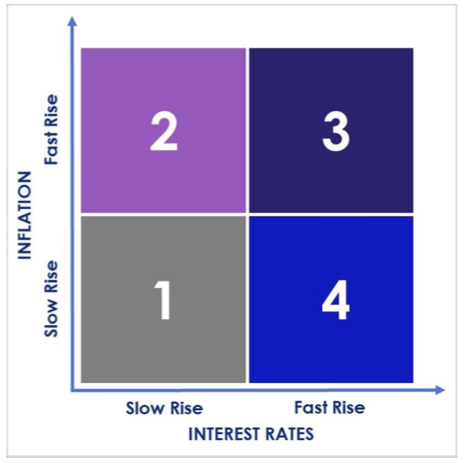 The Equipment Leasing and Finance Foundation issued a report called “How Inflationary Pressures and Rising Interest Rates Could Impact the Equipment Finance Industry.”
Given its name, the report is fairly self-explanatory. Its premise is that within the next one to three years there is likely to be a rise in inflation and interest rates which may affect the equipment finance industry, including customer demand, portfolio performance, spreads, and the propensity to finance.
The report conveys three potential scenarios regarding inflation and interest rates. Scenario #1 is “Status Quo,” or a continuation of low interest rates and inflation levels. This would place the economy in quadrant 1 of the accompanying chart.
Scenario #2 is “Breakout Inflation Prompts Strong Fed Response.” According to the report, in this scenario, inflation rises quickly, moving in quadrant 2. Then, in order to slow inflation, the Fed raises interest rates and the economy moves into quadrant 3.
What would this Scenario #2 look like for the equipment leasing industry? Among other outcomes, the report said that “equipment end-users are better able to make payments when their revenues are being driven up by higher prices, but their equipment payments are fixed.” This is a good thing for the industry, but may be a double-edged sword because, with more cash on hand, customers may be more likely to buy equipment, rather than lease it.
Scenario #3 is “Aggressive Fed Action While Inflation Lags.” This would put the economy in quadrant 4 with rising interest rates, but slow inflation. According to the report, this could create an environment where “real interest rates are rising in the absence of persistently strong economic growth, [and] business confidence is likely to fall.” This would translate to a falling demand for investment and a decline for the industry.
Established in 1989, the Equipment Leasing & Finance Foundation is a non-profit dedicated to inspiring innovation and contributing to the improvement of the equipment leasing and finance industries.
New York Institute of Credit Celebrates 100 Years and Honors Harvey Gross
June 12, 2018 About 300 people gathered underneath the soaring ceilings of Guastavino’s ballroom in Manhattan last night to celebrate the 100th anniversary of the New York Institute of Credit (NYIC). Most attendees were members of the association, which provides networking opportunities and education to a myriad of constituents, including factors, financial advisors, lawyers, investors and accountants.
“[NYIC] is one of the few meeting places that brings judges, investors and professionals together,” said Jack Butler, CEO of Birch Lake, a boutique merchant bank based in Chicago.
In addition to Butler, other members, like Maxwell Cohen, traveled to attend to event. Cohen works in Fort Lauderdale, FL as Managing Partner for Corporate Strategy & Financial Consulting LLC and specializes in underwriting and brokering business loans.
“[NYIC] is great because it connects people in similar sandboxes…and sometimes we can build off each other’s strengths, ” Cohen said. “Everyone here is verified [and] if you’re here, we know you have capabilities to deliver.”
 A central part the NYIC centennial celebration was the honoring of the organization’s Executive Director, Harvey Gross, who has worked for organization for 54 years.
A montage video of congratulations to Gross included praises from New York judges and others, including:
“He has a way of putting people together that produces spectacular results.”
“He’s been a mentor to so many.”
“Harvey has communicated best practices.”
“Some organizations looks inward. NYIC looks outward, because of Harvey’s leadership.”
“To talk about 54 years in five minutes is not easy, but I will try,” Gross said to the audience upon receiving the award. He explained that when he was 12 years old, his brother suggested that he get into the factoring business. He later told deBanked that he spent the next five or so years learning the business and left school by the time he was 18 to start a career in factoring. When he started working for the NYIC, the organization primarily served the factoring business, and has since expanded.
“I think tonight showed that the NYIC went through a lot of transitions over the last 100 years,” Gross told deBanked. “And we’re excited about new transitions in the next 100 years. And that includes MCA and fintech.”
Second Annual Alternative Finance Bar Association Conference Draws Lawyers from Afar
June 11, 2018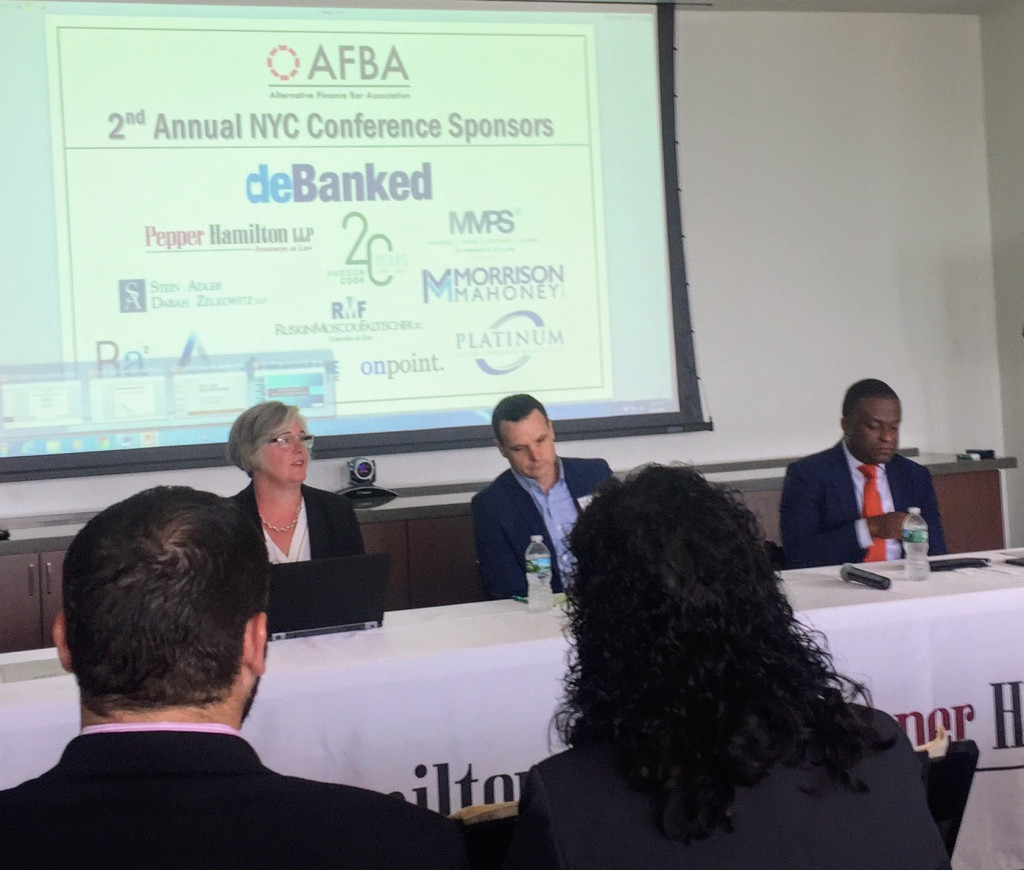 Attorneys who represent alternative finance companies congregated in New York on Friday for the second annual conference of the Alternative Finance Bar Association (AFBA.)
They came for a day of learning about the latest legal developments pertaining to alternative finance, and MCA in particular. Seminars at the conference had names like: “Credit Facilities 101: What an Alternative Finance Company Can Expect,” “Syndication Relationships: Partner? Participant? Investor?” and “Bankruptcy Developments: The Rise of the Adversary Proceeding.”
“I think it’s like heaven for a new attorney in the MCA world,” said Judith Ramos, who is Corporate Counsel at McKenzie Capital in the Miami area.
Another attorney somewhat new to the MCA space and eager to learn more was Alexis Shapiro, General Counsel at Forward Financing in Boston.
“This was one stop shopping to learn about the latest legal developments in the MCA industry,” Shapiro said.
In one seminar, called “Updates on Recent Case Law,” attorney panelists Steven Berkovitch of ABF Servicing and Adam Stein and Christopher Murray of Stein Adler Dabah and Zelkowitz, discussed the positive impact of the Pearl Beta Funding v Champion Auto Sales decision in New York. They spoke about how judges have dismissed lawsuits against their MCA clients by referencing this decision, which establishes that MCA deals are not loans.
Murray reviewed the current climate with regard to MCA cases in New York, California, Texas and Utah. And one panelist emphasized the importance of simply being knowledgeable about the industry by relating a story of an MCA defense lawyer who, when asked by a judge about the interest rate on a particular MCA deal, fumbled and gave a percentage. (MCA deals do not have interest rates given that payments are subject to change over time).
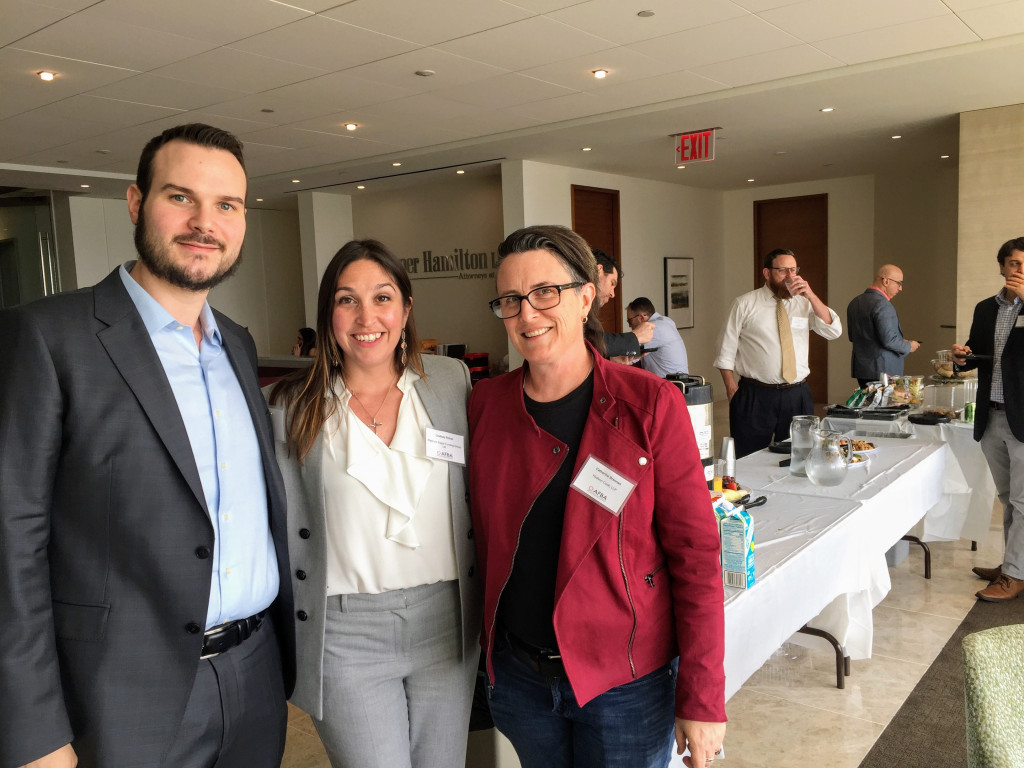 Later, Gregory Nowak, a partner at Pepper Hamilton, entertained the crowd with a few jokes before diving into the details and the risks of syndication. The conference was held at New York offices of Pepper Hamilton, with expansive views of the Hudson River.
“We are energized by the response of so many attorneys from different backgrounds in this emerging and evolving industry,” said one of founders of the AFBA, Lindsey Rohan, General Counsel at Platinum Rapid Funding Group in Long Island.
AFBA’s other founders are Kate Fisher, partner at Hudson Cook outside of Baltimore, Patrick Siegfried, Assistant General Counsel at Rapid Advance in Bethesda, MD, and Murray, attorney at Stein Adler outside of New York City.
 Robert Cook, one of Hudson Cook’s founding partners, was at the conference. He told deBanked that he remembered back in 2006 when an investment bank client asked his firm to do due diligence on a merchant cash advance company.
“We didn’t know what that was,” Cook said. “The client looked around for a law firm that had experience with MCAs. They couldn’t find any. So they came back to us and said, ‘You’re going to have to learn.’”
More than a decade later, MCA is no longer so obscure and the AFBA has at least three more planned events in 2018. The next event will be a cocktail reception on October 24th.
For more information, contact: Tiffany@LRohanlaw.com

deBanked was also a sponsor of the second annual AFBA conference.
An Inside Look at Strategic Funding’s Portfolio
June 10, 2018A Kroll Bond Rating Agency report reveals interesting details about Strategic Funding Source’s $105 million securitization and also their business. Here are a few main takeaways:
Pool breakdown
60% MCA
40% Loans
Average original receivable balance per merchant: $40,705
Weighted Average FICO Score: 649
Weighted Average RTR Multiple: 1.35
Weighted Average Time in Business: 12.5 years
Weighted Average Gross Revenue: $1,729,709
Number of ISOs/referral partners: 1,300
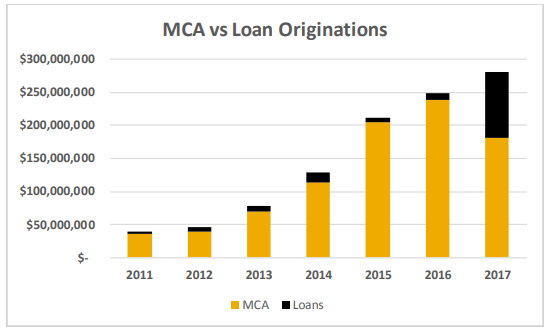
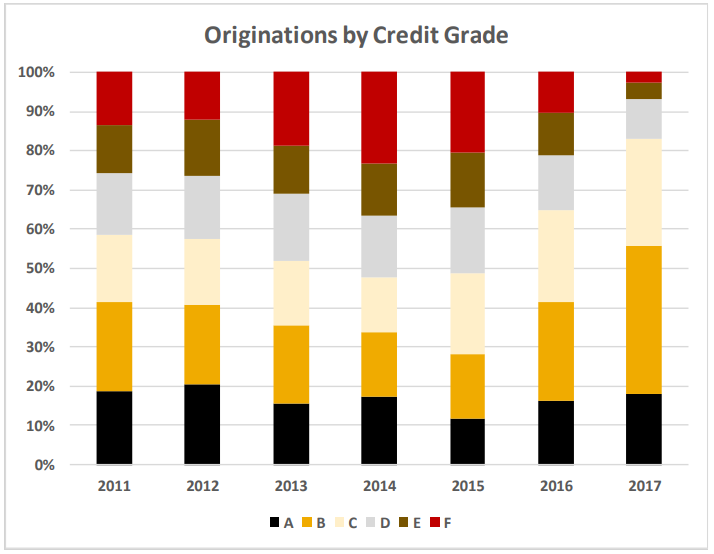
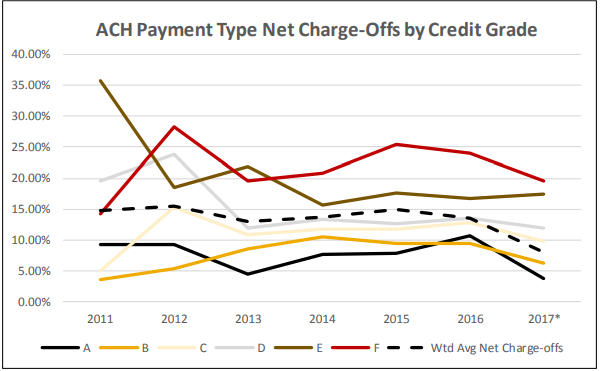
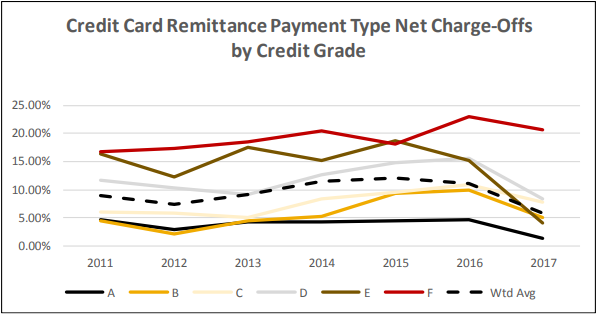
In an earlier interview, Strategic Funding CEO Andrew Reiser said, “It’s certainly exciting to be able to meet the requirements of a securitization. Kroll is a very responsible agency and they put you through a lot of rigor to be able to meet [their] requirements and have a rated bond.”