
Story Series: broker
Compete to Be The Top Broker in Person and Win Cash, Trophy, and the Title
January 23, 2025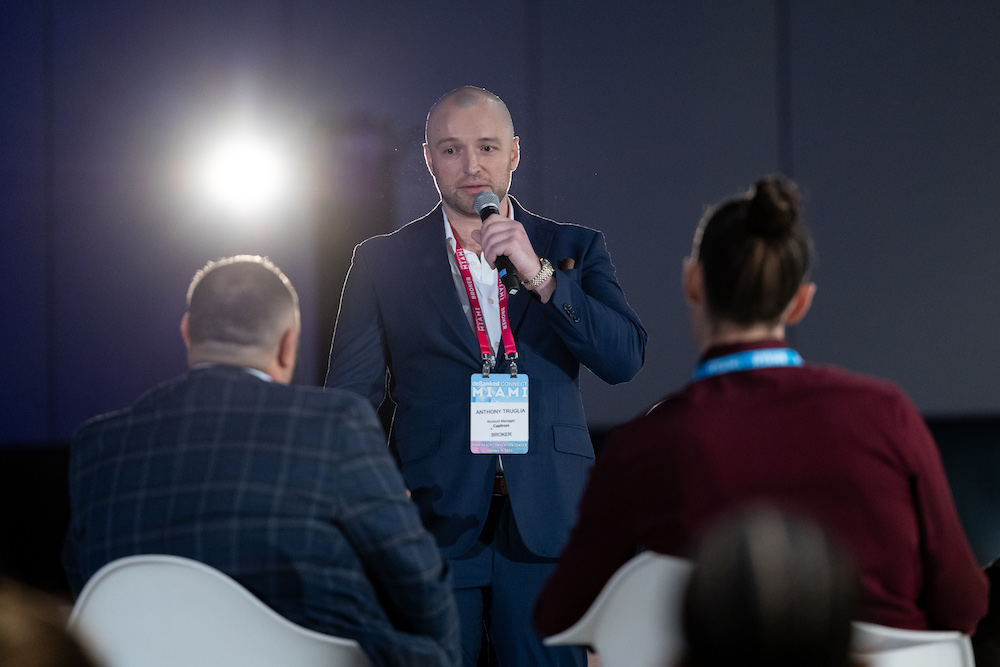
If you sell revenue based financing, SBA lending, or equipment financing, deBanked MIAMI invites YOU to compete in Broker Battle 2 in Miami Beach at the Fontainebleau on February 20th. It’s simple, just register to enter it here if you’re already attending the event, and be judged in a short qualifying round in person during deBanked MIAMI. The two highest scored contenders for each of the 3 aforementioned categories will compete on stage at the conclusion of the event for a short championship.
THE WINNER OF EACH CATEGORY GETS:
- $3,000
- TROPHY
- TITLE OF BEING TOP BROKER
- INTERVIEW WITH DEBANKED (AT YOUR DISCRETION)
This year, Anthony Truglia, the winner of Broker Battle 1, will return as an MC! The judges are a mix of previous participants and industry veterans who are ready to make the competition one you won’t want to miss participating in. All attendees of deBanked MIAMI will get to watch the battle as part of the day’s normal course of activity. See the photos from last year’s inaugural battle here or watch the full video to see what it was all about below!
Work With a Broker or Go Direct?
August 2, 2022“I believe that a merchant might be better off going to a broker so the broker can make available to the merchant several different offers,” said Pooja Nene, Broker Relations Manager at Balboa Capital. “And if they’re doing what they need to do correctly and if they’re really consulting the merchant correctly, I think that they would be providing the best offers to the merchant based on their needs.”
 It’s the age-old question, are merchants better served by using a broker or going direct? Opinions vary and are usually colored by what role one has in the process.
“The advantages of working with a broker is it saves the merchants a lot of time, and in some cases saves them money in fees,” said Randy Guerrier, Senior Funding Executive at Banana Exchange, a company that provides capital to MCA providers. Guerrier’s vantage point makes him less biased. “A lot of brokers do have a lot of preexisting relationships and wholesale rates that they could get with their relationships,” he said.
Matthew Washington, Founder & CEO of Moneywell GRP, says there’s a bit more nuance to the whole thing.
“The reality is that when the merchants go direct with lenders, they’re essentially dealing with the lender’s broker shop, right?” he explained. “Any lender that gets directly contacted by a merchant usually gives them off to their sales team, which [is also able] to send [them] off to other lenders.”
Washington, whose company is a funder, was an advocate for what brokers can accomplish for their clients especially since he relies entirely on them for business. He emphasized that his company is one that doesn’t have a direct sales team to handle any direct inquiries.
“All my business comes from my ISO channel,” he explained. “So when I approve a deal, it’s up to me and the broker to win it if there’s competition, but if I declined the deal, my brokers take that deal to another lender that has an appetite for that particular scenario.”
 “[Lenders] may not have the staff available to form that relationship with a merchant,” said Pooja Nene of Balboa about the debate on broker vs. direct. She also cautioned that sidestepping a broker in the process might not translate into an increased likelihood of approval.
“If it’s the first round of funding, if it’s their first loan schedule, we don’t know who this merchant is, and we may feel a little bit more comfortable with that file coming through the broker and the broker discussing the terms with the merchant,” she said.
Guerrier of Banana Exchange said, “It always comes down to working with the right type of broker, right? It comes down to the person that answers the phone that’s working with you, whether it’s at a big company or small company, I like to look at things from the individual working with the right people.”
And finding the “right people” isn’t automatic because they still have to be found, and once they’re found the lender has to decide if the customer is also right for them. Speaking about that in relation to all the economic uncertainty, Washington of Moneywell GRP said that a funding company should stick to what they’re comfortable with and not “chase deals” that they wouldn’t normally fund.
“But, also [on being found], I would market the heck out of my company and make sure that everyone in the world knows what I do, my product line, my branding, my logo, and make sure that anyone that is looking for capital that they know ‘hey, this company is always popping up,’ and I’d make sure that I stand out,” Washington said.
Brokers, Funders Find Their Footing and It’s Back to Business
April 12, 2022 For Mike Brooks, CEO of Best Connect Capital, the deal making never stops. A former boxing trainer turned funder said that there are no days off. “I’m always funding, I am always, always funding,” he said.
Recently, Brooks has taken an interest in text message marketing. “I’ve had trouble finding somebody in text marketing,” he said. I was going on the internet and using word of mouth, and I wasn’t really able to connect with anybody. I hooked up with this company [in Miami], and it worked out really well. I already funded a couple of deals.”
Around the industry, brokers and funders have found their footing after Covid. A recent mass gathering in Miami definitely helped push things along. “The second I got off the plane in Miami this year, I saw an old friend, a business associate,” said Brooks. “That was a great connect right there.”
Nicholas Saccone, Senior Funding Advisor at Proto Financial had a similar experience. “Having the opportunity to meet up with some of our partners face-to-face [is] a really cool experience,” said Saccone. “Sometimes it is hard to find time to build relationships with all of our schedules. [Through networking] I’m able to get different perspectives on where the industry is headed and where we are now.”
“Small business lending is on the up and up,” said Frankie DiAntonio, CEO of Lexington Capital, who also ventured down to Miami with his team from Long Island. “With inflation going up, we’re finding that small businesses are outsourcing their need of funding outside the government, and there are companies like us that can come in and take care of them.”
DiAntonio spoke about how important it is to sell legitimacy to both his lenders and staff. “We’re the new kids on the block, we’re a newer company,” he said. Despite the head start his competitors may have, DiAntonio said that old school sales mentalities combined with modern marketing strategies have recently helped his company consistently fund deals and build a book of business.
“We bring in a lot of Google click ads which brings us a lot of leads, but obviously our guys just make phone calls throughout the day, as much as humanly possible,” DiAntonio said. “My guys know what they’re doing, they know the industry, they’re really good on the phones, and they know how to take care of customers.”
Latin Financial Launches First Lending Podcast in ‘Spanglish’
February 4, 2022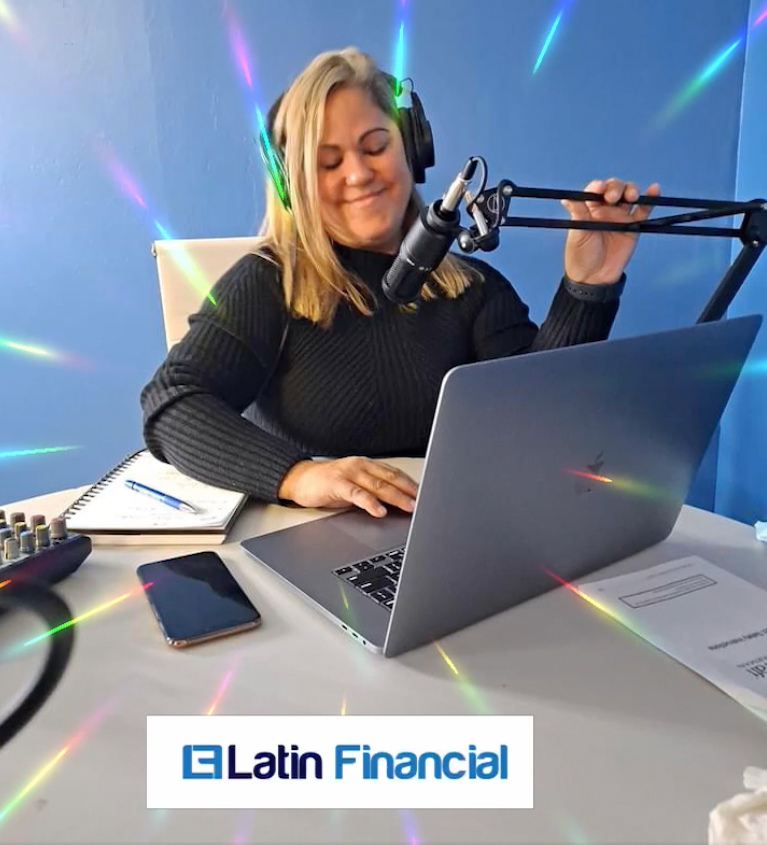 In an inaugural move for small business financing this week, Latin Financial launched the first ‘Spanglish’ podcast for funders, lenders, merchants, and brokers titled the Latin Financial Podcast. Hosted by the company’s CEO Sonia Alvelo and co-hosted by Underwriter Ruth Alustiza, Latin Financial hopes to create an open forum of discussion and education about how Latino-owned businesses can get access to different types of financial products; all in two different languages.
“It was so much fun, but so scary,” said Alvelo, when asked about her experience recording on her first episode. “[I’m doing this] to make sure the merchants and clients have and will have the right information, I know I’m breaking barriers of languages, it’s the right thing to do.”
While still in its infancy, Alvelo is expecting the show to take off. Her target audience among merchants is a growing group of Latino-owned small businesses who have been historically underbanked. Offering episodes in both English and Spanish, the podcast hopes to not only educate the show’s listeners on how small business lending works, but also hopes to serve as a crash course in either Spanish or English for those who are already members of the non-bank finance world.
The show will have funders, lenders, merchants, and staff of Latin Financial on as guests, according to Alvelo. The show has begun a stream of content that will be released on a regular basis that is being uploaded on platforms like Apple Podcasts, Google Podcasts, and Spotify.
“We are doing one episode per week, said Alvelo. “We’re going to add guests, they are already asking me to attend, and lenders. I’ll be doing back and forth, Spanish and English for sure.”
Alvelo seems confident that the show can separate itself from the countless other finance podcasts that exist. With a dynamic of two languages, two cultures, complex financial products, and revolving guests, it seems as if Latin Financial has discovered a niche in the business media space. “The audience can listen in Spanglish about what we do to help business owners in the United States and Puerto Rico. It’s a new way to stay informed, get educated on updated programs in the financing Industry, all in two languages,” Alvelo said. “It’s Spanish and English, equals Spanglish!”
A weblink to the show can be found here.
Broker in Early Twenties Builds MCA Business in Less Than Three Years
February 10, 2021 Davron Karimov, a 22-year-old MCA broker, went from $10k in debt to collecting $200k a year in commissions. It took less than three years, and Karimov shared his journey on his personal, sometimes chaotic, yet always informative YouTube channel.
The Staten Island native said he first started at a Long Island City shop and quickly made some early deals, eventually leaving to start his own firm, FunderHunt, and recently opened an office in Miami.
But do the YouTube videos help him make deals? Of course they do, Karimov says, and he not only gets deals through his video platform but he also get questions from other MCA brokers who reach out for help.
“Of course, we get people all the time calling in, people that have questions, people in the industry need help with their merchants,” Karimov says. “I started around 2018, and there was no info on YouTube about business funding, a huge void online. I stepped up and thought I could be the one to supply info.”
Nearly three years later, Karimov has built an expanding business while helping others through the struggles of being a broker and CEO in the MCA world. In the last year alone, the pandemic caused applications to explode, Karimov says.
“It’s been better than ever; I’ve never seen so many applications in March and April; they were just soaring,” Karimov says. “And then I’ve never seen so many applications get denied because of the industry at the time everything was shutting down.”
It was a time to capitalize if your shop was strong enough to survive what Karimov called the “dark ages” for MCA. If you survived, you get to reap the reward of a capital-deprived market, he says.
“The whole crisis took out so many funders that were just not good, they probably were supposed to go out of business a long time ago, but this accelerated it,” Karimov says. “It took out all the bad funders and replaced them with people that are solid, fast, and have everyone’s best interest at heart, from the merchant to whoever the ISO is.”
According to Karimov, 2020 solidified who is a real player in the game. Launching a new office himself, Davron says he enjoys sunny days in Miami while it is twenty degrees in-between blizzards in New York. Though snow wasn’t the reason he moved, but instead the funding environment.
“Everyone has been warm and welcoming [in Miami], the government knows what this is, and that’s what we do. We try to educate them: not a lot of people know here about this; it’s like it’s a secret,” Karimov says. “If you go to New York, it’s like everybody knows, there are so many shops there. But here, it’s kind of rare to see someone that knows what a cash advance is.”
Compared to New York’s increasingly restrictive funding ecosystem, the Florida space is open to growth. That’s exactly the environment Karimov hopes to profit from, expanding his business in any way that will be geared toward helping businesses.
“I’m not a huge fan of diversification,” Karimov says. “I like doing one thing. But we opened up an office in Miami; we’re bringing experienced people in and trying to fund deals as fast as possible. We’re maybe looking to develop into offering a debit card, whatever is in the business’s best interest.”
For ISOs Only — How To Develop Your Factoring Brokerage Business (Part 2)
December 12, 2019In Part 2, we’re going to focus on 3 major areas:
(1) What is Factoring and How Does it Work?
(2) What Are the Costs?
(3) How Do You Qualify?
We’re also going to touch on HOW TO find factoring funders.
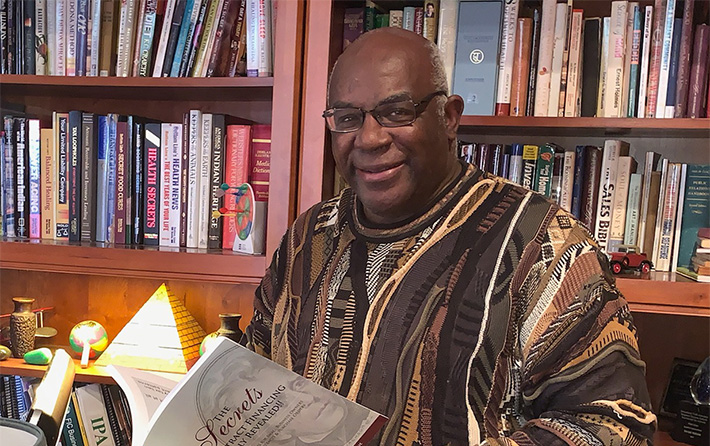 What is Factoring and How Does it Work?
Factoring actually dates back to 2000 BC but got going in the US during the 1600s when colonists sought “advance payments” on tobacco, cotton, etc., shipped across the Atlantic to England. Today, it’s a TRILLION DOLLAR INDUSTRY worldwide, involving commercial banks, asset-based lenders, Fintech companies, and private hedge funds all over the world. And a million years later the purpose of factoring is the same; speed up cash flow by leveraging receivables, while waiting to get paid.
In a nutshell, much like an MCA, factoring is an advance against “future invoice proceeds.”
However, unlike an MCA where the advance is largely based on bank statements, with factoring, advances are based on the number of confirmed invoices the merchant has outstanding with their approved B2B customers. The invoice(s), which is the asset, serves as COLLATERAL.
So, while an MCA funder “looks backwards” at bank statements to help determine eligible amount, the factoring funder “looks forward” to determine eligible amount based on approved invoices.
Factoring advance rates typically range from 70% to 90% of the invoice face value, and are based on volume, industry type, etc.
There are two major elements required for factoring to work. The first is the merchant must be doing business with a credit-worthy B2B customer. Approval isn’t based on the financial strength of the merchant, but on their customer, i.e. the company paying the bill.
The second major element is that, in addition to being credit-worthy, the customer must agree to send invoice payments DIRECTLY to the funder. This provides the funder with an assurance of payment and substantially reduces the risk of re-payment or default.
So, unlike an MCA where payment is on a daily or weekly basis, the factoring advance has NO PAYMENTS, and actually pays itself off once the invoice has been paid. The funder then deducts the advance along with their fee and wires the balance to the merchant.
With no payments and invoice proceeds automatically paying off the advance, I refer to this as a “SELF LIQUIDATING LOAN”. It’s also “ELASTIC”, which means the more confirmed invoices the merchant has outstanding, the more funding they are eligible to draw. It’s like having a revolving LOC with no payments………of course unless the customer doesn’t pay, right? Good question!
So, here’s the answer: There’s actually two types of factoring; (1) RECOURSE FACTORING, which means if a customer doesn’t pay the invoice, the Merchant is financially responsible for the advance, and (2) NON-RECOURSE FACTORING, which means they’re not.
Here’s the process in a nutshell: Merchant submits app and doc checklist for preliminary underwriting approval. Funder issues term sheet, and if accepted by Merchant, underwriting and due diligence is completed. A closing and funding docs package are submitted to the merchant, and upon execution, the funder is prepared to start confirming and funding invoices.
How long does it take from start to finish? Depends on how much hair there is on the file. A clean file can take as little as 5 to 7 business days. A file with a lot of hair can take much longer. We actually had a $13 million file funded in 48 hours! That guy was pretty happy and so was I. It was an acquisition with a deadline. So, here’s what to tell your merchants with regards to timing: “funding is not calendar-related, but event related”. In other words, once the required events are completed then funding can occur.”
What Are the Costs?
There are several major factors that determine cost, rate, terms. volume, invoice size and funding frequency, industry type, risk, etc. Every funder has their own respective rate and fee schedule. Some charge application/due diligence fees while others don’t. Some charge origination and/or admin fees, while others don’t.
Some funders base their pricing on APR, with rates as low as Prime + 3 to 5%, while others have all-in rates typically ranging from 1.5% to 3% per month. After the first 30 days, monthly rates are typically broken down in 10 or 15 day increments (pro-rating). As a result, the ACTUAL COST of factoring in dollars and cents, is based on the amount of time the advance is outstanding, from the funding date to the date the invoice payment is received by the funder.
Here’s an alternative perspective on cost: Factoring is like “renting money on a daily basis,” where the funder essentially takes “equity in the transaction” versus equity in the business. Comparing the bottom-line cost with the bottom-line benefits is the key. But at the end of the day, “the highest price you pay for money is the price you pay for the LACK of it”.
Just like with MCAs, make sure you understand the rate structure, terms, and fees charged by your factoring funder, and how to calculate the cost in dollars and cents as well.
How Do You Qualify?
Factoring approvals have 3 components: The first is the merchant. Again, every funder has their own approval criteria and document checklist. Some require minimal info, while others ask for EVERYTHING including a pint of blood. While most only require one month bank, approval is not based on deposits, or how well they manage their account. Remember their primary focus is on assessing the quality of the receivables, determining if they have sufficient gross profit margins, ensure they are in good standing, and address any “deal killers”, i.e. tax liens, judgments, or UCC filings in first position, which is where they need to be, in most cases. (We actually have funding partners who will factor in second and third positions)
The second factoring approval is the merchant’s customer(s), typically referred to as the debtor. This is determined by the funder who looks at things like D&B, PAYDEX Scores, and other proprietary industry databases. In some instances, a lack of secondary financial/credit information on the customer can be offset through their payment history with the merchant. In other instances, the funder may require bank and trade references if no history exists. Candidly speaking, best practices by the merchant says they should already be doing the same thing; i.e. credit qualifying their customers, whether they need funding or not, unless it’s a large, well established company or government agency. The fact is, extending terms to someone you don’t know can be risky because ‘all businesses may not be good businesses.’ Let’s face it, it’s all about getting paid, right?
Ever heard this horror story; “I need an MCA because I got burned by one of my customers who strung me out and never paid me!” Too bad. They should have picked up that $100 bill off the street! Just kidding!
The third factoring approval is on the deal itself, i.e. the purchase order or contract the merchant has with the debtor. There are over 15 different things the funder will look at to identify existing or potential funding issues. Here’s an example. I recently got a referral for a client who had 63 different purchase orders going to 63 different locations for the same large customer, but BEFORE he started shipping, half the orders had already passed the CANCELLATION DATE! What do you think the chances are of the deal being approved for funding? Don’t know yet. Will let you know when I get to part 3 of the series. Keep your fingers crossed and so will I.
Typical things the funder looks at are payment terms, default clauses, customer signature, offset clauses, just to name a few. If you’d like a complete list, just shoot me over an email.
How to Find Funders
Finding factoring funders is easy. Just google FACTORING and you’ll get a whole bunch. What’s NOT so easy is determining the “best fit” for YOUR merchant because one size does not fit all. Over the years, some of the biggest horror stories I’ve heard from both funders and clients was a relationship that went bad because it was not the best fit. But remember this; “just because you picked the wrong spouse doesn’t mean getting married is a bad idea.” Determining the best fit is one of the key functions for your factoring brokerage business.
Some funders you will find specialize by industry, i.e. transportation, medical, staffing, construction, while others don’t. Some can move quickly while others take two weeks. Some are more flexible than others. Some focus on A-credit Merchants and have the lower rates, while others work with start-ups. Always find out UPFRONT their approval criteria and constraints. Shoot over an email and I’ll send our list of the Top 10 Questions to Ask Before Selecting a Factoring Funder.