

Watch the House Subcommittee Hearing on Fintech and Online Small Business Lending
October 26, 2017deBanked streamed the small business subcommitte hearing that took place at 10AM EST in Room 2360 of the Rayburn House Office Building on October 26th. If it’s not loading below, you can watch it at: House Small Committee website.
Kate Fisher, a partner at law firm Hudson Cook, testified on behalf of the Commercial Finance Coalition. As described in her prepared written testimony, “CFC member companies offer fair and innovative alternatives to bank term loans and have stepped in to provide capital to small businesses when larger, traditional banks stopped providing such financing. CFC member companies primarily offer Merchant Cash Advance (‘MCA’) factoring products. An MCA allows small businesses to access funds for, as an example, a seasonal inventory surge or to replace an unexpected major equipment failure. CFC members provide financing between $10,000 and $500,000 to qualified small businesses.”
Her written testimony can be accessed HERE.
The CFC’s Spring Fly-in was covered back in June when the group met with 26 members of Congress and senior staff. The group was reportedly back in Washington again this week to educate members of the House Small Business Committee about MCAs and alternative finance. We will provide more information as it becomes available.
The Top Small Business Funders By Revenue
October 23, 2017The below chart ranks several companies in the non-bank small business financing space by revenue over the last 5 years. The data is primarily drawn from reports submitted to the Inc. 5000 list, public earnings statements, or published media reports. It is not comprehensive. Companies for which no data is publicly available are excluded.
| Company | 2016 | 2015 | 2014 | 2013 | 2012 |
| Square1 | $1,708,721,000 | $1,267,118,000 | $850,192,000 | $552,433,000 | $203,449,000 |
| OnDeck2 | $291,300,000 | $254,700,000 | $158,100,000 | $65,200,000 | $25,600,000 |
| Kabbage3 | $171,784,000 | $97,461,712 | $40,193,000 | ||
| Swift Capital4 | $88,600,000 | $51,400,000 | $27,540,900 | $11,703,500 | |
| National Funding | $75,693,096 | $59,075,878 | $39,048,959 | $26,707,000 | $18,643,813 |
| Reliant Funding5 | $51,946,472 | $11,294,044 | $9,723,924 | $5,968,009 | $2,096,324 |
| Fora Financial6 | $41,590,720 | $33,974,000 | $26,932,581 | $18,418,300 | |
| Forward Financing | $28,305,078 | ||||
| Gibraltar Business Capital | $15,984,688 | ||||
| Tax Guard | $9,886,365 | $8,197,755 | $5,142,739 | $4,354,787 | |
| United Capital Source | $8,465,260 | $3,917,193 | |||
| Blue Bridge Financial | $6,569,714 | $5,470,564 | |||
| Lighter Capital | $6,364,417 | $4,364,907 | |||
| Fast Capital 360 | $6,264,924 | ||||
| US Business Funding | $5,794,936 | ||||
| Cashbloom | $5,404,123 | $4,804,112 | $3,941,819 | $3,823,893 | $2,555,140 |
| Fund&Grow | $4,082,130 | ||||
| Nav | $2,663,344 | ||||
| Priority Funding Solutions | $2,599,931 | ||||
| StreetShares | $647,119 | $239,593 | |||
| CAN Capital7 | $213,402,616 | $269,852,762 | $215,503,978 | $151,606,959 | |
| Bizfi8 | $79,886,000 | $51,475,000 | $38,715,312 | ||
| Quick Bridge Funding | $48,856,909 | $44,603,626 | |||
| Funding Circle Holdings9 | $39,411,279 | $20,100,000 | $8,100,000 | ||
| Capify10 | $37,860,596 | $41,119,291 | |||
| Credibly11 | $26,265,198 | $14,603,213 | $7,013,359 | ||
| Envision Capital Group | $21,034,113 | $19,432,205 | $12,071,976 | $11,173,853 | |
| Capital Advance Solutions | $4,856,377 | ||||
| Channel Partners Capital | $2,207,927 | $4,013,608 | $3,673,990 | $2,208,488 | |
| Bankers Healthcare Group | $93,825,129 | $61,332,289 | |||
| Strada Capital | $8,765,600 | ||||
| Direct Capital | $432,780,164 | $329,350,716 | |||
| Snap Advances | $21,946,000 | ||||
| American Finance Solutions12 | $5,871,832 | $6,359,078 | |||
| The Business Backer13 | $19,593,171 | $11,205,755 | $9,615,062 |
1Square (SQ) went public in 2015
2OnDeck (ONDK) went public in 2014
3Kabbage received a $1.25B+ private market valuation in August 2017
4Swift Capital was acquired by PayPal (PYPL) in August 2017
5Reliant Funding was acquired by a PE firm in 2014
6Fora Financial was acquired by a PE firm in 2015
7CAN Capital ceased funding operations in December 2016 but resumed in July 2017
8Bizfi wound down in 2017. Credibly secured the servicing rights of their portfolio
9Funding Circle’s primary market is the UK
10Capify’s US operations were wound down in early 2017 and their operations were integrated with Strategic Funding Source. Capify’s international companies are still operating
11Credibly received a significant equity investment from a PE firm in 2015
12American Finance Solutions was acquired by Rapid Capital Funding in 2014, who was then immediately acquired by North American Bancard
13The Business Backer was acquired by Enova (ENVA) in 2015
The Voice of Main Street – Small Businesses Share Their Experience With Non-bank Finance
October 18, 2017
If she hadn’t scored the $250,000 loan through Breakout Capital in 2015, Jackie Luo says, the commercial-software firm she heads in Baltimore could not have made the “strategic hires” and purchased the new server to support additional customers and maintain the company’s 30% growth rate.
“Without that infusion of capital” from the McLean (Va.)-based lender, says Luo, chief executive at E-ISG Asset Intelligence, the software solutions provider would have been hard-pressed to deploy the “bandwidth and capacity” necessary to meet burgeoning demand.
And demand there is. Luo says billing for her company’s services helping more than 100 businesses and government agencies improve operational efficiency by keeping tabs on multiple assets — human, financial and equipment — topped $1.5 million last year, up from $1 million in 2015. This year, moreover, E-ISG is on track to collect nearly $2 million.
Meantime, she says, the $250,000, 10-year note at 6% interest she obtained with the help of Breakout was both a good deal and convenient: she reports securing the financing in three weeks, compared with the six months that a commercial bank would likely have taken. In addition, she’s been able to forge a better relationship with Breakout than with a faceless financial institution.
“We are a small business,” she says, “and we’d be just one in a million at a big bank like Wells Fargo. They wouldn’t give us much attention.” With Breakout, Luo adds: “I have the freedom to make decisions about infrastructure investments without worrying about the short-term. And I don’t have to deal with people second-guessing me.”
Had she not gotten the financing, moreover, “I would not be able to pay myself,” she says. “I’d have to use my salary as working capital.”
Luo is not alone. Her company’s story of finding much-needed capital from a nonbank financial company is increasingly common. It has always been challenging for small businesses to obtain credit from a big bank — roughly a financial institution larger than $10 billion in assets. But the small and community banks that have been the lifeblood for small businesses have also been winding down their small-business lending as well, according to a March, 2016, working paper published by the Federal Reserve Bank of Philadelphia.
“As recently as 1997, small banks, with less than $10 billion in assets, accounted for 77% of the small business lending market share issued by commercial banks,” co-authors Julapa Jagtiani and Catharine Lemieux write in “Small Business Lending: Challenges and Opportunities for Community Banks.” However, the market share dropped to 43% in 2015 for small business loans with origination amounts less than $1 million held by depository institutions.
“The decline is even more severe for small business loans of less than $100,000,” they add, “where the market share for small banks under $10 billion declined from 82% in 1997 to only 29% in 2015.”
 The Philadelphia Fed study notes that alternative nonbank lenders are filling a widening gap. “By using technology and unconventional underwriting techniques, many alternative lenders are competing for borrowers with offers of faster processing times, automatic applications, minimal demands for financial documents, and funding as soon as the same day.” And the Fed study finds that it’s likely that nonbank lenders, which are growing rapidly, are having a positive effect by “increasing the availability of credit, particularly to newer businesses that do not have the credit history required by traditional lenders.”
Meantime, the Small Business Administration reports that small businesses remain essential to the health of the U.S. economy. Businesses with fewer than 500 employees account for 55% of overall employment in the U.S., according to the agency, and are responsible for creating two out of every three net new jobs. Which means that alternative funding sources — which do not, it is worth noting, depend on depositors’ money, as banks do — are playing an increasingly important and largely unrecognized role in the country’s economic fortunes, notes Cornelius Hurley, a law professor at Boston University and executive director of the Online Lending Policy Institute. “They’re still a small percentage of the overall lending picture,” he says of nonbank financial companies, “but they’re an emerging force and a lot of small businesspeople certainly depend on them. If they disappeared tomorrow,” he adds, “a lot of businesses would be wiped out too.”
To find out what is happening in the real world, deBanked interviewed small business owners around the country: among others, a Houston sports medicine provider, a Connecticut restaurateur, a Midwestern truck hauler, and a Maryland hardware-store owner. Some recounted being shunned by banks because of poor credit while others registered unhappiness with traditional financial institutions as inconvenient and impersonal. While some who turned to alternative lenders admitted they would have preferred not to be paying dearly for borrowing or for cash advances, most said the tradeoff was worth it.
The existence of alternative lenders has made it possible for these businesspeople to meet payrolls, pay contractors and suppliers even when business was slow or billings stalled. Customers with alternative funders – in addition to Breakout’s customers, deBanked spoke to clients of Pearl Capital Business Funding and Merchants Advance Network– also reported that they were able to purchase or replace equipment and maintain inventory, hire additional employees and accept new customers, pay for upkeep and upgrades of their business’s physical plant, and make other expenditures necessary to keep operations up-and-running.
Jason, for example, who heads a family business in Louisiana manufacturing and selling pesticides (and who asked to be identified only by his first name), reports that his suppliers began demanding that he pay in advance for chemical feedstock after he took a “financial hit following a nasty divorce.”
The roughly $1 million (annual sales) business — which was started by his parents back in 1960 — furnishes chemicals mainly to cotton farmers and homeowners in Louisiana and Texas, most of whom purchase the company’s products through feed and hardware stores. Jason says he spends a substantial amount of time on the road handling sales and distribution.
 His suppliers not only require him to pay for the chemicals upfront but, following his divorce, they now insist upon larger purchases as well. Following the departure of a previous lender, he says, Breakout stepped in with an $80,000, 12-month loan in March, 2016, which he was able to repay within six months. This was followed by a $60,000 borrowing in March, 2017, which he again paid down early – in 90 days, Jason says – and the account manager at Breakout “went to bat for me and gave me an additional discount for early payment.”
Had Breakout not provided external funding, Jason says, he would have been “wiped out.” He adds with feeling: “It would have meant the end of me.” And sinking the fortunes of the company would also have spelled job losses for five employees, including both his son, who works part-time, and his sister, the business’s co-manager. “Now I’m out of the hole,” he says.
In Houston, Anna, co-owner of a physical therapy and sports medicine concern, was interviewed in August just before Hurricane Harvey loomed on the horizon. “We’d been around for four years and growing rapidly,” she says, asking to be identified only by her first name, and “we couldn’t keep up with the growth.”
Anna recalls that a few years ago (she is vague about the exact dates) the company needed $50,000 to $60,000 to add equipment and staff to meet the growing demand. Because of some “ups and downs” in her business and credit history, however, a bank loan was out of the question. “My credit wasn’t the best,” Anna says, “and we had not been in business the five-to-seven years that most banks want.” She began casting about for financing and quickly saw that factoring would not be a suitable choice for a business like hers, which depends heavily on third-party payments from health insurance providers. “Companies using factoring are taking money based on credit card payments,” she says, “and we’re not a restaurant or a bar. So we can’t pay a percentage of every transaction.” Typically, she notes, getting paid by an insurance company involves a “90-day turnaround.”
 Anna went online, did some research, and talked to three or four nonbank lenders searching for the “right kind of company.” That led her to Breakout. “What I really liked about them is that they did a lot of due diligence on our field,” she says. “They did their homework, asking us: ‘What are your collections and payroll? How much outstanding debt do you have?’ They also asked to see our actual bank statements.”
Despite the high level of due diligence that Breakout performed, Anna says, it only took “maybe three or four days” for the loan to be approved and for the money to land in her bank account. Before long, she was off to the races. With the added capital, she hired three more employees – bringing the employee headcount to 18 — purchased more gym equipment, made payroll, and paid off miscellaneous expenses.
The added capacity and fortified staff, meanwhile, enabled the company to “almost triple its volume,” the entrepreneur says. And not only did the financing “put me in a good financial place,” Anna adds, but after repayment, Breakout made it possible for her to effect a merger with a competitor by approving a second loan for about $30,000. “The best thing about Breakout,” she says, “has been the communication. One time I did need to make a payment two or three days late. But I just called (the account manager). I was very surprised because these kinds of companies are seen as a last resort. But it was like they were investing in us.”
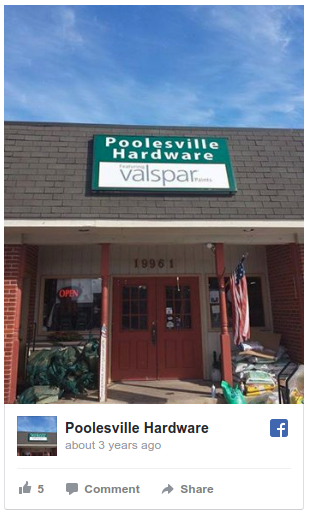
John Speelman, who owns Poolesville Hardware in Poolesville, Md., can boast a raft of five-star Yelp reviews online. “Extremely helpful and friendly service, surprisingly good selection (and) the complete opposite of a big box hardware chain,” raves one customer. “It is so rare to find a well-stocked store that has helpful personnel—makes this store a real gem!” says another fan.
For his part, Speelman attributes much of his hardware store’s popularity to the financing arrangement that he’s been able to work out over the past eight years with Merchants Advance Network, a Fort Lauderdale (Fla.)-based alternative funder. “It takes money to make money,” is one of his pet aphorisms.
Located roughly 35 miles west of the White House, the hardware store boasts a clientele who tend to arrive in BMW’s rather than the pickup trucks that predominated a decade or so ago in this exurban community of some 5,000 denizens. Whatever their class background, though, they’re looking for items that are not a good match for an online purchase. “People don’t buy a toilet plunger, a can of paint or picture-hanging stuff online,” Speelman says. “Because they want to do that today,” he says, “they won’t order with Amazon.”
“One industry that has not been impacted” by online merchandisers, he adds, “is the garden center. They’ll buy a garden hose, weed killer and seeding,” he explains of his regular customers. “And light bulbs” while they’re there, he adds. “We’re like the 7-Eleven — a convenience store.”
To guarantee that convenience, Speelman pays cash-in-advance for most of his inventory, and banks have not been helpful. He contrasts the relationship he has with Michael Scalise, the chief executive at Merchants Advance, with loan officers at commercial banks. “It’s hard to get a loan for anything in retail,” he says. Never mind that he maintains “a high credit rating and I never bounce a check,” he went on. “There are no more local banks. At M&T Bank, all the managers I knew are gone and there’s always a new teller. The banking industry is a revolving door.” So he opts for capital from Merchants Advance “when I need 30-40-50 grand in a day, I use Mike’s money” even though the cost can be as steep as 25%, he says. If he doesn’t have something in stock – specialty items like ammo boxes, a Sugarplum tent, as many as 32 packs of size D batteries, metric measuring tapes – he can put in a special order with suppliers. But he prides himself on the full panoply of wares on his shelves. “You can’t sell from an empty cart,” is another of his favorite sayings.
Lori Hitchcock, who also draws capital from Merchants Advance, is manifestly displeased with the banking industry. She’s an owner with her husband of Hitchcock Trucking, the couple’s 60-year-old family business, which is located on a ten-acre tract in Webberville, Mich., situated between Detroit and Lansing, the state capital.
Of her experience with banks, Hitchcock says: “At the time we went with (Merchants Advance), banks weren’t lending. And they’re still not lending. We’re considered high-maintenance and high-risk. Banks don’t want a bunch of trucks” should they foreclose on a loan, she observes. “If you’re a farmer, they can take all your land. Great! In this crazy world you live in, it’s hard to get the banks interested.”
 The Hitchcock family’s fleet of ten Peterbilt semis hitch up to more than 20 trailers and truck bodies – flatbeds, dump trucks, vans, and refrigerated trucks or “reefers” – and haul grain, sweet corn, onions, celery, fertilizer, and soft drinks across the Midwest. Most recently, she says, the family business took out $80,000 from Merchants Advance to expand its fleet and buy another reefer trailer and a backhoe. “Out here in the country, you always need a backhoe,” she says.
To satisfy her lender, the company makes daily ACH payments. “I’m not going to lie and say that things aren’t tight,” she says. “It is a burden. You just have to have constant cash-flow – which we do have. And it’s important to have good relationships…I can usually tell three weeks in advance if (making payments) is going to be challenging. So it all comes down to being loyal to people.”
Whatever the struggle to keep up with debt payments, it beats using her own money. “My husband and I are raising a family,” Hitchcock says, “and it’s nice having the cash so you’re not putting your personal earnings into the company.”
In Manchester, Conn., a stone’s throw east of Hartford, Corey Wry says that he wouldn’t be able to operate his two, highly rated restaurants just off Interstate 84 – Corey’s Catsup & Mustard and Pastrami on Wry – if he didn’t have funding from Pearl Capital, a New York (N.Y.)-based alternative funding company. A graduate of Johnson & Wales University in Providence, a restaurant-and hotel school, Wry describes himself as “a culinary guy” whose first love is serving food that’s both innovatively prepared and delicious. He candidly admits that his credit hit “rock bottom” after a confluence of untoward events.
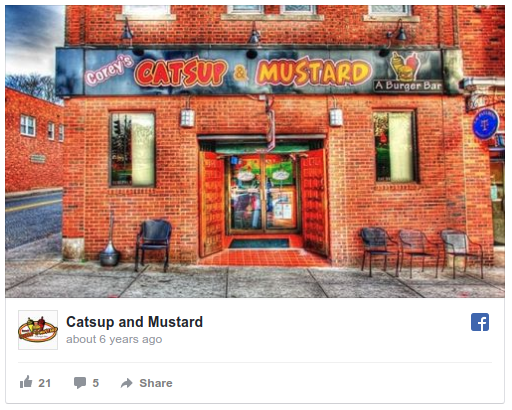
Last year, a third restaurant in town, Chops & Catch, that he and some partners had “bootstrapped” had to shut down after six years of operation. Despite generally favorable reviews for such creative fare as the “lobsterburger,” the surf-and-turf themed restaurant was a money-loser. He was also struggling to pay off credit cards. And he’d been late more than once on car payments.
At the same time, Wry was in the process of moving Pastrami & Wry — a deli whose moniker is wordplay on his last name – to a new location. Both the general contractor and electrician were “over-budget” on that project, he says. Meanwhile, Catsup and Mustard, a hamburger spot, needed to be spruced up. Says he: “It was getting busier and the original seats were worn. I had a hole in a booth big enough to swallow someone.”
He approached a few banks for a loan and “it did not seem like it was going to happen,” he says. “Then I got a cold call from one of these financiers. Some of them had super-high rates. When you have bad credit but need to make capital improvements you do what you have to do.”
He’s accessed more than $100,000 from several alternative funding sources, including Pearl – from which he reports getting merchant cash advances for $30,000. But hard as it is to meet the obligations, which typically require a daily ACH payment, the financing has made renovating the burger place possible. Moreover, he’d still be on the hook with plumbers and other contractors – all of whom are local tradesmen and would likely be paying him personal visits until they were repaid — for the relocation of Pastrami & Wry.
“Business is good,” says Wry, who at 40 is single, often works 15-hour days, and says that he doesn’t have time for a girlfriend, much less a wife and family. “I’ve still got $3,200 on the books with the electrician,” he adds, “which means that I won’t be able to purchase a deli slicer. I have to plan these things out…”
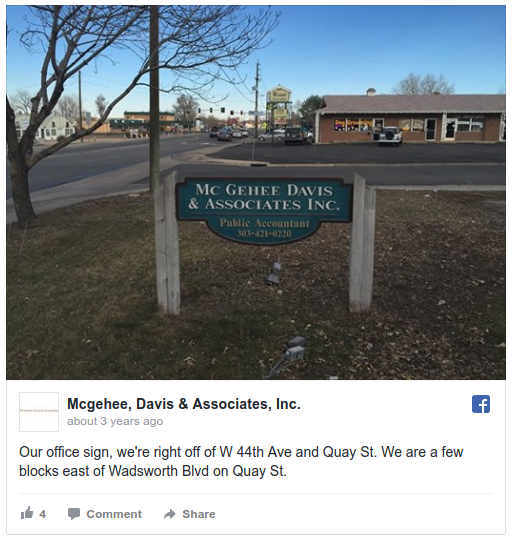
James McGehee, a partner at the boutique accounting and tax-preparation firm McGehee, Davis & Associates, which is located in the Denver suburb of White Ridge, reports that the firm took a merchant cash advance from Pearl Capital, among other financiers, to bridge the gap between tax season and the rest of the year when billings invariably diminish. “Our overhead is pretty high,” he explains. “We’ve added two employees. We’ve been expanding on what we were doing, adding tax and accounting clients.”
A very conservative, sober-sounding man, McGehee explained that his credit was nonetheless “trashed” after he suffered from health problems five years ago. “Major stuff,” he says, “it was open-heart surgery.” The medical ordeal meant that he could not work for a time and had trouble paying his bills. “Some family members helped me through the mortgage and utilities payments and I ended up in arrears and in credit card debt,” he says.
All of which made an alternative source of financing his firm’s only option. “I’m not sure how we heard about Pearl,” he says. “I think they just happened to call. We took out [$11,000]. It was not a huge amount. We also borrowed $9,000 from another entity. We paid it all back during tax season. The terms were pretty steep,” McGehee adds.
“But when you need the money for cash-flow,” he explains, “you just absorb it. You grin and bear it. When you need the money, you need the money.”
The Sept/Oct 2017 Issue of deBanked Magazine Has Shipped
October 12, 2017The latest issue of deBanked Magazine has shipped. In this issue we explore a new rule implemented by credit bureaus surrounding the reporting of liens and judgments, the shifting landscape for lead generators, and once again, what merchants themselves are saying about their experiences with online loans and merchant cash advances. There’s a lot more of course!!!
If you’re already subscribed, you should receive a copy soon. If you haven’t subscribed, you can make sure to get all future issues FREE by SIGNING UP HERE
Bizfi Alum Jared Weitz Reflects on Demise of Former Employer and Rise of UCS
October 9, 2017 Jared Weitz has come a long way since his earlier days as one of the original Bizfi employees. Today he’s at the helm of online funding marketplace United Capital Source (UCS), which has been on a tear since deBanked last spoke with Weitz a couple of years ago. The UCS founder and chief executive took some time to revisit with us about having to painfully watch the demise of his former employer, which is where he cut his teeth in this business, and the rise of his own company UCS as a funding marketplace.
In some ways, the more things change the more they stay the same. Since the last time Weitz spoke with us, the company’s location remains in the heart of Times Square in New York, and UCS has grown its staff by only four people including two sales reps. What has changed, however, is the amount of funding that the company has done and the size of the average transaction, all of which have blossomed.
“When we first spoke a few years ago we were doing $8 million to $10 million a month in funding volume. Now we are doing between $14 million and $16 million per month,” said Weitz.
He added that where the company differentiates itself is that while a few years ago the products they were selling were predominately in the sub-prime space now they sell other products, which allows merchants to “swim upstream” when they qualify for that.
The result has been bolstered partnerships and product offerings and an average loan size that has jumped from $30,000 to $40,000 per deal to a range of $500,000 to $2 million.
“We opened up the funnel to the kind of relationships we’re able to broker and the kinds of financings we’re able to offer. We’re playing in the field of SBAs, account receivables financing, lines of credit and asset backed loans. By offering these products our volume has jumped significantly and allowed us to talk to different referral partners.”
UCS does all of its own marketing and generates leads for their in-house sales reps. Those sales reps take a file from open to close and they analyze the small business owner’s needs on a consultative call.
“We understand their business and their pain points. The first question we ask isn’t how much do you need but what’s paining you in your business today that we can help you with?”
One such business owner recounted his experience with UCS to deBanked, saying that traditional banks were “an absolute pain” to secure funding. He spoke of the “very stressful” and time-consuming process of applying for a loan, saying he doesn’t have time to “jump through a million hoops to get a loan.”
“When I was initially looking to curb my temporary cash flow problem, I searched online for the best alternatives to traditional bank loans. I read all the reviews on companies and decided to call UCS,” the business owner told deBanked, adding that he’s been a UCS repeat customer for a number of years and is especially fond of the ease at which the process is completed.
“I could literally call Jared today and have six figures in my account tomorrow. The best part is the pay back process. They only take funds when I run credit card transactions. So, in my slow months, I don’t have to stress and worry about repaying the loan. UCS is a perfect fit for me,” the business owner said.
Eye Opener
As the seventh or eighth employee of Bizfi, Weitz really has been part of the evolution of online funding. He says the rise and fall of Bizfi has been an “eye opener” for him.
“It caused a bunch of funding companies to be a little gun shy when it comes to funding. I told my guys this too shall pass. People are shaken and wondering if it’s a larger global issue. Thankfully it’s not a global issue. There are plenty of funding companies that are well backed that are still funding. My group is well able to pick it back up. We have signed up with more funding companies to increase our offerings and make sure we have no concentration issues,” said Weitz.
And although he left the company to eventually launch UCS, which has proven to be a prudent move, he has nothing but respect for his former employer.
“My history there is very deep and I’ve got a genuine love for the founders of the company. It’s where I cut my teeth. I was really sad the day I heard they’re not funding anymore.”
In fact, Bizfi was one of the funders that UCS counted among its partners.
“We had a good book there. We started to see problems and began to shift where our new business was going. Thankfully it didn’t affect me. But it showed me that you should sign up with more funding companies. If you think the mix should be X go 50% more and be super cautious. This approach has worked out for us,” he said.
Weitz has advice for other funders that might be looking to grow at lightning speed.
“Someone that’s growing so fast while they’re also innovating and looking to close larger transactions that bring them to a bigger place – that’s hard to do all at once. Driving at 200 MPH either works out well and takes you to the finish line or it doesn’t work out really well. It’s really unfortunate that it didn’t work out for them.”
 Deal Competition
For its part, UCS competes with the likes of LendingTree and other online marketplaces, but that seems only to add an ounce of perspective to Weitz and the UCS team, driving them to adjust and remain nimble so that they can get the next deal.
“Healthy competition is good for us. We welcome anything like that. Some of my best learning experiences have been when we were beat out on a deal. I call the merchant personally and say hey, who gave you the deal? Honestly, I want to sign up with them and offer those rates to my clients. We form a friendship with both the funder and the small businesses,” he said.
UCS also counts some high-profile funders among its partners.
“We’ve worked with some funders forever and it’s been great. But we really had to also find folks that offer certain products but at a cheaper rate,” said Weitz, pointing to the scenario of a merchant having a few of those loans under their belt and improved credit as a result. “They are being solicited by depository banks and can qualify for that rate. We don’t want to lose the relationship. My thought process is sign up with similar folks with that product and when the time comes we can swim the merchant upstream.”
For instance, not all funders offer SBA loans but UCS has been doing so for the past two years. “It’s really kind of taken off for us over the last year. The same thing with accounts receivable and future order financing.”
UCS acts as both a broker and investor in their own deals, so they have a vested interest in the underwriting standards. “Investing with some of our funding partners on the syndication side allows us to have buying power and to take an actual interest in the merchant we’re dealing with,” said Weitz, adding that UCS takes a hybrid approach offering both a fully automated underwriting process for those merchants who want it but also having the capability to talk to the business owners, which is what the large majority of business owners prefer.
Google Restricts Ads for Merchant Cash Advances
October 8, 2017Google’s quest to stamp out payday loan advertisements from its paid search results has caused collateral damage to merchant cash advances. That’s because the two-word term cash advance, often synonymous with payday loan, appears to now have a blanket restriction that blocks ads whenever that term is included in search, regardless of the words that come before it or after it.
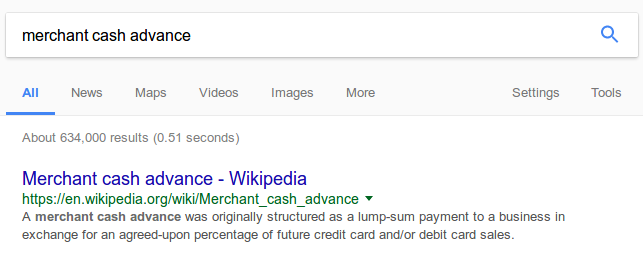
Merchant cash advances, however, are commercial factoring transactions with no relation to payday or consumer finance.
A user on the deBanked forum first alerted me on October 5th and deBanked conducted tests from internet connections in two states to see if we could replicate the results. Below is a sample of our results:
| Keyword | Google Adwords Status |
| cash advance | BLOCKED |
| merchant cash advance | BLOCKED |
| business cash advance | BLOCKED |
| business loan | ACCEPTED |
| loans | ACCEPTED |
| get a business loan | ACCEPTED |
| loan for my business | ACCEPTED |
| cash advance for my business | BLOCKED |
| business loan companies | ACCEPTED |
| merchant cash advance companies | BLOCKED |
| factoring or business loans or credit cards | ACCEPTED |
| factoring or business loans or merchant cash advances | BLOCKED |
| loan from ondeck | ACCEPTED |
| cash advance from ondeck | BLOCKED |
| consolidate loans | ACCEPTED |
| consolidate cash advances | BLOCKED |
No such block exists on rival search engine Bing.
Though Google has not said this, the mass removal of payday lending ads, once a massive source of revenue for them, is likely the result of government pressure. Over the last two years, federal regulators have begun targeting lead generation sites that direct users to lenders in a misleading manner.
Unless Google fixes the glitch that caused merchant cash advances to get wrapped up with consumer cash advances, the organic search results will experience a huge boost in value. Last month we reported that companies like OnDeck, Fundera, and Nerdwallet were winning the search engine optimization battle for several keywords including merchant cash advance. Absent any ads, those companies and several others will now benefit from a stream of free traffic and applicants for which their cost of acquisition will be zero dollars.
Perhaps little has been mentioned about this ban within the industry because the end result is FREE leads for those that rank well organically. Long live SEO!
Broker Fair 2018 – The Inaugural Conference for Merchant Cash Advance and Business Loan Brokers
October 5, 2017 New York, NY – Foinse, LLC, in collaboration with deBanked, is excited to announce Broker Fair 2018, the inaugural conference for merchant cash advance (MCA) and business loan brokers. Broker Fair 2018 is being held at The William Vale in Brooklyn on May 14, 2018. It will be the largest gathering of MCA and business loan brokers in the country.
This exclusive one-day event in New York City’s most vibrant and creative corner will offer brokers, lenders, funders, and service providers opportunities to learn, connect, and grow their businesses.
Broker Fair founder and deBanked Chief Editor Sean Murray, said “Online business lenders, MCA providers, and independent brokers employ thousands of salespeople to connect business owners with sources of capital. There are numerous products, tools, and resources out there now but the landscape remains fractured. Through Broker Fair, I want to empower the salespeople, empower the brokers. They’re the ones on the frontlines with America’s small business owners. I’ve been covering this space for seven years and was actually an MCA broker myself prior to that. I know the industry. A lot of folks and companies want to be successful but I know that they also want to have a positive impact on their customers and the industry they’re a part of. I want to facilitate that and more at Broker Fair.”
The three central tenets of the conference will be education, inspiration, and opportunities.
Registration is already open at http://brokerfair.org/pages/register/
To become a sponsor or inquire about the benefits of sponsorship, contact info@brokerfair.org or call 917-722-0808. Event sponsors can be viewed at: https://brokerfair.org/sponsors/
About Foinse, LLC
Foinse, LLC is an events company and the owner of Broker Fair 2018. For more information, visit: https://brokerfair.org/
About deBanked
deBanked® is a registered trademark of Raharney Capital, LLC and is the name of a print and online publication that has covered alternative finance including merchant cash advance and online business lending since 2010. deBanked is a presenting partner of Broker Fair 2018. For more information, visit: https://debanked.com/
Dear MCA and Business Loan Brokers, It’s Time
October 5, 2017 It’s been two years since the Year of the Broker was published. And it’s been many more than that since the last time I brokered a deal myself. Though I’ve only been writing about merchant cash advances (MCAs) and non-bank business loans for seven years here, my involvement in that industry started more than a decade ago. In all that time I’ve gone to countless trade shows, conferences, networking events, meetups and discussion sessions. To their credit, many of those provided excellent value across the spectrum of finance or payments, but none ever quite fully gripped an industry that is now pumping out approximately $15 billion to small businesses each year.
MCAs and online business loans are still overwhelmingly facilitated by salespeople, whether they’re employed by direct capital providers or independent sales organizations and brokers. Notably, a recent survey of industry CEOs suggested that in the last two years, the industry has come to rely even more on brokers for originations despite the belief that their reliance on them would decrease. An average of 64% of originations are currently coming from external sources/ISOs, the survey revealed.
Even salespeople at direct capital providers can find themselves playing the role of adviser or middleman when the solutions they offer in-house are not the right fit for a prospect. Small businesses need someone to help them navigate the massive universe of options and have that person be able to explain those options correctly. It only makes sense then that there would be an annual gathering of brokers, lenders, and MCA funders where all of those salespeople and their colleagues come together. Much to my disappointment (and I’m not alone in that) I’ve never found such an event.
I expect that will change in 2018. I truly believe dear friends that it’s time…
Update: Meet Broker Fair 2018