
Canada
Lendified Survives, Under New Management
October 23, 2020 Toronto-based Lendified has returned from the brink. The Canadian alternative small business lender has a new CEO and has resumed the origination of new loans.
In June, deBanked published a story that described the company’s impending doom after it was placed in default with its credit facilities, could no longer originate new loans, and had virtually no capital to continue its operations.
The company was since able to partially recapitalize and John Gillberry has come on as the new CEO. Gillberry is described as a “seasoned senior executive with nearly three decades of experience in areas of managing the finance and operations of special situations and venture capital backed enterprises.”
In an announcement, Gillberry expressed optimism for Lendified’s future. “I am excited about the opportunity that Lendified presents and it is uniquely positioned to take advantage of a very large and underserved market,” he said. “The credit underwriting foundation that we are starting from is distinct from any other in this market and we are pleased to be once again originating new loans to independent business owners.”
The company’s primary senior lenders have resumed financing new loans.
Loans Canada Survey Shows Areas to Improve Online Lending
October 14, 2020 As part of the mission to find the best loan options, Loans Canada, a loan matching service, surveyed 1,477 people who have borrowed from online payday lenders. The goal was to look at the average person’s experience that gets an online or payday loan, and the respondents reported problems with the unregulated nature of payday lending.
The sample was composed of “credit-constrained” individuals, with 76.2% reporting they had been rejected for a loan in the past year, and 61.5% reporting that they had a low credit score. The data shows that borrowers with poor credit will have to rely on alternative lenders, the survey outlined.
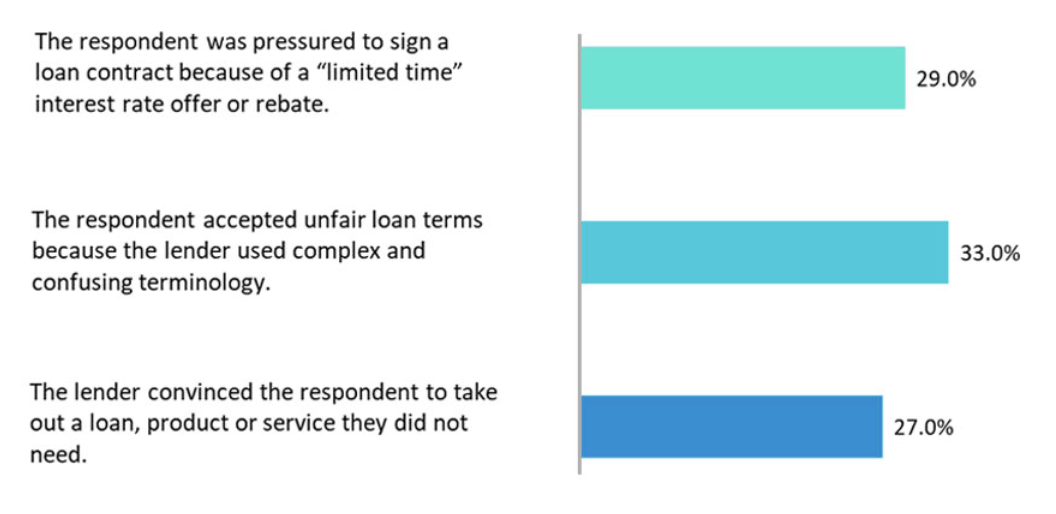
Of those surveyed, more than a fourth reported unfair, problematic lending and debt collecting practices. 33% of respondents said they accepted unfair loan terms because the lender used confusing language and 27% said they took a loan product or service they did not need, convinced by aggressive sales tactics.
Undisclosed and hidden fees were also reported as a problem. 22.4% of respondents said they were charged undisclosed fees while 32.8% were charged fees that “were hidden in the fine print.” 28% of respondents said they were charged without consent at all.
Borrowers faced issues with pre-authorized debits, an agreement where the borrower gives their bank permission to send money to the lender. 33.6% of respondents complained their lender debited their bank when asked not to do so, while 32.5% of respondents had to place a “stop payment” order on the lender.
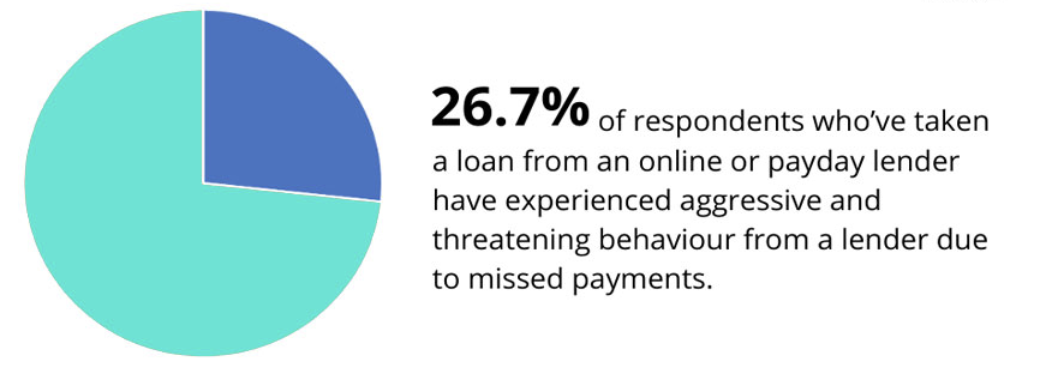
When it came to paying on time, only 21.9% of borrowers did not miss any payments. Of those who did, over a fourth experienced aggressive behavior from a lender.
Finally, 32.9% of people who took out an online or payday loan had their debt sold to a collection agency. The paper argues that Canada’s debt collection businesses have to follow different regulations in different provinces. Sometimes, debt collectors can rely on Canadians not knowing their local rights by using unethical intimidation techniques.
Of those that had their debt sent to agencies, 62.1% reported the agency misrepresented themselves when they contacted the borrower, sometimes as law enforcement or as a law office. 52.7% of respondents sent to collections received calls from an agency masked to hide their true identity.
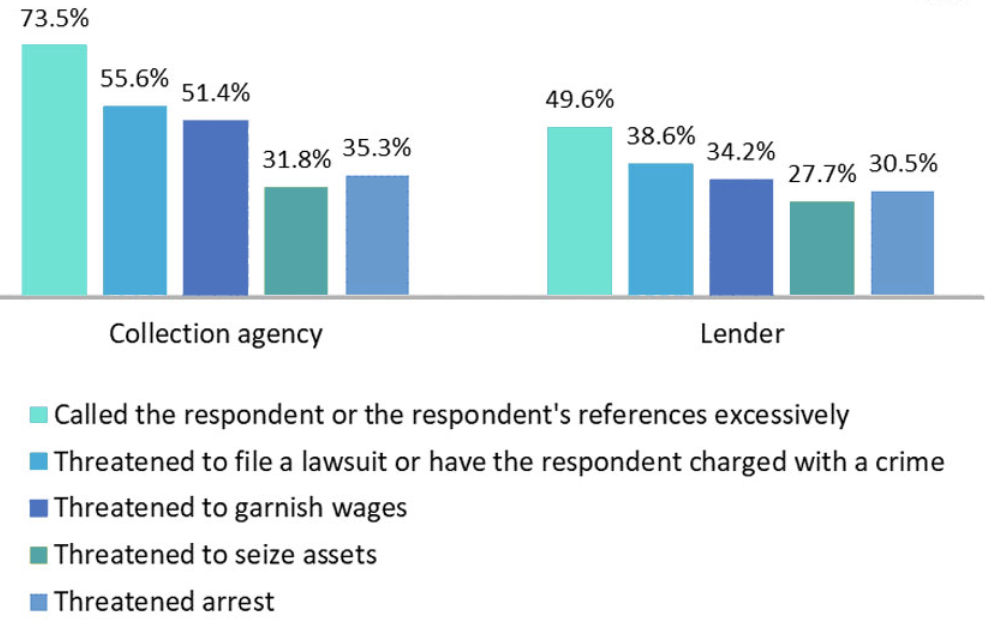
Among lenders themselves, threats to garnish wages, seizing assets, and arrest were in the toolbox for collecting delinquent payments
Loans Canada hopes the information shows problems with online payday lending but highlights credit lines are a two-way street. As lenders need to be held to standards that aim to fix unfair practices, borrowers need to uphold their side of the agreement. Overborrowing is a one-way street to missing payments, leaving lenders little choice.
As Fintech Accelerates in Canada, Smarter Loans Expands
September 22, 2020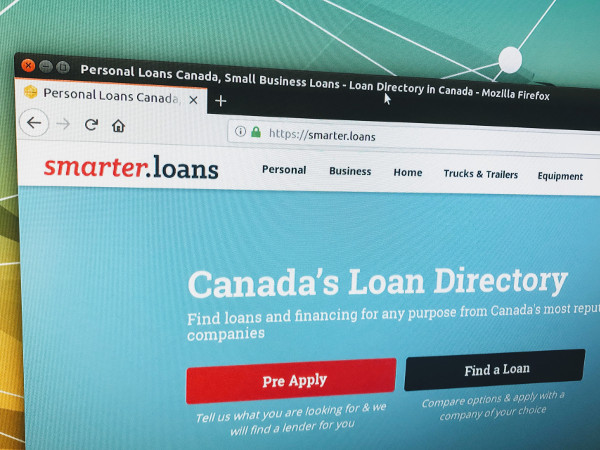 Smarter Loans, a Canadian loan comparison site, announced they are expanding their services to new categories- including “Everyday Banking, Insurance, Investing Money Transfers, and Debt relief.”
The additions are part of the Smarter Loans’ mission to become the go-to place for Canada’s online financial options. Founders Vlad Sherbatov and Rafael Rositsan founded the company to bring together information on the top financial companies all in one place. They started with information on personal and business financing but have expanded to auto loans, mortgages, equipment financing, and information on all kinds of financial products.
“We wanted to bring additional financial services and products that people can now access online,” Vlad Sherbatov, the president said. “And to do that, we partnered with some of the leading companies that offer these financial services.”

The addition is the latest resource for their 40,000 monthly user base, who access a database of top banks, credit unions, and innovative fintech leaders. Rafael Rositsan, the CEO, said as a trusted industry voice, the firm is adding this new info to update consumers on new opportunities firms provide.
“There’s a rise of companies that are now offering innovative products online,” Rositsan said. “Canadians might not be aware of some of the services that are out there.”
Sherbatov said that Canadians have been gravitating toward conducting business on the go at an accelerated rate this year. The firm listened to the customer base and learned they’re not going online for just financing.
“Entrepreneurs are running their businesses online,” Sherbatov said. “People that used to just shop for household items online are now looking for ways to handle investments and everyday financial errands because the old way of doing things is not available.”
He said that many areas of the financial space have evolved. Customers can obtain life insurance, get a line of credit, and a bank account funded in less than 24 hours, all from the comfort of their home.
“This move is to both bring more services relevant to our existing user base that use Smarter Loans,” Sherbatov said. “But also for all Canadians that are looking for these types of products. We want Smarter Loans to be the go-to place for them to learn about [these offerings], and to learn about the companies behind these products.”
Smarter Loans Expands into Banking, Insurance, Investing, Money Transfers and Debt Relief Solutions
September 22, 2020 Smarter Loans – Canada’s largest loan comparison website – is excited to announce their expansion into new financial categories that include: Everyday Banking, Insurance, Investing, Money Transfers, and Debt Relief.
Canadians nationwide use Smarter Loans to find the most innovative financial products and services in the country, compare their options, and make smarter financial decisions. Launched in 2016, Smarter Loans today works with over 80 of the top financial brands in Canada, including banks, credit unions, alternative lenders, financial services and innovative FinTech companies that are leading the digital transformation in the Canadian financial sector.
The expansion is another step by Smarter Loans in helping Canadians access more financial products online.
We believe that Smarter Loans is at the forefront in the evolution of how people want and expect to shop for financial products. There is a big shift towards buying online and companies that are setup to transact and sell their services on the Internet are winning. We work hard to seek out top financial brands and are really excited that Smarter Loans visitors can now find even financial solutions on our site. (Rafael)
It’s a great experience when a person can send money overseas, get life insurance, and open a savings account all from the comfort of their home or on their mobile device. Our mission is to highlight all of the great and reputable companies that offer Canadians that experience. (Vlad)
Smarter Loans has responded to the growing demand for digital financial products and services in Canada by securing working relationships with leading brands that offer financial services online, including chequing and savings accounts, investing solutions, insurance for personal and commercial coverage, international money transfers, debt relief and credit solutions.
The new categories are available to all new and existing Smarter Loans members, everywhere in Canada.
The new categories will help even more Canadians save time and money, and discover great companies that can help them with various financial needs, entirely online.
If you are a financial brand and are interested in discussing partnership opportunities please get in touch with Smarter Loans at: info@smarter.loans.
Lendified Is Still Trying To Pull Through
August 18, 2020On June 29th, deBanked ran a story titled Canadian Small Business Lender Looks Doomed In Wake of COVID-19. It was about Lendified. Several of the company’s top executives had recently resigned and its financial situation was dismal.
“Lendified is in default in respect of credit facilities with its secured lenders,” the company disclosed at the time. “Forbearance and standstill agreements are being discussed with these senior lenders, with none indicating to date that any enforcement action is expected although each is in a position to do so, however, no formal agreements in this regard have been concluded as of the date hereof.”
Among the company’s last ditch plans to recapitalize was the raising of equity through a private placement. But that was made impossible by the Ontario Securities Commission who entered an order prohibiting any such transaction for “failing to file certain outstanding continuous disclosure documents in a timely manner.” The filing failures, of course, were due to the issues they were facing. This order just compounded them.
The Commission partially revoked the order on August 14th, paving the way for the private placement to continue. Lendified is only seeking up to $1.4M, the proceeds of which would be used to “pay, among other things, outstanding fees owed to the Company’s auditors and other service providers, public and filing fees, legacy accounts payable as well as for general working capital purposes.” The company further said that “Completion of the Private Placement will help the Company in its efforts to prepare and file the outstanding continuous disclosure documents with the applicable regulatory authorities.”
Lendified offers no guarantees that the private placement will be successful. The company sold off a subsidiary, JUDI.AI, in July.
“People are Starting to Come Out of Their Caves”: How 2M7 got through the lockdown
July 13, 2020 For 2M7, the Toronto-based alternative funding company, the concept of a global economic shutdown was far-fetched. January and February of 2020 had been some of their best months in business yet. But, like every company, 2M7 was forced to reckon with the unreckonable and feel the effects of an economic lockdown.
“In terms of client onboarding and funding volume, in terms of collecting volume, and in terms of any metric you would look at, [January and February] were two very strong months,” CEO Avi Bernstein explained in a call. “And then in March, I don’t want to say we slammed on the brakes, but in the first or second week of March we basically just said, ‘you know what, we just need to really change the focus of what we’re doing.”
Saying that they were a week or two ahead of the curve, Bernstein notes that in the leadup to the shutdown their customers had already been asking for deferred or reduced payments. And with anxiety and concern in the air, 2M7 changed course and moved from focusing on bringing in new customers and increasing collections, they “hunkered down” and worked exclusively on the needs of existing clients.
“We funded throughout very minimally … and really our main effort was to get in touch with all our existing merchants and see how they were being affected, if they needed a payment plan, or if they needed a little bit more capital to tide them over. And we adjusted each one on an ongoing basis as we kind of floated through the panic of the lockdown to the waiting time to when we really started to reopen. … And you know, the ones that were still operating in the kind of environment that they were operating, if they had any additional expenses, they had additional requirements for capital.”
This approach lasted up until mid-June, around the time that the Canadian economy began to reopen. Lasting all of three months, this halting was not without victims as 2M7 had to furlough a number of staff members, many of whom were on the sales team that had reduced responsibilities during this time. Since then though, these employees have been brought back in, new customers have been brought on, and 2M7 has returned to its offices.
“As the Canadian economy started reopening and wrapping up even a little bit earlier than we were, we worked with provinces that were already more advanced in the opening stages. Saskatchewan, Nova Scotia, New Brunswick, Newfoundland, they were doing better in terms of reopening and they were ahead of us. … We were able to work with them in terms of ramping up. Now as the economy’s kicking into gear, we’re seeing more and more demand from businesses and we’ve started feeling our how much of their client base is still in existence, how much of their market is still in existence; whether it be manufacturing or transportation, or whatever it is.”
Looking ahead, Bernstein is cautiously optimistic, believing the worst is behind them but that there is still a ways to go for the Canadian market that has shown resilience in that last four months. Explaining that he think the shutdown won’t lead to any great reset of the Canadian market, the CEO thinks that it will instead act as a catalyst for events that were already in motion: debt-laden companies will struggle and possibly perish.
But beyond that, Bernstein is feeling positive about the future, saying that “people are starting to come out of their caves, and slowly but surely businesses are starting to reopen and invest. A lot of businesses are hiring back their employees. So that’s good news for Canada and good news for small businesses in the Canadian marketplace. … I feel like we’re going to come out okay.”
Canadian Small Business Lender Looks Doomed In Wake of COVID-19
June 29, 2020As well-known (1, 2) small business lenders in the United States continue to negotiate COVID-19 era workouts with their creditors, another in Canada appears to be falling off the cliff.
On Thursday, Lendified’s President & Director Kevin Clark tendered his resignation effective July 3rd. He follows other board members Edward Kelterborn and Benjy Katchen whose resignations went into effect on June 25th. Company CFO Norman Tan previously resigned on June 9th and no replacement has been named.
COVID-19’s arrival came at a difficult time for Lendified. Before COVID, the company had never turned a profit or reported positive cashflow in its entire history.
“Lendified is in default in respect of credit facilities with its secured lenders. Forbearance and standstill agreements are being discussed with these senior lenders, with none indicating to date that any enforcement action is expected although each is in a position to do so,” the company said. “However, no formal agreements in this regard have been concluded as of the date hereof.”
The company expressed that it would not be able to continue operations if it was not able to finalize a forbearance on its defaults AND simultaneously obtain an immediate infusion of capital to fund its operations.
Lendified’s board of directors is presently considering selling its assets or its entire business in order to raise revenue.
A wholly owned subsidiary of Lendified, Judi.ai, an automated loan underwriting platform, is poised to cease operations as a result of a cashflow shortfall. “[Judi.ai] requires cash infusions in the amount of approximately $100,000 per month in order to maintain operations,” Lendified reported. “Its cash reserves at this time are approximately $80,000. At this time, the Company is not in a position to continue to fund the Business and there can be no assurances that it will be able to do so in the future.”
The company went public on the Toronto Stock Exchange on May 26th via a reverse merger and has since experienced a 95% drop in its share price. The company’s market cap on Monday hovered around $700,000 USD.
Study Finds Vulnerable Canadians Ill-Equipped Against Coronavirus
May 4, 2020 Last week Loans Canada, a loans comparison platform, released a survey of over 900 financially vulnerable Canadians. These being defined as those Canadians who rely on low income, who have limited access to credit, and who have little to no savings available, the study found that many of the respondents were at risk of financial troubles from covid-19 due to their restricted means and ineligibility for government welfare programs.
30% of those surveyed reported that they are unable to access the Canadian Emergency Relief Benefit, a program that offers CAD$500 a week to those whose finances have been negatively affected by covid-19, due to the terms of the package. In order to qualify, one must earn less than CAD$1,000 over the four week period that the claim is for, leaving many who work part-time or who have had their hours cut unable to access the money.
As well as this, the survey recorded that many of these individuals are having difficulty accessing credit, as nearly 50% said that their bank has denied them funding. This coupled with the fact that 80% have experienced a loss of income due to the novel coronavirus, as well as only 12% of respondents having the government-recommended three months of living expenses saved up, paints a grim picture for the future finances of those vulnerable Canadians.
Beyond immediate finances, 73% of those surveyed believed that the pandemic would negatively affect their credit scores, 63% expect to miss paying at least one bill over the next six months, and 78% claim that they will struggle to finance their necessary expenses if the covid-19 situation continues through the summer.
Altogether, the study indicates a need for more financing amongst those likely to be hit hardest by the economic knock-on from covid-19. What remains to be determined however, is whether it will come in the form of governmental relief, credit from their banks, or funding from the non-bank lenders.