Business Lending
The ‘Loan’ Star State – Texas is an alternative finance nexus
June 15, 2017
We’re at Able Lending in Austin, Texas, a financial technology company occupying three floors deep in the heart of the Seaholm power plant overlooking Lady Bird Lake. The fortress-like building anchors an inner-city complex of offices and residences, chic restaurants, boutique shops, and a Trader Joe’s.
Once the main source of electricity for Texas’s capital city, the natural gas-fired boilers have given way to a warren of glassed-in offices and meeting rooms connected by angular metallic stairways and a carpeted mezzanine.
It is here, in a tiny conference room, that Will Davis, a slim man of 35 and an alumnus of Harvard Business School, is drawing a bell curve on a whiteboard. Dressed for the balmy Texas weather in tan Bermuda shorts, a black tee-shirt and Nike running shoes, the company’s chief executive and co-founder is explaining how Able’s friends-and-family lending formula “widens” the risk curve.
“We all compete here in this box on price,” Davis says, drawing a square at the topmost point of the bell curve, indicating where the near-prime borrowers abide and where lenders are crowded in pursuit. But when loans from friends and family form 10%-15% of the total loan, he says, drawing squiggly lines just to the left of the box, a cohort with less-than-stellar credits now becomes credit-worthy.
Because of the “peer pressure” and “behavioral change” exerted by the involvement of family and friends, the formula produces a “positive-selection effect on the loan portfolio” Davis says, declaring: “We can serve more of the market.”
It all sounds very business-schoolish. But here’s the bottom line: Able’s lending model sharply reduces both risk and borrowing costs, allowing it to go head-to-head with national rivals like Funding Circle, Bond Street, OnDeck and StreetShares. Thanks in large part to its reduced risk, asserts Able’s director of development, 30-year-old Matt Irving, the Austin fintech can lend twice as much money as its competitors at half the interest rate.
Since opening its doors and firing up its computers in the fourth quarter of 2014, Able’s average loan size has climbed to $231,200 from $100,000. Of that, an average of 3.2 “backers” have accounted for $40,691, or 17.6% of the average total loan amount. The average “blended” annual percentage rate is 16.41%.

Meanwhile, Able, which has made some $48 million in loans to entrepreneurs through the end of April, 2017, reports CEO Davis, is itself on sound financial footing. According to the data-services firm Crunchbase, Able has raised $12.5 million in three rounds of venture capital financing from 21 investors. Principal equity financiers are Peter Thiel’s Founders Fund, Peterson Ventures, RPM Ventures, and Blumberg Capital. On Sept. 27, 2016, moreover, Able added another $100 million to its arsenal in debt financing from Community Investment Management, a San Francisco investment firm. Borrowers include owners of food trucks and apparel shops; professionals including doctors, dentists, veterinarians, and accountants; “creatives” like public relations and advertising firms; and construction companies. Since its inception, Davis says, just one borrower has defaulted, resulting in an $85,000 charge-off.
So far in 2017, the company has lent out nearly $15 million in the first quarter, but it’s on track to make $80 million this year. “We’re ramping up,” Davis declares.
Welcome to fintech in the Lone Star State. While everything may be bigger in Texas, as the saying goes, that’s not quite true of financial technology. The geographic contours of fintech operations are roughly 60% in California (especially Silicon Valley/San Francisco), 30% New York, and 10% scattered about the rest of the country, says 40-year-old Mihir Korke, the San Francisco-based chief marketing officer at Able.
Nonetheless, Texas offers fertile ground for the burgeoning fintech industry. The vaunted Texas business climate promises a relaxed regulatory regime, the absence of either a personal or corporate income tax, and a lower cost of living. All of which were cited by Able Lending, as well as an additional pair of fintech companies that specialize in factoring and merchant cash advances: Jet Capital, located in North Richland Hills in the Dallas-Fort Worth “metroplex”; and Ironwood Finance in Corpus Christi, a port city on the Gulf of Mexico.
“What’s interesting about fintech companies is that they can choose to locate where they want to do business,” says Erin Fonte, an attorney at Dykema Cox Smith in Austin whose legal practice includes mobile payments, mobile wallets and financial technology. “They don’t necessarily get a regulatory advantage because much of what they do is based on their customers’ location,” says Fonte, who is currently serving as a member of the Federal Reserve’s Faster Payments Taskforce. “That said,” she adds, “some companies have chosen to locate in Texas because of the labor and talent pool, because it’s a good source of venture capital, and it’s more affordable.”

Jet Capital’s 42-year-old chief executive, Kenneth Wardle, confirms many of Fonte’s observations. “So far, Texas has been friendly to MCA companies,” he says, using the initials for “merchant cash advance.” Especially favorable to his industry is the fact that “Texas regulators do not define an MCA as a loan,” he adds.
Prior to co-founding Jet Capital with chief operating officer Allan Thompson, 49, Wardle served as a portfolio manager at Exeter Finance Corp, a $3 billion company in nearby Irving which specializes in subprime auto financing. Wardle has also held leadership positions at AmeriCredit Corp., now GM Financial, and Drive Financial, now Santander Consumer USA.
His 20-year background has included the gritty work of repossessing cars when owners fell into arrears on their auto loans. “Most of my career in auto finance was in risk management and I’ve driven a repo truck,” he says. “You take off with the car right away and then chain it down after you’ve gone a couple of blocks so you don’t lose it out on the highway.”
Backed by more than $5 million in equity financing from a family office in Puerto Rico, Jet Capital makes cash advances of $25,000-$30,000, on average, for working capital.
The sweet spot for Jet’s financings are retail establishments, trucking companies, hair-and-nail spas, and medical doctors. Doctors in particular are prime candidates for a Jet cash advance. “They have a pretty good gap between when they perform services and when they get paid by insurance companies” during which they have to cover payroll expenses and overhead, Wardle notes. Prospecting for customers is done largely through independent sales offices, direct mail, and pay-per-click services offered by Google, among additional online channels.
“Our defaults are relatively in line with expectations” and were largely confined to the first year of business, Wardle says. “We made some underwriting and verification changes last September and October,” he adds, “and we changed our minimum credit scores. Since then we’ve seen defaults migrate in the right direction.”
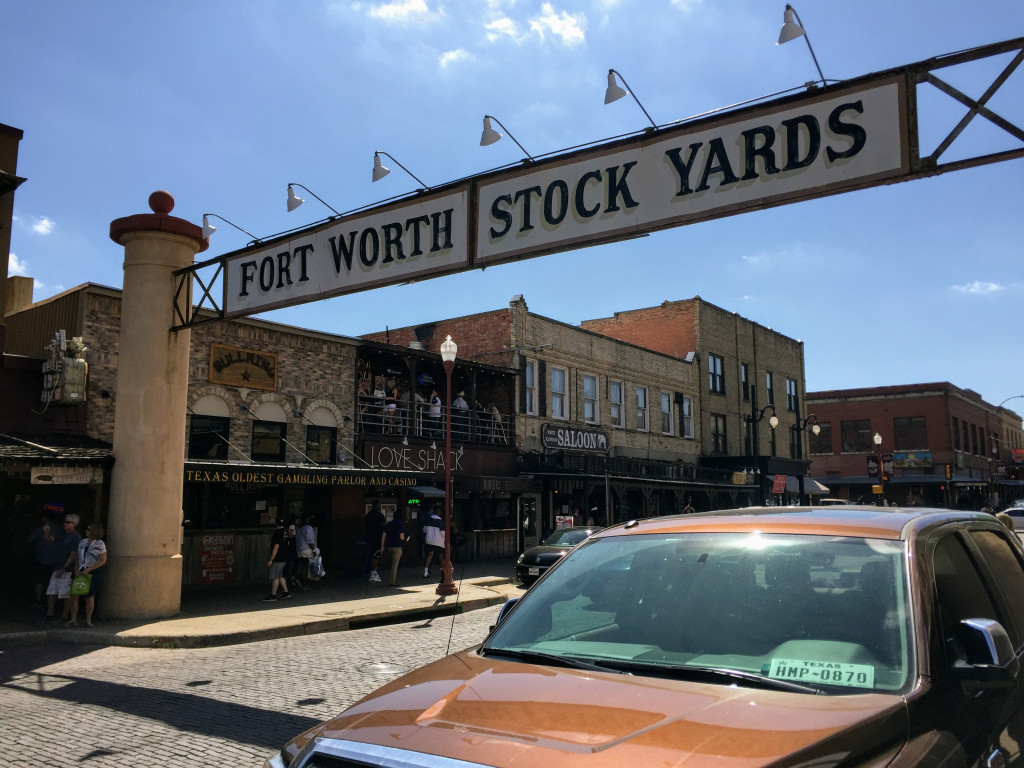 Since Wardle and Thompson took occupancy of an empty office outside Fort Worth in October, 2015, Jet has grown to 12 employees who today have “a variety of roles” says Thompson, citing sales, underwriting, customer service, collections, analytics, and information technology. “They wear a lot of hats and there’s a lot of cross pollination,” he says.
Looking ahead, Wardle foresees Jet expanding its product line beyond merchant cash advances to offer lines of credit and installment loans. “Our goal is to be a one-stop, nonbank financing solution,” Wardle says.
Kevin Donahue, 37, owner of Ironwood bootstrapped the South Texas company, which opened in 2013 using personal savings of $1.5 million remaining from the sale of mobile home parks in South Dakota and Texas. He also plowed earnings into Ironwood from a subsequent job as a commercial loan broker.
Donahue, who grew up in a family of fishermen on the Oregon and California coasts and is a 2006 graduate of California Polytechnic State University at San Luis Obispo, says that he turn up in Corpus Christi somewhat by accident. While operating the mobile home park in nearby Kingsville, he got married, started a family, and put down roots.
With 20 employees, Ironwood focuses on providing merchants cash advances in the $5,000 – $50,000 range, Donahue says, “but we can go up to $1 million.” The average cash advance – usually $10,000-$15,000 – is put to use as working capital by what he dubs “Main Street” businesses: restaurants, boutiques, trucking and transportation companies, professionals, and contractors. Ironwood charges clients factoring fees that are collected via ACH.
“Many times (these businesses) don’t qualify for bank loans,” Donahue says. And even when they do qualify, he notes, “banks take forever – up to three months – while we’re using our own money and can do it in three days. We’re very low on requiring a lot of documents.”
For his part, Donahue wants to see a customer’s bank statements, a photo I.D., voided checks, and a financial report. But, he says: “Cash flow is much more important than financials.”
Clients typically find their way to Ironwood through the website, although they often arrive through referrals from brokers and real estate agents, attorneys, accountants and “anyone doing commercial lending,” he says. Donahue says he closed down a call center. “The way to get leads is more through relationships than marketing,” he says.
Trucking companies are important customers. “They work on thinner margins, the barriers to entry are lower, sometimes their customers don’t pay their bills,” Donahue says of the industry’s economics. “They have huge expenses for fuel, payroll, insurance – and they might not get paid (by their customers) for 30 days or more.”
Ironwood’s advance for a million dollars, cited earlier, was made to a trucking company in Midland, Texas, which hauled both general freight and oilfield equipment. The money was put to use both to smooth out cash flow and as growth capital. The trucking concern “used part of that for expansion, making down-payments with Volvo or Peterbilt,” Donahue recalls.

Backstopped by the titles for 18 trucks valued at roughly $1.5 million, the deal was structured as a three-year, sale-leaseback agreement with “no interest” but rather a fee, Donahue says. Payments were $32,000 monthly, he says, amounting to $152,000 above the advance.
Donahue has no trouble justifying the steep fee schedules. Not only does he release money quickly but in many instances Ironwood has stepped in to bail out businesses that could have gone belly-up. He cites a trucker in the Midwest who had a “very lucrative” business hauling Boeing jet engines worth $30 million to Seattle where they could be worked on and returned to the planes for installment. In order to fulfill the contracts – which earned the hauler $25,000 monthly — the trucking company’s owner needed to purchase pricey insurance.
The owner, however, “had horrible credit,” Donahue says, largely the result of cash flow problems after investing in a special trailer for the jet engines, compounded by a messy divorce. To secure the $10,000 for the special insurance, the trucker sold Ironwood $14,000 of their future receivables. “For his investment of $4,000 he’s making $25,000-a-month forever,” Donahue explains.
Back in Austin, Able is gearing up for another round of capital-raising to bulk up staff and, according to Korke, win licensing to do business in California. At the same time, its friends-and-family credit structure is winning kudos for reaching what researcher David O’Connell calls “the unloaned.”
 A senior analyst at Aite Group, a Boston-based consulting firm, O’Connell recently completed a study disclosing that 35% of small and medium-sized businesses in the U.S were unable to obtain credit over a recent two-year period. Able’s lending model is “a good example of using covenants to structure a deal that brings down borrowing risk,” the Bostonian says. “It’s terrific.”
Able’s staff doesn’t have to travel far to witness the fruits of their efforts. On Congress Avenue, in the heart of downtown Austin, is Jae Kim’s food truck offering Korean barbecue thanks to a $100,000-plus loan from the fintech lender. Kim, the founder and chief executive at food vendor Chi’lantro, enlisted his mother to pitch in $10,000. All told, family and friends ponied up 30% of the total loan.
In the three years since he hooked up with Able, Kim has gone on to bigger things, including a television appearance last November on Shark Tank that netted him $600,000 from celebrity investor Barbara Corcoran.
Chi’lantro is now operating five restaurants and four food trucks and as Kim disclosed on Shark Tank, annual sales topped $4.7 million last year.
Able Funds Chi'Lantro from Able Lending on Vimeo.
In an interview, he told deBanked that he counts himself fortunate to have gotten the Able “micro-loan.” It played a key role in generating the cash flow that qualified his company for a $200,000 bank loan backed by the Small Business Administration. “It was one of many opportunities, and now we have good relationships with banks,” he says.
And then, a little farther south, there’s Stephanie Beard’s “esby apparel,” a women’s clothing boutique named for her initials. Beard, 35, came to Austin in 2013 after a decade in New York designing men’s clothing at Tommy Hilfiger and Converse. Originally from North Carolina and a graduate of Appalachian State University, she had zero connections in Texas and only a little money.
But she had a big vision: She would open a store and design and sell top-quality, flattering clothes for women that had “a menswear mentality.” Men, she had discovered, buy fewer clothes than women. But men tend to buy clothes that are durable, clothes that they can wear again-and-again over many years. After she sold $65,000 worth of her casual clothing line on the website Kickstarter, Beard developed a fan base and was put in touch with Able. “Actually, they contacted me,” she says.
To qualify as an Able borrower, Beard assembled $20,000 from friends and family, she reports, including $2,500 from her future mother-in-law, another $2,500 from the proprietor of a dress shop that “wholesaled” her collection, and the rest from aficionados of her wares. Once that money was gathered, Able lent her $100,000 at a 10% APR in October, 2014, which enabled her to open her shop. The combined interest rate was 9.8%. Monthly payments have automatically been withdrawn from her business’s checking account.
She’s scheduled to repay both Able and her backers in full by this October. Total sales for the shop have cleared $1 million and Beard expects annual revenues for 2017 to hit $900,000. “A lawyer friend who helped me out with the paperwork pro bono told me that Able was practically giving money away,” she says. “I definitely was lucky.”
Sound Bites From Underwriting – The Risk of Imperfect Merchants
June 12, 2017
When you’re funding a business, does the risk begin and end with the business? Or does the character of the owners play a role? Can you judge the business on weak financials if your product is geared towards weak financials to begin with? And can you trust unaudited internally prepared financial statements?
At the Factoring Conference during a portfolio warning signs panel, Michael Bagley, VP at Action Capital Corporation, spoke about the risk of internally prepared financials:
“The issue is from a financial standpoint, are they breaking even? That gives you some ability they can function, but one thing that jumps out at you is the payables. It really seems pretty simple. But if you’re in an industry where there’s a critical vendor, or you’ve got a critical supplier, or you’ve got subcontractors and the payables are stretched beyond what is logical past terms, well, that’s a huge warning sign in the underwriting, but it didn’t always show up in underwriting, right, because these were internal financials and 90% of the time and they’re garbage, right?
They’re created by the user so that you at some level have to create or mitigate that by creating procedures that allow you to chase down what are your critical expenses associated with customers. So, for example, in the government space, it would be a subcontractor not getting paid. In manufacturing, it could be a critical vendor that you see on the aging. But if you see that their insurance company had not been paid a couple months, it may not be as big a deal.”
Emma Hart, the COO of Sallyport Commercial Finance, on where the risk lies:
“[…] More than anything I would say even beyond the collateral, it’s the integrity of the client that you’re dealing with. Because in my experience, it’s people that pay you back, not businesses.”
Hart again, on judging a customer’s financial situation:
“[…] quite often, that’s the reason they’re factoring, is because their AP is a mess and you can see the AP is a mess and you raise it in the underwriting, you know. Is anybody suing you? What are you gonna do about it? And they’re like ‘Oh, I’m gonna use the money that you provide to me to sort out my AP.’ ‘Okay then.'”
Melissa Baines, Risk Manager of Republic Business Credit, LLC, on a deal going too smoothly:
“We had a situation where I believe they were doing the parking lot striping, the painting on a parking lot. And it was one invoice. It was a dealership. A car dealership was the account debtor. The account executive who was helping out with the take-on sent out the verification letter. The no-offset verification letter came right back. No issues. And our CEO at that time— Again, going back to the gut feeling, just it was too easy— There weren’t even any questions asked. “What is this?” It was just “Sure. Send it over. I’ll sign it.” And he did and we got it back. And so, our CEO called and talked to him. And he said, “Yeah, yeah, yeah, it’s fine. It’s fine.” It still didn’t feel right. So, we called the dealership main line, got the receptionist. She answered the phone. She said, “Who signed it? Okay. Hold on.” Ended up somebody from the accounting department got on the phone and said, “That’s not real. You’re not the first person to call, you know, and then we’ll call you back.” And then ultimately, the owner of the dealership called back and said, “We will take care of this. It will not happen again, but it is not a real invoice. And please do not fund that to that client.” So, you know, don’t ever give up on that gut instinct. There was nothing that said it wasn’t real to begin with, but thank goodness for [employee’s name]. She just had that gut feeling. It wasn’t right. It was too easy. And here you go.”
This is one of several excerpts from this panel that we plan to post under the Sound Bites From Underwriting tagline.
Sound Bites From Underwriting – Gambling With a New Broker
June 9, 2017At the Factoring Conference during a portfolio warning signs panel, Emma Hart, the COO of Sallyport Commercial Finance, was asked if she recalled any red flag situations that hinted at collusion. Whether in factoring or not, you can probably relate to this situation with a new broker:
We had one fairly recently that we should not have funded that the CEO of our business puts on. It was a slow one. We needed the deals. The client was a flour mill supplying flour to Indian restaurants. It was a special type of flour. I can’t remember what it was. He had 4 debtors. The invoices were for $14,500 each. Each of the 4 debtors verified by invoice perfectly and we never heard from him again. And every single one of the debtors claim to have paid him directly. He came to pick up the checks. We don’t even know whether they were valid invoices, whether they even parted with the money, but we never saw him again. And the warning flags were all over the place. They were bright red, weren’t they? It didn’t pass any of the underwriting criteria. The individual was not an individual of good character. He had some history, but the deal had been given to Nick [the company’s president] by a broker. We were establishing a relationship. We always say in our business and every other business, you know, the new sales people get a freebie. Nick doesn’t get any freebies ever anymore, but that was a first funding loss. So, that was a classic first funding loss. It didn’t pass any underwriting criteria. We did it because we were slow. We needed some business. It was a new broker relationship. […] So, that was classic case of collusion, but we should have known better. Absolutely. And he absconded.
This is one of several excerpts from this panel that we plan to post under the Sound Bites From Underwriting tagline.
Industry CEOs Were Less Confident in Q1
June 6, 2017According to the latest quarterly Bryant Park Capital/deBanked survey of industry CEOs, confidence dropped to the lowest levels since the survey first began in Q4 2015. Specifically, confidence in being able to access capital needed to grow dipped down to 78.7% from 82.7% in the prior quarter. Confidence in the continued success of the Small Business Lending & MCA Industry shrank from 81.9% in Q4 to 73.8% in Q1.
See the trends below:
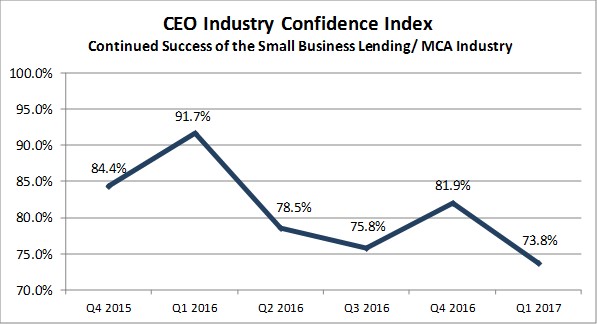
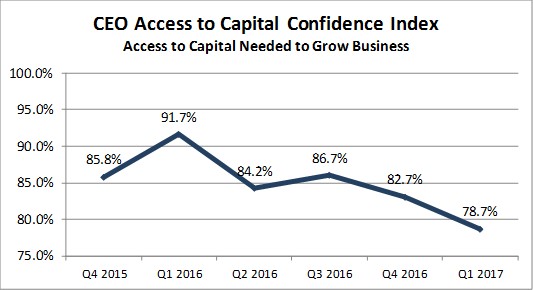
The survey does not ask participants to offer a reason for their confidence but the drop could probably be partially attributed to the events that occurred at CAN Capital, OnDeck’s struggles, and a general correction that took place at several other competing firms.
Sneak Peek of Our May/June 2017 Magazine Issue
June 5, 2017
Move over New York, California and Florida because Texas has become a strong incubator for alternative small business finance. In this newest deBanked magazine issue, we went to Dallas-Fort Worth, Austin and Corpus Christi to find out how and why non-bank financing products are flourishing. We were impressed by what we found and inspired just enough to dub Texas The ‘Loan‘ Star State.
And we went bigger than Texas (if that can be believed) by exploring how alternative lenders are spreading their wings beyond the states into other countries like the UK, Australia and Canada. But does it make sense to go abroad before you’ve cornered the market domestically? Industry captains share their thoughts.
There’s more of course, like how new tweaks to automated processes are actually making manual underwriting exercises easier. That itself has re-opened a debate that won’t seem to go away, humans vs computers in underwriting. In 2017, the humans aren’t out of the game yet and some think they never will be, but there are new tools available to increase speed and efficiency.
There’s legal decisions you’ll want to read and details about a new small business lending regulator you’ll want to know about. It’s all in the May/June 2017 issue that subscribers will be receiving in the mail soon and if you’re not subscribed, you should sign up FREE right now!
Are Small Business Borrowers Bank-Loyal to a Fault?
June 1, 2017 Applying for a small business loan is easier than it’s ever been. Online lenders have streamlined the process, brought it all online and whittled down approval times. Still, the majority of small business owners still think a bank is the only place to get a loan. They’re four times more likely to seek funding from banks than any other source; more than 80 percent of funding applications go to traditional financial institutions.
Big banks’ small business loan approval rates have dropped sharply thanks to tightened regulations and compliance costs post-Great Recession. Because the transaction costs on a $100,000 loan are roughly the same as a $1,000,000 loan, banks are passing right over small business owners seeking smaller amounts. And since the majority of small businesses want loans smaller than $100,000, they’re not being served by the institutions they turn to first.
Small Business Borrowers Turn to Banks First, But They’re Not as Loyal as They Seem
While it would seem that small business borrowers are loyal to a fault, a Lendio survey of 50,000 business owners found that 74 percent of them would move their account to a new bank if the new bank offered them a loan.
Business owners may be keeping their deposits at banks and turning there first when they set out to obtain funding, but when push comes to shove, they want the easiest path to accessing the capital that will keep their businesses afloat or help them to grow and scale.
Banks Realize They Can’t Rely on Customer Loyalty Alone
Banks have shifted some of their focus back to the small business loan market in the last couple of years. In this space where online lenders have made the process of applying for a loan much more customer-friendly, banks have realized that in order to remain competitive, become more effective and profitable, and ultimately retain customers, they must take a page from the book of online lending.
As little as two years ago, banks were closed off to the idea of outsourcing in the online lending space, while lending firms were armed with technology and ready to compete. Banks have caught on to the idea that investing in a fintech partnership is a quicker, less-expensive way to build technology and create a better customer experience without completely reinventing the wheel, allowing them to serve more of the small business borrowers they’ve been turning away. Now both parties are seeing the value in joining forces.
Recent partnerships in areas such as merchant services, researching, underwriting and accounting software have paved the way for more collaboration between banks and online lenders. Last year we saw banks begin to explore new strategies for converging with online lenders through licensing deals and partnerships, and this year we’ll see even more collaboration in the marketplace.
Partnerships, like JPMorgan Chase’s team-up with online lenders OnDeck and LiftFund, allow banks to leverage technology while expanding their loan offerings and revenue. ScotiaBank, Santander and ING have collaborated with online lender Kabbage to license its technology platform for automating a more efficient underwriting process and to provide more comprehensive lending solutions.
Bank-Alternative Lending Partnerships Are a Win-Win-Win
For banks, the benefits of an alternative lending partnership lie not only in cost savings and tech advances, but also in building and maintaining those loyal customer relationships that have served them for decades. Banks will be able to capture a new generation of customers while also retaining more of their existing customers’ deposits by providing them a better, more streamlined loan application and approval process.
And in such partnerships, online lenders and marketplaces win big too, with access to some of the built-in advantages of a bank: an existing customer base with a high level of trust, risk management experience, access to key data and the ability to offer low-cost capital.
Bank-fintech partnerships offer both parties the opportunity to improve processes and reduce costs. And more importantly, they offer those bank-loyal small business borrowers more options, more efficiently when they turn to the banking institutions they know. When banks and online lenders collaborate to serve small business owners, it’s a win-win-win.
IOU Financial Reports Q1 Results, Lost $1M
May 31, 2017IOU Financial lent (CAD) $22.1 million in the first quarter of this year, down from $25.4 million over the same period last year. This translated into a $995,085 loss on $4.3 million in revenue.
Their quarterly report said that they will continue to focus on achieving profitability in 2017, much like another company in the space. IOU had a net loss of $4.8 million last year.
IOU had previously disclosed that they were in breach with a third party lender, MidCap Financial, over the consolidated tangible net worth covenant of their agreement. IOU has a $50 million credit facility with MidCap, who granted them a waiver on that breach last month in April. Their latest earnings report, however, states that IOU had now also breached the fixed charge coverage ratio covenant, and that MidCap has just granted them another waiver.
MidCap Financial also just recently approved a credit facility for Fundation, an IOU competitor.
Goldman, Cohen Bet on Nav
May 19, 2017
Goldman Sachs. Steve Cohen. These are a couple of the high-profile investors that small business credit and finance startup Nav has attracted to line its coffers. Nav recently lifted the size of a Series B round by $13 million for lead investor Goldman Sachs Principal Strategic Investments as well as Cohen’s Point72 Ventures and others, bringing the tally for this round to $38 million.
Levi King, co-founder and CEO of Nav, told deBanked that Goldman Sachs was drawn to the startup’s robust vision, which is to decrease the death rate of small businesses in the United States. He said doing so would have a trickle up effect on Goldman and the capital markets.
“Goldman Sachs invested as a bank investment, not other people’s money. They believe with scale we will change how small business owners make financial decisions, and that will impact the capital markets. We will have a fundamental impact on the entire ecosystem, if we’re successful.”
Goldman clearly believes it’s a good bet, and Cohen’s Point72 Ventures agrees.
“We have the ability at scale to change what can happen in the capital markets based on our data, and that’s something [Point 72] wants to be a part of. They are a smart advisor for us from a data perspective – a quant hedge fund that’s best in class on data. We get free advice along the way. That’s part of the deal,” King said.
In fact, it was another major player in the credit scene that gave the nod to other investors to follow.
“It all started with Experian. That investment was a bigger landmark than any of the other ones. Experian is the biggest credit agency in the world and they had never done a venture investment until us. This sent a signal to other investors,” said King, referring to a partnership that was inked less than a year ago.
The Vision
King points out that bringing the startup’s vision to reality is a gamble. For instance, Nav’s current customer count is 215,000 and they aspire to have 28 million. “That’s the path that we’re on,” he said. The path includes the startup’s most recent expansion into business checking account data.
“We launched a loan reality check app on Android. We’re only testing it. Nothing like it exists. You put in a username, password and banking information, and we model that data and determine how likely it is that you will qualify for a loan based on that data set,” said King.
For instance, if a business has a history of bouncing checks, that’s a negative for scoring. Depository trends also count toward scoring.
“We’re sitting on personal credit, business credit and checking – three data sets. Now we have enough data for lenders to make full decisions on products like business credit cards,” said King, who makes a clear distinction between the various channels involved in the credit equation.
“To be clear, the small business owner is our customer. Lenders are our partners. Business owners win every time,” he said, pointing to the example of one lender partner.
While King wouldn’t disclose the lender he acknowledged that they are a top-10 financial institution that wanted to pay for a top result for its business credit cards among Nav’s product recommendations. This would have been a sponsored result, but it didn’t sit well with Nav. “It would have been a sweet check, but our product would lose integrity for the customer. We said no,” he said.
Also part of the vision is international expansion. “We have those ambitions. That’s why we’ve taken capital from foreign investors, to see how our model can apply in their markets. But that’s way out there,” he said, pointing to investments by CreditEase Fintech Investment Fund in this most recent round and Tencent in a previous round, both of which are based in China.
Meanwhile King said the fresh capital will be prioritized across three buckets. “We’re pretty disciplined at how we deploy capital. I will tell you what I have repeated thousands of times internally to our business. We spend money on acquiring new customers, improving our technology and UX and compensating our employees. We don’t waste money on in-office massages. At this stage a lot more of that capital goes toward customer acquisition,” he said.
Clocktower Technology Ventures also invested in the most recent Round B. Point72 Ventures and Goldman Sachs did not immediately return calls seeking comment.