
Business Lending
Ocrolus Named #1 Fastest Growing Fintech By Inc.
September 1, 2020 Ocrolus, a document analytics company, was recently named Inc.’s #1 fastest growing fintech company in the US and #1 fastest growing software company in NYC. The rating is based on percentage revenue growth between 2016 and 2019. Ocrolus placed as the #30 fastest-growing private company in America overall.
Ocrolus was founded in 2014 and has grown by 8,000% to become an industry-leading document scanning platform. Automating document applications for partners like BlueVine, Cross River, and Square, Ocrolus recently facilitated 761,455 small business applications for PPP loans.
So what sets Ocrolus apart? CEO and Co-Founder Sam Bobley credits the growth factor on just how fast and accurate the Ocrous API is.
“Lenders who were not using Ocrolus were not able to get to underwriting decisions as fast as lenders that were using Ocrolus- we saw a domino effect,” Bobley said. “Once we got a few big consumers on the platform, we were able to quickly onboard more and more funders and help them increase speed in their underwriting process.”
Bobley also said that while competitor document applications struggle with the accuracy at which they can read documents, landing somewhere in the 70-85% accuracy area, Ocrolus boasts more than 99% accuracy.
Success snowballed, and Ocrolus was helping grow businesses. The API directly addresses many financial institutions’ problems with scale- typically, more applications require more manpower to sift through paperwork.
“Typically, when a customer starts using our platform, within one year of using our platform, they double their volume, and within two years they quadruple,” Bobley said. “One of the reasons for that is they no longer have to staff up and deal with the operational complexities of handling the fluctuating volume of loans.”
With Ocrolus plugged in, customers were free from a major operating cost, and could go all out taking on new clients- which would mean more paperwork to process with Ocrolus.
Today, the company employs more than 900 team members across four offices but was founded in New York City. And like Seinfeld, Bobley loves the city, especially as a thriving hub for fintech activity.
“There’s no better place to do it than in the heart of the financial center of the US here in New York City,” Bobley said. “We’re right near where a lot of our lender customers are operating.”
On the news of recent acquisitions and reports that companies like PayPal and Intuit are ramping up their involvement in small business lending, Bobley said he sees larger entities in fintech as an opportunity for pricing transparency and better access to capital.
“I think the headline here is that financial services firms are recognizing that there’s a significant amount of businesses that used to be underserved,” Bobley said. “The bigger players are raising their eyebrows and want to get more involved, which in my opinion will be ultimately good for small business.”
And when it came time for Ocrolus to do its part for small business, Bobley said that more than 430,000 PPP applications of the 761,455 that were made using their partner network got approved, saving an estimated 1.5 million jobs.
“It’s always great when you know you can connect your work to a greater purpose for the community, so it’s really just a cool rewarding experience,” Bobley said. “It’s been fantastic, but we think we’re still in the early innings in terms of what we can do as a company- not just in small business lending but also in consumer mortgage and auto.”
Become CEO Eden Amirav Speaks Optimistically About Kabbage and OnDeck Acquisitions
August 31, 2020 Eden Amirav, CEO and co-founder of Become, shared his optimistic insight into what the recent round of acquisitions in the fintech lending world might mean. With the purchase of Kabbage by AMEX and OnDeck by Enova, the industry is moving toward consolidation.
“For many years, we saw many different players and high competition, now we’re starting to see consolidation,” Amirav said. “When a big player like AMEX puts in close to $1 billion [allegedly] in an acquisition of the IP and tech of Kabbage- an amazing technology for underwriting- we think that it’s a very good sign of belief in the industry, it shows the huge potential that AMEX sees in it.”
Eden said from the beginning, Become was happy to be a part of the journey of Kabbage as a partner.
Become is a company that empowers small businesses to improve their fundability and choose lending options through proprietary tech that rates businesses for their loan potential. Become has been a partner with Kabbage in the past, the company says.
Last year, Become underwent a rebranding, adopting a contact-free tech-only mindset. Needless to say, that move came with some unforeseen benefits- contact-free finance is now the name of the game.
Become partnered with Kabbage for loan facilitation in PPP, and Amirav said it was a huge opportunity for alternative finance.
“At the beginning [of the pandemic] there was no supply – practically all the lenders stopped lending,” Amirav said. “We built a very quick process that allows small business to sign the PPP and get the forms ready and get access to the funds as quickly as possible.”
Amirav said that it is because of the dire need for capital and traditional institutions’ inability to respond that alternative fintech markets became so attractive. He hopes that through the purchase, Become will have the opportunity to keep working with Kabbage and feature AMEX on the platform.
“Now that PPP is over we will start seeing alternative lending come back with a more important role- and I think the fintech lending industry as a whole has proven that it has an important role in assisting small business,” Amirav said. “Banks are serving big companies and traditional clients, fintech companies are really there to serve the mom and pop shops.”
BlueVine is Back and Now With Business Checking Accounts
August 28, 2020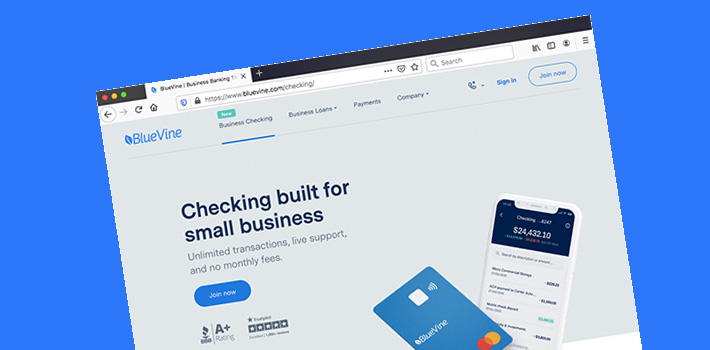 BlueVine, a leading small business lender, has resumed its normal services after generating $4.5 billion in PPP loans to more than 155,000 businesses. The company had continued to offer its normal lending products even while others in the industry paused completely, the company says. Herman Man, the chief product officer, said that BlueVine has also fully launched a small business checking account platform.
“Our goal always was to be that small business banking platform,” Man said. “Last year at Money 20/20 we announced we were going to build a small business checking account. Recently, we launched it post-COVID, derailing our plans. We have a breadth of offerings now, and we are that small business platform.”
BlueVine also released a survey this week of more than 800 small business owners to learn what they need most in an ever-changing market. Their findings supported their online product offering. Distressed by COVID-19, the respondents reported an overwhelming interest in reliable customer service, day to day support, and fee-less transactions.
77% of small business owners surveyed reported demand for direct guidance in day-to-day accounting. In the face of an emergency, many respondents noted that banks were more interested in new customers than servicing current customers.
Following this emergency support trend, nearly nine out of ten or 87% of small business owners said access to emergency credit was necessary from the same bank providing them regular service. Accessing credit from the same provider was not just important, but over half or 64% reported it was exceptionally so.
Finally, 58% of business owners reported that a lack of overdraft, monthly, or maintenance fees were the essential features a business checking accounts could offer.
With the launch of a checking account platform, BlueVine can service the needs of these businesses, offering one common platform that connects factoring services, payments services, and now credit and banking services.
“If a small business wanted to take a line of credit and do it on a Friday night, using our algorithm and things that are automated, it could run through our system; if they get approved, money would be transferred into their checking account instantaneously,” Man said. “This isn’t something they have to wait until Monday morning. It will land immediately, so that’s a huge game-changer.”
Banks, Non-Banks, Fintech and More Came Through for Lendio on PPP, But it Wasn’t Easy
August 27, 2020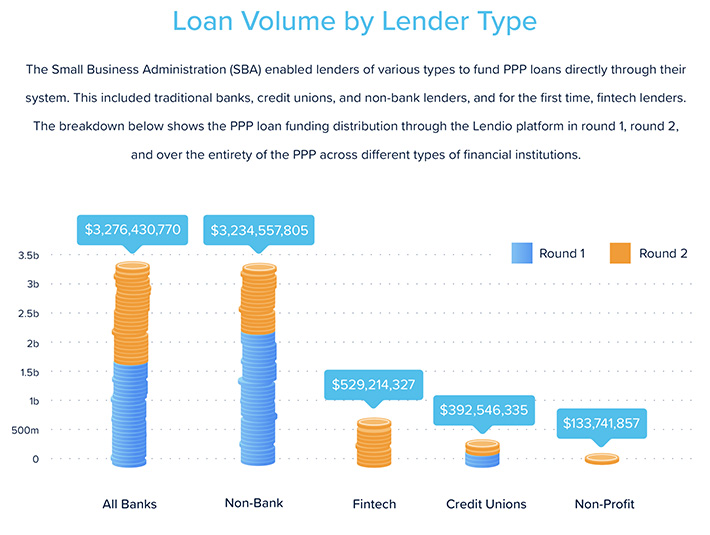 Last week, Lendio, a facilitator of small business loans, released a report analyzing the $8 billion of PPP loans that were approved through its lending platform. A coalition of more than 300 lenders was able to give aid, saving an estimated 1.1 million jobs, Lendio indicates.
Through Lendio’s service, traditional banks approved the most funding at $3.3 billion- or about 44% of the PPP dollars on the platform. Though non-bank lenders secured the highest number of approvals at 50,264 transactions in lesser dollar amounts.
Fintech lenders funded 6% of the total loan volume through the platform.
Lendio was well situated to facilitate lending from institutions to those that needed help through funds provided by the SBA. Brock Blake, CEO, and co-founder of Lendio, said the company’s success in delivering on PPP was no accident— they had to remove all stops and almost bet on the success of the PPP program.
“Our mission at Lendio is normally ‘Fueling the American Dream’: helping the American business owner accomplish their dream,” Blake said. “We tweaked our mission during this timeframe to ‘Saving the American Dream.'”
Blake said while other companies were closing their doors and sending off employees on furlough, Lendio took on 250 new hires- and buckled down for thousands of hours of engineering work to overhaul their system. Not just loan sales, but legal processes, onboarding, training, and backend tech work had to be updated in just days.
This all came on fast, but so did the quarantine. Beginning in April, more than 100,000 business owners applied for economic relief under the PPP using Lendio’s online marketplace.
The demand for capital was outrageous.
“It was more demand in one weekend than the SBA had seen in the last 14 years combined,” Blake said. “We were helping these business owners that were watching their entire lifes’ work flushed down the drain in a matter of weeks, and they were desperate for capital.”
Lendio was finding that many institutions could simply not handle the volume, Blake said, and he knew if banks were only able to process loan requests for their current customers, there would be an exploding demand for loan processing. The company took on 100 new partners who needed help during this time.
“Our systems were tested to their limits, like 1000 times more pressure than we ever saw before,” Blake said. “Some partners of ours got so much demand they couldn’t handle it and turned off their spigot. So we scrambled to find lenders that would take on new customers.”
Though it was ten times more challenging than anything Blake has done in his career, it was ten times more satisfying. Lendio doubled the number of loans it has issued since 2011, and quintupled the dollar amount the platform facilitated in just four short months. Where are they going to go from here?
For one, Lendio is one company out of many that are hoping for another round of PPP funding. Blake said he is getting customer feedback all the time asking for help, dealing with quarantine regulation that is harming business, like restaurants that have nowhere to seat patrons.
Outside of PPP, Blake said that many of the 110,000 businesses they served are now applying for other loans, or using Lendio’s bookkeeping and loan forgiveness applications. Lendio is happy to help business owners and banks through this tough time by launching digital applications.
“Before, lenders across the country were requiring business owners to come into branches [with] paper applications,” Blake said. “Now, there’s not one business owner in America that wants to walk into a bank branch. The demand for lenders to go digital is as high as it’s ever been.”

QuickBooks Capital Has Already Funded $683M in Cumulative Business Loans
August 26, 2020 QuickBooks Capital has funded $683 million in cumulative small business loans since Intuit launched the program in late 2017. This excludes the $1.2 billion in PPP loans the company facilitated, according to the latest quarterly earnings report.
Showing optimism, Intuit recorded revenue of $1.8B in Q4 and $7.7B for the fiscal year, up 13 percent.
Among Intuit’s leading products is TurboTax, which experienced its strongest customer growth in four years. Growth was also strong with QuickBooks online payments, QuickBooks Online payroll and TSheets.
Intuit announced that it was acquiring Credit Karma for $7.1B in cash back in February.
Sketchy Virginia SBA Loan Brokers Indicted
August 26, 2020Ronald A. Smith and Terri Beth Miller, owners of Virginia-based Business Development Group (BDG), an SBA loan brokerage, were indicted this month over an advance-fee scheme in which many customers are alleged to have paid money to obtain SBA loans but did not in fact get them.
As part of the scheme, defendants are alleged to have made many false and misleading representations to prospective borrowers including that:
- BDG was a large, multi-state company
- BDG was headquartered at the Trump Building in New York City and had an additional business in Las Vegas
- BDG has assisted certain named companies in obtaining SBA loans
- BDG was a business established in 2005 or earlier
- BDG was affiliated with the SBA
- BDG had relationships with banks across the nation that allowed it to facilitate the loan approval process with SBA lenders in a customer’s area by utilizing a “Lender Linker” made up of the most preferred SBA lenders in the country
- BDG had a program that included a “Powerful Online Grant Writer Interface Service” that was directly connected to the federal government and “handled everything from A to Z in Finding, Writing, Submitting and Securing Grants”
- BDG offered a money back guarantee
- BDG won the 2016 Best of Manhattan Business Award for Business Development Software and Services
BDG was really just an internet-based business whose goal was to obtain money through fraudulent pretenses and promises, prosecutors contend.
A copy of the grand jury indictment can be obtained here.
Section 1071 is Back and The CFPB Wants to Know How Much It Will Cost You to Comply
August 25, 2020 At some point in this century, small business finance companies will be expected to comply with Section 1071 of the Wall Street Reform and Consumer Protection Act that was passed in 2010.
In the wake of the ’08-’09 financial crisis (remember that?!), lawmakers passed the above act that has become colloquially known as Dodd-Frank. Section 1071 gave the Consumer Financial Protection Bureau the authority and the mandate to collect data from small business lenders (and similar companies).
The costs, risks, and challenges with rolling out this law have been discussed on deBanked for 5 years, yet little progress has been made to finally implement it. But it’s starting to move along and the CFPB would now like to know how expensive it will be for businesses to comply.
If you are engaged in small business finance, you should seriously consider submitting a response to their survey. The CFPB is specifically cataloging responses from merchant cash advance companies, fintech lenders, and equipment financiers.
Lendified Is Still Trying To Pull Through
August 18, 2020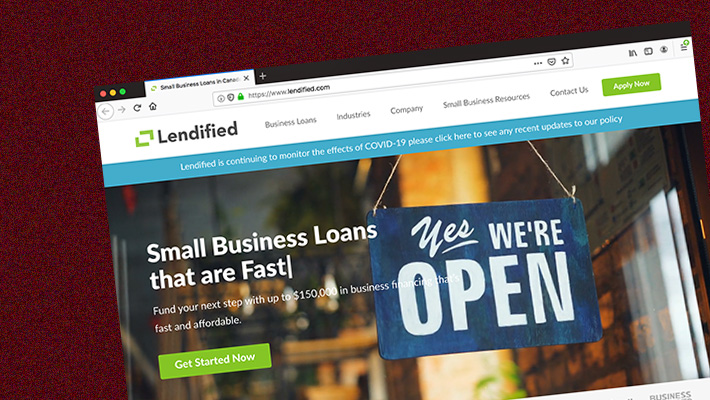 On June 29th, deBanked ran a story titled Canadian Small Business Lender Looks Doomed In Wake of COVID-19. It was about Lendified. Several of the company’s top executives had recently resigned and its financial situation was dismal.
“Lendified is in default in respect of credit facilities with its secured lenders,” the company disclosed at the time. “Forbearance and standstill agreements are being discussed with these senior lenders, with none indicating to date that any enforcement action is expected although each is in a position to do so, however, no formal agreements in this regard have been concluded as of the date hereof.”
Among the company’s last ditch plans to recapitalize was the raising of equity through a private placement. But that was made impossible by the Ontario Securities Commission who entered an order prohibiting any such transaction for “failing to file certain outstanding continuous disclosure documents in a timely manner.” The filing failures, of course, were due to the issues they were facing. This order just compounded them.
The Commission partially revoked the order on August 14th, paving the way for the private placement to continue. Lendified is only seeking up to $1.4M, the proceeds of which would be used to “pay, among other things, outstanding fees owed to the Company’s auditors and other service providers, public and filing fees, legacy accounts payable as well as for general working capital purposes.” The company further said that “Completion of the Private Placement will help the Company in its efforts to prepare and file the outstanding continuous disclosure documents with the applicable regulatory authorities.”
Lendified offers no guarantees that the private placement will be successful. The company sold off a subsidiary, JUDI.AI, in July.