Business Lending
Need Capital for Your Funding or Lending Company? 3Jane Does it On Blockchain
July 27, 2026“I’m a big believer in agentic capital markets. I think we’re going to see a Cambrian explosion of novel primitives, driven largely by two pieces. Today, it’s just very easy to construct arbitrary financial building blocks using smart contracts,” said Jacob Chudnovsky, Founder of 3Jane, to deBanked.
3Jane provides credit facilities and forward flow arrangements across a range of products, including consumer loans, small business loans, and even merchant cash advances. The company previously provided a $10 million senior warehouse facility to consumer lender LendSwift, for example, and followed that with an inaugural $8.5 million purchase of small business loans from Slope, an embedded credit infrastructure provider that powers business lending programs for major players across the US, including Amazon. According to Chudnovsky, 3Jane would like to do even more deals in the small business lending and MCA space.
But with a twist.
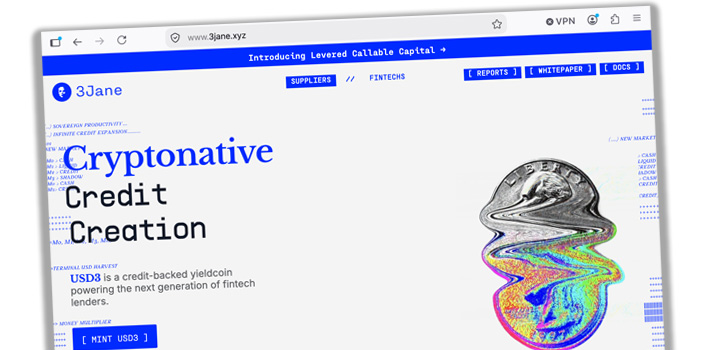 3Jane has built an entire protocol on the blockchain. It offers a credit-backed “yieldcoin” that earns its yield “from warehouse facilities, forward-flow programs, and credit-lines.” Investors can mint the coin on Ethereum, and it earns a yield backed by the performance of 3Jane’s credit assets. Minting is not open to US investors, but the company’s capital markets offerings are focused exclusively on North America. So, if you’re a small business funder seeking a credit facility or forward flow arrangement, 3Jane wants to speak with you.
Chudnovsky is a software engineer by trade and entered the DeFi space in 2020.
“…around 2024, I basically came to the realization that credit is still an extremely underdeveloped vertical in crypto and particularly both the capital aggregation and the capital distribution side of it,” he said. “My initial focus was ‘can we get the best of crypto to distribute capital in a better way?’ and so I founded 3Jane, and we started off by doing unsecured lines of credit for crypto users in the United States who had a bunch of these different assets and could not really borrow against it in a streamlined way.”
 That effort eventually led to 3Jane’s current business model. If the name 3Jane sounds familiar, it’s because Chudnovsky drew it from the 1984 novel Neuromancer, the famous William Gibson book that coined the phrases “cyberspace” and “the matrix.” By pure coincidence, Apple TV is releasing a 10-episode series based on the book in January 2027.
“I just think we’re going to enter this complete renaissance of new different financial primitives and I think it’s going to drive a lot of adoption, new ways of thinking about our financial system and that sort of really resonated with me with the book,” Chudnovsky said.
And that new way of thinking is starting to take root. The capital markets utilizing blockchain to create efficiencies is already cropping up around the industry. Since 3Jane last spoke with deBanked, its purchase of embedded finance products from Slope has increased to a total of $60 million.
3Jane’s customers do not need to be crypto experts. The company handles that side of the transaction while underwriting the risk and executing what is otherwise a conventional capital markets deal, but one in which the infrastructure is robust enough that this can be a lender’s first and last facility. On 3Jane’s part, doing this requires a strong understanding of the various financial products it evaluates, including MCA.
“…there are a number of MCA operators in the United States that are doing things right, they’re growing significantly and they need leverage to scale their business,” Chudnovsky said. “and so warehouse facilities and to a lesser extent forward-flows for MCAs sort of equally make sense for them as long as you are cognizant of the risks.”
Enova Originated $1.6B in Small Business Loans in Q2
July 27, 2026Enova’s small business loan originations increased 29% year-over-year, coming in at $1.6 billion for Q2. Enova owns OnDeck and Headway Capital.
During the Q&A session of the company’s quarterly earnings call, Enova CEO Steve Cunningham was asked about the performance of their small business loan portfolio.
“I think on the SMB side, it’s been remarkably stable,” Cunningham said. “You can see quarter-to-quarter, we can have some growth variations, but we’ve been very healthy growth. Our net charge-off ratio has been hanging within the 4%-5% range that we would expect every quarter for quite some time.”
It’s Live, You Can Now Invest in a Credibly Warehouse Line Through Figure
July 21, 2026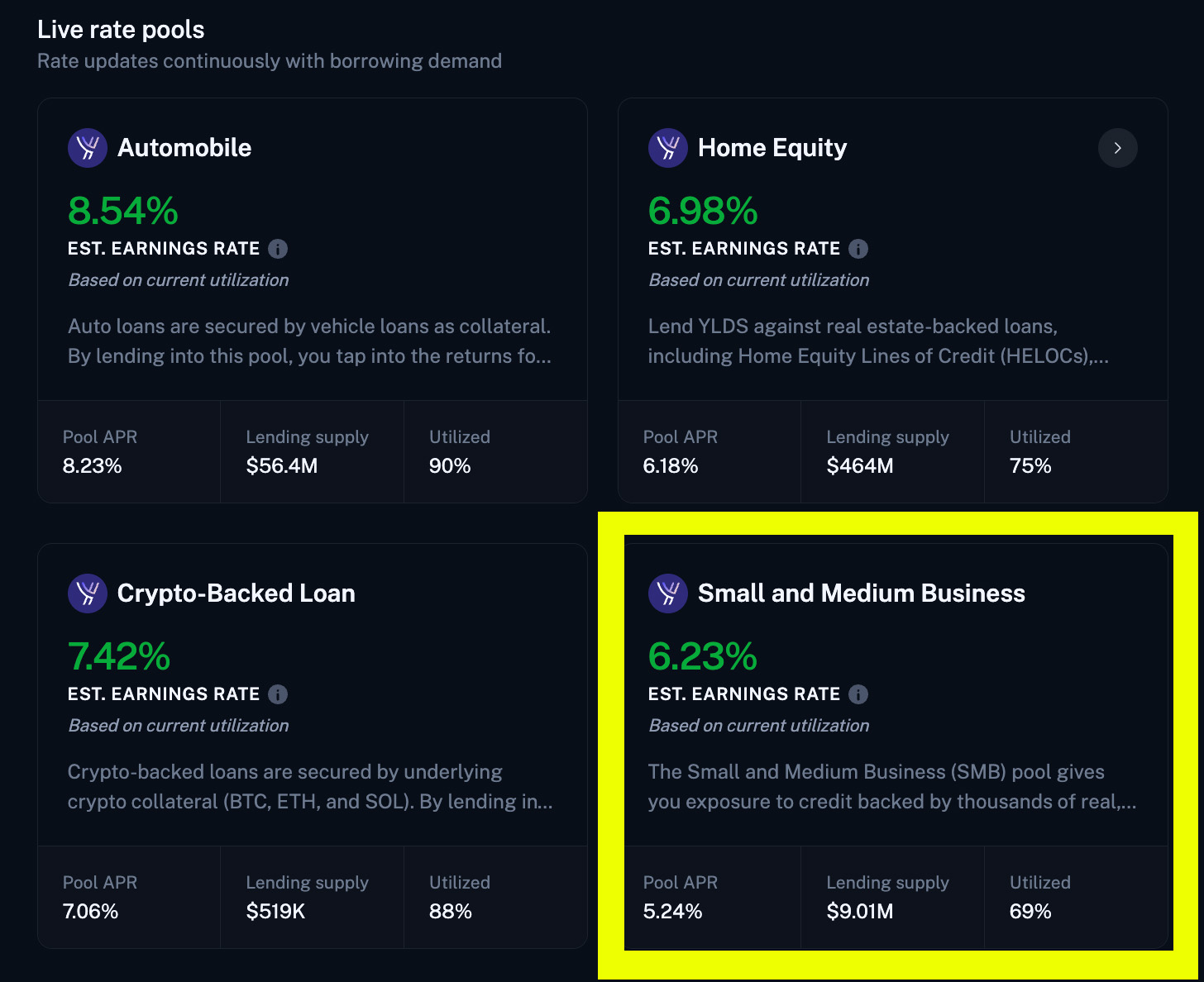 IT’S LIVE. Less than two months after Credibly announced a strategic partnership with Figure to “modernize SMB capital markets via blockchain rails,” investors big and small are now able to share in the earnings of a Credibly business loan warehouse line.
Specifically, Credibly boarded a business loan portfolio on July 21 and can already borrow against it using Figure’s Democratized Prime. Investors can now effectively participate in the earnings of that line by lending their own money into the pool. The amount of capital contributed to the pool and the utilization rate of it play a big role in the yield generated from that. Investors can pull out of the pool at any time assuming there is liquidity available to do so.
Unlike most investing platforms, investors can only participate in this one using blockchain rails (as was explained in deBanked’s May 23 story). Investors fund their accounts using dollars, crypto, or stablecoins, convert them into Figure YLDS tokens, and then lend those tokens into any number of available pools. As of the time of this writing investors can participate in HELOCs, auto loans, crypto loans, and now “small and medium business loans” which at present is sourced from Credibly. This all takes place on the Provenance blockchain and can all be easily conducted through the Figure Markets mobile app. deBanked was able to execute this process with no issues while using the investor side of the platform.
The investing opportunities on Figure’s Democratized Prime are warehouse lines for institutional-grade portfolios so investors are likely to see returns that resemble warehouse line rates (versus what one might expect if they do direct syndication with mom & pop lenders/funders). Credibly stands to benefit in the long run by the likelihood of lower borrowing rates and costs versus other capital market options and then being able to pass those savings onto their customers.
Investors will see some stats for the inaugural small and medium business loan pool which looked like this at the time of this writing:
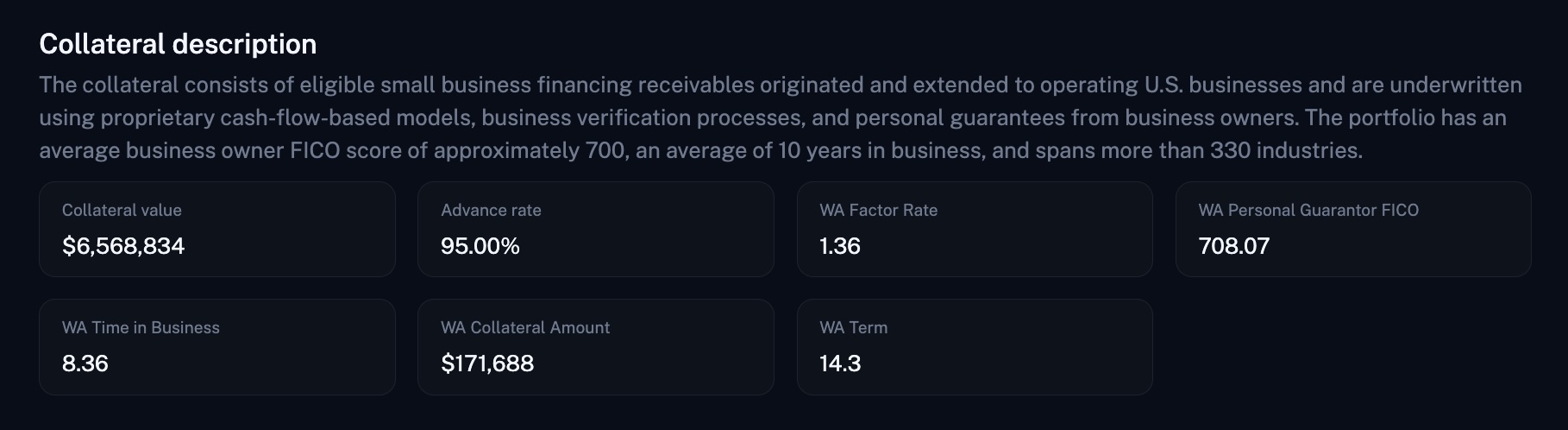
The page also offers this information:
The Small and Medium Business (SMB) pool gives you exposure to credit backed by thousands of real, vetted American small businesses. The receivables represent payments owed by operating U.S. businesses. By lending into the pool, you earn from the cash flows those businesses generate as they repay their financing obligations. Backed by institutional-grade small-business credit, the SMB pool provides yield generated by a tangible, collateralized asset class, and a new way to diversify your portfolio.
Risk parameters
Democratized Prime manages risk through a structured financing facility backed by a diversified pool of prime small business financing receivables. The facility benefits from multiple layers of credit enhancement ensuring the pool can absorb a variety of adverse conditions before depositor yield is affected. This is enabled by a variety of mechanisms, including a 95% advance rate cap, reserve account funding, overcollateralization, originator repurchase obligations, and full recourse provisions. All receivables included in Democratized Prime must satisfy established eligibility requirements and be performing at the time of inclusion.Collateral description
The collateral consists of eligible small business financing receivables originated and extended to operating U.S. businesses and are underwritten using proprietary cash-flow-based models, business verification processes, and personal guarantees from business owners. The portfolio has an average business owner FICO score of approximately 700, an average of 10 years in business, and spans more than 330 industries.
The author contributed $5,000 in YLDS tokens into the Small and Medium Business loan pool on his own volition prior to the publication of this article for test purposes.
Stripe Capital, PayPal Working Capital Could Merge If Acquisition Offer is Accepted
July 19, 2026The old rumor that Stripe was interested in acquiring PayPal was apparently true. Partially anyway. This past April, Stripe, along with Block and Advent (a private equity firm), let PayPal know they were jointly interested in acquiring it. But Block dropped out of the deal and the newest acquisition offer, now public, comes from just Stripe and Advent together. While Stripe and PayPal are obviously known as payment processing companies, the two originate more than $3 billion a year in MCAs and short term business loans a year combined.
PayPal is one of the few online payment platforms to struggle with bad debt in its merchant funding program and the company had never weaponized its lending offerings to grow PayPal’s business. Nevertheless, its origination volume outpaced Stripe’s in 2025. Stripe and Advent offered $53 billion to acquire PayPal. It remains to be seen if a deal will actually happen.
Building a High-Trust Lending Platform in a Low-Trust Environment
July 7, 2026Richard Henderson is the Chief Executive Officer of BriteCap Financial, a technology-enabled small business capital platform that has deployed over $1 billion to support American small businesses. He brings more than two decades of leadership experience in financial services and small business lending, with a track record of driving growth, strengthening operational discipline, and leading strategic transformation. Prior to BriteCap, Richard served as Chief Revenue Officer at CAN Capital and held senior leadership roles at Marlin Capital Solutions and CIT Bank.. Learn more at https://www.britecap.com
Let’s start with something most people in this industry understand but don’t always say clearly: The barrier to entry into the revenue-based financing space is relatively low. That’s true for brokers. It’s also true for funders.
And that matters. Because when barriers are low, standards tend to vary. A lot.
There are exceptional operators in this space—on both sides. I’ve met and worked with many who actually care about their customers, about building real relationships, and about seeing their businesses and customers thrive long term. There are also aggressive players. Some cross lines; some don’t even realize they’re crossing them.
Over time, the market reflects all of it: Borrowers come in skeptical. Good brokers feel like they have to defend themselves, funders feel the same, and an entire industry gets lumped together. And when viewed as a whole that way? The industry doesn’t look that great.
That’s the environment.
The Scaling Problem
In my experience, most businesses in this industry don’t break because of bad intentions. They break when they scale.
A great broker or funder can run a clean, high-integrity operation as an individual or small team. But what works at 1–5 people doesn’t automatically work at 25, 50, or 100.
Why? Because standards that live in someone’s head don’t scale. They have to be explicit, operationalized, and enforced. If they’re not, small decisions start to drift:
• Deals are framed a little too aggressively.
• Details are left out because they “probably won’t matter.”
• Customers are pushed a bit further than they should be.
Nothing dramatic. Until it compounds.
Where Things Actually Go Wrong
Let’s talk about something real.
There are cases where a business owner takes a loan, then quickly gets stacked—sometimes multiple times—with compounded payments outstripping cash flow. In the worst cases, that same customer ends up being referred into a debt settlement situation by the same bad actor who just keeps getting paid. This happens at the expense of the customer we’re all supposed to be trying to help, not harm.
They’re over-leveraged, their credit is damaged, and their access to capital is effectively shut down for a long time—if not permanently. Or worse, it turns a business owner into a former business owner.
That’s not a one-off issue. It’s a structural vulnerability. And here’s the uncomfortable part: Without the right controls, well-meaning organizations can participate in that outcome without even realizing it. It just takes one bad actor within your organization.
Intent isn’t enough.
The Foundation: The Big Three
If you want to build a high-trust platform, you have to start with alignment. At BriteCap, we’ve distilled our model into three non-negotiables:
• A strong business model that delights customers profitably.
• A sales system that ensures customers are delighted consistently and predictably.
• A high-performing talent environment that drives excellence and ownership.
If your business model depends on outcomes that hurt the customer, it will fail in the long run. If your sales system isn’t consistent, the experience will drift. If your talent environment doesn’t reinforce awareness of your vision and accountability, none of it holds.
Then You Build the Controls
Trust doesn’t scale without structure. We’ve invested heavily in making sure ours does:
• Achieving SOC 2 Type II certification.
• Participating in the Secure Funder program.
• Implementing continuous inspection of vulnerabilities across our systems and processes.
And just as important: ownership. Our Chief Administrative Officer & General Counsel and our Chief Technology Officer actually own governance, compliance, and operational controls as mission-critical mandates. This is not a back-office function. It’s core to the business.
You Also Decide Who You Work With
This is where I’ve seen many platforms compromise. We don’t. And neither should you.
We run a highly selective, by-invitation-only broker and overall partner acquisition strategy. We set a very high bar for whom we’ll invite into (and allow to stay in) our ecosystem. When that standard isn’t met, we act quickly.
We walk away from brokers delivering or promising to deliver million-plus per month origination volume. That’s not theoretical; we’ve done it. Because once you let standards slip, they don’t come back.
That includes a clear stance on something that’s become increasingly common: We do not work with brokers who sell debt settlement services. Not because we don’t understand the economics, but because we understand them too well. It creates a structural conflict that almost always ends the same way for the customer. That’s not a system we’re willing to be part of.
Culture and Incentives Drive Everything
You don’t get high-trust outcomes from low-trust incentives. If your organization is purely volume-driven, behavior will follow.
We focus heavily on alignment: what we reward, what we tolerate, and what we reinforce. Our Guiding Principles act as absolute operating constraints:
• Truth-Seeking and Radical Transparency: We deal in reality.
• Ethical Decision-Making: No shortcuts, no cutting corners.
• Building a Culture of Purpose and Connection: People perform at their best when they understand what they’re building, why it matters, and how their actions impact others.
That alignment is what keeps standards high as you scale. And underneath all of it: Trust is our most valuable asset.
Technology Is Necessary—But Not Sufficient
We believe the borrowing experience should be ridiculously fast, smooth, and predictable. Technology gets us there, but technology doesn’t create trust. It amplifies whatever is already there.
If your system is disciplined, technology scales discipline. If it’s not, it simply scales problems faster.
What This Means for Brokers and Funders
If you’re building in this space, the challenge is simple—and hard: Can you maintain your standards as you scale?
That means making expectations explicit, aligning incentives with outcomes, building real oversight, and acting quickly when something isn’t right. The operators who figure that out will stand out.
The Long Game
At BriteCap, we’re building for the long term with an epic journey to number one. That’s not about being the biggest. It’s about building something that holds together at scale, delivers consistently, always keeps our customers’ best interest at the center, and earns trust over time.
In a low-trust environment, that’s the opportunity. Not to move faster than everyone else, but to build something better.
Bottom Line
Trust doesn’t break all at once. It erodes—through small decisions, unclear standards, and misaligned incentives.
The inverse is also true. Trust is built the exact same way: clear expectations, disciplined systems, aligned people, and consistent decisions. Every single day.
Do that long enough, and you’ll have built yourself a high-trust lending platform in a low-trust environment. And if enough of us do it long enough, we’ll create a high-trust, mainstream funding mechanism for small businesses. That is good for all of us.
SoFi’s Small Business Loan Product Details
July 2, 2026SoFi is now a small business lender, according to their most recent announcement.
But they’ve been in this market for a while. They first flirted with the idea in February 2023 and then launched a marketplace in January 2024 to warm up to it. As a marketplace, they referred their own customers to other direct providers of capital, including MCA companies. Under this new program, applicants will be evaluated for a SoFi business loan first and then referred to their marketplace if they don’t qualify, second. Fundbox is referenced by name as one of the possible destinations for these applicants.
SoFi’s in-house business loan comes with a max APR of 36% and dollar ranges of $2,500 – $250,000. They’re personally guaranteed and have max terms of 2 years. Applicants need not be a SoFi customer to apply and funding can take place in as little as 24 hours.
Parafin Has Funded 50,000 Businesses, How Does That Compare?
June 25, 2026Parafin’s new credit facility with Goldman Sachs was complemented by the disclosure that the company had funded more than 50,000 businesses since inception. Founded in 2020, Parafin typically markets how much it has extended in “offers” to small businesses rather than how much it has actually funded. This bucks the prevailing industry trend.
To put Parafin’s 50,000 deals funded over the last 5 years into perspective, the industry leading online lender, Square Loans, funded approximately 700,000 loans last year alone.
Parafin disclosed revenue in 2025 as $90M, which is approximately double that of Lightspeed Capital over the same time period. Lightspeed originated $340M in MCAs in 2025.
Parafin says that the majority of its fundings go to repeat borrowers. The company powers platforms such as Amazon, Walmart, DoorDash, Gusto.
Big Deals, Big Consequences: How some deals went very wrong
June 18, 2026In November 2018, a conglomerate of car dealerships went out of business in California. Within three weeks, a merchant cash advance company, 1 Global Capital, was discovered to have filed bankruptcy as a result. They had lost more than $40 million in that dealership deal alone. Over the ensuing weeks, additional funding companies revealed that they had also been in it and gotten burned, some so badly that they also closed their doors. It was a moment of reckoning for the industry as deals got bigger and the stakes got higher. At the time, it was considered the largest deal (and then the largest default) in history.
Less than two years later, an even bigger deal was revealed, a $91M MCA made by Par Funding. Par also became a rather infamous failed business.
And some time in between the two, a $1B hedge fund that provided credit facilities to small business lenders, also failed and took some lenders down with it.
In each case there was a lesson learned.
1 Global Capital
In 1 Global Capital, internal emails revealed that the company knew the dealerships were on the brink of collapse, but were compelled to keep funding them to avoid taking the loss.
“…if they were to become insolvent, everyone loses,” said 1 Global’s Director of Accounting. The result was they dug a deeper and deeper hole until they were on the hook for tens of millions and their exposure became existential.
1 Global was not forthcoming about the performance of its portfolio to its investors and by the time the dealerships went bust, regulators and prosecutors moved in to deal with the fallout.
Par Funding
In the Par Funding case, foul play appears to have been the defining issue. The large funding amounts and low defaults looked good to the investing public because the books were not being accurately reported. Par was adamant that the power of “compounding” could make up for any losses they incurred, but regulators said they had not even properly disclosed their losses to begin with and investors were not aware of them. The $91M deal was just the tip of the iceberg. Another customer purportedly owed $35M, for example. And then those combined with the next eight largest deals on their books added up to $228M, which made up 54% of their entire portfolio. Par had very severe concentration risk and compounding probably could not save it on other deals if these went bust.
Direct Lending Investments
In the Direct Lending Investments hedge fund case, the CEO had famously proclaimed that small businesses were overpaying for credit and that was how their investors stood to profit. But over time, it became evident that some of the small business lenders they backed actually had customers underpaying for credit and the losses overwhelmed the hedge fund. Unfortunately, the CEO was unwilling to concede the losses and told investors they were actually profitable instead. To try and cover it up and make it back, the hedge fund loaned nearly $200M to telecom companies at high interest rates. And because they made these loans during a state of distress and probably were not underwriting them carefully, the borrowers scammed them and disappeared with the funds. There was no longer a way out and the CEO resigned. The receiver in the case initially estimated that portfolio was then worth $500M less than what they had last reported to investors.
Ironically, the CEOs of all three companies were convicted of crimes for their roles in the lies and the losses.
Concentration risk, misleading investors, and falling victim to the sunk cost fallacy ultimately were their undoing. For some, the deals got larger to try and keep a dead deal from failing. For others, it was a Hail Mary play to try and generate a return to make up for losses elsewhere.