

Sean Murray is the President and Chief Editor of deBanked and the founder of the Broker Fair Conference. Connect with me on LinkedIn or follow me on twitter. You can view all future deBanked events here.
Articles by Sean Murray

Calling Timeout On Financial Regulations, A Pump For Trump?
August 10, 2016
Only 24% of small business owners say that Hillary Clinton is the presidential candidate that has their best interest at heart, according to a survey conducted by Capify, a business financing company based in New York. 53% selected Donald Trump.
And whatever your opinions about Trump, his proposed moratorium on new financial regulations could entice both small businesses and alternative financial companies to consider a Trump presidency.
“Under my plan, no American company will pay more than 15% of their business income in taxes,” Trump said in Detroit on August 8th.
A report published by the National Federation of Independent Business (NFIB) last month found that 20% of business owners ranked taxes as the single most important problem facing their business. Only 2% reported that financing was their top business problem.
Message received? It appears not
In states like Illinois, some legislators are focusing their efforts on finding ways to make it harder for small businesses to obtain financing, convinced that questionable lending practices are the source of their problems, not taxes. But in a call with Bryan Schneider, secretary of the Illinois Department of Financial and Professional Regulation, he told deBanked that no one has complained of any small-business lending problems in Illinois to state regulators.
Regulators should not indulge in creating solutions in search of problems, Sec. Schneider cautioned. “When you’re a hammer, the world looks like a nail,” he said, suggesting that regulators sometimes base their actions on anecdotal isolated incidents instead of reserving action to correct widespread problems.
And that’s why a moratorium on financial regulations (albeit on the federal level) might also resonate with small businesses. Lawmakers don’t appear to be addressing their grievances and ironically, passing new laws that make it harder to obtain financing could potentially even exacerbate the problems they’re already vocalizing.
Small businesses seemed to have become aware of the government-as-obstructionist role however since 22% of them surveyed in the NFIB study, said that government requirements and red tape were the single most important problem they faced, more than anything else.
The Finance Side
A timeout is not a sure-fire way to woo Wall Street however, since a moratorium on federal regulations could actually serve as a hindrance for some financial companies hoping to reach some legal framework consensus down the road. Last year, Bizfi founder Stephen Sheinbaum, said that a 50-state patchwork of laws would make operating companies like his more challenging. “Personally, I’d be glad to see it on the federal level, we won’t have to deal with 50 individual states, which is more unruly,” Sheinbaum said in regards to potential regulation.
But a timeout on making any moves might indeed be in order anyway, given the questions that are being asked by some federal legislators. Last month during a hearing, Rep. David Scott asked what made business loans different from consumer loans. Parris Sanz, the Chief Legal Officer of CAN Capital, who was there testifying on behalf of the Electronic Transactions Association (ETA), gave his answer.
But there is a fear, just by those questions, that some legislators are still having trouble understanding the fundamentals. And that may be why a dozen trade associations and lobbying groups have formed in the last year to provide educational resources about alternative financing.
In states like Illinois, Scott Talbott, SVP of government affairs for the ETA, said they are encouraging legislators to adopt a “go-slow approach” that affords enough time to understand how the industry operates and what proposed laws or regulations would do to change that.
Keep it Simple?
With Trump, despite all his quirks, it’s possible that his ideas about a moratorium, could be a deciding factor in how small business owners and those employed by alternative financial companies vote. Lower taxes, timeout on regulations, has the potential to resonate far and wide.
60% of small business owners think that the outcome of the presidential election will have a severe impact on small businesses, according to the Capify survey. 29% said it possibly will have a severe impact. With taxes and government red tape at the top of their list of grievances, there might just be a pump for trump on both sides of the alternative finance aisle.
OnDeck is NOT a Marketplace Lender
August 9, 2016
It’s finally time to stop calling OnDeck a marketplace lender.
The company only sold 15.6% of its originated loans through the OnDeck Marketplace, according to their Q2 earnings report. That’s down from 26% in the prior quarter. It’s not hard to see why that might be as the Gain on Sale Rate was only 3.5% in Q2, a significant drop from the 5.7% in Q1 and 7.8% at this time last year.
On the earnings call, OnDeck’s chief officers argued that demand for their loans remained very high but that investors are requiring more return for the same risk. With the profit incentive to sell loans severely diminished, the company plans to continue selling only 15% – 25% of their loans going forward on the basis of keeping institutional relationships and diversification.
But if not a marketplace? Then?
OnDeck is a non-bank commercial balance sheet lender. And as a result, the company’s cash dropped from $160 million on December 31, 2015 to only $78 million at the end of Q2. OnDeck CFO Howard Katzenberg said that this wasn’t a burn, but rather cash being invested into their loans, all part of their plan of moving away from the marketplace. The company still has $300 million in GAAP equity, $100 million available to it from its warehouse lenders, and other debt facilities that it plans to increase for more leverage.
OnDeck funded a whopping $590 million in loans in Q2 but posted a net loss of $17.9 million. Origination figures include the full loan principal amount on renewals even though part of the principal may be used to pay off an existing loan.
Marketing costs remained relatively stable as did loan performance. Little was said about their relationship with JPMorgan Chase other than the fact that it’s still “early days at this point.”
OnDeck, Lending Club to Announce Earnings Today
August 8, 2016 Both OnDeck and Lending Club are scheduled to host their Q2 earnings calls today At 5 PM EST.
For Lending Club, investors will have an opportunity to assess the damage that rocked the company in May. Back then, the sudden resignation of the CEO was brought on by a loan manipulation scandal and conflicts of interests. That led to a DOJ Grand Jury investigation that was compounded by a New York Department of Financial Services subpoena in an unrelated probe. The ensuing appetite to buy their loans waned, forcing Lending Club to use their own balance sheet to ensure the flow of their business went on uninterrupted. On July 28th, CEO Scott Sanborn announced that they were NOT becoming a balance sheet lender and were holding only 2% of their expected quarterly loan volume. More recently, investment bank Jefferies is said to have sold $105 million in bonds backed by Lending Club loans, showing signs that confidence in the company’s product remains.
OnDeck isn’t embracing the tech company characterization as much as they used to. Earlier in the year, CEO Noah Breslow described the company as a “non-bank commercial lender” in an interview on CNBC. As such, origination growth at the expense of all else is no longer likely to excite investors who have shifted to judging the company on its path to profitability and its long term plan to sustainability. In Q1, they were asked what would happen if the company stopped the marketplace aspect and just held all its loans on balance sheet. The response? More short term losses, due to accounting standards. Two things investors will surely be looking at is the cost of marketing in Q2 in the face of increasing competition and loan performance.
Have You “deBanked” Yet?
August 5, 2016If you’re not already subscribed, you can make sure that you receive the July/August 2016 edition in print by subscribing here.
Among the featured stories and content are:
- The role of MCA/business-loan brokers around the world contrasted with the U.S.
- The continued growth of alternative commercial finance
- How to grow an MCA or business loan brokerage
- Uber’s new finance program
- And much more!
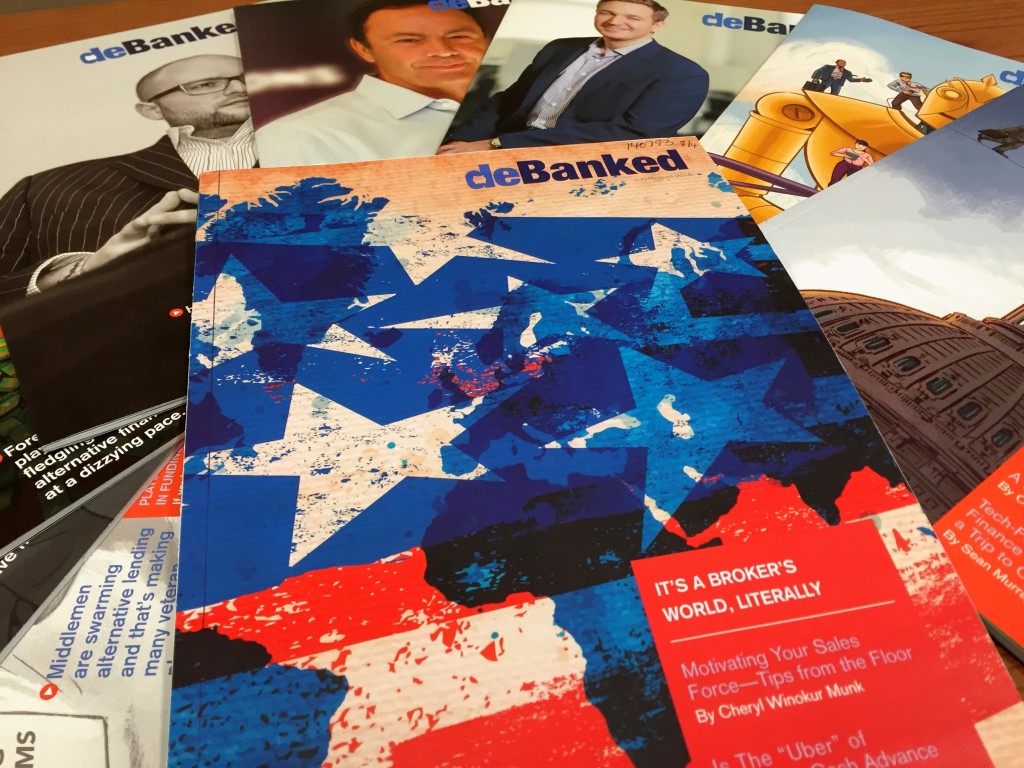
Are you involved in funding businesses outside the bank? It sounds like you’ve de-banked! We hope you enjoy this issue. The digital version will be online later this month.
Square Capital Revs Up, Funds $189M to Small Biz in Q2
August 4, 2016
Square is proving that the business loan sector is still hot, especially since their payment processing ecosystem requires nearly no marketing budget to advertise Square Capital. With $189 million funded in Q2, a growth of 123% year-over-year, their shift from merchant cash advances to loans seems to have had the desired effect since they have attracted even more investors willing to buy them.
“We sell a majority of our loans to third-party investors for an upfront fee and a small ongoing servicing fee. In addition, we continue to have a strong continued pipeline of interested investors,” the company said in its earnings report.
The average loan size remains small, only $6,000, but ranges from $1,000 to $100,000. Square CFO Sarah Friar, said during the earnings call that their data shows an overall increase in the gross payment volume of merchants who use their loans, which indicates that borrowers are indeed using the funds to grow their businesses.
A typical Square Capital loan is close to 10% of a seller’s annual processing sales and the average repayment term is 9 months. Loss rates remained steady at 4%.
Friar also said that PayPal Working Capital and American Express Working Capital were not really competition since they are working directly with their own existing user base.
The company made about 34,000 loans in Q2.
Is Lending Club Going to Become a Balance Sheet Lender?
July 29, 2016 An email that Lending Cub sent out to many of their investors yesterday was also published on their blog. In it, CEO Scott Sanborn addressed the following questions, ones they’ve been hearing more frequently these days:
“Are you going to become a balance sheet lender, just like a regular bank? Has Lending Club’s business model changed?”
“Let me be very clear,” Sanborn wrote in response, “Lending Club is committed to the marketplace model and we do not plan to become a balance sheet or ‘hybrid’ lender. Our mission of connecting borrowers and investors has not changed.”
The industry around them however, is changing. Goldman Sachs, for example, is expected to introduce a non-marketplace consumer lending division this Fall to compete against companies like Lending Club.
Sanborn also wrote that there may be times that they use their balance sheet. “One example would be to enable test programs. Another situation would be to bridge imbalances on the platform,” he wrote. “In plain English, this means that if there is a timing mismatch resulting in more borrower demand for loans than available investor capital, we’ll consider investing in and holding the loans with the plan to sell them to investors in short order.”
So the answer is no, Lending Club is not becoming a balance sheet lender.
With Goldman Sachs’ Entry Into Online Lending Looming, Peer-to-Peer Lending is Deader Than Dead
July 28, 2016 When I first started writing about Lending Club and Prosper years ago, I was intrigued by the ability for everyday average Americans to have the opportunity to earn the yield of a credit card company. It was peer-to-peer or close enough anyway, and the allure was that you became the judge, jury and underwriter of people applying for loans, plopping down amounts as small as $25 at a time, hoping it’d come back plus interest.
There was a social movement that latched on to it too. When I attended the 2014 LendIt Conference, for example, I met people who were there for no other reason than to connect with other like-minded peers, whether it was to compare investing strategies, share free tools or just hang out. Those days are over. And with the looming arrival of Goldman Sachs into online consumer lending, people have asked me if I’m excited about what it means for “the industry.”
What industry? I wonder.
If Goldman truly begins making consumer loans online, they would certainly be competing with Lending Club and Prosper. But the fact is they’d also be competing with Discover, Bank of America and every other financial institution in the nation that makes consumer loans. And while it might be an odd market for Goldman to enter, they’re not really going to be part of “the industry” unless you’re defining the industry as traditional banking. Most of today’s online lenders rely on offline marketing like direct mail. Discover does the same for its personal loans and Goldman will inevitably follow suit. But there will be no peers on Goldman’s platform. Therefore with them being a bank, making loans “online” or on a “platform” doesn’t make them part of any special revolution, it just makes them modern and quite boringly so. There’s nothing sexy about a bank making loans to consumers. It’s a 20th century headline masquerading as 21st century innovation because the word “online” is in it.
Cynical I might be in my view here, but the movement that once was, is all but gone. The little guy’s opportunity to earn yield like a Wall Street bank has been replaced with actual Wall Street banks. And companies like Lending Club, who were the marketplaces fueling the flames of social revolution, have been caught engaging in shady Wall Street shenanigans like manipulating loan data. And if that somehow still didn’t mark the end of an era, surely the arrival of the most powerful bank on Wall Street makes it final.
Peer-to-peer lending became marketplace lending and marketplace lending will now become Goldman Sachs lending.
Exciting for an industry, you say?
You know nothing Jon Snow.
Funder or “Funda”? Either Way, The Korean Government is Worried
July 25, 2016 In South Korea, the government isn’t sure if Funda is a direct funder. Funda, ironically spelled like the New York pronunciation of the word, is one of several companies offering high yields to investors across their peer-to-peer lending marketplace. The average rate of return is 10.94%, according to Funda’s home page.
But according to Bloomberg, the government isn’t positive if investor money being poured into the industry is really being used to fund loans. Not that any company is accused of wrongdoing at this time, rather the Financial Services Commission is attempting to get out in front to prevent problems from occurring in the first place.
In China, for example, the government’s willingness to remain hands-off and let p2p lending blossom, resulted in catrastrophic levels of fraud and mismanagement. By May, ratings agency Moody’s reported that 800 Chinese platforms had already failed or were facing liquidity issues. Even worse, more than $10 billion of investor money was ensnared in Ponzi schemes. An astounding 900,000 individual investors lost money in the Ezubao fraud alone.
The Korean market is still relatively new. According to the The Korea Economic Daily, there were only 20 p2p lenders in the country as of the end of March. South Korea is home to more than 50 million people, about 15% the size of the US.