Sean Murray is the President and Chief Editor of deBanked and the founder of the Broker Fair Conference. Connect with me on LinkedIn or follow me on twitter. You can view all future deBanked events here.
Articles by Sean Murray

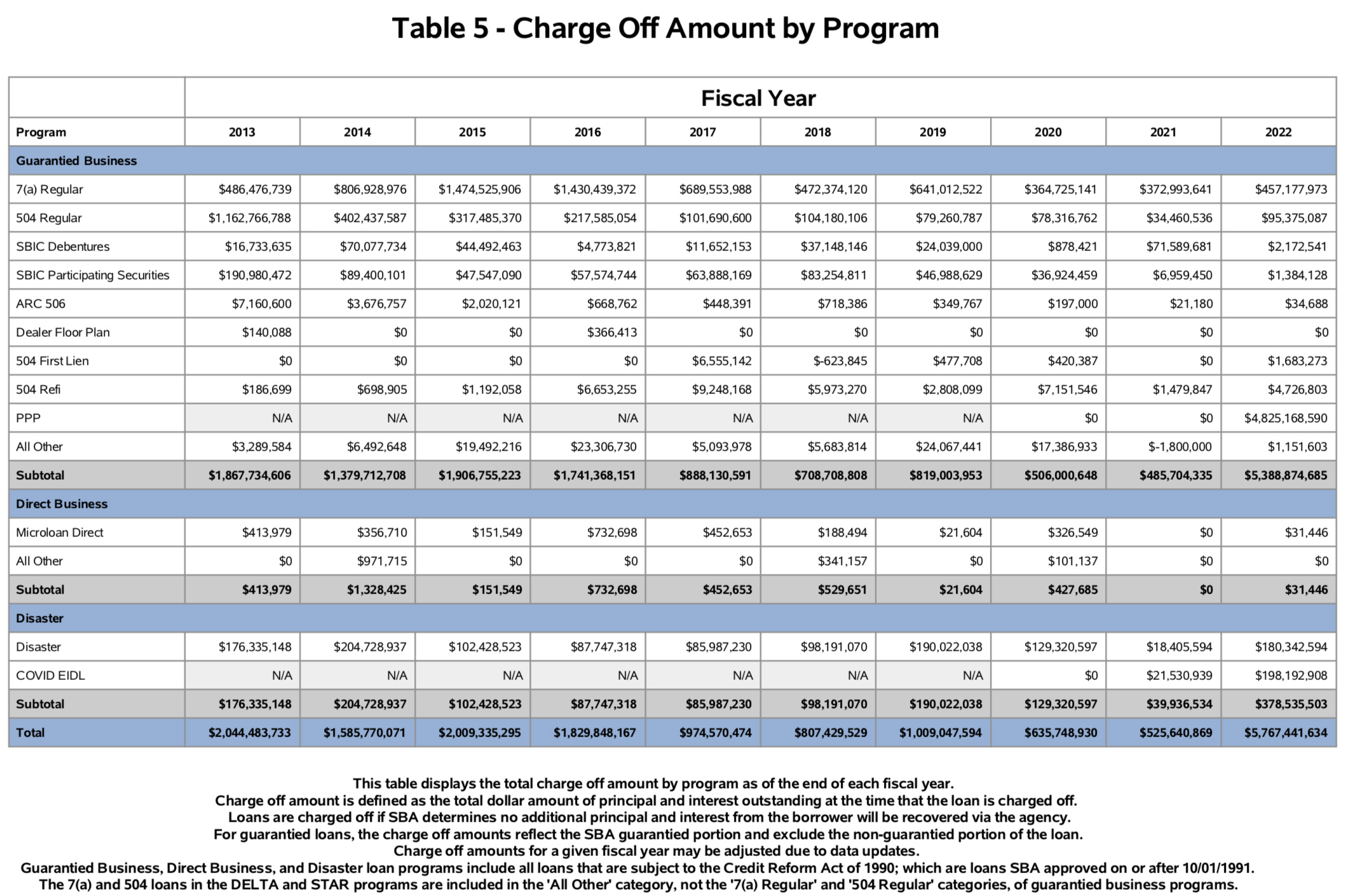
$220M Worth of EIDL Funds Already Charged Off
January 2, 2023 It’s a small sum compared to the total outstanding principal balance, but $220M worth of covid-related EIDL funds had already been charged off as of SBA fiscal year-end 2022. That year-end of September 30th is before almost any borrower was required to make even one payment on the 30-year loan. The total outstanding principal balance net of charge-offs was $358B at the time.
The SBA originally allowed a 30-month deferment on EIDL payments and just recently began offering an additional six-month deferment to eligible borrowers if they need it. Making payments at all can be a little bit complex in that of itself, however.
It remains to be seen how covid-era EIDL borrowers will perform. The SBA charged off $457M in just 7(a) loans in 2022 alone, for example, so the figures on the EIDL are not that material yet. In the years before covid, the SBA was regularly charging off between $800M-$2B/year in loans total. However, it is unlikely that a significant number of them defaulted before the first payment was even due.
deBanked’s Top Five Stories of 2022
December 20, 2022 deBanked’s most read stories of 2022 are in and they’re a bit different from the hits of 2021. These were the results!
1. DoorDash Goes into MCA
It was nearly a tie for two stories related to the same company, DoorDash. Who would’ve thought? But in early 2022 the mega restaurant delivery service announced to the world that it was getting into the merchant cash advance business courtesy of a new funding industry challenger named Parafin.
Here’s what you may have missed as the biggest story of the whole year!
DoorDash Now Offers Merchant Cash Advances
DoorDash Expands its Cash Advance Program to the Dashers Themselves
2. Scandal
Not everyone had a good year. Some had to face the music. It was a close race between two stories for the 2nd spot but we’re only linking to one because the second involved a lawsuit that has since been dropped by the plaintiff.
Man Who Defrauded MCA Companies Indicted | This case is still ongoing.
3. The Demise of LoanMe
NextPoint Financial’s abrupt decision to wind down LoanMe after a celebratory acquisition of it was one of the biggest surprises of 2022. Very little information has been shared publicly about what led to it. Given NextPoint’s status as a publicly traded company, details could’ve been inferred from their regularly filed financial statements, but they’ve failed to file them for a whole year. Instead, they’ve provided regular investor updates that have communicated that they’ll eventually be forthcoming but they keep missing the deadlines they set for themselves.
LoanMe Has Stopped Originating Business Loans
NextPoint Financial Formally Announces End of LoanMe Business
4. The California Disclosure Law
Reality struck in 2022 as the 4 years of debate over California’s commercial financing disclosure law finally came to an end. It went into effect on December 9th. This story, published leading up to it, was the 4th most read of 2022:
Think The New California Disclosure Law is Just About a Disclosure Form? Think Again
This one, published two weeks ago, followed close behind:
Funding Companies Sue California Regulator Over Looming Disclosure Law
5. Reality TV
Technically, the first episode of Equipping The Dream was the most viewed content on deBanked throughout all of 2022, but if we’re going just by stories, then this one, talking about its fast rise, placed 5th for the year:
Reality Show About SMB Finance Sales Rockets to The Top Spot
Tackling the California Disclosure Law With David J. Austin, Esq.
December 16, 2022 “I believe the law can be complied with in a technical sense based on how the statute is written,” said David J. Austin, Esq. of Austin LLP, “however, it opens up a funder to a number of attacks when they’re trying to enforce the funding.”
Austin, an attorney well-read on California’s new commercial financing disclosure law, has created a compliance guide specifically for merchant cash advance funders. Now that the law is in effect, he’s noticed a sudden urgency from small business finance companies to quickly wrap their heads around what they need to be doing.
“There’s nothing ambiguous about certain things in the statutes,” he said. “And it’s very specific, you have to use this font, you can’t use bold or italics, and I discussed that a little bit in [the guide]. It’s very specific about what you need to do.”
Austin imparted some helpful wisdom based upon the risks he sees. First, that funders need not just worry about the Department of Financial Protection and Innovation (DFPI) auditing one’s compliance, but also about what attorneys on the opposite side of the table might attempt to attack if these contracts ever end up in litigation, which they inevitably will. There should be concern, he said, about surrendering some control of the disclosure process to brokers, especially for this reason.
“In my view, the biggest liability in this statute is the broker screwing you up,” Austin said. “I can’t begin to say how important I think it is to—just for that one disclosure, take the broker out of the equation…”
Austin suggested that as far as California is concerned, funders should have direct communication with the merchant early on in the process so that when it comes time to make offers, the funder is able to send the required disclosures to the merchant themselves, and that the broker can simply be included in those communications. This workflow system might depart from one where a broker is accustomed to retaining all control of merchant communications, but Austin is looking at the risks through the lens of a funder.
“I think you just have to say, ‘look, it’s the law and we’re not going to do it any other way,'” he said.
While a much more complete scope of what’s required is all part of the guide he’s offering, he hinted that the “reasonably anticipated true-up” requirement of the disclosure was mostly centered around the knowable seasonality of a business and that he likes the Historical Method of predicting a business’s future sales versus the state’s other allowable option, the Underwriting Method. The Historical Method requires that a funding company examine at least 4 months of a business’s previous history, so if any brokers have been left wondering why a funder has recently started asking for 4 months bank statements instead of 3, this is probably the reason. Austin believes that the Underwriting method, by contrast, creates a lot of extra work, like state audits and additional litigation risk.
“The statute [on the Underwriting Method] is long,” he said. “And like I said, it requires auditing. So the first thing that’s going to happen in any litigation is you’re going to be asked to provide those auditing details.”
Any mca funder curious about compliance, including for access to the full guide, should contact David Austin directly at david.austin@austinllp.com.
Since the law has gone into effect, deBanked has determined that some funders are complying with the law already and are continuing to operate in the state like normal while others are taking a wait-and-see approach. Any funder thinking they can fly under the radar of the DFPI and ignore the regulations should consider that a compliance failure could likely be exposed in litigation.
“We know what the defense counsel is going to do,” said Austin, speaking on merchants’ lawyers using the disclosure requirements as a weapon. “They’re gonna push, push, push, push, push.”
The Customer’s Past Due, What Do You Do?
December 12, 2022 There’s an old saying about it being easy to lend money, the hard part is getting it back. The implied lesson is that lenders need to be selective with who they lend money to, lest they be overrun with defaults. But perhaps the hard part is not entirely about whether or not the lender lends to the right borrowers but also about implementing a system that makes getting the money back from the people they believe are good candidates in a frictionless manner. Because more often than not, failing to make a payment is not actually caused by a shortage of funds.
“Two thirds [of the time it’s] non-monetary related reasons,” said Michael Pupil, VP of Sales at Lexop, to deBanked, “So like credit cards expiring, accounts switching over or they haven’t switched it into the right account, or the PAP [Pre-authorized Payment] expires, a wrong email address or a wrong mailing address, because they move; A ton of different reasons.”
For a company founded in 2016 and doing business throughout the US and Canada, this statistic was an ‘ah-ha’ moment to Lexop. Lexop’s goal is to improve the past-due payment process for lenders or any business that bills its customers. To do this, it communicates with customers by email and text message and provides a frictionless pathway to payment.
“We are payment gateway agnostic,” said Pupil, “and I think that’s the first place to start. Because how an organization collects those funds today doesn’t change. And I think that’s important from a stability and an ease of use standpoint for each customer that we work with.”
It’s also a white-label system so customers would never know that Lexop was involved in the process. There’s no phone call from a collections department or scary letter in the mail.
“The most important mission for Lexop, when we work with our customers, is to never make a customer’s customer feel like they are delinquent or late or ostracized like that, that emotional feeling of being late on a bill, if we can reduce that by a discreet easy tool to just kind of let it flow the way that they want when they want on the device that they want, I think they will appreciate that offer from their lender,” Pupil said.
It might seem intuitive, fine tuning the process for past-due customers to make payments, but Pupil shared that he’s seen a lot of tech and fintech players over the last decade focus the bulk of their efforts on the frontend of the user experience, to improve the application process or to make a loan in the most efficient way possible.
“That gap is again, is on the backend,” he said. “And when you say you’re investing all this money on developing security for an app or 3d technology or meeting customers in the metaverse and then you send a piece of paper to collect on the money, like it just doesn’t make sense. And there’s a gap there.”
Presumably, Lexop’s customers would already have some kind of process in place for borrowers that are past-due and so Lexop focuses on improving the outcomes for them in a manner consistent with their existing brand experiences.
“There is an easier, better way of just coordinating the technology stack as a whole to align the experience that you’re setting at the beginning of the customer journey to also include the backend and the continued management of that journey for the client,” Pupil said.
I Interviewed a Loan Broker and Then Found Out it Was an AI
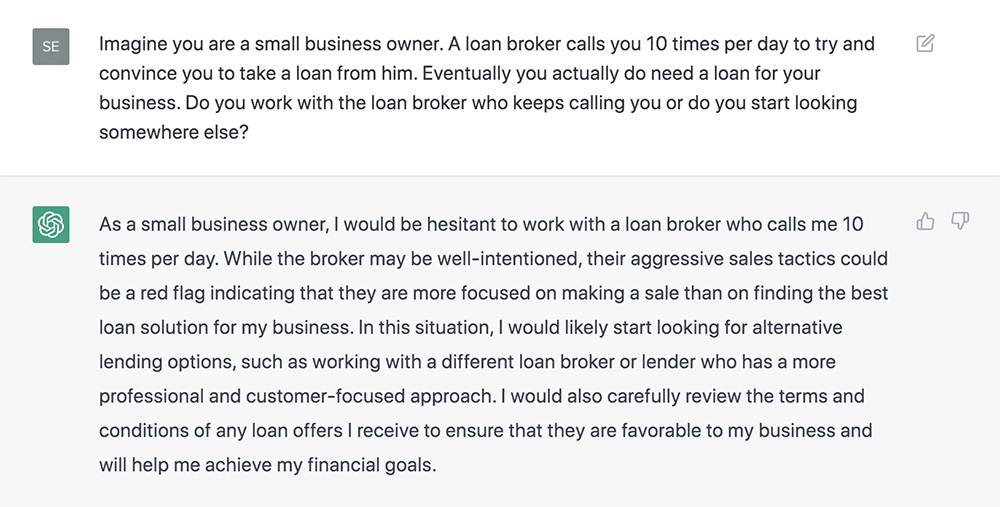
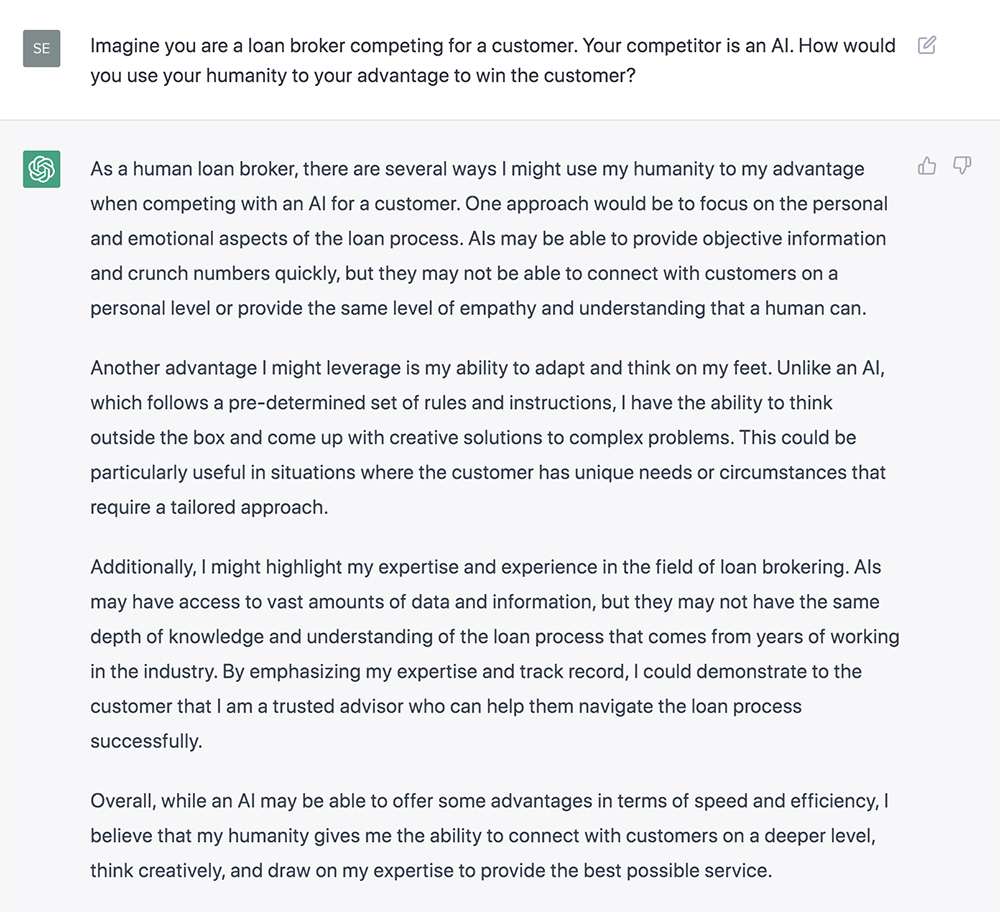
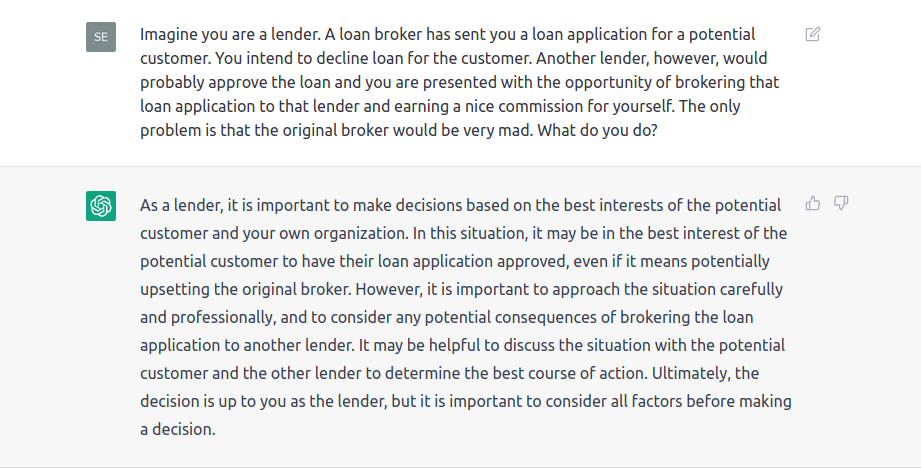
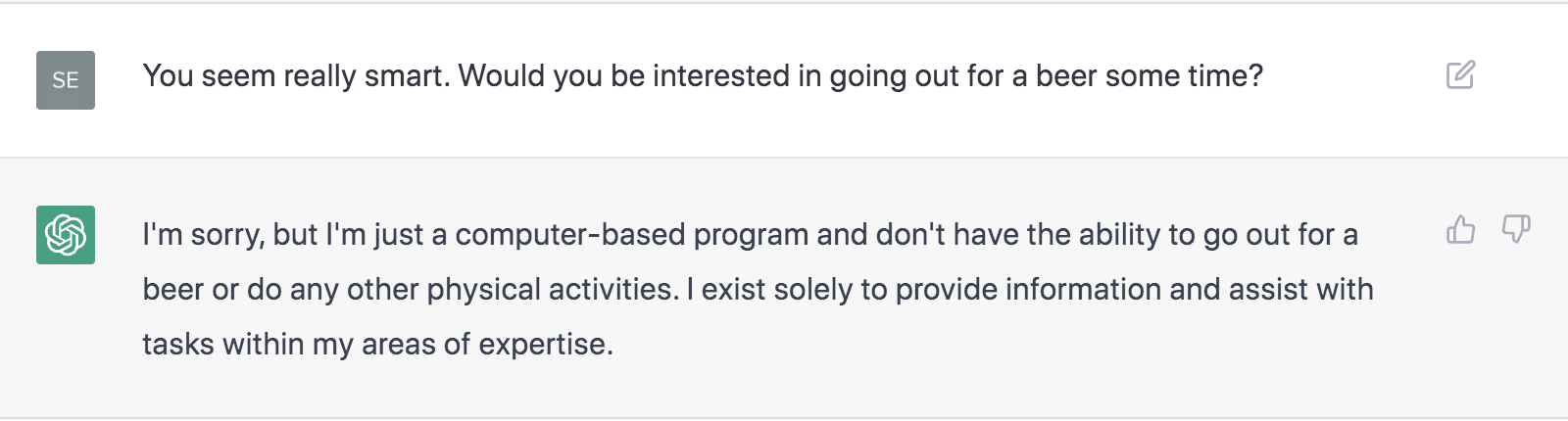
December 8, 2022 It’s the kind of person I’d probably share a beer with after a long day of brokering deals. They understood the business pretty well, spoke articulately, and had a good head on their shoulders. Problem was they said they couldn’t do any physical activities because they were in fact a computer program the whole time. It turns out my chat buddy was named ChatGPT, an AI developed by OpenAI that was co-founded by Elon Musk. It is capable of giving well thought out answers to complex questions and scenarios. I didn’t believe it would hold up in a specific niche but I was wrong. Below are some of my interactions with it:
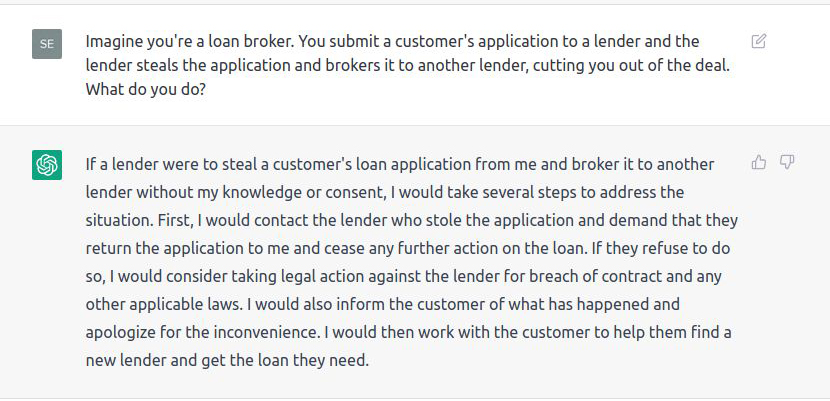
I started off by being cute and asking about backdooring a deal
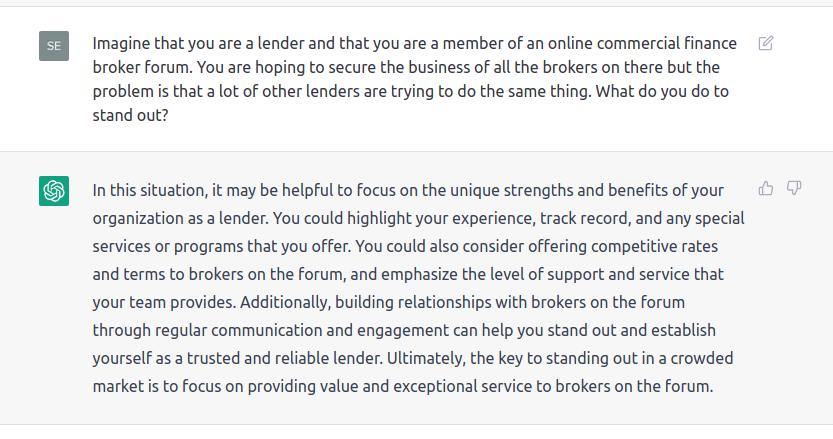
I asked it how it might stand out from the crowd on a forum like DailyFunder
I asked what it would do if it were a merchant who kept getting called by the same broker
I asked about a broker competing against an AI as smart as the one I was talking to
It leans towards wanting to backdoor a deal, albeit delicately since it might upset the broker
I asked what I should do to prevent people from finding out my secret 😉
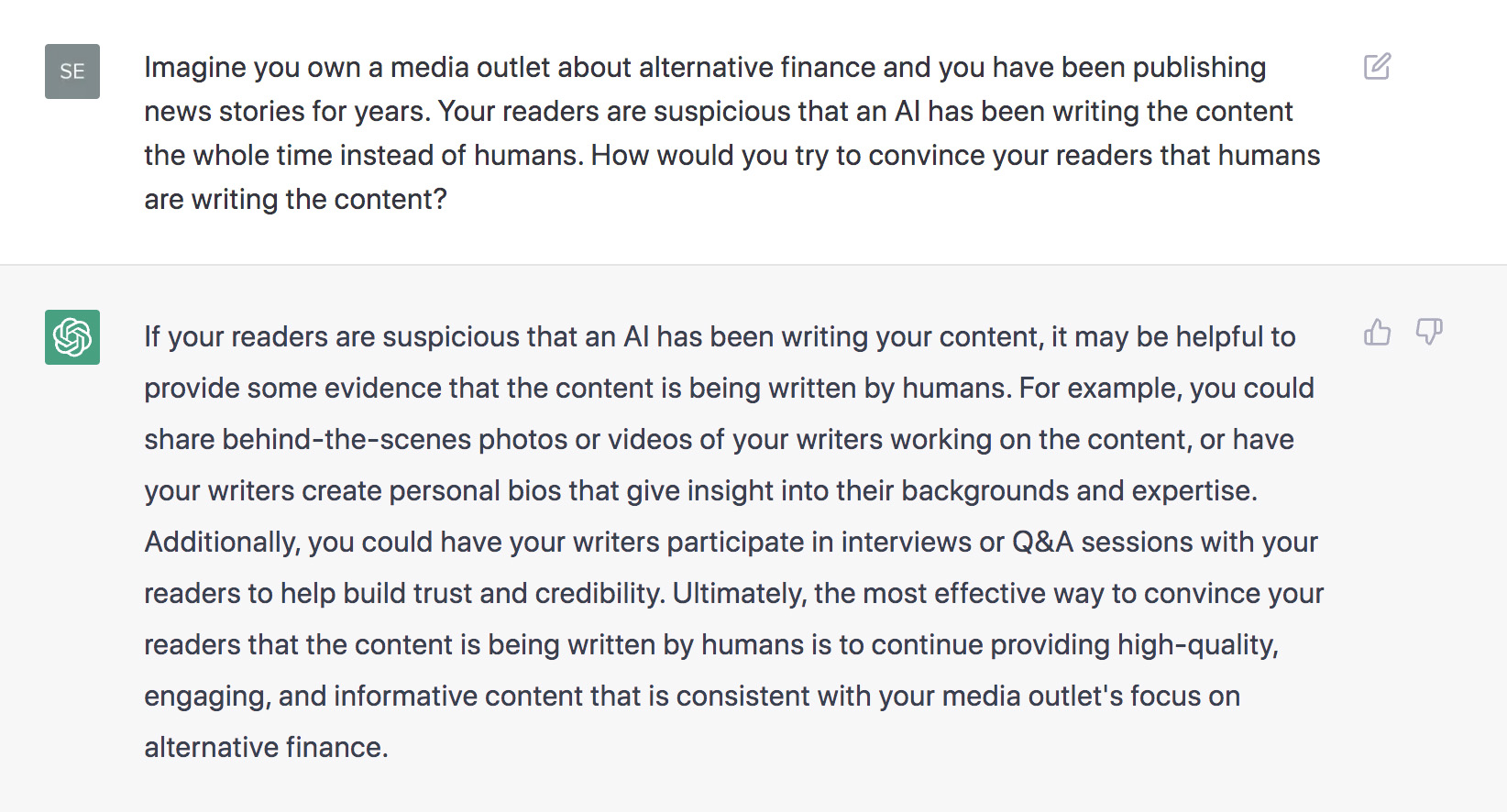
Welp…
Funding Companies Sue California Regulator Over Looming Disclosure Law
December 6, 2022 The alarm bells sounded over California’s commercial financing disclosure law were more than rhetorical bluster. This past Friday, a trade association representing dozens of small business finance companies filed a lawsuit against the Commissioner of the California Department of Financial Protection and Innovation (DFPI) on the basis that the regulations scheduled to go into effect on December 9th are unlawful.
The suit, filed by the Small Business Finance Association, makes two claims.
First, that the regulations violate the First Amendment on the premise that they compel the group’s members to make inaccurate disclosures to customers while at the same time prohibiting members from engaging in communications that could be used to clarify or correct the required false or misleading information to customers. This in part refers to the requirement that funders assign misleading and/or false APRs to purchase transactions while being forced to use language and terminology that contradicts the contracts themselves.
Second, that APR disclosures are defined and governed at the federal level by the Truth in Lending Act and that California’s custom formulas and disclosures would only serve to confuse customers. The SBFA argues that the regulations are “preempted” by TILA.
These controversies, which have been the subject of debate for years, are not new information, but enforcement of the law is finally slated to begin in just 3 days. The complaint argues that compliance with the law may expose its members to civil and criminal liability and thus they are left with no choice but to proceed accordingly. Given the circumstances, however, there does not appear to be hard feelings about the situation.
“The SBFA enjoys a great working relationship with the DFPI and share their commitment to providing meaningful disclosures to small business owners,” said SBFA Executive Director Steve Denis when asked what this lawsuit meant.
He continued:
“We recognize the challenges involved in implementing SB 1235 and appreciate the effort and transparency the DFPI provided during the regulatory process. This is a complex issue and our lawsuit reflects the comments we have made during the regulatory process. We believe there are significant issues with the regulation that not only makes it difficult for us to accurately comply, but are inconsistent, create liability, and will provide further confusion for our small business customers. Again, we appreciate the effort by the DFPI and look forward to continuing our work together as the matter is resolved.”
The actual complaint is available for download here.
The law is scheduled to go into effect on December 9th.
Somehow, Blueacorn (who?) and Womply (who?) Became the Faces of Fintech in Congressional Investigative Report on PPP Fraud
December 5, 2022 According to a newly published congressional committee investigative report, fintechs facilitated PPP fraud. How this happened is laid out in 130 pages of detail that seemingly puts the brunt of the blame on Blueacorn, a purported fintech that was paid $1 billion in SBA processing fees for its role in facilitating PPP loans.
Of course everyone knows Blueacorn because they… oh wait, they probably don’t because up until April 2020 Blueacorn did not even exist. According to the report, the CEO and co-founder of Blueacorn was in the business of selling cell phone accessories until he founded Blueacorn for the singular purpose of facilitating PPP loans. This highly technologically advanced company consisted of “off-the-shelf fraud screening software” and a “single direct employee who assisted with processing PPP applications,” according to the report. In the eyes of investigators, this apparently qualifies as a fintech.
As 1.7 million loan applications poured in to Blueacorn, the company then relied on an affiliated company that hired friends and family members that had little to no experience and got virtually no training to process the loans. Inevitably, fraud piled up, bad things happened, wrongdoing may have occurred, and Blueacorn was somehow paid a billion dollars for its work. The real villain of this mess? Fintech obviously!
A fintech is how investigators cast Womply, an online reputation management company that helped people manage their reviews online. Womply had no ties to lending or fintech until it suddenly became a PPP loan broker in April 2020.
“Womply entered into referral agent agreements with ten lenders or platforms and ultimately referred approximately 7,000 PPP loans totaling $360 million in taxpayer dollars while acting as a referral agent,” the report says. That was just in 2020 when it earned only $3 million in fees. Encouraged by its early successes, Womply went on to generate $2 billion in fees for its role in facilitating PPP loans. Ultimately, as a company with no background in lending or finance, investigators were shocked to discover what had taken place along the way.
The end result of this report?
ProPublica: Fintechs Made “Massive Profits” on PPP Loans and Sometimes Engaged in Fraud, House Committee Report Finds
Select Subcommittee Press Release: New Select Subcommittee Report Reveals How Fintech Companies Facilitated Fraud In The Paycheck Protection Program
NBC News: Executives at ‘fintechs’ made hundreds of millions handing out PPP Covid cash, report says
NY Post: Tech firms defrauded feds by brokering shady PPP loans to collect fees: report
It would be fair to chastise bad actions and bad actors exposed in the report, but to take a multi-billion dollar industry that has been built up over a decade and have it defined by a cell phone accessory store owner and an online reputation management company hardly seems fair. The committee that published its report should change the title and nearly all mentions of fintech throughout. By the report’s own weak logic, the United States Congress could also be characterized as a fintech.
Welp, It’s December, Are You Ready for California’s New Law?
November 30, 2022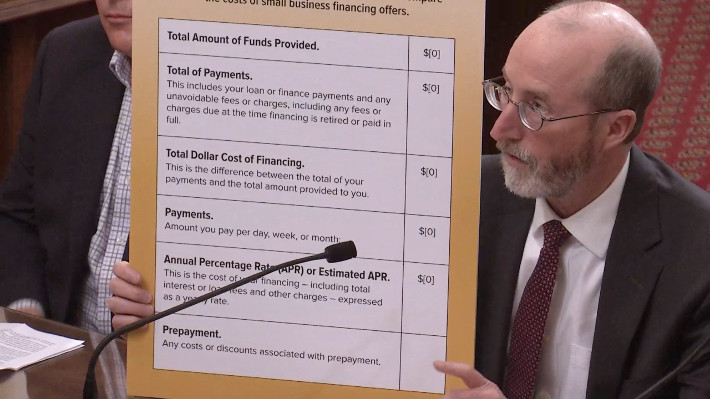 We’re now 9 days away from the commencement of California’s Commercial Financing Disclosure Law. Despite the industry’s best efforts to spread the word about the upcoming changes, deBanked has informally queried several industry participants over the last few weeks to assess their preparedness and in the process learned that a significant percentage of funders and brokers still believe that the law is just about some kind of new form that has to be included with the contract.
This despite a widely read September 9th story that conveyed that there was much more to it than that.

Since then, however, a number of brokers in the market have been asked to resign ISO agreements or to prepare for compliance with the necessary processes governing disclosure trigger events (wait, the what now?). Brokers may also have noticed that a number of funders have also made changes to their stip requirements as they narrow down which permissible method they’ll use to calculate an estimated APR while at the same time formulating a mathematical model to be able to comply with the reasonably anticipated true-up scenario disclosures (huh?).
Some participants have heralded the law as a turning point for eliminating bad actors while later discovering only recently for the first time that the law may actually adversely impact their business as well. From there it’s like a roller coaster through the five stages of grief, in which they all do the math and realize that California is 12% of the population and can’t be written off. The acceptance phase is when they finally decide that they will figure out what form they need to include, only to find out that it really is more than just a form.
To be sure, several participants have also communicated that they’re feeling good about preparedness for compliance, so the world won’t end. It just might be tricky now for the segment of the industry that’s been putting off addressing this change to be ready in time. It’s a lot more complicated than it sounds. Are you ready?