

Sean Murray is the President and Chief Editor of deBanked and the founder of the Broker Fair Conference. Connect with me on LinkedIn or follow me on twitter. You can view all future deBanked events here.
Articles by Sean Murray

Is MCA Still New?
July 19, 2022 Recently, I had the pleasure of someone telling me that they were happy to be getting in on the MCA industry while it’s still very new. While I appreciated the irony given that it’s an industry that’s been around for more than 20 years, it prompted me to take a walk down memory lane to understand why someone might truly believe that. On the one hand, industry insiders long ago predicted that the product would prompt new regulations. They were right, but they were just 17 years off, literally. In 2022, new regulations that were imagined in 2005 are FINALLY starting to become reality. Maybe it is still all very new indeed?
But more ironic than that is how certain some people were that the industry had already matured 15 years ago, that it had peaked in 2007. The story was that MCA was some legacy product borne out of the dot com bubble of 2001 that never had a sustainable future and that 2009 and beyond would usher in the era of in-person sales for what would remain of those that didn’t change careers. Computers didn’t even factor into the vision.
Apparently, change and adoption can be slow, but certain products, if they’re meeting a need, have staying power. Below is a few quotes I pulled from the earlier years from various places. I hope you enjoy them:
“The merchant cash advance industry is growing at an astonishing clip.” – October, 2005
“The merchant cash advance industry only has a max of two years left.” – June, 2007
“Once our splits are compatible with First Data, then that means we win. We’ll have conquered the merchant cash advance space.” – July, 2007
“The merchant cash advance space is just a fad.” – August, 2007
“I think the [merchant cash advance] boat has come and gone and I missed it.” – August, 2007
“The cash advance business is going through the tech bubble phase.” – November, 2007
“The merchant cash advance industry has grown too large…” – February, 2008
“Cash advance is clearly a growing trend in the payments industry. But, down the road, will cash advance reach a saturation point at which the value proposition to ISOs and MLSs is no longer a winning proposition?” – February, 2008
“Gone are the days of call centers, phone/fax blasts and mailings and in are the days of meeting and greeting merchants face to face.” – March, 2009
“[Merchant cash advances] are definitely not going to grow like people had hoped, and it’ll be very rare that you’ll find a company like mine really making its money or building its future around this product.” – November, 2009
deBanked Happy Hour is SOLD OUT
July 17, 2022The deBanked happy hour scheduled for July 28th in NYC has hit its registration limit.
Missed out? Register for Broker Fair 2022 taking place on October 24 at the New York Marriott Marquis in Times Square. This is one event that small business finance brokers won’t want to miss!
The Highway to Quality Leads and Closing Deals
July 13, 2022 In the early months of 2020, twenty-two year-old Gary Parker found himself on a nature walk along a stretch of highway in Canada. As a savvy marketer in the medical spa field, the wide grip of Canadian pandemic lockdowns had quickly turned his thriving business into dust.
Swept off of his feet by the suddenness of his predicament, he turned to nature to clear his mind and found his next venture in the unlikeliest of ways.
“I went for a walk outside, and so I saw these trucks,” Parker said, “just like trucks on the road just driving. I was like, ‘everything is shut down but there’s trucks just moving things across the country.'”
Parker’s verbal description of the moment was enhanced by his scenic Zoom background when he was interviewed for the story. Parking his laptop on the hood of his car next to a real life mountain range along a Canadian highway, he explained that he didn’t have to tell me how that walk felt because he could show me. Moving his laptop camera around to show off tractor-trailers behind him in the distance, the inspiration that had come to him in 2020 was still present.
Though the country was supposedly closed for business back then, he couldn’t help but notice how many trucks were still on the highways shuttling supplies around.
“I’m a bit of a curious guy,” Parker said, “so I started Googling, like, ‘How much for a truck this big?’ and you know, they were like 70,000 bucks, 100,000 bucks. And I was like, ‘how do people even purchase these trucks?'”
Parker went on a research mission and discovered that few people, if any, were buying large trucks outright with cash, that so much of it was done through financing.
“And so I look up ‘what’s financing? How do people get truck financing?’ And then I recognized that other than truck-sales groups, there’s a section of people where their job is just to help people find the right financing methods.”
Parker thought he might be able to work with the latter group, given his marketing background, to help connect truckers with financing, but discovered the market in Canada was relatively small.
 “Things really started to boom when I met my first USA client,” Parker said, because the demand in the US for truck financing seemed endless. “…in one day you could generate 100 inquiries of people who wanted financing for trucks,” he said.
Parker soon figured out that trucks were just one market in a wider industry of equipment financing, a rabbit hole of endless opportunity that led him to other big name entrepreneurs in the space like Josh Feinberg and Cheryl Tibbs. Feinberg, coincidentally, was a featured cast member in deBanked‘s recently produced equipment finance sales reality show.
Parker found common synergy with both and with their help was further introduced to the entire gamut of small business financing solutions.
“And that’s when I got fully immersed,” he said.
He didn’t want to be a broker or a lender, however, so instead he set out to focus on one very particular area of the process, lead generation. First, he built a system to help others, and then he gravitated towards creating a matchmaking system where brokers could connect with businesses that came to his company for help. The end result is his current company that many brokers have now become aware of, Fundly.
“So Fundly is an online marketplace,” he said, “where we have two things. Right now we have real-time matches, so [merchants] who are looking for funding every single day can come in free-of-charge and submit their inquiries, and we have funding members who can join for $1 a month who can see all these inquiries come in and then decide whether or not they want to pitch or share their profile with someone for five bucks.”
Parker explained it as a Tinder-style system where brokers can see the inquiries but can’t talk to the merchants unless the merchants also choose to engage with them. The upside is that when merchants say ‘yes,’ the brokers get to speak to someone that is interested right at that moment and with them specifically.
But Parker is a marketing guy, not a developer, and the execution of this required additional people to put the vision together.
“So we have a team now. Before when we just started, it was just me,” he explained. “If you’re going to write anything, let them know [about the team], because I have a hard working team who is behind every single thing and it wouldn’t have been possible, the technology wouldn’t have been possible without the team.”
Despite the business being born in Canada, Fundly is only targeting the US market because of its scope. Finding interested business owners is not even the hard part of his job, he explained, but rather the hard part is about educating brokers about how to communicate with businesses.
“I’m trying to teach our community members as they come into our orientation, what they think small business owners care about,” he said.
A big mistake for a broker, he explained, is starting off with a pitch about how many lenders they work with.
“Small business owners do not care about how many lenders you have in your back pocket,” he stated. “We’ve come to recognize a small business cares about one thing, what can you do for them? speak in terms of them.”
He imbues them with this marketing wisdom not just because he wants to improve their success rate, but also because he is adamant about making sure the businesses that come to his company get access to the right people with the right programs and prices. He doesn’t want to see these customers get a bad deal.
That Parker is a 24-year old former medical spa marketer hardly matters to brokers who recognize talent when they see it. When deBanked asked a senior executive of one reputable broker shop off the record what they thought about Parker, they responded by saying “he’s a genius.”
And besides, he’s not exactly that far off from where he started.
“The machines that some of the brokers finance, like laser therapy machines, stuff like that, I was working on the flip side, from the consumer perspective, having people sign up for high ticket packages from these machines,” he said.
And yet he’s very appreciative of how far he’s come since he went for that walk to reflect on his loss.
“God helped me. It was, it was rough, man. Yeah, not going to lie,” he said. “It was really rough.”
Toward the end of the interview, Parker had already shifted into marketing teacher mode.
“What really sets us apart is psychology,” he said. “Most people think that to get a business owner, you have to hit them and say, ‘Are you looking for the lowest terms? And you know, X, Y and Z??'”
The better approach, he explained, is to tell them that you will get them answers quickly.
“That results in a lot more funding,” he said, “because it’s not making a promise upfront, saying ‘let’s get you funds in 24 hours,’ it’s saying ‘let’s get you answers. And here’s someone to help you find these answers.'”
Thoughts on Inflation, a Recession, and Regulation From Someone Who’s Seen ‘This Movie’ Before
July 7, 2022 “I can tell you that in the US that originators are starting to adjust their underwriting policies,” said David Goldin, CEO of Capify and Head of Originations at Lender Capital Partners, “I don’t know about pricing. I haven’t heard that yet.”
Goldin, who has been a small business finance chief executive for 20 years, believes that the economy, inflation, and interest rates are front-and-center issues that the industry should be thinking about right now. In the UK, one region that Capify operates in, Goldin said that several small business finance executives there are already talking about raising margin and doing shorter term deals to prepare for the increased risk.
“Some originators are smart enough to be proactive and others are saying, ‘oh we’ll just watch it.’ So it’s either going to take trickling down through the economy globally or defaults to go up for these adjustment to happen,” he said.
During the Great Recession of ’08/’09, Goldin was right in the thick of it as the CEO of AmeriMerchant, one of the first MCA companies in the US. He explained that there’s a notable difference between now versus then.
“One of the things that didn’t exist back then, someone doing a second [position] was like unheard of in 2008,” he said. “Now, what is it now? first, 2nd, 3rd, 4th, 5th? 6, 7, 8, 9. It’s like a horse race. Ten horses in the race in some cases. […] You have to be careful, right? You have to make sure you’re covering your margin by charging enough and going shorter.”
But in a competitive environment where nobody wants to reveal their cards or risk losing business, not every funder is keen to start making changes right now. Goldin said that many funding companies will wait to see if their competitors start tightening up first especially if they’re driven by their ISOs and brokers. The downside of becoming more conservative is that brokers might just decide to take all of their business elsewhere.
But a looming recession isn’t all bad. “There are some positives,” he said. “The positives are the banks do tighten up. It’s just a question of when not if. So, you may get applicants that come to alternative financing that may have never taken or considered these types of products because they got bank financing.”
Complicating the landscape now, however, is that funding companies are wrangling with new state regulations. Goldin is aware of several originators that have temporarily paused business in Virginia, for example, where a disclosure requirement went into effect just last week. The soon-to-be implemented New York and California laws are also causing rumblings about funding suspensions respectively. In each of those states it was “sales-based financing” products that were specifically targeted, a trend that looks sure to continue as states like Maryland, Connecticut, and others are determined to reintroduce disclosure legislation next year.
“I think more and more originators will eventually get away from the MCA model,” Goldin said, “and go more towards the business loan model by partnering with a bank. I think you’re going to see more companies trying to implement bank programs to become full business loans and not deal with all the nuances of a state by state and MCA program.”
 Goldin’s point of view, wisdom, and predictions are aggressively sobering. Only three months ago, industry sources were telling deBanked that their outlook for 2022 was optimistic and that the end of covid-era government stimulus suggested that there would be growth for non-bank finance companies. Suddenly the tone has shifted, the stock market has plummeted, and interest rates are rising.
“I think if you resurveyed originators now, I think you’d get a different response than you did eight weeks ago or even four weeks ago,” Goldin said. “I can tell you right now that capital providers are asking their originators about how they’re making adjusments in this environment…”
Indeed, deBanked did speak with several players just last week and did notice that the general sentiment had shifted to one of concern and caution.
“I think funders should be thinking about redundancy,” Goldin said. “More than ever the best time to raise capital is when you don’t need it. And I don’t know if [funding sources] will pull lines, yes if defaults go up, but they may not be as inclined to enter into new relationships in this environment.” Because of that, now might be the last best opportunity to secure additional credit sources even they’re not necessarily needed, he suggested.
With that, he said that funders should be thinking about tightening up the bottom of their credit profile, increasing their margins, doing shorter term deals, looking for more mature businesses, and working with businesses with higher credit scores.
“I think that those that don’t make credit adjustments, raise margin, and go shorter are going to have their you-know-what handed to them,” he said. “I’ve seen this movie too many times. It doesn’t have to be called a recession. […] It’s all about affordability to repay, and the more debt [the customers] have, and the more their margins are squeezed, or the more their sales go down. That’s when problems begin. You’re less likely to have a problem if you’re only out six months instead of eighteen months. I’ve used this saying a million times: ‘When the ships are too far out to sea and it’s a tidal wave, you can’t get them back.'”
Deal Gone Bad? Next Stop Arbitration
June 20, 2022 When a funder is unable to resolve a breach of contract with a customer on its own, litigation may seem like the only option left. But there may be an alternative, a process known as arbitration.
“Arbitration is a creature of contract,” said Zachary Meyer, a partner at a law firm. Meyer is also the co-founder and Chief Administrator of RapidRuling, an arbitration forum that has recently experienced an uptick in cases from the small business finance space. An arbitration forum is an alternative to the courthouse, where disputes are adjudicated by an arbitrator instead of a judge. It’s binding. The prevailing party, for example, can take an arbitrator’s award to the Court and turn it into a judgment.
Meyer told deBanked that part of the original vision for RapidRuling was an entirely online system that would prevent one or both parties from having to incur travel costs to participate. The overall cost of arbitration for a respondent in Montana, for example, would go up if they had to pay for a flight to New York City just to appear for it. “It’s beneficial for the [respondent],” Meyer said.
But in 2019 when RapidRuling first launched, the industry was already well accustomed to relying on AAA, the acronym for the American Arbitration Association. AAA, which was founded in 1926, resolved more than 300,000 total cases in 2019 alone. But then, Covid hit.
“It was like a perfect storm,” Meyer said. As the court system ground to a halt and struggled to move online, an all-online arbitration forum like RapidRuling suddenly had significant appeal. Meyer explained that the forum’s low filing fee compared to alternatives also grabbed attention. It understandably took off.
But the path to arbitration, including which forum to rely upon, may all hinge on the original contract itself, which a funding company’s attorney should carefully draft. Copying and pasting a random contract off the internet, for example, carries great risk, Meyer explained, because one may later discover a boilerplate arbitration clause to be limiting or disadvantageous.
RapidRuling’s website describes its arbitration process in four steps:
1. Submit Your Dispute
2. Wait For Opposing Party To Respond
3. Arbitrator Reviews Submissions
4. Receive An Arbitration Award
Contrast that value proposition to litigation, which depending on the circumstances could be drawn out for years.
RapidRuling seeks out arbitrators that are well-qualified, fair-minded, and diverse. “We have a panel of six arbitrators right now,” Meyer said, “and we’re looking to add more.”
David Picon the Recipient of the Greg Nowak Impact Award
June 16, 2022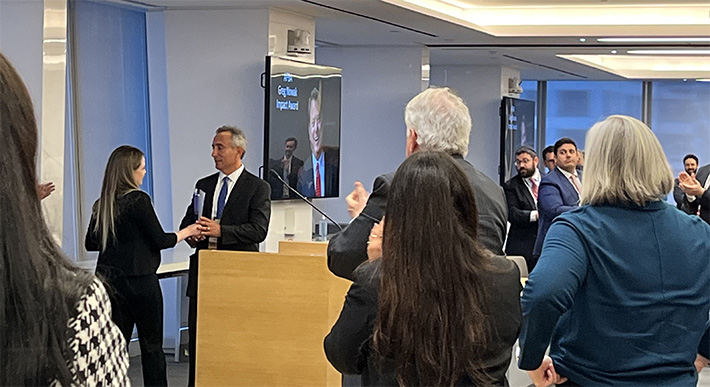 The Alternative Finance Bar Association named Proskauer partner David A. Picon the recipient of the AFBA Greg Nowak Impact Award. Picon, who was also the keynote speaker of the AFBA conference, was selected by the association’s members for his all-around efforts for the legal community both on matters of law and outside of it.
Greg Nowak, who passed away suddenly last year, was a partner of Troutman Pepper and a beloved founding member of the AFBA. His wife and son were both present for the heartfelt moment in Nowak’s honor.
New Owner of Loan.eth Says its Worth Millions
June 8, 2022 Less than two months after spotlighting a new domain name market linked to the Ethereum blockchain, the name loan.eth was sold on a secondary market for the equivalent of $45,000. It’s not a website domain like one would expect with a .com or a .net, but rather a crypto wallet address shortener that can double as a screen name and authentication service on web 3.0. That’s just the tip of the iceberg of the utility that a .eth domain can offer.
Although most people may not be familiar with .eth domain names, the new owner of loan.eth, who goes by @BloomCapital_ on twitter, is so confident that such names will be adopted in the future, that he believes the value of this one will be many times what he paid for it.
“Just so it has to be said, Loan.eth won’t be sold for less than $10M,” Bloom wrote. Bloom said he considers loan to be the top .eth name that he has.
The Alternative Finance Bar Association Conference is SOLD OUT
June 7, 2022Next week’s Alternative Finance Bar Association Conference has already sold out. The exclusive go-to event for industry attorneys takes place on June 15th and 16th in New York City.
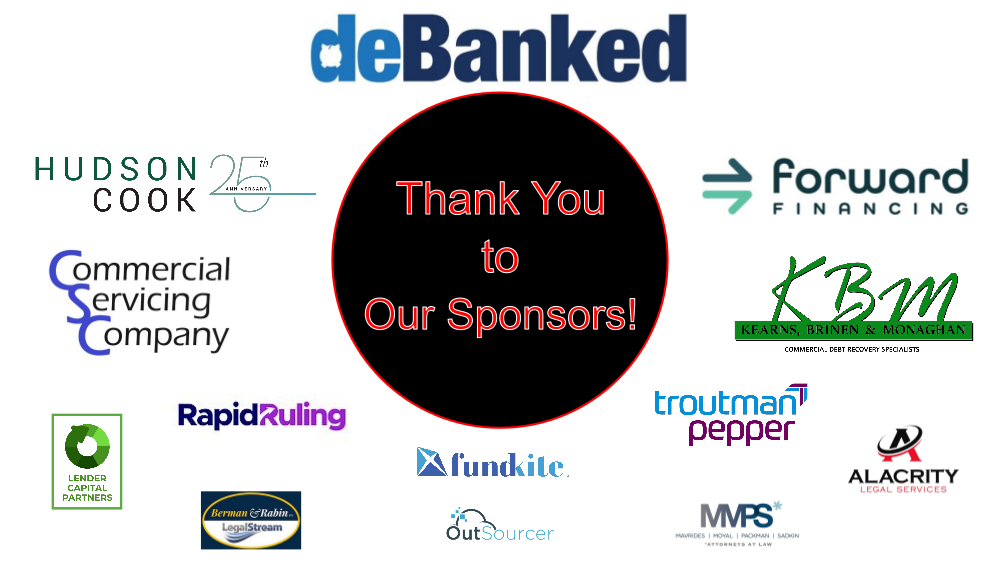
Thirteen organizations are sponsoring it, including deBanked. The AFBA provided the attached graphic to showcase who they are:
deBanked plans to have three representatives present. For information and inquiries about the event, please contact Lindsey Rohan at lindsey@lrohanlaw.com. This event is sold out.