
Sean Murray is the President and Chief Editor of deBanked and the founder of the Broker Fair Conference. Connect with me on LinkedIn or follow me on twitter. You can view all future deBanked events here.
Articles by Sean Murray

Movember Rocked!
December 1, 2012 Movember: Mo’ Merchants, Mo’ Deals
The pre-holiday season is usually big in the Merchant Cash Advance (MCA) industry but this year seemed different. We’ve been saying that we’ve entered a new era for a long time, but it’s finally starting to seem real. It feels like 2007 again in a way, when everybody was getting rich and nobody even knew what the heck they were selling. It took years for account reps to finally stop referring to advances as loans and by then it was too late because the ACH loan industry was born.
E-mails like this don’t happen very much anymore:

You know… the ones where the deal would be blatantly shotgunned to multiple companies at once. The major broker shops would “accidentally” CC everyone instead of BCC to let the funders know who was in charge.
That’s not to say that deals don’t get shopped, Some do, but the circumstances have changed. To minimize the risk of being flooded with bad paper, funders ask resellers to put their money where their mouth is. The syndication game has become THE game in town and it’s led to Super ISO networks like the Factor Exchange. A user on the DailyFunder that seems to be intimately familiar with Factor Exchange is quoted as explaining the model like this:
The “mom and pop” ISOs and “Onesy-Twosey” brokers are backed by one giant ISO network and The Factor Exchange assumes half of the risk by syndicating 50% on nearly ever deal…
The massive volume of FEX submissions to lenders gives the ISOs power to negotiate for better rates and terms, One point of submission reaches 15+ lenders, the merchants credit is only pulled once, and the commission is passed straight through to the ISOs because FEX makes their money from participation.
Companies like this empower the smaller brokerages…

Who Did Mo’ Deals in Movember?
Yellowstone Capital broke their single day funding record… TWICE. This actually happened on back to back days. Executive management reported that they funded approximately $3 million in 48 hours.
Who Got Mo’ Money?
Wall Street wizard and business professor, Steven Mandis acquired a stake in Bethesda-based RapidAdvance. The news is all the more interesting with the fact that RapidAdvance is easily one of the top 5 largest players in MCA. Single individuals don’t exactly just walk through door and buy a stake in companies like this. Mandis is taking on a Strategic Advisor position and it’s our guess Rapid is about to enter another major phase of growth.
Who Got Mo’ Likes?
Merchant Cash and Capital’s (MCC) facebook fan page has gotten thousands of Likes since the third week of Movember when they announced their charity campaign. For every new Like until December 7th, MCC is donating $1 to the American Red Cross to help people that were affected by Hurricane Sandy.
Who Got Mo’ Wins?
RapidAdvance was the first team to clinch the playoffs in the MCA industry fantasy football league for charity. Something tells us that Mandis is behind their incredible winning streak.

Who got Mo’ Leads?
You did if you bought leads from either one of our lead advertising partners, Meridian Leads or SmallBusinessLoanRates.com.
Lendio has also been making a splash on the MCA lead scene with Dave Young being a big contributor on DailyFunder. To discuss pricing, he can be reached at dave.young[at]lendio.com
Who lied Mo’?
According to CNN’s statistics, 247 million people in the U.S. went shopping on Black Friday. That’s equal to the entire American population over the age of 14. Something doesn’t smell right with these numbers. It’s our guess that CNN is using Mitt Romney’s polling experts. 😉
But someone else lied just a little bit Mo’. On Movember 26, 2012, PRWeb published a release that claimed ICOA Inc., a small tech company in Rhode Island was acquired by Google for $400 Million. The release turned out to be a hoax as part of a stock pump and dump scheme. Many critics have been left wondering why PRWeb didn’t do anything to verify its authenticity. Considering PRWeb is such a widely used PR service in the MCA space, we can testify that they’ll pretty much publish anything so long as you pay the fee. Some smaller companies use it as part of their SEO campaigns, which explains why there are so many strange looking releases out there that seem to repeat the same keyword in every sentence.
ABC Funding Co Just announced a program that will help small businesses in need of cash by providing these small businesses in need of cash with a special type of financing that will hep them if they are a small business in need of cash. Not exactly New York Times material…
Will Movember be followed by Make-a-lot-of-Doughcember? We’ll find out!
– Mo’chant Processing Resource
https://debanked.com
MCA History in Honor of Thanksgiving
November 21, 2012
Before fax, e-mail, and e-signatures, merchants used to travel up to 400 miles to fill out a funding application.
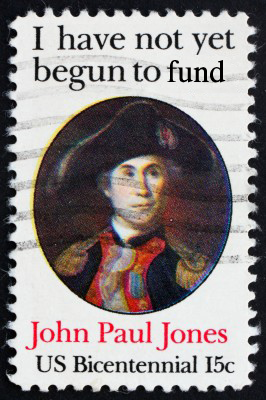
The famous response to a British sea captain by John Paul Jones is actually believed to be a misquote. 'Fund' was changed to 'fight' to better preserve his memory but it is theorized that he predicted the birth of Merchant Cash Advance. He died in 1792, two hundred years before the first small business got funded based on their credit card sales

In 1621, the local merchants were funded on the third Thursday of November, just narrowly beating the wire deadline. This feast was almost not possible.

The first underwriters. Yeah... they were British.

The first collections department.
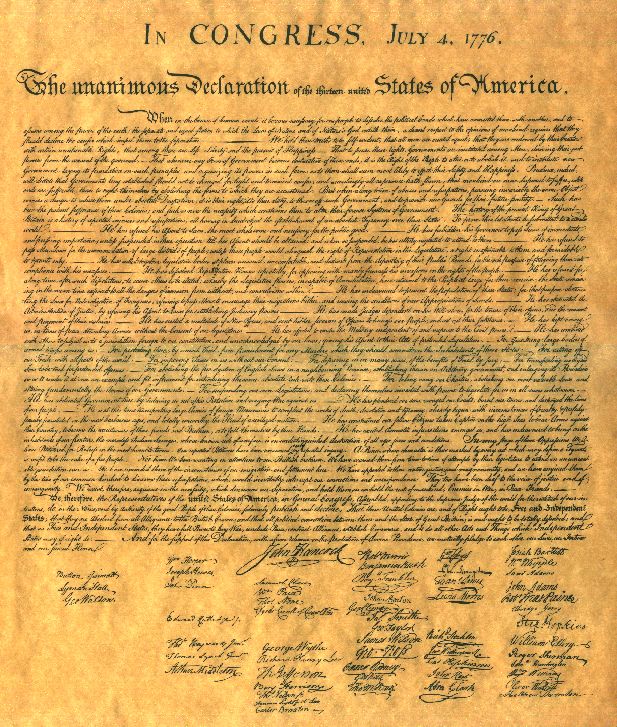
Back then you needed a lot more than just a payoff letter to change companies...

This merchant successfully opened his 2nd location.

This winery just refi'd again last week. $132,292,222,144,923,383,293,819,183,189,380,678 was withheld and credited to the outstanding balance.

Reason for Advance: Need to stock up on more tea inventory.

We apologize if our history is a little off 😉
– Merchant Processing Resource
https://debanked.com
MPR Advises MCA Companies to Perform Penetration Tests
November 20, 2012The Merchant Cash Advance (MCA) industry is riding high from a stream of recent publicity and investor interest. Billions of dollars are pouring into the market and some companies are desperately trying to upgrade their software platforms to keep up with the growth. With more exposure comes new curiosity, and not all of it is positive.
There is no widely used software platform in the MCA industry, which is a good thing and a bad thing. It’s bad in the sense that each company has more or less created their own database system, increasing the odds that some companies will have security flaws. It’s good in the sense that if one company suffers some kind of breach, the method used should not be applicable across the entire industry.
Don’t worry, we’re not posting this to scare merchants. In fact, we don’t recall a single MCA firm ever having suffered a public data breach, a statistic unheard of in other industries. So why bring it up? As MCA firms collect more data and handle more money, the more likely they will become attack targets by hackers. The more valuable the stash, the more sophisticated the attacks. Major players like Heartland, TJX, and Global Payments have had sensitive information compromised on hundreds of millions of customers. The moral of the story? Prepare yourself as much as you can.
 If you think it can’t happen to you because your system was developed by a third party, you’re wrong. It’s time to get tested. A Penetration Test, as defined by wikipedia is:
a method of evaluating the security of a computer system or network by simulating an attack from malicious outsiders (who do not have an authorized means of accessing the organization’s systems) and malicious insiders (who have some level of authorized access).
Some may be inclined to compare a Pen Test to sitting in the waiting room of Student Health Services. You’re scared of what they might find and maybe you’d rather not know, but not getting tested at all is the worst thing you can do.
One such Pen Test was performed by an MCA firm months ago that had just purchased a customized software system from a third party. We will not name the firm or the software provider.
After a year of designing, testing, and writing fat checks to a prestigious group of software developers, the MCA firm had finally implemented a state of the art system that would propel them to the next level. After a month of using it, they asked a new hire to do some tests to make sure all of the basic features were working. The bells and whistles were decked out to the nines but no one had tested the easy things like going through the motions of resetting their password if they forgot it.
The new hire noticed something slightly off with the basics and reported his findings to the executives. Interested, but not really worried, they gave him permission to act as if he were a disgruntled employee. Turnover was high in the telemarketing department and there was occasionally a person that would shoot off a couple of dumb e-mails on their way out. But now with a system in place, could they do real damage?
The disgruntled employee test was really a simple Pen Test and this firm is eternally thankful that it performed one. Within 7 minutes, the new hire was able to access and modify every piece of data in the system. He was able to exert administrative power without having administrative level access. The worst part of what he did? There was no way to prevent against this mess because of how the software was coded. The best part of what he did? It was only a test and all modifications were immediately reversed.
It took a long time for the MCA firm to take a corrective course of action. Whether they ended up patching the software or tossing it altogether, we won’t say. What’s important is that they were able to identify these flaws on their own and early on. Many companies in this industry have long-term funding projections that exceed $1 billion. At that size, there will be much more to worry about than disgruntled employees. The bad guys will be lined up around the block in cyberspace trying to get in. SQL injections, buffer overflow attacks, DDoS Attacks, and much more will be lighting up those systems on a daily basis. Most MCA account reps advise their merchants about PCI compliance, but today we’re reminding you to take your own advice.
Resources:
In-house Penetration Testing for PCI DSS
Penetration Testing Guide and Samples
Security Assessment-Penetration Testing and Vulnerability Analysis
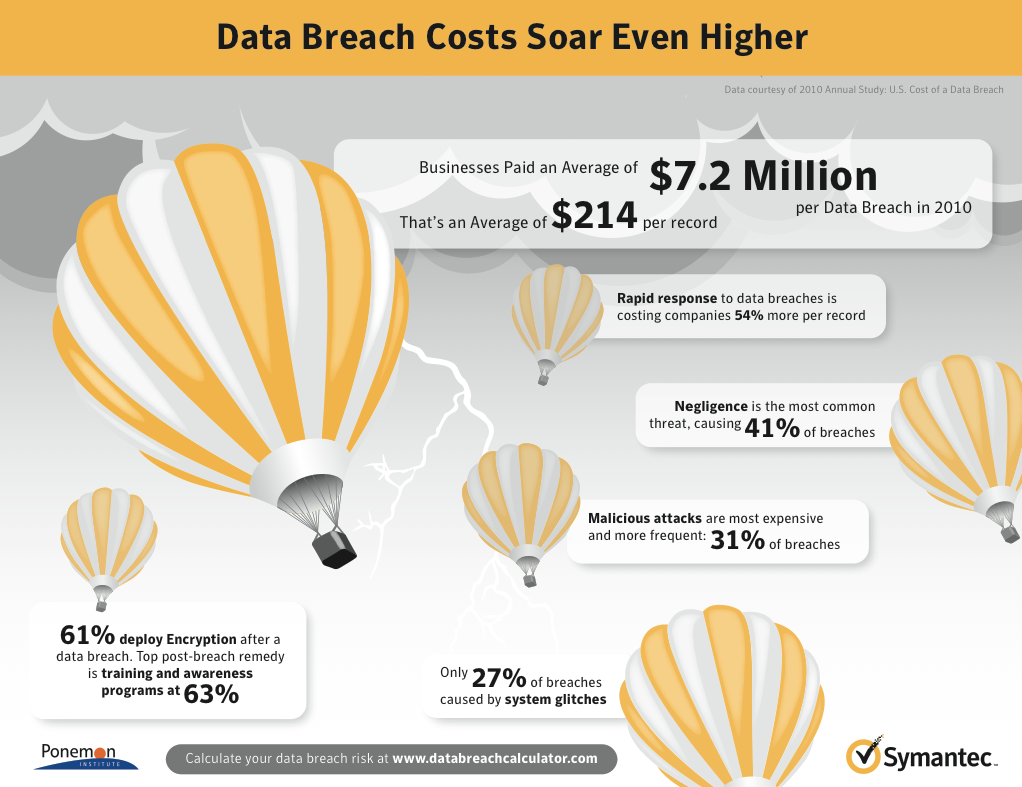
Cost of a Data Breach
Estimate Your Risk Exposure
Global Payments Breached
Pass it on.
– Merchant Processing Resource
https://debanked.com
Such a Deal
November 15, 2012 You may have considered taking part in a “daily deal” program to increase sales at your small business. As always, you want to do your homework before jumping in. Lucky for you Constant Contact just published a post where they share information they gleaned as to “how and why” people use daily deals.
The research firm Chadwick Martin Bailey sent out a survey on behalf of Constant Contact asking 1,433 consumers over the age of 18 and came up with some pretty interesting results:
- Consumers who sign up to receive daily deals end up purchasing them
- Recommendations from friends make consumers more likely to purchase a deal from an unfamiliar small business
- Personal endorsements drive deal purchases, especially for women
- People are willing to share a deal if it’s great, regardless of whether they are a customer
- More than 1/3 of consumers are more likely to buy a deal from a local small business
- For nearly 60% of customers, even a good deal experience doesn’t automatically equal loyalty
- More than twice as many consumers share deals via email than on social networks
- Deals for restaurants and entertainment are the most commonly shared
- 92% of consumers think local deals are here to stay
- Consumers think deals help attract new customers to local businesses
A lot of this information isn’t new. For example, the fact that women are more likely to make a purchase based on a “personal endorsement.” However, it should be noted that not too long ago that endorsement didn’t need to be “personal.” According to some statistics, an online recommendation from an unknown consumer was trusted by 70% of online consumers. However, what is of real interest to small business is the fact that this survey indicates at least one-third of those seeking online “daily deals” are more likely to buy something from an equally local small business (i.e. your small business.)
On the “not so great” side of the coin is knowing participating in daily deals isn’t a sure fire way to inspire customer loyalty. Again, this isn’t surprising. Think about it. Consumers who use daily deals are consumers who buy based on price. More than that, the fact that 60% state a daily deal doesn’t inspire loyalty indicates that it is likely that this 60% are consumers that always buy solely based on price. This means the minute your price isn’t the lowest they will skip town in a heartbeat. On the other hand, all is not lost. There’s that other 40% of daily dealers you should be following up on in ways that DO create customer loyalty. So daily deals do, in fact, provide an opportunity to create repeat business.
However, perhaps the most significant finding from this survey is that almost 100% of the people who sign up to receive daily deals purchase daily deals. Wouldn’t it be great if 92% of those you just sent emails translated into buying customers? This is a phenomenal statistic. Again, you can’t count on someone buying based on price to be loyal, but a mechanism this motivating to consumers represents an avenue to market to those who may otherwise not consider your local small business when making their buying decision.
Guest Authored
– Merchant Processing Resource
https://debanked.com
Betting on the Future With Merchant Cash Advance
November 14, 2012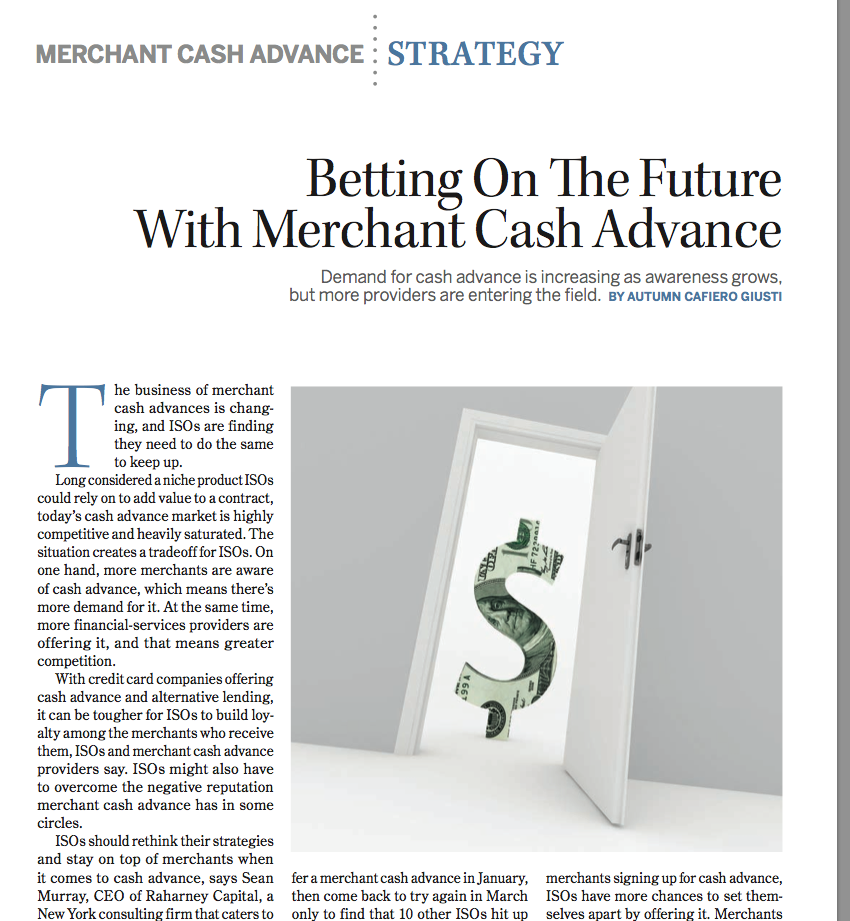 An excerpt of the article in ISO&Agent’s November/December 2012 Issue:
“The business of merchant cash advances is changing, and ISOs are finding they need to do the same to keep up.
Long considered a niche product ISOs could rely on to add value to a contract, today’s cash advance market is highly competitive and heavily saturated. The situation creates a tradeoff for ISOs. On one hand, more merchants are aware of cash advance, which means there’s more demand for it. At the same time, more financial services providers are offering it, and that means greater competition.
With credit card companies offering cash advance and alternative lending, it can be tougher for ISOs to build loyalty among the merchants who receive them, ISOs and merchant cash advance providers say. ISOs might also have to overcome the negative reputation merchant cash advance has in some circles.
ISOs should rethink their strategies and stay on top of merchants when it comes to cash advance, says Sean Murray, CEO of Raharney Capital, a New York consulting firm that caters to merchant cash advance companies. “You know the saying, ‘Always be closing?’ Well, you should always be offering merchant cash advance,” he says.
It’s not uncommon for an agent to offer a merchant cash advance in January, then come back to try again in March only to find that 10 other ISOs hit up the merchant in February, Murray says. “You can’t just throw it in there casually every few months. Everyone is marketing cash advance,” he says.
But opportunities arise…”
Read the full article in the November/December magazine available on the site.
It requires you sign up for a FREE subscription
Is Print Media Dead? Why Small Business Owners Should Take a Second Look
November 11, 2012 Many small business owners may have thrown out the newspaper with the bath water when it comes to using print media as a marketing and promotion channel for their small business. Number one, most of us are pretty much convinced that print media is dead. Major newspapers that have been around for eons are dead or dying. Print magazines are failing or subscriptions are woefully down. On top of that there are literally hundreds of thousands of online social media specialists and bloggers out there tooting the digital horn not as “the way of the future” – but telling us that the future is now. Any small business owner out there not engaging in social media marketing isn’t only missing the boat, they’re on a sinking ship.
However, small business owners might want to take a second, and much closer, look at whether or not investing in print media still represents an opportunity to achieve a high rate of return for their particular business.
Print Media Can Hit Your Target
The most obvious example is a small local business owner. A business owner who serves a local community with distinct boundaries is targeting consumers and clients within that local jurisdiction. That local community may be at the neighborhood, small town, or even large municipal area. What is common to all local businesses is that oftentimes print media exists that provides a relatively low cost vehicle to promote their small business.
For example, small business owners in small towns are likely to get a pretty big bang for their buck promoting their business in their local small town newspaper. Many of these small town papers provide what could be classified as “hard journalism” reporting on local political and other town issues such as city budget and the like. However, a major focus in small town newspapers tends to be human interest articles that attract local readers. In turn, those articles attract specific types of readers.
For instance, often there will be a column dedicated to subjects such as gardening, cooking, local events, the environmental, the arts, books, and so on. Because the paper is so small, many local newspapers provide a greater opportunity to locate your ad near copy that relates to your small business, or that is read by people you’ve targeted as your most optimal customers or clients. If you’re a local hardware store, an ad located near the gardening article can be very effective. If you’re a local podiatrist or retail store selling running shoes, an ad near an article about a local 10K is a great opportunity. Most neighborhood and municipal newspapers offer this type or similar opportunities for ad placement.
Loyalty and Numbers Matter
Regarding reach of your small businesses’ ad, local print media can be a better option than promoting your local small business online. For one, many of these publications already have a very loyal readership. Any small business owner with even a modicum of experience creating an online presence can appreciate just how much effort, time, and (yes) money goes into creating a strong, loyal, and large following online. While social media is low cost, it isn’t “no cost.” Even if you’re not outsourcing social media activities (i.e. content creation, posting, replying, etc.) – you are paying a huge premium in time.
Equally important is that print advertising in many ways isn’t as limited as social media. You can get a whole lot more information in an ad in your local newspaper than an online banner ad. Additionally, advertising in your printed local publication can actually create more credibility for your small business. Consumers understand that print advertising comes at a cost and tend to assign credibility to businesses using print advertising. Consumers are savvy and know online banner ads can come pretty cheap – a print ad can effectively communicate your small business is both established and reliable.
Ironically, we’re going to provide you with the best argument for taking a second look at promoting and marketing your small business using print media with an online example. On their “About” page here is how one community paper describes themselves:
The College Park Community Paper has been in circulation since 1989. We are a monthly, full color, family friendly newspaper delivering the good news happening in College Park each month. The paper is delivered free of charge by mail to over 7,000 homes and businesses in the 32804 zip code which includes College Park and the Country Club of Orlando. Additional distribution is provided throughout the community and commercial district through the use of newspaper stands and counter top display. Additional exposure is garnered through our website which includes additional material not shown in the print edition.
You’ll also want to take a look at their ad rates here, but we use them as an example for quite another reason: they provide an excellent example of a small business integrating both on and offline channels to promote their small business, which can be not only a balanced approach, but an approach that provides the biggest bang for your buck.
– Merchant Processing Resource
https://debanked.com
Forward?
November 8, 2012The election is over and now it seems we will be “Moving forward, not back.” The republicans that have already come to accept Romney’s defeat are sounding a lot like Sookie Stackhouse:

Onwards we go to help the little guy, a process many feel can’t happen until we end trickle-down economics. It’s the trickle part that doesn’t sound good. Money should flow freely gosh darn it, not trickle! We couldn’t agree more. Here’s a broad diagram of the economy at work:
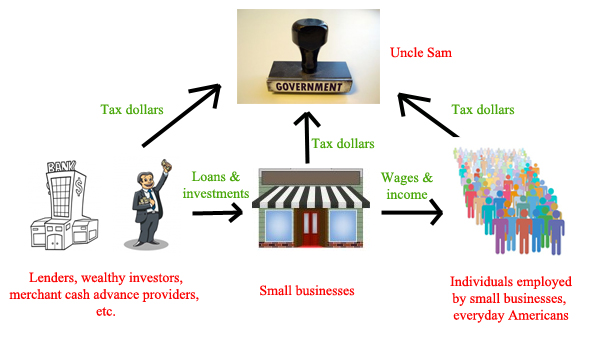
It’s popular to hate Wall Street, but Wall Street provides small businesses with financing to expand, who in turn employ more people in the process. Wall Street is not just banks and Merchant Cash Advance companies. It is any party that has enough money to invest in others while being able to absorb potential losses. A private investor is Wall Street. Wealthy friends or family members are Wall Street.
Tax these parties more and there is less money to invest in small businesses which means fewer businesses will receive capital to expand and hire. Wall Street will make less money as a result of less money being invested and therefore tax revenue will decrease. With fewer businesses hiring, less people will be employed and therefore less people will be paying taxes. Taxing Wall Street more does not necessarily mean more net tax dollars.
This Darn Trickle
One can dislike the economic chain since the flow of money between parties may not happen perfectly or because it allows Wall Street to get richer. There is nothing wrong with the rich getting richer, so long as the middle class and poor get richer too. If small businesses use the money invested by Wall Street wisely, they too will eventually become Wall Street. The amount of new jobs created as a result of a small business’s success means more wage earners will have a shot at becoming small businesses. In economics, a wide divide between rich and poor can be positive, for it creates a ladder that anyone can climb with no cap.
Empower the Little Guy
There is a competing theory and that is to believe that the economic chain starts with middle class wage earners. One could argue to significantly lower taxes on the middle class and the poor and impose much higher taxes on the rich. By doing so, consumers would have more money to spend at small businesses, prompting those small businesses to draw up plans to expand. That expansion capital still needs to come from somewhere and less of it will be there if Wall Street has been further taxed. Perhaps a small business could save money for a few years and use their savings to self-finance their own expansion. Under this theory, everyone becomes part of a very broad middle class. The extremes disappear.
Whoops
When the extremes disappear, there will be few investors with the capability to make large investments or investments that are particularly risky. A small business owner could save up for several years and open a 2nd location without an investment, but could he open 200 nationwide? Not without Wall Street. How many jobs will be created by the opening of 1 store? How many would be created by the opening of 200?
Now calculate how much new tax revenue is generated in each scenario, as well as the number of people that move up from being poor and unemployed to middle class and employed.
When the rich aren’t getting richer, the other classes can’t really move up either. Everyone stays in a broad middle class and innovation and advancements decline. The consumer or small business owner with a potential $100 million innovative idea won’t be able to raise the capital to see it through. How can they when the rich have been prevented from becoming really rich? What if they had a $10 billion idea?
One could argue as a single class society, that a $100 million idea or $10 billion idea could be financed by the government. This is true. It is also textbook state socialism. A one class society is also the premise of Marxism, where everyone is getting their needs met through cooperative work.
Marxism ignores the realities of a global economy. Ultimately, Americans need to obtain resources from other nations, and stay ahead technologically so as not to be conquered by outside forces. A classless society is a stale society, with no economic movement, social movement, or technological advancements.
How will the Merchant Cash Advance Market be Affected?
Merchant Cash Advance companies typically invest in businesses with less than 50 employees. Under Obamacare, any business with less than 50 employees does NOT HAVE to provide health insurance. This program may not affect the business as a whole, but the law mandates that all individuals purchase health insurance for themselves if they don’t have coverage already. Small business owners in the MCA market may be incrementally stressed by having to purchase health insurance. Their employees will be further stressed by having to buy it as well. As a result, wages may need to go up to help workers pay for their own insurance and less money will be available to grow and hire.
The total public debt outstanding has exceeded $16 trillion. That debt has to be paid for somehow and it is more likely than ever that Wall Street is going to have to pay up. This will not stimulate growth and as such, the economy is not likely to pick up any time soon.
Traditional lenders are going to remain quiet while the alternative lenders are going to power through it. A business could save up for three years and open a 2nd location or it could open it today with a Merchant Cash Advance. In three years, the location they want may no longer be available and that individual looking for a job will have run out of unemployment benefits long ago.
A Merchant Cash Advance helps small businesses expand today, hire today, generate more tax revenue for the government today, and helps everyone move up the economic ladder. Baby steps are better than none at all. What starts with a 2nd location may lead to a dream of owning 200 locations nationwide. They’ll need a bigger fish than MCA to get there. Let’s make sure we don’t tax those fish to death.

What do you think Michael?

Forward!
– Merchant Processing Resource
https://debanked.com
Best Tip EVER to Start Your Business
November 5, 2012Our website offers lots of advice on operating a business, merchant cash advance, and merchant processing, but nothing matches the wisdom we gained when we encountered this sign. Starting your business? Here is a great tip to ensure its a success!