
Sean Murray is the President and Chief Editor of deBanked and the founder of the Broker Fair Conference. Connect with me on LinkedIn or follow me on twitter. You can view all future deBanked events here.
Articles by Sean Murray

A New Approach to Providing Employee Feedback for Small Business Owners
January 22, 2013 Sometimes you just can’t figure out how to deal with employees. Take Rebecca your receptionist. She’s excellent with clients, knows exactly what calls to put through and when to take a message, dresses professionally, and gets along with everyone in the office. She can juggle answering multiple phone lines while greeting multiple clients with ease, and is great in a crisis.
On the other hand, as far as performing her day-to-day duties, you can’t complain as to accuracy, but let’s just say prioritizing isn’t Rebecca’s strong suit. Take ordering office supplies. Sure, you never have to worry whether or not you’re going to run out of paper clips – but not when Rebecca somehow thinks getting the office supply order into the vendor is more important than the unfinished monthly report sitting on her desk – a report you need for this afternoon’s weekly sales meeting.
You’ve tried giving her positive feedback – you’ve tried giving her negative feedback, both to no avail.
Things aren’t always “either or” as in “either the employee’s behavior merits positive feedback OR the employee’s behavior merits negative feedback.” The world we operate in has a tendency not to be that straightforward – especially when we’re talking about human behavior, even more so when the subject is employee behavior. You may think you’re limited to one or the other of these approaches – but maybe what Rebecca needs isn’t feedback – maybe Rebecca needs feedforward.
Paying it Forward
You might have seen the movie “Pay It Forward” where the premise was that whenever anyone did a good deed for you that you should “pay if forward” to three other people. The idea is put forward by a little boy responding to a school assignment to “Think of an idea that could change the world.”
Now, that’s a pretty tall order – but Dr. Marshall Goldsmith professor of executive education at Dartmouth, prolific author, and well-known management thought leader has an idea that just might change the way small business owners approach managing employees. His idea? Instead of providing employees with feedback he proposes a process he calls feedforward.
Traditionally feedback has been “top down” meaning that a manager (top) provides feedback to an employee (down) regarding their performance. Fortunately the field of management has progressed to acknowledging that, while employees can learn from managers, it is also true that managers can learn from their employees. This has led to better communication between management and employees.
However, Goldsmith points out a fundamental flaw within both approaches: they focus on the past instead of the “infinite opportunities that can happen in the future.” Furthermore, Goldsmith asserts that focusing on the past is “limited and static” whereas focusing on the future can be “expansive and dynamic.”
True Balance
The notion that feedback should be “balanced” usually means the attempt to find some sort of balance between how many times you provide an employee with negative feedback versus how many times you provide an employee with positive feedback. It certainly doesn’t take a Ph.D. in psychology to realize that too much negative feedback will most likely be de-motivating whereas too much positive feedback certainly isn’t going to improve an employee’s performance outside whatever it is they are already doing well.
This is where Goldsmith’s approach shines. Instead of struggling to come up with some impossible ratio between negative and positive feedback, the focus shifts to making observations about the past within the context of positively changing the future.
A Feedforward Conversation
Feedforward is not some inapplicable academic approach to managing employees at your small business. Feedforward is a process versus a “reprimand” or “compliment” you give an employee. Feedforward is a two-way conversation. Let’s take a look at what that conversation might look like with Rebecca the receptionist:
Small Business Owner: “Rebecca, I’d like to take a few moments to discuss this month’s report with you.”
Rebecca: “Sure.” (Rebecca is thinking: I wonder what I did wrong?)
Small Business Owner: “Before we begin, I want you to know that the goal of this conversation is to focus on how we can better use this report in the future to help our sales team. What we’re talking about here is what you can do to help make that happen, as well as how I might be able to help you as we move forward. I’d like to use this week’s report as an example we can learn from. How does that sound to you?
Rebecca: “Great.” (Rebecca is thinking: This is weird, I think my boss wants my help, not just tell me what to do.”)
Small Business Owner: “OK, so tell me what you think about how things went this week.
Rebecca: “I guess it was so sort of hurried. I almost didn’t get it done in time.”
Small Business Owner: “Why do you think that was?”
Rebecca: “Well, I had to get the office supply order out which meant I had to take inventory and that took a while.”
Small Business Owner: “Making sure everyone has the supplies they need is important. How do you think you could make certain that those two responsibilities don’t come into conflict in the future?”
Rebecca: “Hmmm…maybe I should change the day I do supply ordering to Mondays. Sales meetings are always on Fridays. That would give me three complete days to devote to the report. We could even plan to go over the report on Thursday morning together to make sure there aren’t any problems or errors.”
Small Business Owner: “I think that’s an excellent idea. You definitely got that priority straight. I’d like you to take a look at your duties and provide me with a schedule that allows you to meet your priorities. Let’s meet at ten next Tuesday to do that.”
Rebecca: “OK, but…” (Rebecca is thinking: She wants ME to set priorities?) “Well, what if I don’t prioritize things correctly?”
Small Business Owner: “We’ll work together on that. You know, Rebecca, you’re the one doing the work. You know what happens in the front office. I’d like to get your take first before I make any decisions as to how we want to prioritize your duties. Does that make sense?”
Rebecca: “It does, and I’ll be sure to do my best.”
– Guest Authored
Merchant Processing Resource
https://debanked.com
MPR.mobi on iPhone, iPad, and Android
Getting Permission
January 21, 2013 Numbers don’t lie.
77% of online consumers surveyed said they want to receive permission-based marketing messages via email. Sounds impressive – but even more impressive when you learn that direct mail came in a distant second with only 9% looking forward to opening their mail box. Interestingly, only 5% preferred text messages. (Source: ExactTarget 2012 Channel Preference Survey)
That’s the good news. After all, email is perhaps the most inexpensive means for small business owners to communicate with consumers. The bad news is – before you can communicate with consumers via email – you’ve got to get their permission (along with their email address.)
Permission-based marketing simply means that you have your customer’s permission to contact them. However, if you’re a small business owner just getting their feet wet it’s likely that 77% of your list isn’t exactly a large number.
Collecting email addresses from customers and clients who have given you permission to contact them is the “Catch 22” and “between a rock and a hard place” of small business email marketing. Obviously purchasing lists of email addresses of consumers who fit the demographic of your customer doesn’t cut it. Emailing someone without their permission to ask for permission to email them just doesn’t make sense – not to mention today’s consumer tends to be totally turned off by businesses that make the attempt. Not too many fans of spam out there.
So, if you don’t have a list – how do you create one?
The Usual Suspects
It would be hard to find anyone with even a smidgen of experience searching the Internet who hasn’t encountered an “opt-in” when visiting a website. An opt-in is nothing more than a form that serves to ask permission to contact the consumer as well as collect their information. Visitors to your businesses’ website can opt-in to receive a variety of marketing messages from you – for example a newsletter, blog posts, or special announcements (such as a sale.) It makes sense to have opt-in opportunities on every page of your website.
Sounds great but, once again, if you’ve got very little traffic on your website, that translates into very little opportunity to build a Mondo email list. If the obvious tactic of including opt-in opportunities on your small business website doesn’t help that much when it comes to building your list – what other tactics can you employ?
Plenty – here are a few:
If you’re a retailer, make it a practice to ask for (and collect) every customer’s opt-in at the point of purchase. The same goes for B2B small business owners. For example, train your receptionist to ask for opt-in when taking calls.
Display an “opt-in sign up” book where customers and visitors to your office will easily find it. Be sure to include information that motivates people to provide you with their permission (i.e. a description of your newsletter, let them know you routinely email discount offers, etc.)
Do it the old fashioned way. It’s likely you’ve got the phone number of most of your customers and clients. Pick up the phone and call to ask for their permission to be contacted via email.
Contact customers and clients who’ve already subscribed. Let them know you’re running a “forwarding contest” and tell them they will be entered into a raffle for each person they forward your email to. Include a link that says something like “Forward to a Friend” (there are email marketing services that can identify which subscribers actually forwarded their email.)
Ask in-person. We are so “virtually” oriented that the obvious can escape us: ask people to opt-in when you meet them in person. This can be at professional and business networking events – even with that person you struck up a conversation with in line at the grocery store.
Partner with a related, non-compete business. Are you a web designer? Partner with a public relations firm and send out each other’s messages.
Include an invitation to opt-in on all printed marketing material. This includes everything from promotional brochures, stationary, and your business card. It also includes printed advertising.
Last, but definitely not least (and perhaps the most obvious) include a link to an opt-in underneath your email signature.
– Guest Authored
Merchant Processing Resource
https://debanked.com
MPR.mobi on iPhone, iPad, and Android
Like a Rolling Stone
January 16, 2013 There’s an old story still making the rounds on the Internet about a woman calling into a computer company extremely frustrated because her new computer wouldn’t start up. The customer service technician, of course, first made sure the machine was plugged in (there’s a good chance that question made his customer even more angry and frustrated, but we all know it had to be asked.) The woman responded that YES, it was plugged in.
The technician then asked her what happened when she pushed the power button. Power button? The woman told him she wasn’t aware of any power button, but she was certain that the foot peddle was broken. She’s pushed and pushed on it and the computer refused to come on.
She thought the mouse was a foot peddle.
It’s pretty much a certainty that all small business owners and their employees have their own customer complaint stories –and we’re sure thousands and thousands of them are pretty funny. We’re also sure that untold numbers of customer complaint stories small business owners and their employees have aren’t funny at all.
We’ve all had days when we’ve been so used and abused by a customer we wish could just fire them. Which begs the question – is it OK to fire a customer? If so, when?
I Can’t Get No
Wise small business owners know that the customer is always right. However, this doesn’t mean that a customer has a right to be abusive to you or to your employees. On the other hand, things happen – things that customers are justified in making a complaint. Some of those things are going to be the “fault” (even though unintentional) of your business. Some of those things are going to be outside the control of your business. Whether your company is at fault or not isn’t the issue. The issue is making the honest attempt to resolve the complaint to your customer’s satisfaction.
The problem, as the song says, is that there are going to be customers who, no matter how hard you try, “Can’t get no satisfaction.”
Here is the short list of basic ways to respond to complaining customers seeking satisfaction:
Let them vent. Most of the time even the angriest customers just want to be heard. They want to know that you’re taking them, and their complaint, seriously and the way to let them know you are is to allow the customer to vent. It can be frustrating, but don’t break in or interrupt. Instead, let them tell you their whole story. When you do, you’ll be surprised at how many customers “calm themselves down” without your having to say a word.
Help them figure out what they’re complaining about. Many times customers and clients call in and seem to be complaining about a very specific aspect of your product or service (i.e. it didn’t arrive on time, the quality doesn’t meet their expectation) but, after that issue is resolved, are still frustrated and/or angry. The way to respond is by asking clarifying questions that help the both of your sort out what’s really going on. For instance, a client may think they’re complaining about the quality of the product, when what they’re upset about is the fact that the service technician who installed it did not take enough time to explain how to use the product.
Validate the customer’s experience. Right or wrong – what the customer experienced is what they experienced. Attempting to convince someone they really aren’t or shouldn’t be angry or frustrated isn’t productive. And apologizing can backfire. Certainly there are times when a sincere apology for a goof up on the part of your business is warranted. There are also times when doing so can create unrealistic expectations on the part of the customer – expectations that will ultimately lead to the customer complaining again when those unrealistic expectations aren’t met. For example, you might apologize for the technician not taking time to explain the product when they installed it and then discover the technician spent a couple hours doing just that when 15 minutes is the norm.
Use your best judgment when it comes to apologizing, but also understand that more often your customer will be more satisfied that their complaint is being handled when, instead of apologizing, you validate the customer’s feelings. For example, “I know how frustrating new technology can be. Do you have any questions regarding how to use Product A that I can help you with now?”
However, if you’ve listened to your customer, asked clarifying questions to make sure you’ve handled their full complaint, and attempted to sincerely validate their experience and that customer still becomes increasing abusive or unreasonable it can mean it is time to sever the relationship.
This can be done by explaining to the customer that you’re disappointed you haven’t been able to resolve their issue to their satisfaction, but you truly feel this is because their wants/needs aren’t a good match – and then refer them to a reliable competitor. However, you don’t have to take prolonged abuse. If the customer or client uses abusive language or becomes threatening, it is completely reasonable to inform that customer that your company has zero tolerance for that kind of behavior and end the conversation as well as sever the relationship.
– Guest Authored
Merchant Processing Resource
https://debanked.com
MPR.mobi on iPhone, iPad, and Android
Not Science
January 14, 2013 We’ve published 2 articles recently about UK based lender, Wonga. In both, we expressed awe at their scientific algorithm that makes loans in 15 minutes without human interaction. Now we’re not sure that praise is deserved. A Guardian article recently revealed that their top secret super computer racked up 41% bad debt in 2011 as a percentage of annual revenue. 41%, a number that equates to 76.8 million pounds in write-offs. That’s apparently 4x higher than what it was in the previous year.
Is this science? Charge a high enough interest rate and you’re bound to find a balance between bad debt and profit. This isn’t science. This is what the average man calls rolling the dice. The problem with this strategy in the US is that most states cap the maximum interest rate so you can’t force a profit by charging an unlimited APR. Besides, there is proof that the worse the economy gets, the more their defaults pile up. Shouldn’t their algorithm factor in an economic downturn? What will their P&L look like in 2012 and 2013?
For years, we’ve made the case that aggressive lenders who make a point to grab market share while boasting of their dominance are the first to get smoked in the market. For some reason we let our guard down on this one. Maybe it had something to do with it being a British company. Believe it or not Wonga is still profitable, but to claim there is some kind of magic behind what they do is wishful thinking. To take a blogger’s words about this:
I’m sure Wonga would much rather it could know in advance who was going to default. Then it could charge its non-defaulting customers a lot less for its service.
Wonga apparently can’t do what it claims it is best at. Congrats on earning a profit Wonga, but here’s some words of advice about lending in the US. Technology is great, but don’t lend without humans. Trust us.
—–
Previous Wonga Posts:
Funding Down to a Science
Made For Each Other?
Surprise! We Are the Market
January 13, 2013Merchant Cash Advance (MCA) is an alternative to a small business loan. Look around. MCA players have spent so much energy on gaining mainstream acceptance, that we’ve become oblivious to reality. We ARE the small business lending market. There are alternatives out there such as credit cards and SBA loans, but they are industries of their own. Small businesses in 2013 really only have one place to obtain fast unsecured short term financing, and that’s here, the MCA industry. That assumes of course that you agree with our definition of MCA, which we stopped limiting to a purchase of future credit card sales some time ago.
Over the past few months, we began to realize that the only small business lenders making headlines are people we know. Is the country that small or does MCA dominate the market that much?
A glimpse at the sponsored advertisements on Bing in the NYC region:
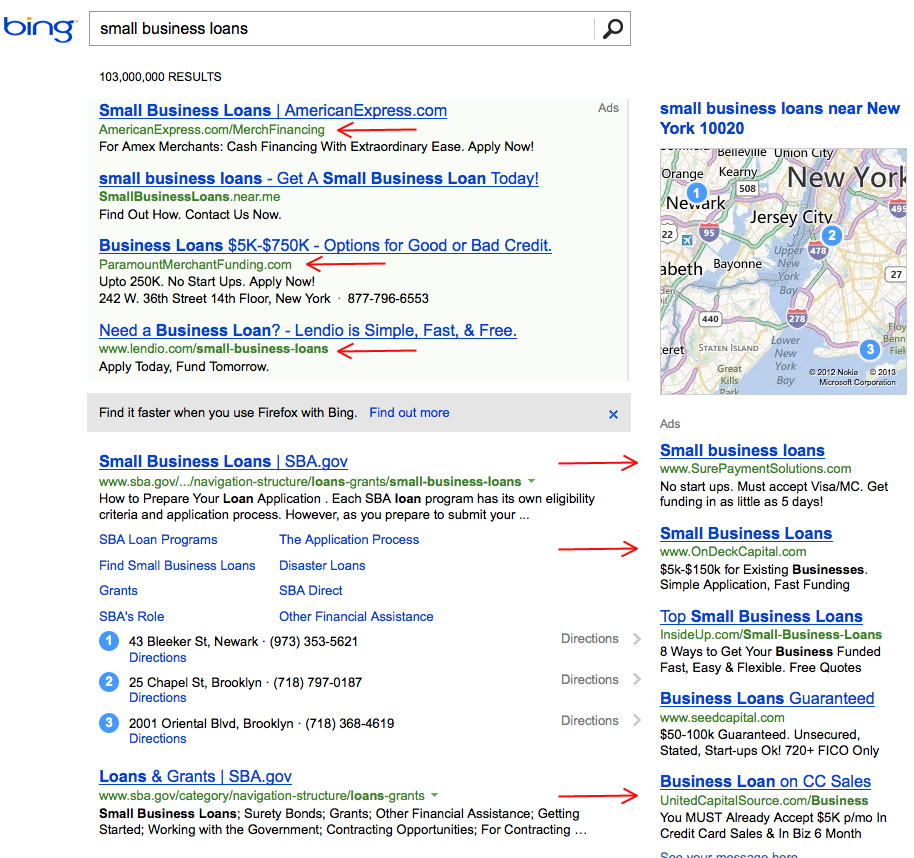
Where are the multi-billion dollar banks? If $15 a click isn’t in their budget, something is wrong, and it may possibly be due to the fact that business loans aren’t on their priority lists.
Lenders, brokers, and bankers on the front lines can’t stop talking about MCA. It is a recurring theme in their columns:
The alternative financing industry is growing rapidly and, I believe, will continue to grow in 2013. These lenders are extremely entrepreneurial and are leaving the banks behind with their speed and use of technology. Many are backed by premier investment banks and Silicon Valley venture capital powerhouses — investors who understand that entrepreneurs and small-business owners are throwing up their hands in frustration over how long it can take to get a loan from a bank, especially if the loan is backed by the S.B.A. More and more businesses are willing to pay the price of the alternative lenders just to be able to get their capital and move on.
-Ami Kassar
The State of Small Business Lending – NY Times 1/8/13
Ami’s Column on NY Times
Cash advance companies, accounts receivable financiers, factors, and micro lenders all have become increasingly more attractive funders for three reasons: flexibility, use of technology, and speed.
-Rohit Arora
Three Reasons for the Rise of Alternative Lending – Fox Business 11/29/12
Rohit’s column on Fox Business
Here’s a dilemma that might have contributed to the growth of MCA… Banks don’t like offering loans and business owners don’t like applying for them if it’s hard:
There’s a large small business segment that needs and wants to borrow on a commercial basis, but their needs are very small. Business owners want $10,000, $20,000 or $30,000 loan–the average is somewhere around $25,000. Traditionally, that’s been a very unprofitable business for a bank. Some banks argue that they are willing to lose money on those loans because they can make it up in deposits. But what happens when the borrower has no deposits? It’s a very tough balancing act.
– The Federal Reserve Bank of San Francisco
A newsletter report that reveals banks lose money on small business loans
Community Investments Volume 8; No 4; Fall 1996
Business owners say the documentation involved is overwhelming. They’ve also found the qualification terms almost impossible to meet.
– Catherine Clifford
Feedback reveals that a burdensome application process and extensive paperwork requirements are enough to discourage business owners even if the loans carry 0% interest.
CNN 1/26/10
Thousands of researchers publish statistics on bank lending every month. Not only do they all contradict each other but journalists that use this data to make bold claims often fail to acknowledge that an increase in bank lending has nothing to do with the applicants, the economy, or the banks themselves. It has to do with the Government. We all know that the SBA will cover the losses banks incur, but there are programs that go one step further. The Federal Government actually bribes banks to make loans. For example, the Small Business Lending Fund is a dedicated investment fund that encourages lending to small businesses by providing capital to community banks. Meaning, covering the losses on defaults doesn’t seem to be enough, so they’ll actually provide the money to make the loans as well.
Click to see full size on mobile
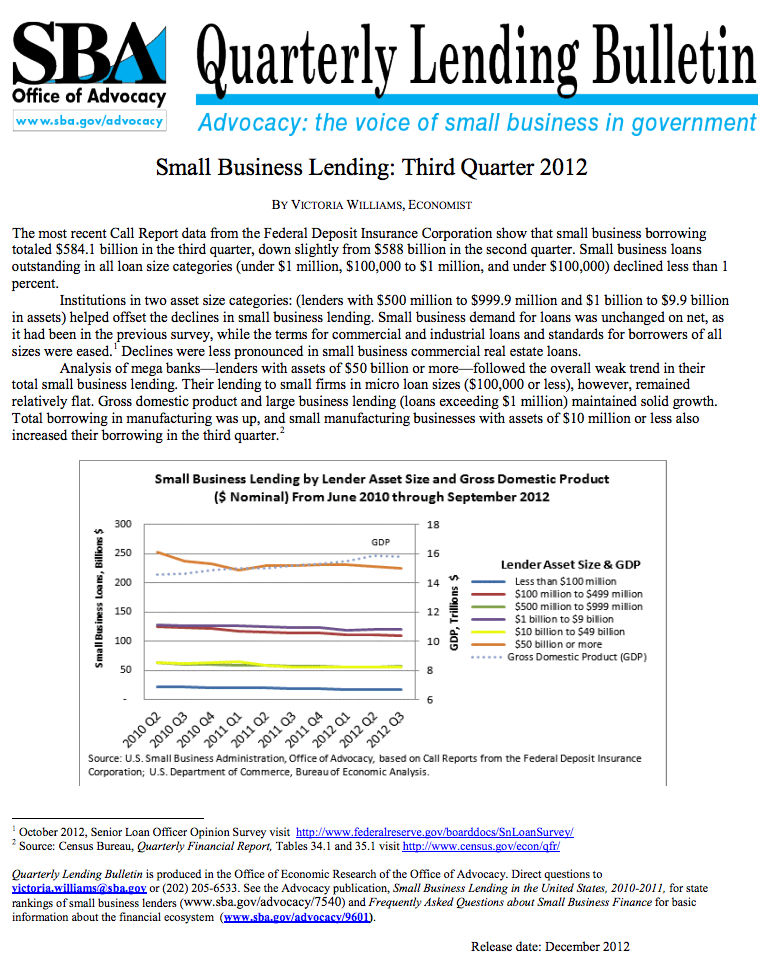 According to the SBA, small business bank borrowing totaled $584.1 billion in the third quarter of 2012. That number dwarfs the volume produced by the MCA industry, but its not an apples to apples comparison. A loan of $1 million dollars is within the range of a small business loan by the SBA, an amount atypical (though not impossible) in the MCA world. Banks are also prodded and coddled by the Government so much that it has reached the extent that we dare claim they are an extension of the Federal Government itself. There’s some food for thought for the Occupy Wall Street movement! They also conveniently got bailed out when they were on the verge of failure, a safety net that MCA companies don’t have.
Subtract the Federal Government’s meddling and there is only one profitable form of B2B lending, Merchant Cash Advance. That is of course again if you accept our definition. There are many young B2B lending firms that claim to be an alternative to MCA, who then go on to describe their product in a manner that is textbook MCA.
Our thesis may be debatable and lacking in concrete proof, but we’re not writing dissertations here. Business owners are increasingly looking to the Internet for loan information and it’s obvious what they’re finding. One would expect a quick Internet search to bring up ads for the billion dollar powerhouses, you know the ones that are given millions to lend out and then millions again when the loans go bad. Instead we find companies owned by friends or friends of friends. The small business loan market isn’t run by anonymous Wall Street kingpins, it’s run by a small community of entrepreneurs that all started from the ground up. Only the community isn’t so small anymore. There was once a handful of MCA companies claiming to be an alternative to a small business loan. Now there are a handful of companies claiming to be an alternative to MCA. It doesn’t take a genius to figure out why that is. After years of fighting to be recognized in the market, something remarkable happened, we became the market itself…
– Merchant Processing Resource
https://debanked.com
The #1 Sales Skill for Small Business Owners
January 10, 2013No matter how well you performed your due diligence before opening the doors at your small business, once you opened them you got a few surprises. And, unless you were in sales before opening your doors, the biggest surprise you got was likely just how difficult it is to “sell.”
Selling is a skill. Now, it’s true that there are “natural born sales people” – but all that means is that they have a talent for selling; they still need to develop their skills. The great thing about skills is that we can learn new skills.
The first skill you need to learn in order to sell successfully is often learning how to change how you think about “selling.” Not sure what we mean by that? If you read the word “zebra” an image of a zebra pops up in your head. Now read the word “salesman” – what image just popped up for you? Most likely not a very positive one.
It might take you a bit of time and effort to get over the prejudices you may have about sales. Unfortunately, as with many things in life, negative experiences we have a tendency to stick to us like glue. To make things even more difficult when it comes to changing attitudes, we also often have a tendency for negative experiences to stick with us much, much longer than positive experiences.
Don’t think that’s true? Here’s a brief exercise to prove our point:
- Write down 10 bad experiences you had with a sales person in less than 3 minutes.
- Write down 10 great experiences you had with a sales person in less than 3 minutes.
We rest our case.
Do You “Hate” Selling?
Let’s face it, if you’ve got a history of “not trusting” sales people it’s going to be pretty tough to feel very good about selling. Successful sales are based on trust and, in order for your customer to trust you, you’ve got to have a strong belief that what you’re doing is of value to your customer. Hard to do if you “hate” sales.
If you hate or are “extremely uncomfortable” about selling those feelings quite likely stem from beliefs you have about the process of selling in general and sales people in particular. For instance:
- Sales people are manipulative.
- Sales people are pushy.
- Sales people lie.
 Right out of the box, it is true that some sales people do/are all of the above. But not most – and certainly the Top 5% are about as far away from manipulative, pushy, and dishonest as you can get. Think about it. You don’t want people to buy from you once – you want to create loyal repeat customers who also refer other loyal repeat customers to your business. Certainly the words “manipulative, pushy, and dishonest” aren’t behaviors that are going to result in creating a loyal customer base. That means that all those bad experiences you had with sales people happened when you were buying from “bad” (under-performing, unprofessional) sales people. While it might have looked like they would do anything to make a sale, it was probably because they were desperate to make a sale because they were so bad at it. Sales people who operate like that and are successful are actually the exception and not the rule. They also frequently aren’t successful for very long periods of time.
Hopefully you’re feeling a bit relieved to find out that learning how to sell does not mean honing skills related to being manipulative, pushy, and deceitful. Most successful, top-performing sales people are the exact opposite. Instead, sales is about solving your customer’s problems and meeting their needs. It’s about having their back and bringing them value even when they don’t buy from you. Why? Because that is how you create trust – and people like to do business with people they trust.
Believing in what you’re doing isn’t the only sales skill you need to learn – but it is definitely the first thing you need to get under your belt, and in a big way. No matter how many sales books you read or seminars you attend, unless you believe in what you’re doing and that your ability to sell is a value to your customer – you run the risk of becoming that manipulative, pushy, less-than-honest image of a sales person you love to hate.
Guest Authored
– Merchant Processing Resource
https://debanked.com
Avoiding Credit Card Fraud
January 7, 2013 Many small businesses that weren’t able to utilize traditional credit card processing services are delighted to find that there are now applications where they can accept credit card payments using a smart phone. However, before you jump on the bandwagon, it only makes sense to do your due diligence as to how to avoid credit card fraud. Just because you can process that card via your cell phone doesn’t necessarily mean you should. You don’t want to get caught holding the bag (and paying for) products after finding out you’ve been “had.”
As a matter-of-fact, not matter what services or devices you use to accept credit cards, as a small business owner you need to institute policies and practices to avoid credit card fraud. Here are some of the basics:
When accepting cards in-person at the point of service.
It is amazing at how just asking one simple question, “Can I see some valid ID?” can make all the difference. Always ask for a valid form of picture identification (such as a driver’s license) before accepting a credit card. If the customer isn’t able to provide ID, then DO NOT process their payment. This means asking for the card and identification BEFORE it is swiped. When you have both the card and identification in hand, check the back of the credit card for the customer’s signature and match that signature with the one on their valid ID. Again, if they haven’t signed their card, or the signatures don’t match, don’t process their payment.
Many small business owners may have an issue instituting the above policies with repeat customers if they have not used the policy previously. Now, this is going to be a decision each individual owner needs to make. You may indeed have long-term customers that deserve your trust, but they may not. At the very least, should you decide to accept their payment without a valid ID and/or their signature is missing on the back of their credit card, let that customer know that this is a “one time pass” and they must be able to provide both next time they make a purchase. You might be hesitant to do so, but letting the customer know that you are pursuing this policy to protect your customers. For example, costs associated with theft (including credit card fraud) must be covered by increases in pricing.
When accepting credit card payments over the phone or online.
The best way to avoid credit card fraud when taking payments over the phone or online is to get all the information you can to identify that the person making the order is, indeed, the owner of that credit card. This means reading off the name exactly as printed on the card. It means not only the full credit card number, but also the 3 digit verification number on the back of the card.
Often a purchaser will want the order shipped to another address. This is why you need to ask for both the billing address and shipping address. It is also why having an address verification feature is critical.
Many credit card processing companies monitor purchasing patterns at your place of business. For example, should there be a sudden increase in the number of credit transactions that can serve as a red flag and you will receive an alert. However, taking steps to avoid theft and fraud (not simply credit card fraud, but also shoplifting, employee fraud, etc.) should always be addressed proactively by small business owners themselves.
Guest Authored
– Merchant Processing Resource
https://debanked.com